

Town on the Camino
Brienz
Switzerland
- places to stay
- 23
- Camino
- 1
- Elevation
- 565 m
Brienz is the woodcarvers' village on Lake Brienz: since 1884 people have learned carving at a school of its own, since 1892 a cog railway has steamed up the Rothorn, and across the water the Giessbach Falls tumble into the lake. In 2024 a debris flow swept away houses and the cemetery; the village is rebuilding. An afternoon is enough.
How long to stay?
An afternoon is enough. It is only 6.0 kilometres from Brienzwiler, so you arrive early. That leaves time for one of the two big excursions: by steam train up the Rothorn or by boat to the Giessbach Falls. Both in one day is tight. If you are tired, sit by the shore and look at the lake.
Brienz in Ninja numbers
- 192.4 kilometres after Konstanz lies Brienz on the shore, and 251.4 kilometres remain to Geneva, the end of the Via Jacobi.
- 1884 is when the woodcarving school opened. It still trains carvers today.
- 1892 is when the Brienz Rothorn Bahn first ran, by steam, 7.6 kilometres up to 2,244 metres.
- 14 cascades make up the Giessbach before it falls into the lake on the far shore.
- 17.8 kilometres to Interlaken tomorrow, with 737 metres of ascent.
Arriving: along the lake
From Brienzwiler you go down via Hofstetten and Kienholz to the water and follow the lakeside path to the station and the boat landing. Then the village stretches along the lake, with the Dorfstrasse as its backbone. Above it all, on the former castle hill, stands the village church, whose tower, according to the route guide, goes back to the 12th century.
In brief: a village that carves
For over a century Brienz has lived from wood and from the lake. In 1884 the woodcarving school opened, where young people still learn to carve today. Later a violin-making school was added. In 1892 the Rothorn railway began running, by steam. Then, on 12 August 2024, the water came: after a thunderstorm the Milibach burst its banks and carried around 50,000 cubic metres of rock, trees and mud into the village. Houses were buried, the cemetery devastated, the station and tracks flooded. Brienz has since rebuilt the cemetery; every gravestone was found and set up again. The stream is to be diverted around the village in the coming years.
Wood, steam and water: what to see
- Woodcarving school: In the exhibition room you see what the students carve. Open Monday to Thursday 8:00 to 11:30 and 14:00 to 17:00, Friday until 16:00, closed on public holidays and during school holidays. Entry is free; a contribution is voluntary.
- Brienz Rothorn Bahn: The red steam train climbs the Brienzer Rothorn, 2,244 metres, in about an hour, stopping at Planalp. It runs to the summit from early June to mid-October; in the early season only to Planalp. After the 2024 storm a third of the line was damaged; it is running again now.
- Giessbach Falls: On the south shore the Giessbach drops in 14 cascades more than 400 metres down to the lake. From the Giessbach See landing the Giessbach funicular of 1879 takes you up, the oldest funicular still running in Switzerland, 345 metres long. At the top stands the Grandhotel of 1875. The funicular and hotel are open in 2026 from 3 April to 25 October; the boat calls until early December.
Food and drink
Brienz is a holiday resort with restaurants by the shore and shops on the Dorfstrasse. We have no verified addresses or prices. Stock up here before you walk through the small villages on the north shore tomorrow.
Honestly
- Brienz is expensive. There is no pilgrim bed, only hotels, holiday flats and the youth hostel.
- The debris flow is not over yet. The Milibach is to be diverted, which will take around ten years, and whether all the houses beside it may stay was due to be decided in autumn 2026.
- In winter the suspension bridge is gone. The bridge over the Ebligengraben on the north shore, about 70 metres long and one metre wide, is taken down in winter. Then you have to detour via Giessbach.
- Excursions cost money. The Rothorn and Giessbach railways are not cheap; we have not checked prices.
Where pilgrims sleep
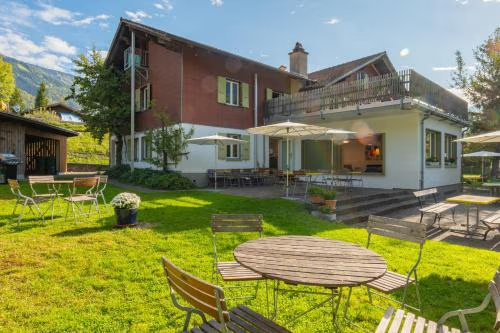
The cheapest option is the Brienz Youth Hostel right on the lakeshore, with 76 beds in 13 rooms. Besides that, Brienz has hotels, B&Bs and many holiday flats with lake views. There is no pilgrim hostel; the nearest one is behind you in Brienzwiler.
Ninja tips
- Boat instead of Rothorn when the weather is bad. The Giessbach Falls are more impressive in the rain than the summit in fog.
- See the carving school's exhibition on a weekday. It is closed at weekends and during school holidays.
- Plan the winter variant. Between late autumn and April or May you are better off going via Giessbach and Iseltwald. This route is not marked with Way of St. James signs; follow the yellow signposts of the Bernese hiking trails.
Practical tips for pilgrims
- Train and boat: Brienz has a station on the Brünig line and a boat landing. Boats also go to Giessbach.
- Two ways to Interlaken: Along the north shore via Oberried and Ringgenberg, 17.8 kilometres, or along the south shore via Giessbach, Iseltwald and Bönigen. We do not have the south variant in our route data; according to the route guide it is about the same length.
Onward: along the north shore to Interlaken
Tomorrow you follow the north shore of Lake Brienz. Via Oberried (km 200.7), Niederried (km 203.9), Ringgenberg and Goldswil you reach Interlaken after 17.8 kilometres. It is not entirely flat: the path keeps climbing up the slope, to as high as 760 metres, and adds up to 737 metres of ascent and 738 metres of descent. The suspension bridge over the Ebligengraben is on the first section.
What awaits you tomorrow
Interlaken, the town between the lakes. A former monastery, a large meadow in the middle of town and behind it, if the weather plays along, the Jungfrau.
Deep dive: The day the Milibach came
A short read, in case you want to learn more about Brienz. About three minutes' reading.
A summer evening
On the twelfth of August 2024 a violent thunderstorm built up over Brienz. So much rain fell in a short time that the Milibach, a stream that comes down from the mountains above the village, burst its banks. It brought not just water. It brought stones, trees and mud, around fifty thousand cubic metres, and pushed them into the village.
What it took
Houses were buried or destroyed, cars and roads covered. The station was under water; the tracks had become a stream. In the cemetery the flood tore away gravestones and buried whole rows. For a while people feared it had also washed away the dead. That turned out not to be true. The bones that were found were much older. The Rothorn railway, Brienz's pride, was damaged along about a third of its line.
Rebuilding
A year later the cemetery had been restored. Every gravestone had been found, cleaned and put back in its place. Some families had returned to their homes, others were renovating, still others were planning anew. And the municipality made a plan: in future the Milibach is to be led westwards, away from the houses. It will cost millions and take around ten years. Whether individual houses will have to make way for it was due to be decided in autumn 2026.
What Brienz gives you
When this text was written, in the autumn of 2026, the stream had not yet been tamed, and still the village went on living, carving, riding up the mountain by steam and sending boats across the lake. Tomorrow you walk on along the shore. Brienz stays, with everything the mountain brings it.
Where to stay in Brienz
Places to stay in Brienz.
 OpenReservations accepted
Brienz Youth Hostel
 OpenReservations accepted
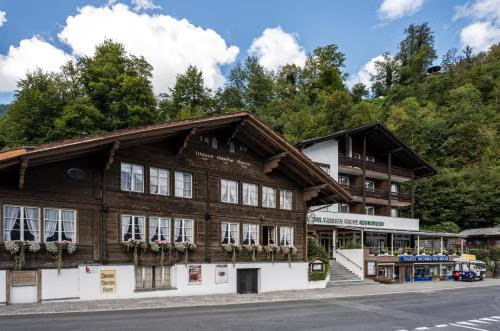
Hotel Weisses Kreuz
 OpenReservations accepted
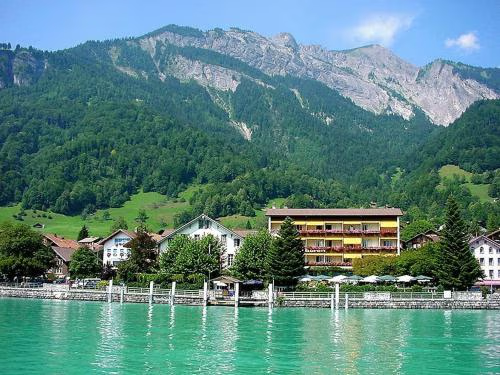
Seehotel Bären


Town 16 of 28