Town on the Camino
Konstanz
Germany
- places to stay
- 24
- Caminos
- 5
- Elevation
- 406 m
Konstanz is a handover: four Camino routes from Germany arrive at the Münster, and the Via Jacobi sets off from here through Switzerland to Geneva. From 1414 to 1418 the Council met in the Münster and sentenced Jan Hus to death. Right next to it, around 940, a bishop had Jerusalem rebuilt.
Right now in Konstanz (as of October 2026)
- Münster tower: The tower and its ticket stand are only open until the end of October. After that the climb is closed.
How long to stay?
Worth a rest day. At the Münster the Mauritius Rotunda with its Holy Sepulchre and the tower await you, plus the Council Building, the Schottenkapelle St. Jakob and, outside the old town, the Hussenstein. If you finish one of the four German routes here and carry on into Switzerland, the day is well spent replanning: from the border you pay in francs, and many beds on the Via Jacobi are private rooms you have to call ahead for. And if you have more time, take a side trip to the monastery island of Reichenau.
Konstanz in Ninja numbers
- 2,340 kilometres to Santiago are written on the signpost on Münsterplatz next to the Marian column. The next place on it, Märstetten, is only about four hours away.
- 4 Camino routes from Germany arrive in Konstanz, and the Via Jacobi starts here (as of October 2026).
- 50,000 to 70,000 people came to the Council between 1414 and 1418, in a town that had about 6,000 inhabitants at the time.
- 45 sessions of the Council were held in the Münster; in the fifteenth, on 6 July 1415, Jan Hus was condemned.
- 445.5 kilometres is the distance on the Via Jacobi from here to Geneva, according to Camino Ninja.
Arriving: four routes to the lake
If you come from Ulm on the Upper Swabian Way of St James, you cover the last kilometres on water: from Meersburg the ferry takes you to Konstanz-Staad, and from there you walk along the shore to the Münster. According to Camino Ninja it is 9.6 kilometres from Meersburg. The ferry runs every 15 minutes during the day. The Lindau – Héricourt route takes the same way.
On the Linzgau Way of St James you take the boat from Überlingen to Wallhausen, walk via Litzelstetten and the Lorettosteig down to the shore and over the Rhine bridge to the Münster. Outside the season this boat doesn't run; then you take the bus to Meersburg and the ferry.
On the Hegau Way of St James you come via Allensbach and the convent of Hegne, 11.2 kilometres before Konstanz according to Camino Ninja, along the edge of the Wollmatinger Ried and through Wollmatingen into town.
In brief: bishops, a council and a farewell
The diocese of Konstanz was founded around 585 or 590, and for a good twelve centuries the Münster was a cathedral. From 1414 to 1418 the Council met here. In November 1417 it elected Martin V pope, and in 1415 it condemned the Bohemian reformer Jan Hus, who was burned outside the town on the same day.
In 1526, before the Reformation, the bishops moved across the lake to Meersburg. In 1821 the diocese was dissolved, and in 1827 the bishop's seat went to Freiburg. Since then the Münster has been a parish church, and since 1955 it has held the title of basilica.
Handover at the Münster
For most pilgrims Konstanz is not an end. Three German Camino routes finish here, the Upper Swabian, the Linzgau and the Hegau, while a fourth, the route from Lindau to Héricourt, carries on down the Rhine. And at the Münster the Via Jacobi begins, the main Swiss route to Geneva.
Its first stretch, as far as Einsiedeln, is called the Schwabenweg, because in the Middle Ages it was mainly Swabians who made the pilgrimage via Konstanz to the Black Madonna. Just beyond the town you change country, currency and waymarks: in Switzerland you follow the sign with the number 4 and the shell. Whatever you bring from Germany, you hand over to Switzerland here.
From the Münster to the Hussenstein: what to see
Much of it is right at the Münster. For the Hussenstein you walk a little way out of the old town.
- The Münster: For a good twelve centuries it was a bishop's church. The Council met here in 45 sessions, and here Jan Hus was condemned. Take a look at the wooden doors of the main portal: the carpenter Simon Haider carved them in 1470, with twenty scenes from the life of Jesus. On Münsterplatz next to the Marian column stands the signpost to Santiago.
- The Mauritius Rotunda: Bishop Konrad had it built around 940 after his second journey to Jerusalem, as a half-scale replica of the Church of the Holy Sepulchre. Around 1260 the stone Holy Sepulchre with twelve apostle figures was made inside it, among them St James with pilgrim's staff and shell. For people who couldn't afford the journey to the Holy Land, this was their Jerusalem. Pilgrims walked around the tomb three times. Today the rotunda is a station on the Schwabenweg, and the Via Jacobi starts at the Münster.
- The Münster tower: The neo-Gothic spire is 78 metres high. 193 steps lead to the platform, which is only partly open. Open Monday to Saturday 11:00 to 16:45, Sundays and holidays 12:30 to 16:45, only until the end of October. Adults pay €4 (as of October 2026).
- The Council Building: In November 1417 Martin V was elected pope here.
- The Hussenstein: A boulder with the golden inscription „Johannes Hus“ has marked the medieval place of execution since 1862. Here the pyre burned on 6 July 1415, and the executioners scattered Hus's ashes in the Rhine. If you carry on along the route to Héricourt, you follow this river.
- The Schottenkapelle St. Jakob: West of the old town on Schottenstraße stood the Irish monastery of St. Jakob, founded according to tradition in 1142, documented from 1220 and demolished in 1529/30. What remains is the Schottenkapelle of 1589, the town's St James site besides the Münster.
Food and drink
We haven't found reliable pilgrim tips for places to eat in Konstanz, and we don't do advertising. Shopping matters more: in Konstanz you still pay in euros. If you continue on the Via Jacobi, stock up before the border, because in Switzerland a day quickly costs three to four times as much as a day in Galicia.
Honestly
- Konstanz has no pilgrim hostel. There is no Spanish-style dormitory, and in July and August the town is full. Book early and expect prices at the upper end.
- The last day of the Hegau route has roadworks. Between Allensbach and Konstanz the B33 is being rebuilt, according to the association until 2035.
- You'll have to look for the stamp. None of the sources we found names a fixed stamp point with opening hours. But pilgrims do get it in the Münster (see Practical tips).
- Beyond the border it gets expensive. From Kreuzlingen you pay Swiss prices, and many beds on the Via Jacobi are private rooms you have to call ahead for.
Where pilgrims sleep
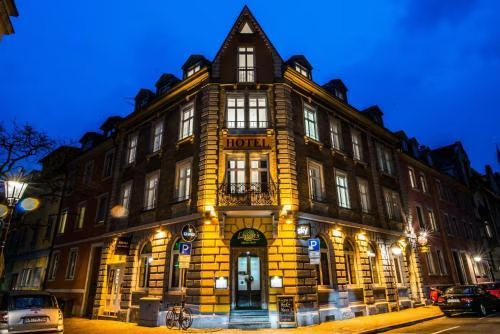
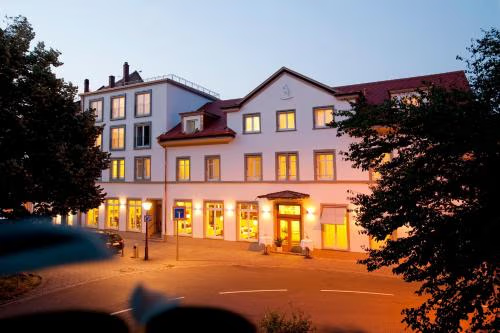
There is no pilgrim hostel in Konstanz. The cheapest option in town is the youth hostel:
- Jugendherberge Otto-Moericke-Turm: on the Allmanshöhe in the north of the town.
On the Hegau route you can already stay before Konstanz at the Gästehaus St. Elisabeth by the convent of Hegne. In the app you'll also find a private host who doesn't rent through booking platforms. If you're moving on: the next pilgrim hostel is in Märstetten, 13.9 kilometres away according to Camino Ninja and just under a kilometre off the Via Jacobi.
Ninja tips
- Three times around the tomb: Do as pilgrims used to and walk three times around the Holy Sepulchre in the Mauritius Rotunda. Look for St James among the twelve apostles while you're at it; you'll recognise him by his pilgrim's staff and shell.
- Photo at the signpost: The signpost next to the Marian column shows 2,340 kilometres to Santiago. For everyone starting here, that's the starting photo.
- Tower while it's still October: If you arrive before the end of October, don't put off the climb. After that it's closed.
- The Seehas for dropping out or joining in: According to the association, the Seehas train runs every half hour between Konstanz and Radolfzell and also stops in Hegne, Allensbach and Markelfingen.
- Side trip to Reichenau: The monastery island in the Untersee has been a UNESCO World Heritage Site since 2000 and has three Romanesque churches. If you have a rest day, it's the obvious destination.
- To the Grödeli in Kreuzlingen: Just beyond the border stands the Grödeli, a former pilgrim hostel in a half-timbered house from 1610. It still serves guests today.
Practical tips for pilgrims
- Pilgrim stamp in the Münster: A pilgrim group on the Via Beuronensis got their stamp in the Münster in September 2024, after the closing prayer at the Mauritius Rotunda. Their report doesn't say exactly where it is kept.
- Münster parish office: Pfalzgarten 4, phone 07531 90620. Ask here about the stamp if you can't find it in the Münster, and about service times.
- Pilgrim passport: For the Linzgau and Hegau routes it is issued by the Beuron pilgrim community (Jakobspilger-Gemeinschaft); order it online in advance.
- Money: Euros in Konstanz, francs from Kreuzlingen. Bring some cash for the first days in Switzerland.
- Getting here and away: You reach Konstanz by train via Singen or Radolfzell, on the Black Forest Railway from Offenburg, and via Kreuzlingen from Switzerland. The nearest major airport is Zurich.
Onward: over the border or along the Rhine
On the Via Jacobi you walk south from the Münster through the old town, past St. Stephan, the town's oldest parish church, past the Hus-Haus and through the Schnetztor from the fourteenth century. Shortly afterwards you reach the border and Kreuzlingen, 2 kilometres from the Münster according to Camino Ninja. Then you climb into the Thurgau hills. You reach Märstetten with its pilgrim hostel after 13.9 kilometres. If you want to go further, plan a stage of about 25 kilometres to Affeltrangen. On the second day the monastery of Fischingen awaits, founded as early as 1138 as lodging for pilgrims from Konstanz to Einsiedeln.
On the Lindau – Héricourt route you stay by the water: via Tägerwilen and Gottlieben along the Untersee to Ermatingen, 9 kilometres according to Camino Ninja, and on towards Steckborn. To Héricourt it is 258 kilometres according to Camino Ninja.
Deep dive: A council, a fire and a Jerusalem by the lake
A long read, in case you want to learn more about Konstanz. About twenty-five minutes' reading.
A signpost in front of the Münster
On the Münsterplatz in Konstanz, next to the Marian column, stands a signpost. It points to Santiago, 2,340 kilometres. If you arrive here, you already have days behind you: from Ulm via the ferry from Meersburg, from the Linzgau by boat to Wallhausen, from the Hegau along the Gnadensee. If you start here, almost everything still lies ahead. For both, Konstanz is a handover: three German routes end at the Münster, a fourth carries on down the Rhine, and the Swiss Via Jacobi begins its journey to Geneva here.
That this town at the end of Lake Constance should be such a junction has reasons far older than any shell on a waymark. Konstanz had the only bridge over the Rhine in the whole area. For a good twelve centuries it was the seat of a bishop whose diocese was, by the end, the largest in Germany. And for four years, from 1414 to 1418, it was the place where Western Christendom tried to repair itself. Along the way a pope was elected, two others were deposed, and two men from Prague died at the stake.
This text tells that story. It begins with a bishop who went to Jerusalem three times, leads you through the Münster you may be standing in right now, and then tells at length the story of the council and of the man whose name appears in Konstanz on a boulder, on a house and on a street: Jan Hus.
A fort, an emperor and a bridge
The Romans settled here around the year 40, at the spot where the Rhine leaves the lake. The place may have been called Drusomagus. Its later name, Constantia, it owes to an emperor, only no one knows exactly which. Either Constantius Chlorus, who had a fortress built here around the year 300, or Constantius the Second, who passed through in 354. The remains of the late Roman fortress were only found in 2003.
Around 585 or 590 a bishop took up his seat here. That began a story that would last until 1821. The town grew around its church and around its bridge, the only one over the Rhine for miles around. It traded in linen that was known far beyond the lake, and in 1192 it became an imperial city, answerable only to the emperor. In the late Middle Ages about 6,000 people lived here, and roughly a quarter of them were exempt from taxes as clergy. Konstanz was a town of the church, of merchants and of people passing through. Pilgrims were never strangers here.
The bishop who went to Jerusalem three times
The man who made Konstanz a pilgrimage destination was called Konrad. He came from the powerful Welf family, studied at the cathedral school, became cathedral provost and, in the year 934, bishop. Politics interested him little, although he was close to Emperor Otto the First and went with him to Italy in 962. What moved him was travelling to holy places. He went to Rome several times, and three times he made the pilgrimage to Jerusalem.
From one of these journeys he brought back a piece of the Cross of Christ. He gave it to a hospital he had founded in Stadelhofen. The hospital and its relic gave the area its name, Crucelin, later Crucelingen. That became Kreuzlingen, the Swiss neighbouring town that is the first place you walk through on the Via Jacobi. Perhaps the word comes from the Latin for the wood of the cross, perhaps it is simply a diminutive, little cross. Either way, the Swiss Way of St James begins in a town named after a pilgrim's relic.
Konrad died on 26 November 975. In 1123 he was canonised, at the First Lateran Council under Pope Callixtus the Second. His 26 November is still his feast day. His tomb is in the Münster, a raised tomb beneath the Konradikapelle. And next to him a second saint is venerated, Pelagius, whose bones came to the crypt by the year 904 at the latest. Konrad and Pelagius are the saints of this Münster, and you will meet them in it more than once.
Jerusalem behind the choir
After his second journey to the Holy Land, around 940, Konrad had a round chapel built next to the Münster. He dedicated it to Saint Maurice, but something bigger was meant: it was to recreate the Church of the Holy Sepulchre in Jerusalem, the rotunda over the tomb of Christ, at a scale of one to two. Anyone who could not afford the long journey to the Holy Land was to find Jerusalem here, behind the choir of a cathedral on Lake Constance.
Around 1260 the rotunda received what you see today: a stone Holy Sepulchre, a small piece of architecture in the style of French Gothic. On the outside stand the twelve apostles, along with twelve scenes from the Christmas story. Inside, three scenes show the Entombment, and since 1552 a wooden shrine has stood there. Look among the twelve apostles for James the Greater. You will recognise him by what you may be carrying yourself: the pilgrim's staff and the shell on his bag.
The people who came here walked three times around the tomb. For this they received an indulgence, and once Konrad had been canonised in 1123, even more came, now to his tomb as well. The rotunda was a pilgrimage destination in its own right long before anyone spoke of a Via Jacobi. Today it is a station on three sections of the Way of St James. In September 2024, down here by the rotunda, Brother Jakobus Kaffanke held the closing prayer for a small group that had walked from Tübingen via Sigmaringen to Konstanz. He is the monk from Beuron who, from 2004, had the Via Beuronensis waymarked, the network to which the Linzgau and Hegau routes belong. So a circle closes across more than a thousand years: a bishop builds a Jerusalem for people who cannot travel far, and pilgrims with rucksacks end their walk there.
A Münster that kept falling down
The Münster Unserer Lieben Frau looks as if it were all of a piece. That is deceptive. It is a building of almost a thousand years, which collapsed and burned several times and was built on each time.
A church of Our Lady stood here as early as the early Middle Ages, probably inside the Roman fort. Konrad had his churches designed on the model of the great papal basilicas in Rome, and his successor Lambert extended the east end with a transept and choir. In 1052 the old nave collapsed. Hermann the Lame, the learned monk from Reichenau, noted it briefly in his chronicle. From 1054 the bishops Rumold and Otto built a new nave with sixteen columns, each made from a single stone. In 1089 Bishop Gebhard the Third consecrated the church.
Then came the towers, and with them misfortune. Around 1100 work began on the twin-tower façade. In 1128 the north tower partly collapsed. On 15 September 1299 a fire destroyed the tower over the crossing, which was never rebuilt. The south tower was not finished until 1378. In the fifteenth century the side aisles were given Gothic vaults, and from 1438 the Schnegg rose in the Thomas choir, a hexagonal stair tower that is still considered structurally delicate. On 21 October 1511 the roofs, the bell chambers and the organ burned. The rebuilding was paid for with an indulgence, that is, with money from believers who hoped it would remit the punishment for their sins. Six years later Martin Luther published his theses against exactly this practice.
The spire you see today is the most recent addition. From 1846 the architect Heinrich Hübsch had the Münster made Gothic again, and on 27 July 1853 the neo-Gothic spire was completed, 78 metres high. So when you climb up, you are standing on the nineteenth century, which stands on the Middle Ages, which stands on a Roman fort.
Start at the main portal. The two wooden doors are more than four metres high and together carry twenty panels with scenes from the life of Jesus. An inscription names the joiner Simon Haider and the year 1470. The figures were carved by sculptors whose names nobody knows. Haider also built the choir stalls, and that has a little story of its own: the sculptor Niclaus Gerhaert was originally meant to make them. But he delivered only the high altar and left after a dispute over his pay. Gerhaert's altar is lost. It was destroyed when the iconoclasts went through the church after the Reformation.
Beneath the choir lies the crypt, the oldest surviving part of the Münster. Four gilded copper discs can be seen there. The largest measures almost two metres and shows Christ as ruler of the world; it probably dates from the eleventh century. The three smaller ones show Konrad, Pelagius and an eagle, the symbol of John the Evangelist.
In the choir, look out for a tomb slab in front of the high choir. Here lies Robert Hallum, Bishop of Salisbury in England. He came to the council, died in Konstanz in 1417 and was buried in the Münster. He is one of many who travelled to this gathering and never returned. In the Blasiuskapelle stands a winged altarpiece that survived the iconoclasm, one of the few pieces left from the time before the Reformation.
And listen to the bells. Nineteen bells hang in the tower, weighing about 35 tonnes together. After Cologne Cathedral it is the second-largest peal in Germany. The biggest bell is called Sancta Maria and weighs 8,349 kilograms.
Three popes and a king
To understand why half of Europe came to Konstanz in 1414, you have to go back a few decades. In April 1378 the cardinals in Rome, under pressure from the Romans, elected Urban the Sixth pope. In September of the same year thirteen of them declared that election coerced and, in Fondi, elected a second, Clement the Seventh, who resided in Avignon. The Church had two popes, each with his own cardinals.
In 1409 a council in Pisa tried to end this. It deposed both popes and elected a third. Neither of the two stepped down. Now there were three. The Konstanz chronicler Ulrich Richental later put it in a bitter formula: the wicked twosome had become an accursed threesome.
The man who wanted to change this was Sigismund, King of the Romans, later King of Bohemia and emperor. He pressed the pope of the Pisan line, John the Twenty-third, to call a new council. The pope would have preferred to hold it in Italy; Sigismund wanted a city of the Empire. The choice fell on Konstanz.
At the end of October 1414 John the Twenty-third rode into the town on a white horse, with around 600 companions. On 16 November he opened the council in the Münster. It was the first of 45 sessions, and all of them took place in this church. Sigismund arrived on Christmas Eve. At the Christmas Mass in the Münster, the king himself read the Gospel.
The town that was too small
How many people came to Konstanz in those years, no one knows exactly, and it is worth being honest about it. Ulrich Richental, the Konstanz citizen who recorded the council in a chronicle, counted 71 secular princes and 141 counts and arrived at 70,000 strangers who are said to have been in the town over the four years. Others reckon more cautiously and speak of 20,000, or of around 30,000 people at any one time, including servants and armed men. The only certainty is this: the town had about 6,000 inhabitants, and for years there were more guests than townspeople.
They came from Lisbon and from Novgorod, from Poland and Lithuania, from England, from Constantinople and even from Ethiopia. More than two dozen cardinals, hundreds of bishops and abbots, doctors of canon law, envoys of kings. Foreign bakers baked bread in mobile ovens. And women came who earned their living from the council. There are said to have been up to 700 of them. Konstanz has never forgotten that number, as you will see at the harbour.
Richental was not a churchman but a citizen who looked closely. He lived from about 1360 to 1437 or 1438 and wrote not in Latin but in the German of his town. His chronicle is richly illustrated and one of the most important sources on the council of all. What survives are copies. The earliest dates from 1460 and is now in New York, another is in Prague. In essence, Richental wrote that in those years the name of Konstanz went out over the whole earth.
A pope flees as a groom
John the Twenty-third had called the council in the hope of being confirmed as the only pope. It went wrong. The council decided to vote not by heads but by nations. With that, the many Italian bishops he had brought along lost their majority. Soon it was clear that all three popes were to go. On 2 March 1415 he promised to resign.
On 20 March 1415 a groom in a grey cloak secretly left the town. It was the pope. He had himself taken down the Rhine to Schaffhausen, accompanied by Duke Frederick of Austria. The council responded with one of the boldest decrees in Church history. On 6 April 1415, in the decree Haec sancta, it declared that its authority came directly from Christ, and that everyone, the pope included, had to obey it.
Sigismund had the fugitive brought back. Elector Louis the Third of the Palatinate took him into custody, first in Heidelberg, then near Mannheim. On 29 May 1415 the council deposed him, for simony, schism and immorality, charges that later historians consider greatly exaggerated. On 4 July the pope of the Roman line, Gregory the Twelfth, also resigned, through envoys who read out his declaration. Only Benedict the Thirteenth, the pope of the Avignon line, never gave in. The council excommunicated him on 27 July 1417. He died in 1423 without having yielded.
John the Twenty-third was later released for a ransom paid by the Medici, submitted to the new pope and died in Florence in 1419. His tomb in the Baptistery was made by Donatello and Michelozzo. The inscription calls him a former pope. The new pope protested against it, in vain.
The preacher from the Bethlehem Chapel
Into this town full of questions of power came, in the autumn of 1414, a man who asked an entirely different question. Jan Hus was born in Bohemia around 1370, studied in Prague, and became a priest, a professor and rector of the university. He preached in the Bethlehem Chapel in Prague's Old Town, which held up to 3,000 people, around 200 times a year. He was, as people like to tell, a passionate chess player.
Hus read the writings of the Englishman John Wyclif and the Bible, and he came to conclusions that were dangerous. He attacked priests who lived with women, mendicant orders that had grown rich, and the buying of church offices. And he distinguished between the visible Church with its wealth and power and the invisible community of those who belong to Christ. That raised the question of who belonged to the true Church at all.
When he defied a ban on preaching, he was excommunicated. In 1412 he had to leave Prague. For two years he lived in the castles of Bohemian nobles and wrote his main work there, On the Church. Then came the invitation to Konstanz. He was to explain his teaching before the council.
With a letter from the king
Hus knew what he was getting into. But he had something in his hand: a letter of safe conduct from King Sigismund, promising him free passage, the salvus conductus, a safe journey there and back. He set off on 11 October 1414 and arrived in Konstanz on 3 November. For a pilgrim that is a familiar calculation: a good three weeks on the road.
He lodged with a widow. For a long time it was believed that this was the house of a woman named Fida Pfister in today's Hussenstraße, near the Schnetztor. There, since 6 July 1878, a plaque has recorded that the Bohemian reformer lived here in 1414. Whether that is true is uncertain. Some suspect he lived closer to the Münster. What is certain is that he went on celebrating Mass and preaching, although he was under the ban.
On 28 November 1414, less than four weeks after his arrival, his opponents had him arrested on the pretext that he was planning to flee. On 6 December he was taken to the dungeon of the Dominican monastery, on the small island by the shore. He was given no lawyer. Sigismund was furious when he heard of it and threatened the prelates. They replied with a sentence that will echo through this story: a promise made to a heretic was not binding.
When John the Twenty-third fled in March, Hus passed into the hands of the Bishop of Konstanz. He had him taken to his castle at Gottlieben, a few kilometres down the Rhine. There Hus lay in chains for 73 days, poorly fed and ill. If you walk along the Untersee on the route to Héricourt, you pass through Gottlieben.
On 5 June 1415 Hus stood before the council for the first time. Afterwards he was taken to the town's Franciscan monastery. He was ready to recant, he said, if they showed him from the Bible where he was wrong. The council demanded something else. It had already condemned Wyclif's teachings in May. Now Hus was to renounce them and recant more than thirty sentences that had been drawn from his writings.
At the last hearing on 8 June the sentences were read out to him. Some he acknowledged as his own, others not. He refused to recant anything he had never taught, and just as firmly refused to give up anything he believed to be right. A recantation would probably have saved his life. But it would also have made him a liar, in both directions.
Shortly before his death Hus wrote letters. In one there is a sentence that shows he was not only a victim to the very end but also kept his pride: it filled him with joy, he wrote, that they had after all had to read his books, in which their malice was revealed. Elsewhere he remarked that they had read his writings more diligently than Holy Scripture.
6 July 1415
On 6 July 1415 the council met for its fifteenth session in the Münster. At that moment there was no pope. Hus was led in and condemned. He protested once more that he only wished to be convinced from Scripture. Then, in a ceremony, he was stripped of his priesthood, his tonsure was destroyed, and, so it is reported, a paper hat was placed on his head bearing the word Haeresiarcha, arch-heretic. The council itself killed no one. It handed him over to the secular power, which sentenced him to death by fire that same day.
He was led out of the town, outside the western wall, to a piece of ground that of all things was called Im Paradies, in Paradise. At the stake the imperial marshal von Pappenheim and the Count Palatine offered him one last time the chance to recant and live. He refused.
What happened next we know from accounts that mingle with legend. When an old woman added brushwood to the fire, Hus is said to have cried: O sancta simplicitas, O holy simplicity. At the end he is said to have called out: Christ, Son of the living God, have mercy on us. His ashes, so tradition has it, were scattered by the executioners in the Rhine so that no one could venerate them as relics. The Rhine carried them past Gottlieben, where he had been held prisoner, and on to the west.
If you continue on the route to Héricourt, you follow this river for many days.
Jerome, the friend
Hus had not come to Konstanz alone, and he was not the only one to die. Jerome of Prague, born in 1379, was his friend and comrade-in-arms, and he was a traveller like few others. He had studied in Prague, was in Oxford in 1402, where he copied writings of Wyclif and took them to Bohemia, went to Jerusalem in 1403, to Paris in 1405, where the great theologian Jean Gerson drove him out, then to Cologne, Heidelberg, Vienna. He was a scholar and a fighter at the same time.
Hus had asked him not to come. Jerome came anyway, on 4 April 1415, to defend his friend. A good two weeks later, on 20 April, he was arrested in Hirschau on his way back to Bohemia, imprisoned and in May brought back to Konstanz. In September 1415, after the death of Hus and after months in the dungeon, he publicly abjured and renounced Wyclif and Hus.
In May 1416 he was brought before the council once more to confirm his recantation. On the first day he spoke. On the second he took it all back. The Italian humanist Poggio Bracciolini was present and wrote a famous letter about it. Jerome, he wrote, complained that he had lain a good 340 days in the harshest prison. He reminded the assembly that it was made up of men, not gods. And he called Hus a good and just man. On 30 May 1416 Jerome was burned in Konstanz, as his friend had been almost a year before. Poggio reports that he went calmly to the fire and sang a hymn until smoke and flames silenced him.
A pope in the warehouse
Only in the autumn of 1417 was the way clear for a new election. Three popes had resigned, been deposed or been excommunicated. Now one was to be elected whom everyone recognised. This time, alongside 23 cardinals, 30 delegates of the council also voted, 53 electors in all.
They met not in the Münster but down at the harbour, in the town's great warehouse, a storage and trading house with a mighty roof structure. After three days, on 11 November 1417, they agreed on Cardinal Oddo di Colonna. It was St Martin's Day, and he named himself after Saint Martin of Tours: Martin the Fifth. It is the only generally recognised papal election ever held north of the Alps.
The new pope had one flaw: he was not even a priest yet. On 13 November he was ordained priest in the Münster, on 14 November bishop, and on 21 November he was solemnly installed on the square in front of the Münster. On that square today stands the signpost to Santiago. On 22 April 1418 Martin the Fifth closed the council with its forty-fifth session. In May he left, travelled slowly through Italy and reached Rome only in September 1420. The schism was over.
The warehouse still stands, on the shore beside the harbour, and today is simply called Konzil. Today people eat there, and concerts and weddings take place in the hall. When the St Martin's procession passes through Konstanz on 11 November, it also recalls this day.
Something else was decided in Konstanz that reached far beyond the town. In April 1417 Sigismund enfeoffed Burgrave Frederick the Sixth of Nuremberg here with the Margraviate of Brandenburg and the electoral dignity. Frederick was a Hohenzollern. His descendants ruled there until Wilhelm the Second abdicated in 1918. So a piece of Prussian history begins on Lake Constance.
The question that remains: a broken word
Was the death of Jan Hus a breach of promise? The question has been asked for six hundred years, and the honest answer is complicated.
On one side stands the letter of safe conduct. Sigismund had promised Hus free passage, and Hus had come trusting in it. When he was arrested, the king was angry. But he did not act. He let himself be persuaded that a promise to a heretic did not count, and when the verdict came, he no longer stood up for Hus. For many contemporaries and for posterity, that was a king's broken word.
On the other side stands the logic of the council. For the men who judged Hus, heresy was not an opinion but a danger to the souls of many people. Many of them were reformers themselves, who had just deposed a pope and declared the council's power over the pope. They wanted to renew the Church, but from above, in an orderly way, and without a preacher from Prague who asked who belonged to the true Church at all. Above all, they probably wanted a recantation. Hus did not give it.
The consequences were terrible. In Bohemia the news of the fire in Konstanz unleashed a storm. The Bohemian nobility sent a letter of protest, and around twenty years of Hussite Wars followed. Sigismund led several crusades against the Hussites, and none succeeded. Only in 1419 did he become King of Bohemia, and only in 1433 did the moderate Hussites come to terms with the Church. A hundred years later Martin Luther saw a forerunner in Hus. The sentence attributed to him is: We are all Hussites.
And the Church itself? In 1999 Pope John Paul the Second expressed his deep regret for the cruel death inflicted on Hus and praised his moral courage. He did not overturn any verdict with this, but it was a step no one had taken for six hundred years.
You don't have to settle this question. But you can take it with you when you stand in the Münster, where the verdict was given, and an hour later at the Hussenstein, where the fire burned.
A stone, a house and a woman at the harbour
Konstanz took a long time to make its peace with Hus. In 1862 the people of Konstanz placed a boulder on the site of the old place of execution, the Hussenstein, in memory of the two Czech reformers, Hus and Jerome. It stands at the corner of the streets Zum Hussenstein and Alter Graben. His name is written on it in gold letters, and an inscription in three languages explains that Jan Hus was burned on this spot on 6 July 1415 because he held fast to his convictions.
The Hus-Haus in the Hussenstraße lies right on the Schwabenweg. If you walk the Via Jacobi, you pass it anyway, shortly before you leave the old town through the Schnetztor. For more than two hundred years the house has been a place of veneration for Hus. It belongs to a society in Prague and is today a small museum about his life, his journey to Konstanz and his death. For the Czech lands Hus is more than a theologian: the movement that invoked him shaped Czech national consciousness in a fundamental way.
And then there is the woman at the harbour. When you walk along the shore to the Konzil building, you see at the harbour entrance a nine-metre concrete figure, weighing eighteen tonnes, that turns once around itself every four minutes. That is Imperia. The sculptor Peter Lenk put her up in 1993, secretly and without permission, on land belonging to the railway, which did not object. The town council was against it but could not stop it. Imperia is a half-naked courtesan, and on her raised hands sit two small naked men, one wearing a papal tiara, the other an imperial crown. They resemble Martin the Fifth and Sigismund. Lenk says they are merely jesters who have appropriated the symbols of power. He ironically called the figure a symbol of female care. The model is a story by Honoré de Balzac in which a beautiful Imperia seduces the cardinals and princes of the council. The real Imperia was an Italian courtesan who died in 1512 and never set foot in Konstanz. The scandal has long since become a landmark. She recalls the 700 women of Richental's time, and the men who sat in judgement on morals.
Pilgrims on the Schwabenweg
Alongside the great events, a quiet stream of pilgrims always flowed through Konstanz. Their goal was usually not Santiago but Einsiedeln with its Black Madonna. The route from Konstanz to there is called the Schwabenweg, the Swabian Way, because it was mainly Swabians who walked it. It has been walked since the twelfth century. A route description from around 1300, the Itinerarium Einsidlense, describes the way via Rüti, the Hörnli, Fischingen and Sirnach to kostentz, as Konstanz is called in it. Bishop Ulrich the Second of Konstanz had founded the monastery of Fischingen as early as 1138, expressly as lodging for pilgrims on this route.
Those looking for the way to Santiago found it here too. West of the old town, on what is now the Schottenstraße, stood the Schottenkloster Sankt Jakob, founded by Irish monks from Regensburg, according to tradition in 1142. It was dedicated to the apostle whose tomb was the goal. From the first half of the fifteenth century it declined, and in 1530 it was dissolved and demolished. What remains is the Schottenkapelle of 1589. In 1495 Hermann Künig von Vach described, in his pilgrim guide, a route from Germany through Switzerland to France.
It was not without danger. In 1419, a year after the end of the council, men in the service of Hermann von Landenberg attacked pilgrims at the Hörnli and at the inn zum Steg. Landenberg's actual task had been to check travellers who were trying to evade the council.
With the Reformation the stream broke off, but it never quite dried up. From the year 1850 there is the diary of the Protestant farmer and home weaver Heinrich Senn in the Zurich Oberland, past whose farm the pilgrims to Einsiedeln walked. He watched them with a mixture of mockery and curiosity. About an 85-year-old pilgrim woman who had vowed her pilgrimage in fear of death, he wrote: Eine fromme Erfüllung, nur schade, dass es nichts Nützlicheres zu geloben gewusst, a pious fulfilment, only a pity she knew of nothing more useful to vow. In June of the same year a barefoot pilgrim from Pfullendorf, Josef Knerli, came by and taught the farmer how to graft fruit trees. Senn called him a knowledgeable, highly skilled spirit. On 28 May 1877 he noted that around a thousand pilgrims from the Toggenburg were travelling to Einsiedeln by train. The old footpaths fell into oblivion.
The bishops leave, the pilgrims return
For Konstanz itself, the Reformation began the farewell to its great role. In 1522 the town joined the Reformation under the preacher Ambrosius Blarer, whose birthplace in the Katzgasse is a few steps from the Münster. In 1526 Bishop Hugo von Hohenlandenberg left the town and went across the lake to Meersburg. Iconoclasts cleared the altars out of the Münster. In 1548 Emperor Charles the Fifth placed Konstanz under the imperial ban. The town had to submit to Austria and lost its freedom as an imperial city. In 1551 the Münster was reconsecrated as a Catholic church, in 1604 the Jesuits arrived, and their theatre of 1610 is considered the oldest in Germany that still performs regularly.
The bishops never came back. In 1806 Konstanz passed to Baden. In 1821 the diocese was dissolved; until then it had been the largest in Germany and had had almost a hundred bishops over some 1,200 years. In 1827 the seat moved to Freiburg. The Münster became a parish church. In the twentieth century Pope Pius the Twelfth raised it to a basilica.
The twentieth century has its dark sides in Konstanz too. The large synagogue was destroyed in 1938, and on 22 October 1940, 110 of the last Jewish residents were deported to Gurs in southern France. Most of those still alive in 1942 were murdered in Sobibor or Auschwitz. No bombs fell on Konstanz in the Second World War, because the town is almost entirely surrounded by Switzerland.
The pilgrims to Santiago returned late. In 1987 the Council of Europe declared the Ways of St James the first European Cultural Route. In 1996 and 1997 a teacher training seminar and the Sankt-Jakobus-Gesellschaft waymarked the Upper Swabian route from Ulm to the lake, and in the Holy Year of 1999 the Via Jacobi was signposted all the way from Konstanz to Geneva. Since 2008 it has been Switzerland's national route 4. From 2004 the routes of the Via Beuronensis were added. Today four Ways of St James from Germany arrive at the Münster.
What Konstanz gives you
Konstanz is a town where much was decided. Here a schism was ended, a pope elected, a king taken at his word and a man burned who would rather die than say something he did not believe. It is a town of great assemblies and great questions.
For you, the decision here is smaller, yet not small: stay by the water or head into the hills, west down the Rhine or south across the border. Perhaps it is also the decision whether to go on at all or to end here.
Before you leave, set aside time for two places. The first was built by a bishop who went to Jerusalem three times and knew that most people would never get that far. So he brought Jerusalem to them, behind the choir of his church. Walk three times around the tomb if you feel like it, and look for the apostle with staff and shell. The second place nobody built. It is a stone outside the old town wall, on a street corner. There stood a man who was offered his life in exchange for a word, and who did not say it.
Both lie in the same small town. One tells of how people set out on their way. The other tells of what it can cost to stay true to yourself. Both belong to walking. And then the path follows the Rhine, into which the ashes were scattered, or it leads to Kreuzlingen, which is named after a piece of wood from Jerusalem. To Santiago it is still 2,340 kilometres.
Where to stay in Konstanz
Places to stay in Konstanz.
 OpenReservations accepted
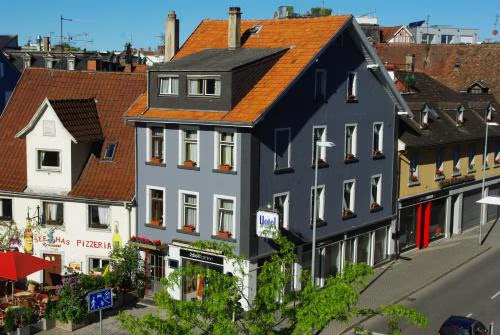
Hotel Pension Graf
 OpenReservations accepted
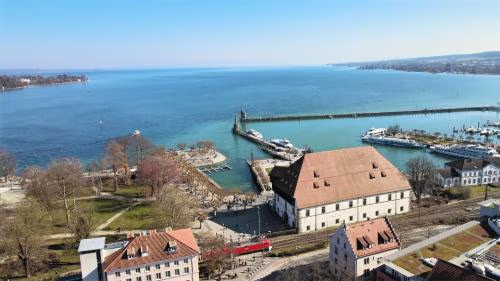
Hotel am Fischmarkt
 OpenReservations accepted
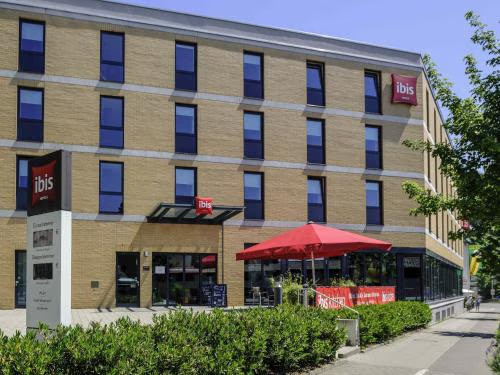
ibis Konstanz