

Town on the Camino
Interlaken
Switzerland
- places to stay
- 19
- Camino
- 1
- Elevation
- 565 m
Interlaken lies between Lake Brienz and Lake Thun, just short of halfway from Konstanz to Geneva. The town bears the name of a monastery first mentioned in 1133, which took in pilgrims until the Reformation dissolved it in 1528. Today it is a tourist hub below the Jungfrau. Worth a rest day when the sky is clear.
How long to stay?
Worth a rest day when the sky is clear. Interlaken is a good place for pilgrims to catch their breath: you are just short of halfway between Konstanz and Geneva, and there are shops, trains and beds in every price range. In clear weather the day is worth spending in the mountains. In rain or fog an afternoon is enough: the monastery courtyard, the castle park, a walk across the meadow in the middle, and tomorrow on to Lake Thun.
Interlaken in Ninja numbers
- 210.2 kilometres after Konstanz lies Interlaken, and 233.6 kilometres remain to Geneva. That means you have just under half of the Via Jacobi behind you.
- 1133 is when the Augustinian monastery that gave the town its name is first mentioned.
- 1528 is when Bern dissolved the monastery during the Reformation, and in the same year it banned the pilgrimage to the Beatus Caves, which you pass tomorrow.
- 1891 is when the town finally got the name Interlaken. Before that it was called Aarmühle.
- 18.6 kilometres to Spiez tomorrow, the last stretch of it by boat across the lake.
Arriving: onto the Bödeli
From Lake Brienz you come via Ringgenberg and Goldswil onto the Bödeli, the flat plain between the two lakes through which the Aare flows. Over the bridges you reach either Unterseen on the other side or the castle grounds with the old monastery. Then the path leads past the Höhematte, the large meadow in the middle of town, and on to the Aare. If the weather plays along, the Jungfrau, 4,158 metres high, stands above you to the south.
In brief: a monastery between the lakes
By 1133 at the latest, Baron Seliger of Oberhofen founded a house of Augustinian canons here, "inter lacus", between the lakes. By 1247 a convent of women had been added, and it became a double monastery. It also took in pilgrims. In 1528 Bern introduced the Reformation, the monastery's property passed to the state, and part of the building became a hospital for the poor. The church choir was converted into a granary and wine store in 1562 and 1563, and the west wing was demolished in the 18th century. The village next to it was long called Aarmühle. Only in 1891, when tourism had long been flourishing, did it take the monastery's name: Interlaken.
Around the old monastery: what to see
- Monastery and castle: In the courtyard of the old complex stands a Gothic cloister with a chapel from 1452. The tower of the monastery church dates from the early 14th century. Today the buildings house government offices; the castle park is open to the public.
- Höhematte: The large meadow in the centre, from which you look across to the Jungfrau on clear days.
- Unterseen: The older neighbouring town on the other side of the Aare. A museum there tells the history of the Bödeli.
Food and drink
Interlaken has everything, from supermarkets to expensive hotel restaurants. We did not find any verified pilgrim offers. Stock up here for tomorrow: along the north shore of Lake Thun there are only small places until Merligen.
Honestly
- Interlaken is crowded and expensive. Coach groups, adventure sports, watch shops. Pilgrims do not stand out here.
- No pilgrim hostel. You sleep in the youth hostel, a hostel or a hotel.
- The mountains cost money. Going up the Jungfrau is expensive. We have not checked prices.
- The boat tomorrow does not always run. Check the timetable before you are standing at the landing in Merligen.
Where pilgrims sleep
The Interlaken Youth Hostel is right next to Interlaken Ost station, so it is the first thing you reach coming in from Lake Brienz. It has 220 beds and is open all year. A bed in a six-bed room costs from CHF 42 (approx. €45) with breakfast, and reception is staffed from 6:30 to 23:00 (as of October 2026). There are also several backpacker hostels and many hotels in Interlaken.
Ninja tips
- Jungfrau only under a clear sky. Look at the clouds over the mountains in the morning before spending money on a mountain trip.
- Find peace in the monastery courtyard. In the middle of the bustle, the cloister is a quiet place.
- Check the boat timetable. For tomorrow you need the Interlaken West–Spiez line with a stop at Merligen.
When it rains
- Monastery and cloister: The castle park is open to the public; the tourist information gives opening hours for the interiors.
- Beatus Caves: On your way tomorrow, at Sundlauenen 8.2 kilometres from here, a dripstone cave with a circuit of about one kilometre. A destination that works in the rain too.
Practical tips for pilgrims
- Train: Interlaken has two stations, Ost and West. The youth hostel is at Ost station; the boats towards Spiez leave from West station.
- Boat: Boats run from Interlaken West across Lake Thun to Spiez, stopping at Merligen. In summer 2026, from 9 May to 11 October, about six sailings a day; fewer in autumn and winter.
Onward: along the north shore of Lake Thun and across the water
Tomorrow you go via Unterseen to the north shore of Lake Thun. At Sundlauenen, after 8.2 kilometres, you pass the Beatus Caves, an old place of pilgrimage. At Merligen (km 224.8, 14.3 kilometres from Interlaken) you board the boat and cross to Spiez, 18.6 kilometres in total, with 475 metres of ascent. If you don't want to take the boat, or none is running, you walk around the lake via Thun. We do not have this detour in our route data; it is considerably longer.
What awaits you tomorrow
Spiez with its castle on the lake, a thousand-year-old church and your first view of the vineyards.
Deep dive: Pilgrims between the lakes
A short read, in case you want to learn more about Interlaken. About four minutes' reading.
A monastery by the water
In the year 1133 the monastery between the lakes appears in a charter for the first time. A nobleman from Oberhofen on Lake Thun had founded it, for Augustinian canons, clergy who lived together according to a rule. Women joined a little later. In the thirteenth century Interlaken was a double monastery, with one community for men and one for women.
Pilgrims on the Bödeli
The monastery lay on the path you are walking today, and it took in pilgrims. And a few kilometres further on, on the north shore of Lake Thun, there was a destination of its own: the cave of Saint Beatus.
The man with the dragon
The legend says Beatus came from England or Ireland. A dragon lived in a cave above the lake; Beatus drove it out and lived there until his death. A book from 1511 even gives a year of death, one hundred and twelve after Christ, written down some fifteen hundred years after the events. Something else is certain: in 1231 the cave is mentioned as a destination of pilgrimages. The Augustinians from Interlaken built a chapel inside it. When plague was going round in 1439, the council of Bern sent a pilgrimage there. Next to the caves stood a hostel for the pilgrims, of which only remains survive today.
The year 1528
Then came the Reformation. In 1528 Bern introduced it, and in the same year both came to an end: the monastery was dissolved and its property passed to the state. And the council banned the pilgrimage to the Beatus Caves, closed the cave and destroyed the chapel. The monastery became a hospital for the poor, later a store for grain and wine, then an administrative seat.
A name remains
The village next to the monastery was long called Aarmühle. In the nineteenth century the travellers came, for the lakes and for the Jungfrau. In 1891 the town gave itself a new name and reached back to the monastery for it: Interlaken, between the lakes.
What Interlaken gives you
When this text was written, in the autumn of 2026, thousands passed through Interlaken every day wanting to see the mountains. Few of them were pilgrims. And yet you are walking a path that existed here before the name did. Tomorrow you pass the cave where people prayed for help eight hundred years ago. The chapel is gone. The path remains.
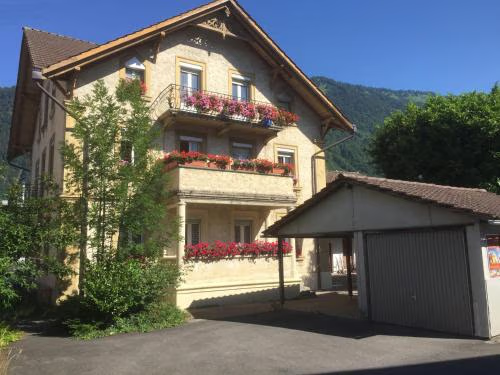
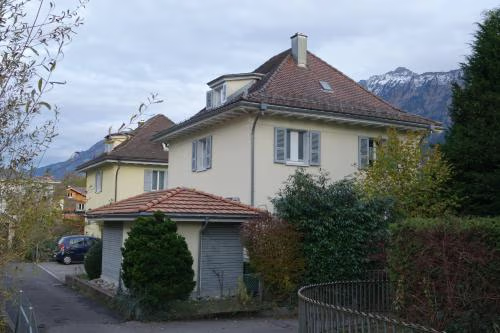
Where to stay in Interlaken
Places to stay in Interlaken.
 OpenReservations accepted
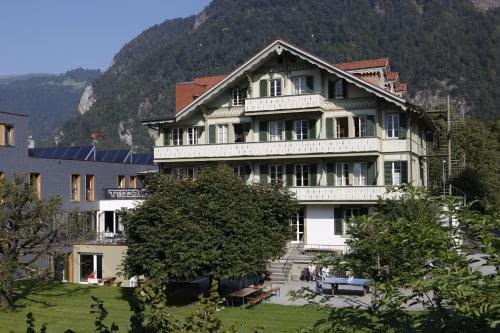
Chalet Hostel @ Backpackers Villa Interlaken
 OpenReservations accepted
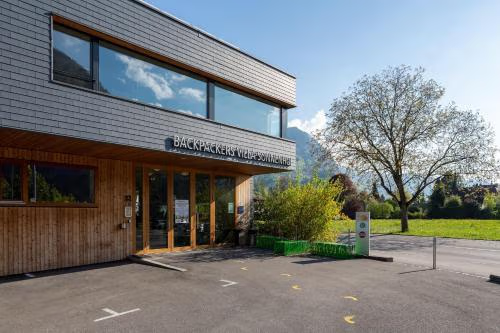
Backpackers Villa Sonnenhof - Hostel Interlaken
 OpenReservations accepted
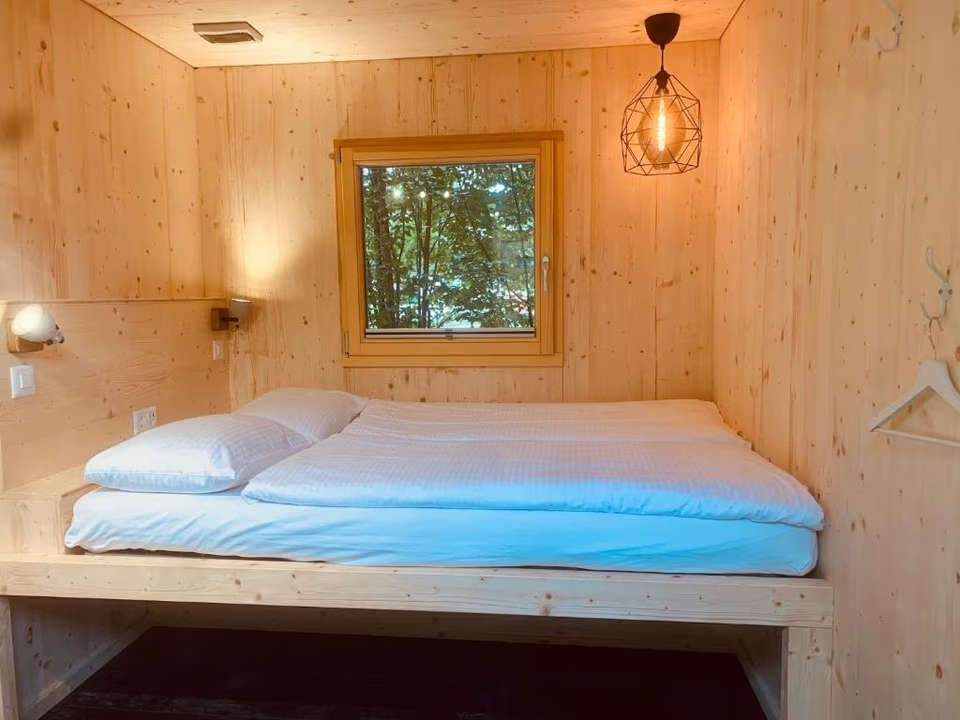
RiverLodge TCS Training & Freizeit AG


Town 17 of 28