

Town on the Camino
Burela
Spain
- places to stay
- 5
- Camino
- 1
- Elevation
- 11 m
Burela is the fishing port of the Mariña: this is where the albacore tuna is landed that ends up on tables all over Spain as Bonito del Norte. An old tuna boat is now a museum, and one in ten inhabitants has roots in Cape Verde. Not a pretty backdrop, but a town that works, and that is exactly why it is interesting.
How long to stay?
An afternoon is enough. Burela lies at the end of a long coastal stage, at 58.8 kilometres from Ribadeo and 19.4 from Foz. For the harbour, the museum ship and a plate of bonito, an afternoon is enough. The town is shaped by the harbour, not by an old town. If you arrive early, you walk on another 11.3 kilometres to San Cibrao.
Burela in Ninja numbers
- 58.8 kilometres are behind you, according to Camino Ninja, since the start in Ribadeo, 19.4 of them from Foz.
- 11.3 kilometres remain, according to Camino Ninja, to San Cibrao, and 213.2 to Ferrol.
- Almost 10,000 people live in Burela, around ten percent of them of Cape Verdean origin (as of June 2026).
- Since 1994 Burela has been a municipality in its own right; before that it belonged to Cervo.
Arriving: from the Areoura into the harbour
From Foz you follow the coast via Fazouro, Nois and Cangas de Foz. Shortly before the town lies the Praia da Areoura, which a pilgrim in September 2026 called the most beautiful beach of the whole way. The construction work on the expressway that used to disrupt the path is finished; the Camino del Mar and the coastal path now run together. Where the expressway crosses the footpath, the path forks: take the left branch, leading downhill. The waymarking only reappears at the end of the path.
In brief: from whaling to bonito
Burela is first mentioned in writing in 1096 as "Burellum", and its history goes back to pre-Roman times. By the sea lies the Chao do Castro, a fortified settlement where a golden neck ring, the Torques de Burela, was found in 1945. It is now in the provincial museum in Lugo and appears in the town's coat of arms. In 1593 Philip II drew the jurisdiction over Burela to the crown.
The harbour used to be a whaling port. Today it is one of the most important on the Galician coast, above all for albacore tuna (Bonito del Norte) and hake, which go every day to the rest of Spain. A canning industry grew out of that.
The Cape Verdeans of Burela
At the end of the 1970s the first Cape Verdeans came to Burela, at first as construction workers for the aluminium factory. Most came from the island of Santiago, many knew the sea and soon switched to the fishing boats. Today people from more than 50 countries live in Burela, including Indonesia, Peru and Morocco, drawn by the sea and by fishing. For a town on the Camino de Santiago that has a nice punchline: the Cape Verdeans here come from an island called Santiago.
Harbour and bonito: what to see
Burela's sights revolve around the harbour. The churches lie a little way off.
- Museum ship "Reina del Carmen": The wooden tuna boat, about 25 metres long and painted red, sailed from 1968 for thirty years as far as the Azores. Since 2000 it has lain at the harbour mole as a museum of fishing culture, about 190 metres from the path. On the guided tour you see the bridge, cabins, galley, engine room and hold, where the old fishing gear is explained; some things you may touch. Visit only with a guide, about one hour, admission 5 euros (as of November 2026). From February to November, reserve beforehand at the tourist office.
- Igrexa de Santa María de Vila do Medio: The old parish church lies about 840 metres off the route. Its construction is late medieval, extended in the 18th century. What is special are wall paintings of the 16th and 17th centuries with scenes of the Passion, which came to light in 1973 under flaking limewash. We don't know the opening times.
- Igrexa de Santa María: The present parish church, about 370 metres off the route on the Rúa da Igrexa, is a single-nave building with religious paintings and a Carmen chapel added at the side. In 1962 the parish moved here from Vila do Medio.
- The beaches: The Praia do Portelo, 700 metres long, has a promenade; the Praia de Ril lies in the middle of the town. A pilgrim recommends the town beach at the harbour for cooling off after the stage.
Food and drink
In Burela you eat fish, and specifically the fish that is landed here: bonito and hake. A pilgrim paid 14 euros for a set lunch in September 2026. On the first weekend of August the town celebrates the Feira do Bonito, a festival of national tourist interest, with music, bonito in various preparations and a competition in which artists paint large murals on the theme of the sea on the harbour wall.
Honestly
- There is no pilgrim albergue here. Burela has only hotels and an aparthotel. The next albergue on the way is in Viveiro.
- Burela is not a postcard. It is a working town with a harbour and canning factories. If you're after fishing-village romance, you'll find it more in Rinlo or San Cibrao.
- The museum ship needs planning. Without a reservation and outside the fixed tour times you don't get on board.
- The waymarking has gaps. Around the expressway, individual markers are missing.
Where pilgrims sleep
There is no pilgrim albergue in Burela, and along the whole Camino del Mar no public one. If you stay here, you sleep in a hotel or in the aparthotel.
Ninja tips
- Get your stamp at the tourist office. They have a Camino stamp there, and that is also where you reserve the tour of the "Reina del Carmen".
- Swim at the Areoura before you arrive. The beach lies on the path just before the town.
- Eat bonito. Here it goes straight from the boat into the kitchen.
- On leaving, follow the arrows uphill. The way no longer has to go down to the harbour and steeply up again.
Practical tips for pilgrims
- Museum ship: adults €5, ages 8–18 €3, under 8 free; at most 20 people per tour; reservation at the tourist office on 982 586 000 or 982 888 506 (as of November 2026).
- Stamp: tourist office (as of September 2026).
- Feira do Bonito: every year on the first weekend of August.
Onward: to San Cibrao
When leaving Burela, the arrows lead you uphill to the right; the old descent to the harbour with a steep climb back up is gone. Between Burela and San Cibrao the waymarking is good. At kilometre 64.4, about two kilometres off the route, lie the remains of the Royal Factories of Sargadelos, ironworks and ceramics manufactory from the late 18th century, with a small museum that only opens on weekdays. After 11.3 kilometres according to Camino Ninja you reach San Cibrao, the fishing village with the sea museum. You stay on the Camino del Mar.
Deep dive: An island called Santiago
A short read, in case you want to learn more about Burela. About two minutes' reading.
Gold from the castro
By the sea at Burela there was a fortified settlement in the Iron Age. In 1945 a golden neck ring was found there, a torques of the kind worn by the people of the castro culture. It is now in the museum in Lugo, but Burela has kept it in its own way: it appears in the town's coat of arms.
From whale to tuna
Like Rinlo and Foz, Burela was once a whaling port. When the whales stayed away, the sea remained. Today the boats go out for albacore tuna and hake, and what they bring back goes every day to the rest of Spain. The old boat "Reina del Carmen" sailed for thirty years as far as the Azores. Since 2000 it has lain in the harbour and shows what life on board looked like.
The island of Santiago
At the end of the 1970s men from Cape Verde came to Burela to build a factory. Most came from the island of Santiago, and many of them knew the sea. Soon they no longer went to the building site but onto the fishing boats. Today one in ten of Burela's inhabitants has roots in Cape Verde. You are on your way to Santiago, and in this town on the Cantabrian Sea you meet people whose families came from another island called Santiago, across the Atlantic.
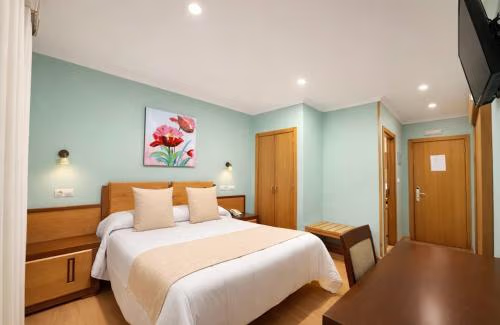
Where to stay in Burela
Places to stay in Burela.
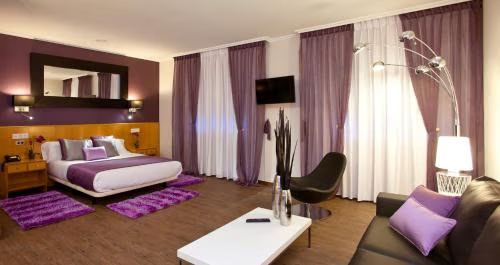 OpenReservations accepted
Hotel Palacio de Cristal
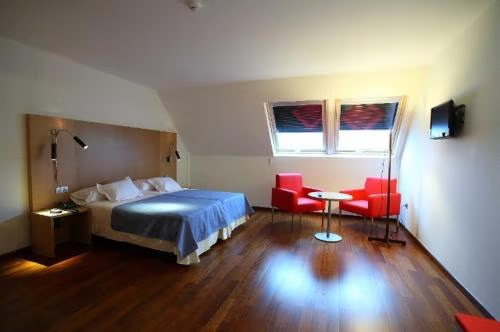 OpenReservations accepted
Hotel Ril
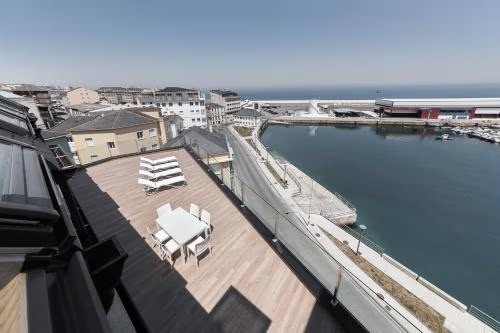 OpenReservations accepted
Apartahotel A Cetárea
Town 6 of 17