

Stage town on the Camino
Carrión de los Condes
Palencia, Castilla y León, Spain
- places to stay
- 12
- Camino
- 1
- Elevation
- 834 m
Carrión de los Condes is the town of the sisters: Poor Clares, Vincentian Sisters and the community of Santa María run the pilgrim albergues here, and in the evening they sing with you. Add two Romanesque portals, a 16th-century cloister and the counts from the Cid epic. An afternoon is enough; tomorrow brings 17 kilometers without a village.
Right now in Carrión de los Condes (as of October 2026)
- Albergue season: The parish albergue Santa María is open from 17 March to 31 October, the Poor Clares' albergue from 1 March to 30 November. In winter the Espíritu Santo albergue remains, open all year.
How long to stay?
An afternoon is enough, but take all of it. Santa María del Camino, the portal of Santiago, the convent of the Poor Clares and San Zoilo across the river all lie close together. More important than the stones here is the evening: the sisters' singing, the pilgrim Mass, the Poor Clares' pastries. Carrión is too small for a rest day, and just right for an early finish, because tomorrow will be long and empty.
Carrión in Ninja numbers
- 367.4 kilometers since Saint-Jean-Pied-de-Port on the Camino Francés. 408.7 remain to Santiago, so you have almost half.
- 17.2 kilometers to Calzadilla de la Cueza without a single town in between. Tomorrow is a water day.
- 24 figures adorn the archivolt of the portal of Santiago, most of them with their trade: cobbler, smith, scribe, harpist, judge.
- 1231 is when two pupils of Saint Clare founded their convent here, one of the oldest of the Poor Clares in Spain. It still takes in pilgrims today.
Arriving: past the Poor Clares
From Frómista you come via Villalcázar de Sirga, the last 5.6 kilometers beside the country road. Right at the edge of town stands the convent of the Poor Clares, directly on the Camino, and on the roundabout in front of it stands a monument, there since 2015 and donated by the sisters: a nativity scene with a present-day pilgrim kneeling before it. Then you go into the old town to Santa María del Camino.
In brief: Counts, relics and an epic
In the Middle Ages Carrión was the most important place on the Camino in today's province of Palencia, with many churches and pilgrim hospitals. In the 11th century Count Gómez Díaz and Countess Teresa Peláez fetched the relics of Saint Zoilus from Córdoba and gave the monastery to Cluny in 1076. Their family, the Beni-Gómez, lies buried there. The counts became famous through the Cantar de mio Cid, in which the Infantes of Carrión marry the Cid's daughters and shamefully cast them off; historically, these marriages are disproved. In the War of Independence the church of Santiago burned down almost completely in 1811, only its façade remained. The Marqués de Santillana, one of the great poets of the Spanish late Middle Ages, also came from Carrión.
The town of the sisters
If you spend the night in Carrión, you will very likely sleep with nuns. The Poor Clares have been here since 1231 and run an albergue at the edge of town. The Daughters of Charity of Saint Vincent de Paul run the large albergue Espíritu Santo, open all year, and invite you to prayer in their oratory at 17:30. And behind Santa María del Camino the community La Conversión runs the parish albergue with volunteers, where the sisters sing and pray with the pilgrims every evening before everyone goes to the pilgrim Mass with blessing in the church.
For many this is the evening they remember most clearly from the whole Camino: people from many countries who, after almost 19 kilometers of Meseta, sit together in one hall and sing, whether they are believers or not. The sisters don't ask.
Two portals and a cloister: what to see
From the albergue you can reach everything on foot.
- Santa María del Camino: The oldest church in town, Romanesque from the 12th century; the south portal was begun around 1130. Look for the four bull heads at the entrance. They belong to the legend of the tribute of the hundred maidens: every year Carrión had to hand four girls over to the Moors, and as they were saying goodbye to the Mother of God, four bulls appeared and chased the henchmen away. In the evening the pilgrim Mass with blessing is celebrated here. In summer 2026 the church was part of the region's opening program for the Camino.
- Iglesia de Santiago: Of the church that burned down in 1811 only the façade from the second half of the 12th century stands, but what a façade: above, Christ sits enthroned as ruler of the world, surrounded by the symbols of the Evangelists and the apostles, and in the archivolt of the portal sit 24 figures, most of them at their work. Here you see who looked after pilgrims in the Middle Ages: cobblers, smiths, scribes. Since 1993 there has been a museum of sacred art inside. We found no reliable opening hours.
- Monasterio de Santa Clara: Founded in 1231, on the Camino at the edge of town. In the museum hangs a Pietà by Gregorio Fernández, and there are two small treasures: an Infant Jesus as a pilgrim from the 17th century and an “Infant Jesus with toothache”. We found no museum hours; ask at the gatehouse.
- Monasterio de San Zoilo: Across the only bridge over the Río Carrión, on your way tomorrow morning. Founded in the 10th century, from 1076 part of Cluny, with the tombs of the counts from the 12th and 13th centuries and a Renaissance cloister that Juan de Badajoz the Younger designed and that took from 1537 to 1604 to build. Today the monastery is a hotel; whether and when you can see the cloister, we could not find out reliably.
Food and drink
Carrión has a pastry with a history: the Poor Clares have baked Pastas de limón, Virutas de San José and Tortas de Santa Clara for generations. You can get them at the convent gate and at the bakery La Peregrina on the Plaza de Santa María. The albergues have kitchens; grocery stores and bars are in the old town. Buy today for tomorrow.
Honestly
- The big albergues take no reservations. Espíritu Santo and Santa María give out their beds on arrival. Only the Poor Clares accept reservations.
- The museums are a guessing game. For Santiago, Santa Clara and the cloister of San Zoilo we found no reliable times.
- San Zoilo is a hotel. The cloister belongs to a house that serves its guests first.
- Tomorrow there is nothing. Between Carrión and Calzadilla there is no village, no fountain can be counted on, and you can't rely on snack vans.
Where pilgrims sleep
- Parish albergue: The Albergue Parroquial Santa María del Camino lies behind the church, is run by the community La Conversión and volunteers, and costs €10 (as of October 2026). Open from 17 March to 31 October, doors open from 12:00, no reservations, pilgrims only. Every evening singing with the sisters and then the pilgrim Mass.
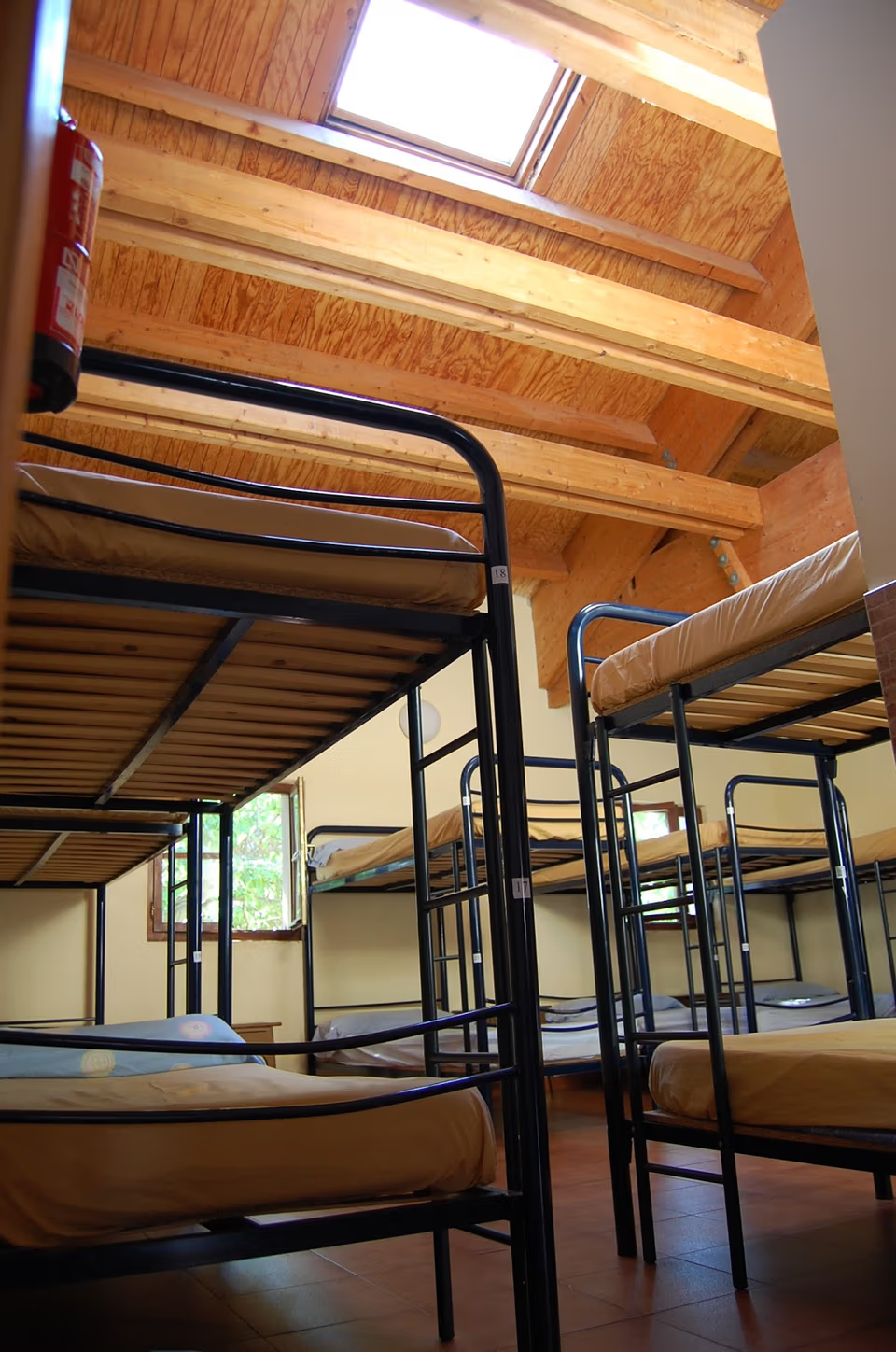
- Vincentian Sisters: The Albergue Eclesial Espíritu Santo is the large, year-round albergue, €10 with disposable bed linen, doors open at 11:30, no reservations. According to pilgrims there are no bunk beds; the albergue has heating and is wheelchair accessible.
- Poor Clares: The Albergue-Hospedería del Convento de Santa Clara at the edge of town has dormitories and single or double rooms, open from 1 March to 30 November. Here you can reserve.
- In addition there are rooms in the Casa de Espiritualidad of the Filipenses and in pensions.
Ninja tips
- Go to the singing, even if you sleep elsewhere. The gathering of the sisters in Santa María is the best-known evening on this half of the Camino.
- Buy the Poor Clares' pastries. The lemon cookies are light and keep until the next day, just right for the Meseta.
- Look closely at the craftsmen on the portal of Santiago. Each figure holds its tool in its hand.
- Fill all your bottles tomorrow morning. For the next 17.2 kilometers there is no dependable water point.
- When it rains, take the shoulder. The Roman road behind Carrión turns muddy when wet; the shoulder of the N-120 runs parallel.
Practical tips for pilgrims
- Credencial and stamps: in all albergues; the parish albergue also issues credenciales. An information point with the local Santiago association is at Calle San Zoilo 23 (tel. 979 880 902), the tourist office at Callejón de Santiago (tel. 979 880 932).
- Health: Two pharmacies, at Plaza Mayor 14 and Calle Rúa 4; health center at Plaza Conde Garay (tel. 979 880 245).
- Post: Calle Adolfo Suárez 18, Monday to Friday 8:30 to 14:30.
- Festivals: Santiago on 25 July with pilgrim Mass and a medieval procession, San Zoilo in the second half of August, Corpus Christi with flower carpets along almost two kilometers of street.
Onward: on the Roman road through the emptiness
You leave Carrión over the bridge on the Río Carrión, past San Zoilo, cross the N-120 carefully and head toward Villotilla. At kilometer 4.8 the remains of the abbey of Benevívere lie on the right, built from 1161 and used as a quarry after its dissolution. Then the Camino follows the Vía Aquitana, an old Roman road, straight as a die through grain fields. After 17.2 kilometers you reach Calzadilla de la Cueza (km 384.6), whose name comes from this road. After that come Ledigos (km 390.7) and Terradillos de los Templarios (km 393.8).
What awaits you tomorrow
A day without villages, the stretch everyone warns you about and that many talk about most afterwards. At the end waits Calzadilla de la Cueza, a small place with an albergue and a bar, and a feeling you learn on the Meseta: that emptiness is also room.
Deep dive: The counts, the Cid and the sisters
A short read, in case you want to learn more about Carrión de los Condes. About four minutes' reading.
A town of counts on the river
Carrión de los Condes carries its lords in its name. In the eleventh century the family of the Beni-Gómez ruled here, and Count Gómez Díaz and his wife Teresa Peláez did what powerful families did at that time to make their town important: they fetched relics. From Córdoba they brought the bones of Saint Zoilus, a martyr from Roman times, and laid them in the monastery by the river. In 1076 they gave the monastery to Cluny, the great Burgundian order that shaped the Camino then like no other. With the relics came two Islamic textiles from the eleventh century, which lie in the sacristy to this day. The counts themselves had themselves buried in this monastery.
The Infantes in the epic
That people still know the counts of Carrión today is due to a poem. In the Cantar de mio Cid, the great epic of the Spanish Middle Ages, two Infantes of Carrión marry the daughters of the Cid. They are cowardly and greedy, they mistreat the young women and leave them behind in an oak forest, and in the end they are defeated and dishonored in single combat before the king. The story made the town famous. It is not true: historically, these marriages are disproved. But it says a lot about the power of this family, if a poet needed them as the villains.
A town for pilgrims
In the Middle Ages Carrión was the most important place on the Camino in this region, with many churches and hospitals. On the façade of the church of Santiago you can see who kept the town running: in the archivolt sit 24 figures, cobblers, smiths, scribes, musicians, a judge. They are the people who mended pilgrims' shoes, forged horseshoes, wrote letters. In 1811, in the war against Napoleon, the church burned down except for the façade. Since 1993 there has been a museum inside.
The sisters
In 1231 two women came to Carrión who had still known Saint Clare of Assisi, and founded a convent. It is one of the oldest of the Poor Clares in Spain, and it stands directly on the Camino to this day. Later other communities joined them. When this text was written, in autumn 2026, nuns ran three of the albergues in Carrión, and every evening in one of them pilgrims from many countries sat together with the sisters and sang.
What Carrión gives you
You are almost in the middle of the Camino. Behind you lie the Pyrenees, the Rioja and the first days of the Meseta, ahead of you the emptiest stretch. Before that, Carrión gives you something you can take with you: an evening when someone takes you in without asking where you come from and what you believe. Tomorrow you walk alone on a Roman road. Tonight you don't.
Where to stay in Carrión de los Condes
The places pilgrims rate highest in Carrión de los Condes come first.
- Top #1
 OpenReservations not accepted
Albergue Eclesial Espíritu Santo
- Top #2
 OpenReservations accepted
Albergue-hospedería del Convento de Santa Clara
- Top #3
 OpenReservations accepted
Hostal Comfort Suites


Services in Carrión de los Condes
What you can find in town before the next stage.
- ATM
- Café
- Shop
- Tobacco
- Medical clinic
- Pharmacy
- Fountain
- Post office
- Bus station
- Restaurant
Source: © OpenStreetMap contributors · updated January 2025
Town 22 of 49