

Stage town on the Camino
Frómista
Palencia, Castilla y León, Spain
- places to stay
- 17
- Caminos
- 2
- Elevation
- 780 m
Frómista is the granary of the Tierra de Campos: its name comes from the Latin word for wheat, a canal was built to carry the grain away, and in the middle of town stands San Martín, one of Spain's most perfect Romanesque churches, first mentioned in 1066. An afternoon is enough, and the albergue is right next door.
How long to stay?
An afternoon is enough. You come into town along the canal, and everything that matters lies within a few hundred meters: San Martín, San Pedro with its museum, Santa María del Castillo with the multimedia show. After two or three hours you have seen it. A rest day is only worth it if your legs demand one.
Frómista in Ninja numbers
- 348.7 kilometers on the Camino Francés lie behind you since Saint-Jean-Pied-de-Port. There are still 427.4 to Santiago.
- Around 300 corbels carry the roof of San Martín, with people, animals, fabulous creatures and a few scenes that people in church prefer not to talk about.
- Four locks in a row lift the boats of the Canal de Castilla at the edge of town. Here your path runs along the towpath.
- 18.7 kilometers tomorrow to Carrión de los Condes, with only 104 meters of ascent.
Arriving: on the towpath
From Boadilla del Camino you walk the last 5.6 kilometers on the towpath of the Canal de Castilla, straight as a die along the water. At the edge of town the four locks follow one another, where the canal raised its boats step by step. The lock keeper's house, the Casa del Esclusero, now holds the tourist office. A few steps further and you are standing in front of San Martín. The Camino Lebaniego Castellano crosses here too: it comes up the canal from Palencia and turns north, to the monastery of Santo Toribio in Liébana.
In brief: Wheat and a queen
Frómista goes back to a settlement beside a Roman villa called Frumesta, and the name hangs on the Latin frumentum, wheat. Around 1066 Queen Muniadona, whom people here call Doña Mayor, widow of King Sancho III of Navarre, had a monastery built, of which only the church of San Martín remained. In 1118 it passed to the monastery of San Zoilo in Carrión, and in the 13th century the monks moved away. In the late 18th century the Canal de Castilla brought irrigation and mill power; work on it had begun on 16 July 1753, and it was meant to carry away the grain of the Meseta. Pedro González Telmo, the patron saint of sailors, after whom St. Elmo's fire is named, also came from Frómista. The town celebrates him on the Monday after Easter Monday.
Textbook Romanesque: what to see
Everything is in the old town center, and the distances are short.
- San Martín de Tours: The church is what you imagine when you think of Romanesque: three naves, three apses, an octagonal dome over the crossing and two round turrets on the façade. It is first mentioned in 1066. Look up at the outside first: around 300 corbels under the roof show people, animals, fabulous creatures and some coarse scenes. Inside, the capitals tell of Adam and Eve or of the fox and the grapes. Not every stone is as old as it looks: in 1894 it became a national monument, after which the bell tower and later additions were removed and much was reconstructed. It reopened in 1904, and to this day experts argue how much of it is Middle Ages and how much wishful image. According to visitors, admission costs one to two euros; we found no reliable opening hours.
- Iglesia de San Pedro: Gothic, with a Renaissance portal. In the parish museum hang 29 Hispano-Flemish panels from the altar of Santa María del Castillo, along with the paten around which Frómista's host miracle of 1453 revolves. In summer 2026 the church was part of the region's opening program for the Camino.
- Santa María del Castillo: The Gothic church stands where the castle stood and is no longer consecrated. Inside runs “Vestigia – Leyenda del Camino”, a multimedia show of about 35 minutes on the history and legends of the Camino, only at fixed tour times, €4 (as per the tourism portal, date unclear; call ahead: 672 146 994).
- The locks of the Canal de Castilla: Four chambers in a row, at the edge of town. In the evening, when the light falls low across the water, this is the loveliest spot in town.
Food and drink
Frómista lives on wheat and sheep. Try the sheep's cheese that matures here for over a year, lechazo, meaning milk-fed lamb, or pigeons from the Tierra de Campos. There is also Esparceta, a wine-based drink made to a family recipe, and as pastries Roscas de palo and Sequillos. According to pilgrims, a bakery opens around 6:30, handy for an early start. Many places close early in the evening, especially at the start of the season.
Honestly
- San Martín is partly a reconstruction. The restoration around 1900 made it more “Romanesque” than it ever was. It is beautiful all the same, but you are also looking at the ideal of the 19th century.
- The opening hours are unclear. We found no reliable times for any of the churches. If you come too late, you see San Martín only from outside, which is no bad consolation given the corbels.
- The municipal albergue closes in winter. From 20 December to the end of January it is shut.
- It goes quiet early in the evening. Don't plan your dinner too late.
Where pilgrims sleep
The Albergue Municipal Frómista of the town lies on the Plaza San Martín, right next to the church. It costs €15 (as of October 2026), has heating, a kitchen and a washing machine, takes only pilgrims with a credencial and is closed from 20 December to 31 January; you can book. Exactly in this period the Albergue Betania opens as a winter albergue on a donation basis. In addition there are private albergues such as the Albergue Luz de Frómista and the Albergue Estrella del Camino for €15 to 17, and several pensions.
Ninja tips
- Look at the corbels in front of the church. The figures under the edge of the roof are the best thing about San Martín, and they are always accessible.
- Go back to the locks in the evening. The canal is the quietest place in Frómista.
- Find tomorrow's arrows in the evening. If you set off before sunrise, you should already know the way out of town.
- Buy provisions for the stretch to Carrión. There are only small villages along the way.
Practical tips for pilgrims
- Stamps: in the albergue, at the tourist office by the locks and in the churches.
- Services: grocery store, pharmacy, cash machine and health center (tel. 979 810 065) in town. Market day is Friday.
- Train and bus: Frómista has a station on the Palencia–Santander line and buses to Palencia, Burgos and Carrión.
- Festivals: San Telmo on the Monday after Easter Monday, Santiago on 25 July, Virgen del Otero on 8 September.
Onward: via Villalcázar to Carrión
The Camino leaves Frómista on a strip of gravel beside the country road, marked off by stone posts. Via Población de Campos (km 352.3), Revenga and Villarmentero you reach Villalcázar de Sirga (km 361.8) with its mighty Templar church, and after another 5.6 kilometers Carrión de los Condes (km 367.4). In total it is 18.7 kilometers, almost flat.
What awaits you tomorrow
Carrión de los Condes, the town of the counts from the Cid epic and of convents. In the evening, nuns sing here with the pilgrims, and the Poor Clares sell pastries they have baked for generations.
Deep dive: The grain and the church
A short read, in case you want to learn more about Frómista. About three minutes' reading.
A town named after wheat
When you walk through the Tierra de Campos, you walk through one of the great grain fields of Spain. Frómista carries that in its name. The town arose beside a Roman villa called Frumesta, and the word sounds like frumentum, the Latin for wheat. Centuries later, in the eighteenth century, the Spanish crown built a canal through this plain, the Canal de Castilla. Work began on 16 July 1753 in Calahorra de Ribas, and in the end, with its three arms, it measured 207 kilometers. It was meant to bring the grain of the Meseta to the ports, it irrigated the fields and drove mills. Today you walk on its towpath, where animals once pulled the boats.
The church of a queen
Around 1066 Queen Muniadona of Castile, widow of King Sancho the Third of Navarre, had a monastery built in Frómista. Of the monastery nothing remains, of the church everything, or almost everything. In 1118 it passed to the monastery of San Zoilo in Carrión, and in the thirteenth century the monks left the town. The church gained a bell tower, a sacristy, stairs and additions.
An ideal from the nineteenth century
In 1894 Spain declared San Martín a national monument. Then began a restoration that is disputed to this day. The later bell tower was torn down, along with the stairs and the gallery at the entrance, damaged stones were replaced and what was missing was reconstructed. In 1904 the church reopened, as pure and unified as people of that time wished Romanesque to be. So what you see is both: a building of the eleventh century and the picture the nineteenth century made of it.
What Frómista gives you
Under the edge of the roof sit around three hundred stone figures, people, animals, fabulous creatures. Nobody made them for pilgrims, and yet for almost a thousand years they have looked down on those who pass by. When this text was written, in autumn 2026, well over four hundred kilometers still lay between Frómista and Santiago. That is a good place to notice that a long road is made of many small things, like a field of grains.
Where to stay in Frómista
The places pilgrims rate highest in Frómista come first.
- Top #1
 OpenReservations accepted
El Chiringuito Del Camino
- Top #2
 OpenReservations accepted
Albergue Luz de Frómista
- Top #3
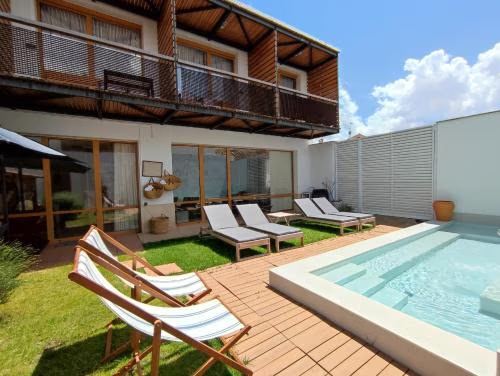 OpenReservations accepted
Hotel Doña Mayor


Services in Frómista
What you can find in town before the next stage.
- ATM
- Café
- Shop
- Tobacco
- Medical clinic
- Pharmacy
- Fountain
- Post office
- Train station
- Bus station
- Restaurant
Source: © OpenStreetMap contributors · updated January 2025
Town 21 of 49