

Town on the Camino
Chemnitz
Germany
- places to stay
- 63
- Camino
- 1
- Elevation
- 311 m
Chemnitz is the halfway point of the Saxon Way of St James: shortly before the city you have half of the 308 kilometres from Bautzen to Hof behind you. The stage ends at the Jakobikirche, the city's mother church, destroyed in 1945, its nave not finished again until 2009. An afternoon is enough for the church, the Marx head and the remains of the old town.
How long to stay?
An afternoon is enough; a rest day is only worth it if you like museums. The stage from Flöha is short, so you reach the Jakobikirche early. The rest of the day is enough for the church, the Hoher Turm, the town hall and the Marx head. What Chemnitz has beyond that is tucked away in museums: the smac archaeology museum in the former Schocken department store, and the natural history museum with the Petrified Forest in the Tietz. If you need a rest day at the halfway point, here you'll find the biggest choice of beds and shops between Dresden and Hof. If you don't need one, carry on tomorrow.
Chemnitz in Ninja numbers
- 159.5 kilometres from Bautzen, 148.5 to Hof (according to Camino Ninja). So the halfway point lies a few kilometres before the city, somewhere between Euba and the Jakobikirche. You may only celebrate at the market, though.
- Over 3,000 kilometres to Santiago, it says on the milestone in the Zeisigwald that Chemnitz St James pilgrims put up in 2011. You walk right past it. From Hof it will still be almost 2,900.
- 40 tonnes is what the Marx head of 1971 weighs, over seven metres high. It has no legs. It is the only one in the city who doesn't have to walk.
- 64 years lay between the destruction of the Jakobikirche on 5 March 1945 and the reopening of its nave on 19 July 2009, six days before St James's Day.
Arriving: through the Zeisigwald to the Jakobikirche
On the Saxon Way of St James you approach the city from Oederan through the Flöha valley and via Euba. Shortly before Chemnitz the path leads through the Zeisigwald, a city forest in the east. There, at around 430 metres, stands a milestone put up by the Interessengemeinschaft Chemnitzer Jakobspilger in 2011. It works out the distance to Santiago for you: a good 3,000 kilometres.
Then it goes on quiet paths via the Forststraße and the Sonnenberg down into the city centre. The goal of the stage is the Jakobikirche on the market. It stands wall to wall with the Old Town Hall, an arch connects the two, and the Hoher Turm towers above them. Watch for the shells: the way is marked in one direction only, towards Santiago. If you look for it the other way round, you'll be looking a long time.
In brief: a town on the Frankenstraße
In 1143 Chemnitz appears in a document for the first time, as "Kameniz". The town lay on the Frankenstraße, the old trade route from Upper Lusatia to Franconia. In 1449 Chemnitz received jurisdiction over the country roads between Zwickau, Chemnitz and Freiberg. In 1462 Elector Frederick II had it written down how wagons heading for Franconia were to travel, and "Kempnitz" is on that list. It is the same sequence of towns that you walk today.
The Jakobikirche is dedicated to the apostle whose shell has accompanied you since Bautzen. In 1264 it is called "ecclesia forensis", the church on the market. Later Chemnitz became an industrial city of factories, engineering and textiles, and in East Germany it was called Karl-Marx-Stadt. On 5 March 1945 the church, tower and town hall burned down. What you see in the city centre today is largely a post-war city. In 2025 Chemnitz was European Capital of Culture.
Halfway at the church that rose again
Somewhere shortly before Chemnitz you pass the halfway point of the way. The figures on the Camino Ninja map tell you: 159.5 kilometres behind you, 148.5 ahead. And the goal of this halfway stage is a church that itself had to start twice.
In spring 1945 the Jakobikirche stood as a ruin. In August the vault collapsed, and in February 1946 the bell tower, which buried part of the town hall beneath it. By 1967 the exterior had been rebuilt, in 1974 the money ran out, and work on the interior stood still. From 1990 the nave was cleared out, from 1994 there were exhibitions and concerts there, and in 2004 a glass wall replaced the brick wall in front of the choir. On 19 July 2009 the nave was finished again.
The Hoher Turm next to it needed patience too. After 1949 its 32-metre stump carried an emergency roof for over 30 years. Only on 26 September 1986 did a crane lift the new Baroque cap from the market onto the tower. So when you stand on the market, you have in front of you a church and a tower that both did not give up. For a halfway point that is not a bad sight.
Around the market: what to see
Most of it lies close together. Church, tower and town hall form a group on the market, and the Marx head and the smac are a short walk. For all of it together you don't need a bus.
- Stadtkirche St. Jakobi (town church): The goal of your stage and the church of the apostle whose way you are walking. Beneath it, excavations in the 1950s found a Romanesque predecessor church. The Gothic hall choir dates from around 1412, and the nave is a plain three-aisled hall. In front of the main portal lies a porch with pointed arches, the "Paradise". In 1912 the west façade was given an Art Nouveau face: Christ, with five music-making angels above him. The church was destroyed in 1945 and not fully reopened until 2009, the story is above. This is also where the Saturday pilgrims of the association meet, who in 2026 walked in stages from the Jakobikirche towards the Vogtland. We haven't reliably found opening times or a pilgrim stamp, so ask at the parish office or try at service time.
- Hoher Turm: The bell tower between the church and the Old Town Hall is one of the oldest buildings in the city and perhaps a defensive tower from the 12th century. At least since the 14th century the bells of the Jakobikirche have rung here. It is 64 metres high, and the great bell of 1749 still hangs in the bell frame, weighing almost 3,000 kilograms. Take a look at the cap: it is made of steel and has only been back up since 1986.
- Karl Marx Monument: The head by the Soviet sculptor Lev Kerbel was unveiled on 9 October 1971: over 7.10 metres of bronze, 40 tonnes, on a granite plinth of 4.50 metres. Behind it, on the wall, is "Workers of the world, unite" in German, English, French and Russian. The people of Chemnitz call it the Nischel. For pilgrims it is above all a contrast: for days you've been walking from church to church, and here one of the best-known critics of religion stands as the biggest head in the city. The sentence the city passes on about it fits: Marx needs no legs and no hands, his head says it all.
- smac, State Museum of Archaeology: The museum is housed in the former Schocken department store, which Erich Mendelsohn built for the brothers Simon and Salman Schocken and which opened in 1930. The curved façade alone is worth the detour. Inside it is about the archaeology of Saxony. According to the City of Chemnitz it is open Tuesday, Wednesday and Friday 9 to 5, Thursday until 8, weekends and public holidays 10 to 6 (as of November 2026, check on the spot), address Stefan-Heym-Platz 1.
- Petrified Forest in the Tietz: In the Tietz cultural centre the Museum of Natural History shows petrified tree trunks buried by a volcanic eruption some 291 million years ago. The volcano was the Zeisigwald, through which you walked this morning. We haven't found current opening times, so look at the museum's website beforehand.
Food and drink
Chemnitz is a big city, and in the centre you'll find everything from bakery to supermarket. We don't recommend individual places, as we lack reliable pilgrim voices. If you're heading for Stollberg or Jahnsdorf tomorrow, it's best to shop this evening for the day.
Honestly
- The old town is small. The city was largely destroyed in 1945. Around the market stand the church, tower and town hall, and behind them a post-war city begins. If you expect a Freiberg or Bautzen, you'll be disappointed. Take Chemnitz for what it is: an industrial city with a few strong places.
- Lots of city, lots of tarmac. The association itself says that in Chemnitz you walk several kilometres through suburbs, and between Chemnitz and Zwickau the main route runs along roads for a long stretch.
- Few real pilgrim beds. In a big city with many hotels, there are only a handful of places that deliberately take in pilgrims, and all of them want a call beforehand.
- The next stage is long. It is 25.4 kilometres to Stollberg. The route's stage plans therefore end in Jahnsdorf with its pilgrim hostel, 17.7 kilometres. Plan that today, not tomorrow morning.
Where pilgrims sleep
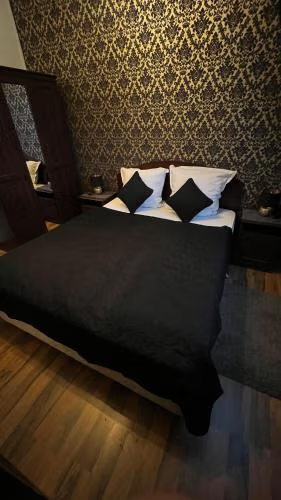
There is no hostel on the Spanish model in Chemnitz. These two houses deliberately take in pilgrims:
- Pilgrim and Youth House St. Antonius: The house of the Catholic parish of Saint Mother Teresa is on the Erfenschlager Straße, right by the church of St Antonius. We haven't found a price. Register beforehand at the parish office.
- Youth Hostel Chemnitz "eins": The DJH youth hostel on the Getreidemarkt is in the association's accommodation directory. It has multi-bed rooms. As in all German youth hostels, you need a membership of the Jugendherbergswerk.
In addition there are private hosts who take in pilgrims, and many guesthouses and holiday flats. They are listed in the app under Chemnitz.
Ninja tips
- Halfway photo at the milestone: The stone in the Zeisigwald is the only sign on the whole way that works out the distance to Santiago for you. Stop for a moment.
- The Citybahn is your friend: The train runs without changing from the Chemnitz city centre through the Würschnitz valley to Stollberg, with a stop in Jahnsdorf. Tomorrow you can walk to Jahnsdorf or Stollberg and ride back in the evening to your Chemnitz bed. The next day you ride back and walk on. That way you save yourself carrying the rucksack for a day.
- Pilgrim credential from the association: The Verein Sächsischer Jakobsweg on the Frankenstraße has its seat in Chemnitz. From them you get the pilgrim credential and pilgrim guide, the credential for a €5 donation (as of October 2026).
- Walk with others rather than alone: The association invites people to walk together on Saturdays, and in 2026 the series ran from the Jakobikirche as far as Treuen. The start was at 9 each time, and no registration was needed. Ask the association about the dates for 2027.
- Marx in the evening: If you haven't seen the head yet, it is a good destination for an evening stroll without a rucksack. Without the rucksack he looks a little bigger still.
Practical tips for pilgrims
- Stamp: We haven't found a fixed stamp point for pilgrims in Chemnitz. Ask in the Jakobikirche, at your accommodation or at a parish.
- Accommodation: Call the pilgrim houses and the youth hostel beforehand. The association writes for the whole way: "A prior telephone registration is absolutely essential!"
- Getting here and away: Chemnitz has a main station with regional trains to Dresden, Leipzig and Zwickau. If you're only walking one section, you can join or finish here easily.
- Shopping: The city has everything. Up to Stollberg the choice gets smaller.
Onward: through the Stadtpark to the Erzgebirge foothills
Tomorrow you leave Chemnitz through the Stadtpark and along the Eisenweg. On the edge of town you pass the Wasserschloss Klaffenbach, then it goes via Adorf (km 175.2) to Jahnsdorf (km 177.2). There, shortly before the end of the village, stands the pilgrim hostel, 17.7 kilometres from the Jakobikirche. If you walk on, you come through the Bürgerwald and past the reservoir to Stollberg, 25.4 kilometres from Chemnitz.
What awaits you tomorrow
Stollberg, a small town in the Erzgebirge foothills with two churches on the way: the Jakobikirche on the market and the Marienkirche, the oldest in the town, which Stollberg has put in its coat of arms. Above the town stands Hoheneck Castle. In East Germany it was the country's largest women's prison, and today it is a memorial. After two days in the big city you walk there into a history that is quieter and heavier.
Deep dive: The church on the market
A short read, in case you want to learn more about Chemnitz. About four minutes' reading.
An apostle on the trade road
When you stand in front of the Jakobikirche, you stand at the place where Chemnitz already had its church for the citizens in the Middle Ages. The documents call it in 1264 the church on the market. It was dedicated to the apostle James, the same saint to whose grave in Santiago you are travelling. Whether more pilgrims came through Chemnitz in the Middle Ages because of that, we don't know. A patron saint proves no pilgrim traffic. But it shows to whom the merchants on the road entrusted their most important church.
The road was real. The Frankenstraße connected Upper Lusatia with the towns of southern Germany, and it ran along the foot of the Erzgebirge. Chemnitz, Zwickau and Freiberg grew up along it. In 1462 Elector Frederick the Second of Saxony laid down which route wagons had to take if they wanted to go to Franconia: via Bischofswerda, Dresden, Freiberg, Chemnitz and Zwickau. Whoever follows the Saxon Way of St James today walks that list in order. The road is more than five hundred years old, the shells along it are not.
Built, burned, built again
Beneath today's church archaeologists found in the 1950s the foundations of a smaller Romanesque church. After a town fire in 1333 an early Gothic choir was built, and in the fourteenth century the church became a hall with three aisles. Around 1412 the tall hall choir was added. It is still the most valuable part of the church, with a net vault and a frieze of tracery.
With the Reformation in 1539 the rood screen and most of the side altars disappeared. That also ended pilgrimage in Saxony, and the Jakobikirche became a Protestant town church. In 1617 it burned again, and afterwards the tower got a Baroque cap. And in 1912 the church was given a new face: a west façade in Art Nouveau style, with Christ and five angels making music.
The fifth of March
On 5 March 1945 the Jakobikirche, the Hoher Turm and the Old Town Hall burned. In August the church's vault collapsed. The tower's ruin stood until February 1946, then it fell to the south and buried part of the town hall. The northern half had to be blown up.
What came after was no quick resurrection but a long holding on. The base of the tower was rebuilt in 1949, with a flat roof as a stopgap. The stopgap lasted more than thirty years. The church got its exterior back by 1967, and inside work rested from 1974 because the money was missing. The city was then called Karl-Marx-Stadt.
A crane, a glass wall, a summer's day
On 26 September 1986 a crane lifted the new tower cap from the market onto the tower. It is made of steel, in the shape of the old Baroque cap, and since that day the group of church, tower and town hall has been complete again. After the Wende the nave of the church was cleared out. From 1994 services, concerts and exhibitions took place there, in the middle of a room that was not yet finished. In 2004 the brick wall in front of the choir was replaced by a glass wall, so that one could see through again.
On 19 July 2009 the nave was finished again. That was six days before St James's Day. In the same summer, in June 2009, the Saxon Way of St James, which you are walking right now, was officially opened. So the church and the way are the same age, if you want to count it like that.
A stone in the forest
The way itself is the work of volunteers. On 10 June 2009 sixteen people founded in Reinsdorf near Zwickau the association that has marked and looked after the Saxon Way of St James ever since. It has its seat in Chemnitz. Two years later, in 2011, a group of Chemnitz St James pilgrims set a stone by the path in the Zeisigwald. On it is written how far it is from here to Santiago: a good three thousand kilometres.
That is a curious number for a forest on the edge of a Saxon city. Hardly anyone who passes here will walk it to the end. But the stone says something simple: this way doesn't end in Hof. It belongs to a network that reaches through half of Europe to Galicia, and the forest on the edge of town is a part of it. Whoever stands here stands neither at the beginning nor at the end, but in the middle.
What Chemnitz gives you to take with you
Chemnitz is not a city that greets you with beauty. It greets you with a church that took sixty-four years until its nave was finished again, and with a tower that stood three decades under an emergency roof. And it greets you at the halfway point of your way.
Halfway is a strange moment. The beginning is far away, and so is the goal. The enthusiasm of the first days is used up, and the joy of arriving isn't there yet. Many pilgrims know this point as the hardest. The Jakobikirche knows it too. For decades it stood half-finished in the city and was used all the same, for concerts, for exhibitions, for services between building sites. Perhaps that is the lesson of this halfway point: you don't have to be finished to walk. Tomorrow you walk on.
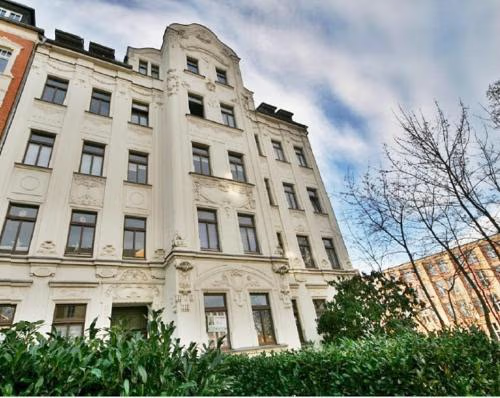
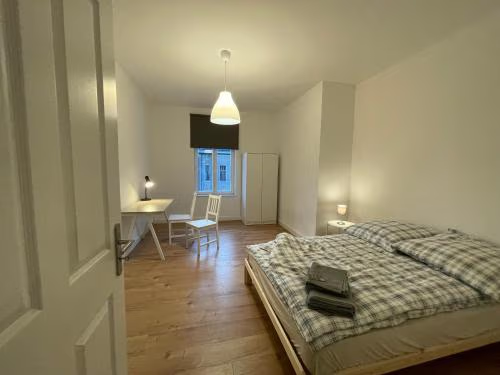
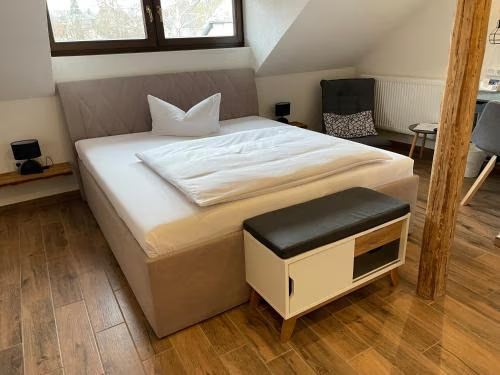
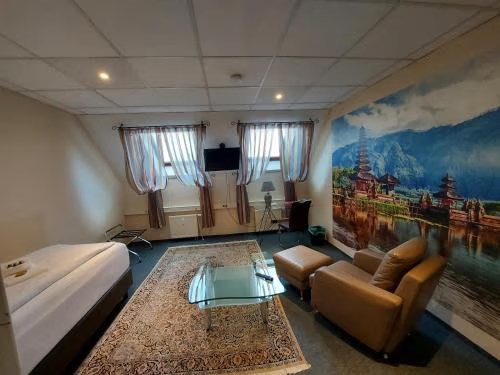
Where to stay in Chemnitz
Places to stay in Chemnitz.
 Open
Familie Raupach
Donativo- Open
Angelika Bergmann
Donativo - Open
Pilger- und Jugendhaus St. Antonius
Donativo
Town 9 of 15