

Town on the Camino
Stollberg/Erzgebirge
Germany
- places to stay
- 4
- Camino
- 1
- Elevation
- 410 m
Stollberg is a small town in the foothills of the Erzgebirge with two churches on the Way and a castle where East Germany locked up some 24,000 women. If you come through on foot, you walk past Hoheneck in freedom, now a memorial. It is still 123 kilometres to Hof, and an afternoon is enough.
How long to stay?
An afternoon is enough, or a long break if you are coming from Jahnsdorf. The stage plans for this route end in Jahnsdorf with its pilgrim hostel. From there you reach Stollberg the next morning after just under eight kilometres. Then a break of an hour or two is worth it, for the Marienkirche and the Hoheneck memorial. If you come from Chemnitz, Stollberg is a stage end after a good 25 kilometres, with one pilgrim bed. Plan your day so that you are here between Wednesday and Saturday, because that is the only time the memorial is open.
Stollberg in Ninja numbers
- 184.9 kilometres from Bautzen, 123.1 to Hof (according to Camino Ninja). The halfway point from Chemnitz is behind you, the Vogtland still ahead.
- 7.7 kilometres from the pilgrim hostel in Jahnsdorf, 8.2 kilometres to Oelsnitz/Erzgebirge. Stollberg sits in the middle of a stage, not at the end.
- Around 24,000 women were held in Hoheneck prison between 1950 and 1989, about 8,000 of them for political reasons.
- €0 is the entry fee for the memorial (as of August 2026).
Arriving: over the reservoir to the market
From Jahnsdorf the Saxon Way of St James leads over the Tabakstanne and through the Bürgerwald. Past the Stollberg reservoir you come into the town and arrive at the Jakobikirche in the centre, on the Hauptmarkt. The Marienkirche, the oldest church in town, lies right on the Way. You can already see Hoheneck castle from far off.
In brief: a town around a castle
Stollberg grew up around a castle that appears in old records as "Stal(e)burc". From 1320 the place belonged to the Lords of Schönburg, and in 1343 it first received market and town rights. In 1473 the Bishop of Meissen bought the town, and in 1564 Elector Augustus of Saxony did, for 74,222 guilders. In the Thirty Years' War the town and castle burned down in 1633. In 1704 the name Hoheneck appears for the castle for the first time. On 4 September 1809 a fire devoured most of the town, including the town hall, in four hours.
From 1855 the hosiery manufacturer F. E. Woller built large factory halls, and in 1864 Hoheneck castle became a prison. It remained one until 2001.
Behind walls, before the gate
In February 1950, around 1,000 women and 30 children were brought to Hoheneck from the Soviet special camp at Sachsenhausen. Soviet military tribunals had sentenced them, and now East Germany took over. Violence, hunger, cold and cells with more than 40 women followed. Until the mid-1950s there were buckets instead of toilets. Political prisoners were put together with violent criminals in order to humiliate them. In 1953 almost all the prisoners went on hunger strike to have their sentences reviewed.
The women worked in three shifts with high quotas. They sewed bed linen and stockings for Western firms, some of which later ended up on the shelves at Aldi. Hoheneck was the largest women's prison in East Germany. On 11 and 12 July 2024 a memorial opened here.
You arrive on foot and move on tomorrow, wherever you like. Nobody counts your steps, nobody dictates your stage. For the women behind these walls, exactly that was out of reach. If you look at only one thing in Stollberg, make it this.
Between church and castle: what to see
An afternoon is enough for all three together. First comes the place you should not miss.
- Gedenkstätte Hoheneck (memorial): In the former castle, witnesses tell why they were locked up here and what they went through. As a pilgrim you walk free every day. Here you see what it means not to have that. Open Wednesday to Saturday from 10am to 5pm, entry is free (as of August 2026), address An der Stalburg 6. Give it time.
- Marienkirche: According to the town, the oldest building in Stollberg, a small Romanesque church. It is the town's landmark and appears in its coat of arms and its town seal, whose model has been in use since the early 15th century. The town considers the ceiling paintings unique in Saxony. After its restoration, Bishop Joachim Reinelt reconsecrated it in 1993, and since then it has been a Catholic chapel again. The Catholic parish that takes in pilgrims here bears its name. We did not find opening times.
- Jakobikirche: The Protestant town church on the market square bears the name of your apostle. The first Jakobikirche was built in 1440. It burned down in August 1633, the foundation stone for the present one was laid in 1635, and it was consecrated on 5 April 1659. The organ has played since 1842, and the tower was built in 1878 and 1879. This is where the association's Saturday pilgrims meet at the end of their stage from Jahnsdorf. We did not find opening times or a pilgrim stamp.
Honestly
- The memorial has fixed days off. It is closed Sunday to Tuesday. If you come through on those days, you only see Hoheneck from the outside.
- The exhibition is small. In 2024 it was limited to one floor in the west wing, and the former prisoners wished for more, including the prison yard. Do not expect a big museum, but voices.
- Only one pilgrim bed. In Stollberg only the Catholic parish deliberately takes in pilgrims. Call ahead, otherwise it is guesthouses.
- A lot of road. Between Chemnitz and Zwickau the main route runs along roads for a long stretch. The association therefore recommends the St. Anna pilgrim path into the forest from Jahnsdorf. It leads via the St. Anna chapel near Zwönitz to Lößnitz. If you take it, you skip Stollberg's market square.
Where pilgrims sleep
- Katholische Pfarrgemeinde St. Marien: The Catholic parish on Zwickauer Straße takes in pilgrims. We did not find a price. Be sure to register beforehand.
The pilgrim hostel in Jahnsdorf is 7.7 kilometres back. There are also guesthouses and holiday flats in town. In the app they are listed under Stollberg.
Ninja tips
- Wednesday to Saturday: Plan your stages so that you pass through Stollberg on one of these days. Otherwise Hoheneck stays closed.
- Back to bed by Citybahn: The Citybahn runs without changes from Stollberg through the Würschnitztal to Chemnitz city centre, with a stop in Jahnsdorf. If you sleep in Chemnitz or Jahnsdorf, you can walk to Stollberg without your rucksack and ride back.
- Meeting point at the Catholic church: In 2026 the association's Saturday pilgrims started their stage towards Zwickau at the Catholic church in Stollberg. If you are looking for someone to walk with, ask the association about the dates for 2027.
Onward: into the old coalfield
Beyond Stollberg you go via Oberwürschnitz (km 189.4) to Oelsnitz/Erzgebirge (km 193.1), only 8.2 kilometres. It is 29.2 kilometres to Zwickau. In the stage suggestion on our route page, Stollberg is therefore an intermediate stop: the stage runs from Jahnsdorf to Oelsnitz/Erzgebirge.
What awaits you tomorrow
Oelsnitz/Erzgebirge in the former hard-coal field around Oelsnitz and Lugau. After the town of the castle you come into an area that lived off coal. After that the Way leads via Reinsdorf, where the association for this Way of St James was founded, to Zwickau.
Deep dive: The castle you could not walk away from
A short read, in case you want to learn more about Stollberg. About three minutes' reading.
A castle becomes a prison
The castle above Stollberg is older than its name. In the old records it is called Stalburg, and in the thirteenth century the town grew up around it. Only in 1704 is it called Hoheneck. In 1864 the castle became a prison, and it stayed one for almost a century and a half, until 2001.
The women of Hoheneck
In February 1950, around a thousand women and thirty children came here from the Soviet special camp at Sachsenhausen. Soviet military tribunals had sentenced them. From then on Hoheneck was the largest women's prison in East Germany. Until 1989, about twenty-four thousand women were held here, around eight thousand of them for political reasons. Some were separated from their children, and some of those children ended up in East German children's homes.
The women worked in three shifts. They sewed bed linen and stockings that Western firms bought. Some of it later lay on the shelves of West German supermarkets. The Federal Republic, in turn, bought political prisoners out of East Germany, for more than three billion marks in total. So the prison was not only a place of punishment, but also a business.
Remembering, late
Only in July 2024 did a memorial open at Hoheneck. A woman who had already been locked up here in 1950 was present at the opening. Nancy Aris, the Saxon State Commissioner for the Reappraisal of the SED Dictatorship, said in the same year that without Hoheneck we would have a largely male view of history. When this text was written, in autumn 2026, the memorial was open Wednesday to Saturday, and entry was free.
What Stollberg gives you
Pilgrimage means walking free. You decide when to set off, where to rest and how far you get today. In Hoheneck, women went for years without even a toilet, only a bucket in an overcrowded cell. When you walk out of Stollberg tomorrow morning, carry this thought a little way with you. It weighs nothing, but it does not carry lightly.
Where to stay in Stollberg/Erzgebirge
Places to stay in Stollberg/Erzgebirge.
 Open
Kath. Pfarrgemeinde St. Marien
Donativo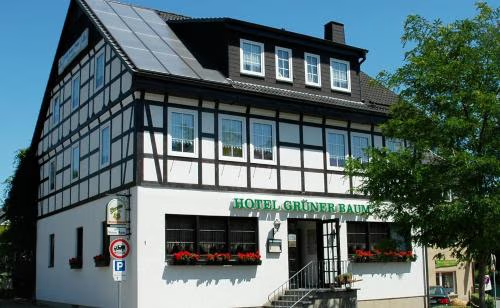 OpenReservations accepted
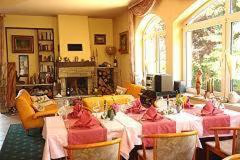
Hotel Grüner Baum
 OpenReservations accepted
Hotel Vinum

Town 10 of 15