

Town on the Camino
Condeixa-a-Nova
Portugal
- places to stay
- 2
- Caminos
- 2
- Elevation
- 108 m
Condeixa-a-Nova is the town that Masséna set on fire in March 1811 as he retreated: church, town hall palace and houses burned, and only the palace where the marshal slept was left standing. Today a museum here tells the Roman story of the ruins next door. An afternoon is enough, then it is 15.5 kilometres to Coimbra.
How long to stay?
An afternoon is enough, preferably not on a Monday. Condeixa lies only 2.1 kilometres beyond the ruins of Conímbriga, and together the two make a good afternoon: outside the real stones, in town the PO.RO.S museum, which explains the Roman era with screens and virtual rooms. The museum is closed on Mondays. For the short stroll round the centre with its church, town hall and pillory you will not need long; it is above all a place to learn what happened here in 1811.
Condeixa-a-Nova in Ninja numbers
- 231.1 kilometres lie behind you, according to Camino Ninja, since you set off in Lisbon. There are still 388.2 to Santiago.
- 15.5 kilometres to Coimbra, a short stage, but with a lot of up and down.
- 13 March 1811: On this day Marshal Ney had to give up his position near Condeixa. As they withdrew, the French left the town in flames.
- 10 years after the fire the parish church of Santa Cristina stood again, rebuilt in the neoclassical style.
- 11 halls on 1,200 square metres make up the PO.RO.S museum, opened in 2017.
Arriving: from the ruins into town
From Conímbriga you walk 2.1 kilometres to the centre, past the district of Valada, where the pilgrim hostel is. The ruins belong to Condeixa-a-Velha, the old Condeixa; the town with town hall, church and shops is Condeixa-a-Nova, the new one. Here the Camino Portugués Central also crosses the Caminho do Norte to Fátima. So the pilgrims with the blue arrows come towards you; they are walking south.
In brief: the fire of 1811
In the autumn of 1810 Marshal Masséna and the French army had got stuck in front of the Lines of Torres Vedras, north of Lisbon. In March 1811 he withdrew, via Pombal and Condeixa, that is, along your route. He wanted to get beyond Coimbra, but found the bridge there cut. Wellington sent Picton's division to outflank him on the right, and Masséna had to give up Condeixa. Before he left, he had the town set on fire.
The palace of the Figueiredos, today the seat of the municipality, burned, as did the parish church and many houses, and there were many victims among the inhabitants. The palace of the Lemos was spared: Masséna had spent the night there. On 14 March Marshal Ney held the British once more, at Casal Novo on the plateau above Condeixa. Then the retreat continued, as far as the Spanish border.
After the fire: what to see
The old centre is small. We have not found opening times for the church and the palaces; you will see most of them from the outside anyway.
- Igreja Matriz de Santa Cristina: The parish church was plundered and set alight in 1811 and rebuilt in the neoclassical style ten years later. Traces of its Manueline origins survived. For you it is the place where you can see most clearly what came after the fire: a new beginning in a new style. We have not found Mass times.
- Paços do Concelho, the Palácio dos Figueiredos: A Baroque palace with a lovely façade, today the town hall. It burned in 1811, lay in ruins afterwards and was later rebuilt, faithful to the old architecture.
- Palácio dos Lemos: The palace where Masséna spent his night in Condeixa, and therefore the house that escaped the fire. A look at the façade is enough to understand the story.
- Palácio dos Sás: After the French, only a ruin remained of it. The coat of arms and a niche from a Way of the Cross survive, a quiet piece of devotion between ruined walls.
- PO.RO.S, Museu Portugal Romano em Sicó: The museum on the Roman era in Lusitania and the Sicó area is housed in the manor house of the Quinta de São Tomé, by the green park of the Ribeira de Bruscos. Eleven halls with an interactive exhibition, from Romanisation through language and trade to everyday life. It works together with the ruins of Conímbriga and was nominated for the European Museum of the Year award in 2021. Open Tuesday to Sunday, 10 to 18:00 (as of November 2026). If you have seen the ruins, it fills in the gaps; if you skipped them, it is no substitute.
- Casa-Museu Fernando Namora: The former home of the writer, doctor and painter Fernando Namora, one of the town's best-known sons. We have not found opening times.
Food and drink
The cooking here is that of the lower Mondego: game, kid roasted in the oven, cabrito assado, and sweets from the convent tradition. The typical pastry of Condeixa is called Escarpiada, a sweet cake that you should pack for the road to Coimbra.
Honestly
- There is no pilgrim hostel in the centre. The only one is out in Valada, between the ruins and the town. If you only look for a bed once you are in Condeixa, you end up in guesthouses and hotels.
- PO.RO.S is closed on Mondays. Then all you have left in Condeixa are façades and the ruins next door.
- The stage to Coimbra is short, but no stroll. Constant up and down, a lot of tarmac and suburbs, and at the end a steep descent to the Mondego.
- You have to imagine a lot of 1811 yourself. There is no museum about the fire. The story lies in rebuilt walls, a coat of arms in a ruin and a hotel that was left standing.
Where pilgrims sleep
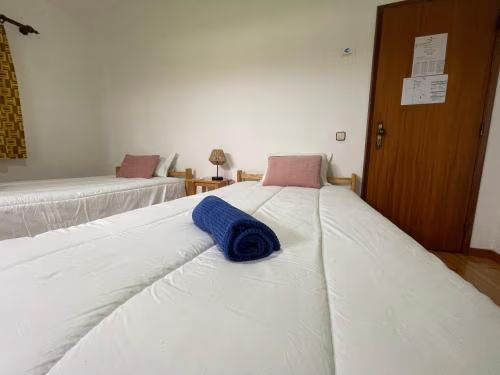
Condeixa has no municipal or church hostel. The private Albergue de Conímbriga is in the district of Valada, about 200 metres off the route, roughly a kilometre past the ruins and about ten minutes' walk from the centre. A dorm bed costs €15 (as of November 2026), there is a small kitchen, and you can reserve. Phone ahead; pilgrims have also found it closed outside the schedule: +351 962 870 633. In town itself there are rooms in a residencial and in hotels, noticeably dearer than a hostel bed.
Ninja tips
- Ruins first, then the museum. Conímbriga shows you the stones, PO.RO.S explains them. In that order both make the most sense, and both lie on your route.
- Sleep in Valada, eat in Condeixa. From the hostel it is about ten minutes into the centre, in the evening without your rucksack.
- Pack some Escarpiada. On the stage to Coimbra it makes a better break than an energy bar.
- Remember the bus at Pousada. About 5.5 kilometres beyond Condeixa, at the village of Pousada, a bus to Coimbra stops on the road. If you need to spare your knees or feet, this saves you the tarmac of the suburbs.
Onward: to Coimbra
According to Camino Ninja the stage is 15.5 kilometres long. After 4.1 kilometres you are in Cernache, with its parish church from the 13th century, rebuilt in the 14th, and a triangular square with a modern pillory. Next come Pousada and the chapel of Palheira, which you climb up to. At Cruz dos Moroucos, after 11.2 kilometres, you stand on the highest point of the area, with a cross, a chapel and a view. Then it goes down and once more up to Santa Clara, and down the steep Calçada de Santa Isabel to the Mondego. Across the bridge you come to the Largo da Portagem, the gateway to the old town.
What awaits you tomorrow
Tomorrow you reach Coimbra, and even before you cross the river you pass the convent of Santa Clara-a-Nova. The relics of Queen Isabel, the Rainha Santa, lie there; in 1325 she herself went to Santiago as a pilgrim. It is the town that inherited its name from the ruins behind you.
Deep dive: The night in the Palace of the Lemos
A short read, in case you want to learn more about Condeixa-a-Nova. About 2 minutes' reading.
An army on the way back
When you walk through Condeixa, you walk the road that a beaten army took in March 1811. Marshal Masséna had wanted to conquer Lisbon and had got stuck in front of the fortification lines of Torres Vedras. Now he withdrew northwards, and behind him came the British and Portuguese under Wellington.
One house is left standing
Masséna wanted to go on past Coimbra, but the bridge there was cut. Wellington sent a division to outflank him, and so the marshal had to give up Condeixa. He had spent one night in the palace of the Lemos family. When he left, he had the town set on fire. The palace of the Figueiredos burned, the parish church of Santa Cristina burned, many houses burned, and many people died. Only the house where the marshal had slept was left standing. The day after, Marshal Ney held the pursuers on the plateau above the town for one more day, then the retreat went on, towards Spain.
Rebuilt
Condeixa did not reinvent itself, it rebuilt. Ten years after the fire the church stood again, in the style of the new age, with remnants of its old form. The palace of the Figueiredos lay in ruins for a long time and was then restored as it had been, and today the municipality governs from it. Of the palace of the Sá family, a coat of arms and a niche for a Way of the Cross remained.
What Condeixa gives you
You come here from a Roman town that was raided a millennium and a half ago into a town that burned a good two hundred years ago. Both lie on the same road. What remains is neither the wall nor the fire, but that people came back afterwards and carried on. That, too, is a way of walking.
Where to stay in Condeixa-a-Nova
Places to stay in Condeixa-a-Nova.
 OpenReservations accepted
Residencial Borges
 OpenReservations accepted
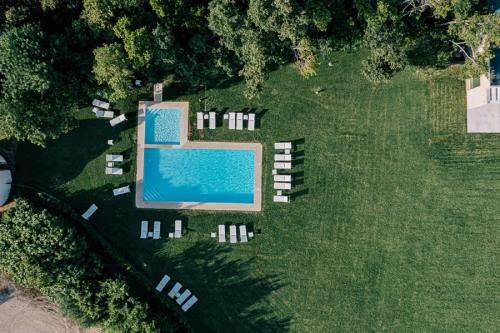
Conimbriga Hotel do Paço
Services in Condeixa-a-Nova
What you can find in town before the next stage.
- Shop
- Fountain
- Restaurant
Source: © OpenStreetMap contributors · updated January 2026
Town 12 of 43