

Stage town on the Camino
Corcubión
A Coruña, Galicia, Spain
- places to stay
- 6
- Camino
- 1
- Elevation
- 21 m
Corcubión is the smallest town in the province of A Coruña and the quieter neighbor of Cee: an old town under protection since 1984, a Gothic church of seafarers and a bay once guarded by fortresses. It is 10.4 kilometers to Fisterra, and beyond the town a donation-based hostel awaits.
How long to stay?
One evening is enough. Corcubión is small, you will have seen the old town in an hour. But it is a good evening: quieter than Cee, with lanes, hórreos and a harbor. If you know you will arrive in Fisterra tomorrow, you find a quiet eve of arrival here.
Corcubión in Ninja numbers
- 76.9 kilometers since Santiago on the Camino a Fisterra, the last 2.5 kilometers of them almost flat along the Ría from Cee.
- 10.4 kilometers are still left to Fisterra, with 264 meters of ascent.
- 1984 is the year the old town was declared a historic-artistic ensemble, on 31 January.
- Around 2,000 people live in the smallest municipality in the province of A Coruña.
Arriving: along the Ría
From Cee you walk along the water around the bay and are there after 2.5 kilometers. The way leads you straight to the church of San Marcos: this is where the climb to Fisterra begins, and where your tour of the town begins too.
In brief: a bay to defend
In 1430 the Counts of Altamira built their pazo here, when Corcubión became the seat of their jurisdiction; later the judge lived there. The bay was rich and exposed, and in the 18th century its entrance was secured with batteries. According to tradition a chain was stretched between the Castillo del Cardenal and the Castillo del Príncipe on the other side to stop enemy ships. A sailor who went to sea as a privateer also lived in the town; his house is still called Casa del Pirata. Returnees who had grown rich in America built the house in 1924 where the town hall sits today.
A protected place: what to see
Everything lies within a few hundred meters, except the fortress.
- Igrexa de San Marcos: The church was built from the early 14th century in several stages, mostly in the Gothic style of the coast, with Romanesque corbels, a neo-Gothic facade and two side chapels from the 18th century. French troops set it on fire, and later lightning struck three times. Your way to Fisterra begins here in the morning. We did not find opening hours. The patron's feast is on 25 April.
- The old town: Stone houses with coats of arms, lanes, a pazo and up to 14 hórreos, the granaries on stilts. The tourist office is in a building from 1858 that used to be the prison.
- Pazo de los Condes de Altamira: Built in 1430, rebuilt in the 17th century, today privately owned. You see it from the outside.
- Castillo del Cardenal: The battery from the second half of the 18th century, once with twelve cannons, lies about two kilometers from the center at the entrance to the Ría. A detour for the afternoon, not a must after a stage.
- Praia de Quenxe: A beach of 350 meters with the remains of old salt factories where fish used to be salted.
Food and drink
Corcubión cooks what comes from the Ría: clams, swimming crabs, goose barnacles, rockfish and an empanada with cockles. Plus hake, sea bream and grilled sardines.
Honestly
- There is no pilgrim hostel in the town itself. The San Roque hostel lies 1.7 kilometers outside, already on the way to Fisterra.
- The climb out of the town is steep, over steps and paving, and it begins right behind the church.
- The road beyond O Vilar is dangerous. Three lanes, no crossing, and afterwards roadsides with traffic.
- On Mondays much is closed. The tourist office opens Tuesday to Sunday, on Tuesdays only in the morning.
Where pilgrims sleep
The Albergue de Peregrinos San Roque lies 1.7 kilometers beyond Corcubión on the way to Fisterra. It is run by volunteers of a Galician Association of Friends of the Camino, on a donation basis and without subsidy, since 2004. It has 14 beds, is open from 1 March to 31 December and opens only at 15:00, sometimes later. There is no kitchen for pilgrims, but shared dinner and breakfast; groups and support vehicles are not accepted. Pilgrims praise the welcome; the dormitory is cold in winter. In the town itself, the Hostel Playa de Quenxe offers beds in a dormitory.
Ninja tips
- Stay for breakfast in San Roque. Dinner and breakfast are shared, and the hospitaleros ask that you do not leave beforehand.
- Bring a sleeping bag. The dormitory is cold, but one pilgrim in November 2025 still praised the tea, biscuits and food.
- Watch out on the AC-445. The crossing is just before the hostel, look twice.
- Swim at Langosteira only with care. On the long beach before Fisterra pilgrims traditionally washed off the dust, but the currents are dangerous.
Practical tips for pilgrims
- Stamp: in the San Roque hostel, when it is open.
- Tourist office: Explanada do Porto 17, tel. 981 706 163, Tuesday to Sunday 11:00–14:00 and 17:00–20:30, closed Mondays and Tuesday afternoons.
- Bus: Monbús runs daily to Santiago, Autocares Vázquez to A Coruña.
Onward: the last 10.4 kilometers
From the church of San Marcos you climb over steps next to a wayside cross and the Rúa Mercedes to the Campo do Rollo, then over paving and a path between stone walls to O Vilar. After the dangerous crossing of the AC-445 you pass the San Roque hostel, walk along the roadside via A Amarela to the almost untouched beach of Estorde and on to Sardiñeiro. A forest path through pines and eucalyptus then opens the view to Fisterra and the cape. Via the small cove Cala de Talón and the beach of Langosteira you pass the Cruz de Baixar and enter the town. The highest point, at 114 meters, lies just beyond Corcubión; in total it is 264 meters of ascent and 271 meters of descent.
What awaits you tomorrow
Fisterra, the end of the way at the sea. Ahead of you lie the beach of Langosteira, where pilgrims wash off the dust, and beyond it the lighthouse at the cape.
Deep dive: The smallest town with the biggest bay
A short read, in case you want to learn more about Corcubión. About three minutes' reading.
Small and sheltered
Corcubión is the smallest municipality in the province of A Coruña, around two thousand people on less than eight square kilometers. But the town has something that larger towns do not: a sheltered bay at the end of the Coast of Death, the Costa da Morte. Whoever dropped anchor here was safe from the storms of the Atlantic. That is why Corcubión was important, and that is why it was coveted.
Counts, judges and cannons
In the year 1430 the Counts of Altamira built a pazo when the town became the seat of their jurisdiction. Later the judge lived in it. In the eighteenth century came the fear of attacks from the sea. Batteries were built at the entrance to the Ría, one of them bears the name of the Cardinal and had twelve cannons. People tell that a chain was stretched between it and the fortress on the other shore to stop enemy ships. That is not proven, but the story suits a town that always had to defend itself.
The church that survived fire and lightning
The church of Saint Mark was built from the beginning of the fourteenth century, piece by piece, in the Gothic style of the seafarers. French soldiers set it on fire in the war against Napoleon, and later lightning struck three times. The church still stands. In 1984 the whole old town was declared a monument.
What Corcubión gives you
When this text was written, in autumn 2026, volunteers above the town were welcoming pilgrims in a hostel that lives without subsidy, on donations alone. Corcubión is the last sheltered harbor before the open cape. Tomorrow you walk out to the end. Tonight you still sleep in the bay.
Where to stay in Corcubión
Places to stay in Corcubión.
 Open
Albergue de Peregrinos San Roque de Corcubión
- OpenReservations accepted
Hostel Playa de Quenxe
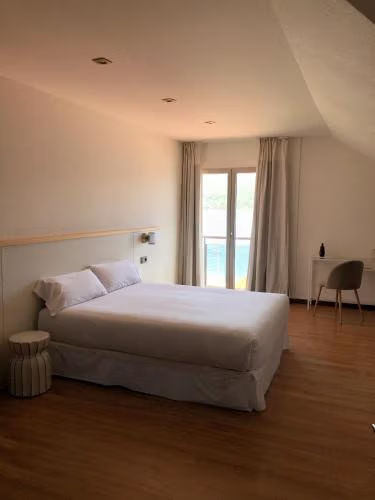 OpenReservations accepted
Hotel As Hortensias

Services in Corcubión
What you can find in town before the next stage.
- Café
- Shop
- Tobacco
- Pharmacy
- Fountain
- Post office
- Train station
- Bus station
- Restaurant
Source: © OpenStreetMap contributors · updated November 2025
Town 6 of 7