

Stage town on the Camino
Fisterra
A Coruña, Galicia, Spain
- places to stay
- 35
- Caminos
- 3
- Elevation
- 14 m
For many, Fisterra is the real end of the Way: 87 kilometres beyond Santiago, the 0.000 km marker stands on the cape above the Atlantic. The fishing town with its harbour, medieval parish church and the lighthouse of 1853 lives for the sunset over the sea. Stay an extra night to see it.
Right now in Fisterra (as of October 2026)
- Albergues in winter: Several private albergues close at the end of October, more at the end of November. The public albergue stays open all year. Pilgrims advise in winter: don't rely on websites, call.
- Don't burn anything at the cape: Burning shoes and clothing is forbidden, the cape is a nature reserve. Anyone caught pays a fine.
- Bus back to Santiago: Monbus runs several times a day, less often at weekends. We haven't found an official winter timetable yet. Ask at the albergue or at the kiosk for current times.
How long to stay?
Worth a rest day. The walk to the cape and back is about seven kilometres, and the best thing out there is the sunset. If you want to see it, you have to stay the night. With an extra day you can also fit in Monte Facho above the town, the beaches and the fish auction in the harbour. Many pilgrims say that they only truly arrived here, not in Santiago.
Fisterra in Ninja numbers
- 87 kilometres is the distance from Santiago to Fisterra.
- 0.000 kilometres is what the marker at the cape shows. There is no further.
- Around 3 kilometres separate the cape from the town. You walk it without your backpack in less than an hour.
- 27.8 kilometres lie between here and Muxía, in case you haven't had enough yet.
Arriving: along the beach to the end of the world
You get your first glimpse of the sea the day before, on the descent to Cee: suddenly Monte Pindo, the bay of Corcubión and the cape lie before you. On the last day the path leads from Corcubión for a good two kilometres along the Praia da Langosteira to the edge of town. Many pilgrims take their first dip in the Atlantic here. Watch out for currents and tides. Over the Cruz de Baixar you reach the centre, where the public albergue, the bus stop and the harbour are close together. You walk to the cape the same day or the next, without your backpack: past the church of Santa María das Areas and then along the road up to the lighthouse.
In brief: Finis terrae
The name comes from Latin, "finis terrae", the end of the earth. Strictly speaking, the cape is not the westernmost point of Europe, even the Galician tourism office says so. But for the Romans and for the pilgrims of the Middle Ages, this was the end of the known world. According to tradition, a sun altar stood on Monte Facho, the Ara Solis, which the Romans found among Celtic tribes. This is not proven. What is proven is that Fisterra already had a pilgrim hospital in the sixteenth century, opposite the parish church.
At the end of the world: what to see
- Cabo Fisterra and the lighthouse: The lighthouse of 1853 stands high above the sea, and in front of it the kilometre marker 0.000. This is where the Way ends. The site is freely accessible, with a bar-restaurant and a hotel. On the ascent a pilgrim monument and a bronze boot remember the pilgrims. Come in the evening: the sunset over the Atlantic is the reason so many people come here.
- Santa María das Areas: The parish church on the way to the cape was begun in the twelfth century and later extended in Gothic and Baroque style. In a Baroque chapel hangs the Santo Cristo da Barba Dourada, a Gothic crucifix. The legend says thieves threw it overboard in a storm and a fisherman rescued it. According to Gronze, a pilgrim Mass is celebrated here daily at 18:00. The pilgrim hospital used to stand opposite.
- Monte Facho: The mountain above the cape is 242 metres high. The sun altar Ara Solis and the hermitage of San Guillermo are said to have stood here. The Pedras Santas, two round rocks, can supposedly be moved with one hand, according to legend, because Mary and the Child rested on them. A good climb for your rest day.
- Castelo de San Carlos: The small fortress at the harbour was built in the eighteenth century against corsairs. Today it houses a small fishing museum. We haven't found opening times.
Food and drink
Fisterra lives from fishing. Fish and seafood come to the table here straight from the auction in the harbour. Pilgrims especially recommend razor clams and seafood in the restaurants by the harbour. If you eat in Cee or Corcubión on the way: seafood there is usually cheaper.
Honestly
- The cape is touristy. Pilgrims compare it to Niagara Falls, with tour groups and souvenirs.
- Rubbish hangs at the lighthouse. Pilgrims leave clothes and mementos at the fence, and the wind blows them into the sea. Leave nothing but your footprints.
- The road to the cape is busy. On the way up you share the road with many cars.
- The public albergue is cramped. Kitchen and common room close around 19:00, and for many pilgrims there are only two showers.
- The bus is often full. The ride to Santiago can take almost three hours, and pilgrims report delays.
Where pilgrims sleep
- Albergue de peregrinos de Fisterra: the public Xunta albergue on Rúa Real, near the harbour and bus stop. €10 per night, open all year, no reservations. In the evening you must be back by 21:30. Anyone arriving by car is not admitted. You also get the Fisterrana here.
There is no parish or donativo albergue in Fisterra. Besides, you will find many private albergues, usually €14 to €20 in a dormitory. In winter most are closed.
Ninja tips
- Headlamp for the way back: After sunset you walk back from the cape to town in the dark. The path is safe, but unpleasant without light.
- Sunset without the crowd: If the lighthouse is too crowded for you, go to the other side of the peninsula, about a kilometre from the albergue, to the west coast. You can watch the sun sink into the sea there just as well.
- Don't swim at Mar de Fóra: The beach on the open Atlantic side is unguarded, with strong waves and currents. Pilgrims have drowned here. You can swim in the bay at Langosteira.
- The coastal path to the cape: Instead of the road, you can take a marked variant from Mar de Fóra beach via A Ínsua to the cape.
- Fisterrana for free: You get the certificate for the Way to Fisterra free of charge with your stamped credencial at the tourist office or in the public albergue. The stamps are checked.
- Bus ticket the day before: The morning buses to Santiago are often sold out, and whoever has a ticket has priority. Tickets are available online or at the kiosk in town.
- Watching the auction: In the fishing harbour there is a viewing area from which you can follow the daily fish auction. Visits are possible by arrangement with the fishermen's guild.
Practical tips for pilgrims
- Credencial: For the Way to Fisterra there is a separate, free credencial at the pilgrim office in Santiago. Your normal one works too, though.
- To Muxía by bus: There is no direct connection, you change in Cee.
- On Sundays: The tourist office is only open in the morning on Sundays.
Onwards: to Muxía or back
If you still have another Way in your legs, take the Way from Fisterra to Muxía for 27.8 kilometres along the coast to Muxía. The Way is marked in both directions: on the stones and arrows there is an "M" for Muxía and an "F" for Fisterra. If you want to split it, stay overnight in Lires, about halfway. Between Lires and Muxía there are no supplies, so take enough water. Most people go back to Santiago by bus. If you walk the whole way back, you get a Compostela in Santiago for it.
What awaits you tomorrow
If you keep walking, in Muxía the pilgrimage church of the Virxe da Barca awaits you, right on the rocks by the sea. According to legend, the Virgin Mary landed here in a stone boat to encourage the apostle James. The stones said to have been her boat still lie next to the church today.
Deep dive: At the end of the world
A long read, in case you want to learn more about Fisterra. About twenty minutes' reading.
At the stone with the zero
At some point you stand in front of a waymarker with a number on it: 0,000. Behind you are the lighthouse, a bar and perhaps a tour group. Ahead of you there is nothing left but rocks falling steeply into the water, and the Atlantic stretching to the horizon. You have walked hundreds of kilometres, past countless stones with ever smaller numbers. Here the numbers stop.
Fisterra is not a big place. A fishing harbour, a parish church, a few streets on the hillside, a mountain above the cape. And yet hardly any spot in Galicia has been described, sung about and romanticised so often. After Santiago, the lighthouse counts as one of the most visited places in Galicia. That is not because of a building or a tomb. It is because of an idea that is older than the Way of Saint James itself: that this is where the world ends.
This text tells where that idea comes from, what in it is history and what is legend, and why pilgrims, for more than six hundred years and on record, have not stopped in Santiago but walked on until the land runs out.
A name from Rome
The name says it already. Fisterra comes from the Latin finis terrae, the end of the earth. For the Romans, Galicia lay in a far corner of their empire, and beyond the cape began an ocean nobody knew the end of.
How remote this corner was from Rome is shown by a story from the year 137 before Christ. The general Decimus Iunius Brutus led a Roman army north across the Douro into the land of the Gallaeci. The Greek historian Appian tells how the soldiers stopped at a river and refused to cross it. They took it for the Lethe, the river of forgetting from the underworld. Whoever walks through it, they believed, loses his memory. Brutus crossed alone, and only then did they follow him. The river is today's Limia, and if you came on the Portuguese Way you may even have crossed it. For his campaign the Senate gave Brutus the surname Callaicus, conqueror of the Gallaeci.
The Galician tourism authority tells that after his victory Brutus came as far as this cape and watched the sun sink into the sea. That is tradition, not the report of an ancient witness. But it sums up well what the Romans felt on this coast: here, on the last edge of the known world, the sun vanished every evening into a water without end.
Strictly speaking, the bit about the westernmost point is not true, by the way. Cabo da Roca near Lisbon lies a good sixteen kilometres further west, and even in Galicia nearby Cabo Touriñán reaches a little further into the sea. That has never harmed Fisterra's fame. The end of the world is less a question of surveying than a question of feeling.
The mountain above the cape
People lived here long before the Romans. On Monte Facho, the mountain above the cape, there are traces of settlement from around 1000 before Christ. A Roman road leads up to it. Ancient writers call the people of the area the Nerii, one of the tribes of the Gallaeci.
Over the centuries a whole wreath of legends has settled around this mountain. Saint Guillermo is said to have lived here as a hermit, and you can still see the remains of his hermitage. Among the finds on the mountain is a sarcophagus from the seventh century. Childless couples came to a stone bed by the hermitage to lie down there and ask for offspring. The Benedictine Martín Sarmiento, who travelled through Galicia in 1745, already describes this. Nearby lie the Pedras Santas, two round rocks on which, according to legend, Mary rested with the Child, and which is why they are said to move with a single hand. And here, it is said, lies the grave of Orcabella, an ancient goddess from Celtic tales.
So if you climb the Facho on a rest day, you walk through a landscape where prehistory, Romans, saints and ancient goddesses lie on top of one another. What of it is history and what is story can often no longer be told apart.
The Ara Solis: an altar nobody has found
The most famous of these stories is that of the Ara Solis, the altar of the sun. On Monte Facho, so it is said, stood a sanctuary where the people of the Bronze Age or the Celts worshipped the setting sun. The Romans are said to have found it and marvelled at it. A square in the old town is still called Praza de Ara Solis today, and a street bears the name too.
An honest look is worthwhile here. The sources do not tell the story consistently. On one page the Galician tourism office writes that the Romans found an altar of the Celtic tribes. On another it says that the Phoenicians built a temple to the sun here. Later guidebooks copy one version or the other. There is no archaeological find that proves the altar. No ancient inscription either. Serious accounts therefore put a cautious according to tradition in front of it.
Does that mean it is all invented? Not necessarily. That people saw something sacred in a place where the sun sinks into the sea so impressively is easy to imagine. And that early Christianity took over pagan places is well attested in Galicia. But imaginable is not proven. So if you sit on the rocks in the evening thinking of the sun worshippers of old, you are thinking of a beautiful story. Perhaps a true one. We do not know.
Duio, the sunken city
A second legend ties Fisterra directly to the apostle. The Codex Calixtinus, the great pilgrims' book of the twelfth century, tells how the disciples brought the body of James to Galicia. Before they were allowed to bury him, they had to ask for permission, in a city called Dugium. Today a place on the bay of Fisterra is called Duio, and it has been identified with that city. The Nerii, who are said to have made offerings to the sun on the Facho, are placed there too.
In Galicia the story is told further: in Duio the people mocked the apostle, and he asked that the city sink into the sea. In Muxía, on the other side of the peninsula, the legend of the Virgin Mary's stone ship begins with exactly this humiliation. So the two places at the end of the Way are linked in the stories as well.
None of this is history. But it shows how early this stretch of coast was written into the story of the apostle. Whoever walked to Fisterra in the Middle Ages did not set foot on foreign ground. He went to a place that appeared in the pilgrims' book itself.
Saint Mary at the end of the earth
On the way to the cape you pass the parish church, Santa María das Areas, Our Lady of the Sands. Its oldest written record dates from 1199. In that year Urraca Fernández, a daughter of the powerful Count of Traba, gave five measures of grain and a third of her cows for building the church. The deed contains a phrase that may move you: ad opus ecclesie Sancte Marie de finibus terre, for the work of the church of Saint Mary at the end of the earth.
The church grew over centuries. Parts of the north wall and the main portal from the late twelfth century are Romanesque. The oldest chapel added on, once dedicated to Saint Lucy, was built between 1225 and 1250 and is already fully Gothic. The main chapel dates from the middle of the fourteenth century, the nave with its three great pointed arches from the early fifteenth. In 1496 Roy Estévez and Alberta González endowed a chapel with a ribbed vault, and in 1524 a merchant's widow called María Blanca endowed another in Renaissance style. Everything is built of local granite, with a bell tower that ends in a pyramid.
Look out for the side door. It dates from the sixteenth century, bears the coats of arms of the Feijoo and Recamán families, and is a Holy Door. In Holy Years it is opened, just like the Holy Door of the cathedral in Santiago. As early as the fifteenth century, it is said, you could receive a plenary indulgence here.
And look at the figures. The patroness of the church, Our Lady of the Sands, was carved in 1534 from a stone from the Coimbra area. In the nave stands a James dressed as a pilgrim. Another James, small and stout, from the fifteenth century, once belonged to a canopy with the apostles, was buried and found again a few years ago. The high altar by the sculptor Francisco de Antas from 1640, on the other hand, is lost. Only drawings of it survive.
The Christ with the golden beard
You will find the church's greatest treasure in the Baroque chapel of the Santo Cristo, the largest of them all. It was begun in 1695. Its altarpiece was made in 1721 by Miguel de Romay, a sculptor from Santiago who a few years earlier had also built the high altar of the sanctuary in Muxía. In the middle hangs a Gothic crucifix from the early fourteenth century, known to people here as the Cristo da Barba Dourada, the Christ with the golden beard.
He is not a beautiful Christ. The blood in the wounds has dried, the face is discoloured, the feet twisted, the arms rigid, the head hangs to one side. The ribs stand out exaggeratedly. Art historians see in this the spirit of the devotional writing of the thirteenth century, which wanted to set Christ's suffering before people's eyes as humanly as possible. It counts as one of the most famous crucifixes in Spain, and very similar figures exist in Burgos and in Ourense. The one in Ourense is said to have been donated by Vasco Pérez Mariño, a son of Fisterra who became bishop there. Which of the two is the original is disputed among scholars.
How he came to Fisterra is told by legend. A ship, most say an English one, had him on board. Off the coast it ran into a storm, and the sailors threw the figure into the sea. At once the storm died down, and fishermen from Fisterra recovered the Christ. In another version thieves had stolen him. Yet another tradition attributes the figure to Nicodemus, the man who took Jesus down from the cross. And people told each other that his hair and nails grow.
The pilgrims already knew this last story. Erich Lassota von Steblau noted in 1580 that it was claimed the Christ's hair and nails grew and that he sweated from time to time. The Austrian prelate Christoph Gunzinger saw him at the end of July 1654 and was shaken. The figure was tremendously expressive, he wrote, and hidden behind three different curtains that were drawn back during Mass up to the Sanctus. And the priest Domenico Laffi from Bologna, who came here in the 1670s, tells the story of Saracen pirates who went ashore and insulted the Christ. One of them raised his sword against the figure and froze on the spot. His companions repented, had themselves baptised and sailed on.
To this day the Santo Cristo is the heart of Fisterra. On Easter Sunday thousands of people come to the church. People from the town act out the Resurrection: an angel announces to the women at the tomb, guarded by Roman soldiers, that Jesus is alive. Bells ring, doves fly up, rockets bang, everyone sings Hallelujah. At the end they dance the Danza das Areas, a dance whose origin historians place in the seventeenth century.
A hospital opposite the church
Where pilgrims come, they need a roof for the night. Fisterra had one. According to the town council, the parish priest Alonso García founded a pilgrim hospital opposite the main portal in 1479, dedicated to Our Lady of the Rosary, Nuestra Señora del Rosario. The Galician tourism office dates the foundation only to the end of the sixteenth century. There were probably several beginnings, because a house for pilgrims apparently existed here even earlier. The Augsburg patrician Sebastian Ilsung came to Fisterra in 1446 and wrote: There I handed my letter of recommendation to the prior. The hospital itself, however, apparently was not working that year.
A church visitation in 1589 found it well maintained and well provided for. But at the end of the eighteenth century, when pilgrimage was declining all over Europe, a visitor found no pilgrims left to give the alms to. He gave them to the poor of the town. Little remains of the hospital, a small Gothic chapel with an ogee-arched window. If you stand at the church and turn around, you are looking at the place where pilgrims before you found shelter.
Fisterra was not the only stop. Along the way from Santiago to the sea there were hospitals in Cee, in Corcubión and in the hamlet still simply called Hospital, whose pilgrim house is already named in medieval documents. The hospital in Corcubión still stands.
Pilgrims who did not stop in Santiago
Sometimes you hear that the Way to Fisterra is an invention of modern tourism. That is not true. The pilgrims who stood here before you have names.
One of the earliest is a Hungarian knight, George Grissaphan. The fourteenth-century account of him tells that he made a pilgrimage of penance to Santiago and then was in Fisterra. He tried to live there as a hermit and gave up after a few months because the place was too busy. If the cape seems too crowded to you today: you are not the first.
In 1417 came the French nobleman Nompar de Caumont. He titled his travel account as a journey to Saint James in Compostela and to Notre Dame de Finibus Terrae, Our Lady at the end of the earth. He probably means the same church that was already called that in the deed of gift of 1199. For Caumont it was not a detour but a second goal, of equal rank in the title.
In 1466 the Bohemian nobleman Leo of Rožmitál travelled through Europe with a large retinue. His companion Václav Šašek wrote of the cape that beyond it there was only the sea, whose end nobody knows but God alone. The Dominican Felix Faber recorded around 1480: after that there is no more world, only mighty water that nobody knows. In 1580 came Erich Lassota, in 1654 Christoph Gunzinger, and in the late seventeenth century Domenico Laffi even put the end of the earth in the title of his book: Viaggio in Ponente a San Giacomo di Galitia e Finisterrae, Journey to the West to Saint James in Galicia and to Finisterre. And a Spanish scholar, the licentiate Molina, wrote in the sixteenth century that many who came to the apostle also went to the Santo Cristo.
What drove them? As far as their accounts reveal, mainly two things: the Christ in the church and the miraculous places near Muxía. The sea itself, the sunset, the feeling of standing at the edge also appear in their words, but more as wonder than as goal. They probably went to the end of the world less to find themselves than to be close to one more holy place. And then they stood there anyway and looked out at the water, just like you.
Pagan or Christian? An honest answer
Hardly any question at the end of the Camino is argued about as eagerly as this one: is the Way to Fisterra a Christian pilgrimage, or an ancient pagan path following the sun that the Church merely painted over?
Some say the Celts were already making their way to the cape to watch the sun die, and the Christians took this over. The Costa da Morte, the Coast of Death, they say, owes its name not only to the shipwrecks but also to the belief that the souls of the dead travelled west over the horizon. In Celtic tales heroes sail in a boat of stone to a paradise in the west. Some reference works, too, consider a pre-Christian origin of the Way possible.
Others counter that there is no written evidence for any of this. What we know for certain begins with Christianity: with the church of 1199, with the pilgrims' accounts from the fourteenth century on, with the hospital, with the Santo Cristo. The Celtic sun religion at the cape is a supposition that is often told as fact.
The most honest answer is probably: both are possible, and only the second is proven. The Church itself does not recognise the Way to Fisterra as a Way of Saint James in its own right. The Pilgrim's Office in Santiago issues no Compostela for it, except to those who walk it in reverse, from the sea back to the apostle. Instead, since 1997 Fisterra has issued its own secular certificate, the Fisterrana. Perhaps that suits this place. It belongs to nobody entirely. Not to the Celts, not to the Church, not to the esotericists. It belongs to those who arrive.
A light for the Coast of Death
The lighthouse you walk towards at the cape went into service in 1853. Its octagonal stone tower is only seventeen metres high, but it stands on a granite cliff, so its light burns 143 metres above the sea. It used to run on oil, later on electricity. In the late 1880s a foghorn was added, which people here simply call the Vaca, the cow of Fisterra. As early as 1879 the navy had built a signal station next to it, the Semáforo, set higher than the lighthouse itself. In 1999 it became a small lodging for pilgrims, and in 2016 a hotel with five rooms. One of them is called Naufragios, Shipwrecks.
The name is no coincidence. The coast north and south of Fisterra is called the Costa da Morte, the Coast of Death, and it has earned it. Off the cape, British and French fleets fought in 1747 and 1805. In 1870 the British ironclad Captain went down here, and almost five hundred people died. On 10 November 1890 the British warship Serpent ran onto the rocks in a storm near Camariñas, north of Muxía. Of 175 men on board, three survived. The dead were buried on a hill above the beach, in the Cemiterio dos Ingleses, which walkers visit today on the coastal path Camiño dos Faros.
At the cape a plaque recalls a different visit. In 2008 the physicist Stephen Hawking came here, a man who thought all his life about the limits of the universe.
The black year 2002
On 13 November 2002 the oil tanker Prestige sent a distress call about 28 nautical miles off Cape Fisterra. It had got into a storm, was taking on water and drifted helplessly off the coast. For six days the ship was towed back and forth, away from the coast, out to the open sea. On 19 November it broke apart and sank. It had 77,000 tonnes of heavy fuel oil on board.
The people on this coast have not forgotten what happened next. The oil drifted onto hundreds of kilometres of coastline, onto beaches and into the rocks. And then volunteers came, thousands of them, from all over Spain, and took the oil off sand and stones. In the first year alone more than 90,000 tonnes of sand and oil were removed. To Camariñas, further north along the coast, at times 150 to 200 helpers came every day. Out of the protest grew the citizens' movement Nunca Máis, Never again. Only years later did Spain's Supreme Court sentence the captain to two years in prison for an environmental crime.
Muxía, the neighbouring village on the other side of the peninsula, became the symbol of the disaster. Today the great monument to the volunteers stands there. If you swim in clear water on this coast today, you are swimming off a coast that volunteers' hands saved.
Fire at the cape
For a long time a ritual was part of arriving at the cape that many thought ancient: pilgrims burned their shoes or clothes to close the chapter of their old life. As late as 2017 the Galician tourism authority described it as a fixed part of the arrival. How old the custom really is, nobody knows exactly. A footwear association from Zaragoza called it a false ritual, and the town council supported its campaign against it.
Because the fire had consequences. Once two pilgrims started a blaze at the cape with their burning boots. And clothing that got caught on the lighthouse fence was blown into the water by the wind. Since 2022 the burning has been stopped. The cape is a nature reserve, and whoever is caught pays a fine. The town council accompanied the ban with a motto you may like as a farewell: Buen camino, buen final. Good way, good ending.
The new rise of the way to the sea is recent. It began with the Holy Year of 1993, carried by Galician pilgrim associations. Back then there were hardly any albergues. Before the Holy Year of 2010 there were eight, a year later nineteen. The official waymarkers begin in the oak grove of San Lourenzo in Santiago with 88.139 kilometres to Fisterra. Since then the Way to Fisterra and Muxía has become, relative to its length, the most walked Way of Saint James after the Camino Francés, according to the Galician pilgrimage encyclopaedia Xacopedia.
What Fisterra gives you
In the end Fisterra is a place where many stories overlap. The Romans who watched the sun set here. The couples who asked for children on the Facho. The count's daughter who in 1199 gave her cows for a church at the end of the earth. The knight from Hungary who found it too crowded here. The fishermen who, according to legend, pulled a Christ out of the sea. The sailors who drowned off this coast, and the volunteers who freed the coast from the oil.
You are the next in this line. You do not have to know whether the Ara Solis existed to sense why people suspected something sacred in this place. You do not have to believe that the Christ's hair grows to fall silent before him. And you do not have to burn anything to leave something behind.
Sit on the rocks below the lighthouse in the evening. Watch the sun touch the water and then disappear. Behind you lie weeks, hundreds of kilometres, encounters, pain, perhaps answers, perhaps only new questions. Ahead of you lies the sea whose end, as the Bohemian pilgrim wrote almost six hundred years ago, nobody knows. For today you do not have to go anywhere. Tomorrow the way home begins. And that, as you know by now, is also a way.
Where to stay in Fisterra
The places pilgrims rate highest in Fisterra come first.
- Top #1
 ClosedReservations accepted
Albergue-Pensión Finistellae
- Top #2
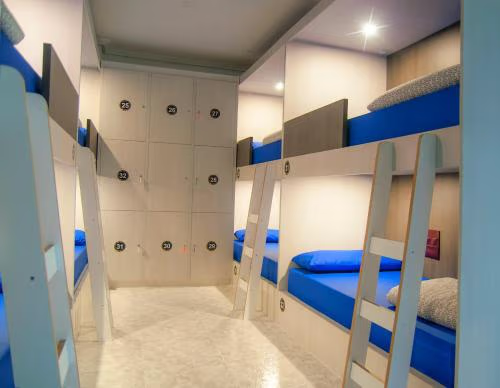 ClosedReservations accepted
Hostel Oceanus Finisterre
- Top #3
 OpenReservations accepted
Albergue de Sonia


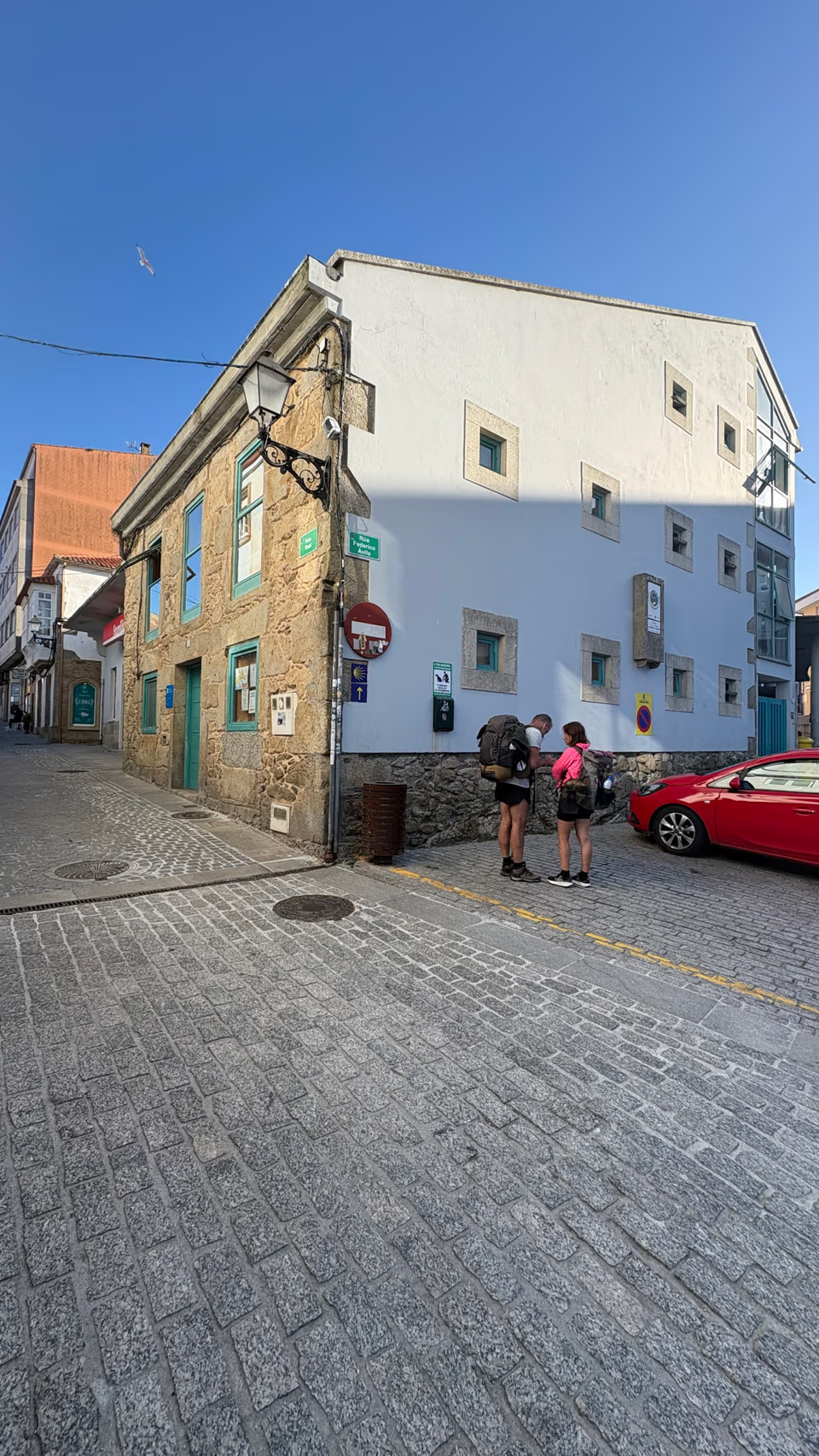

Services in Fisterra
What you can find in town before the next stage.
- ATM
- Café
- Shop
- Tobacco
- Medical clinic
- Pharmacy
- Fountain
- Post office
- Train station
- Bus station
- Restaurant
Source: © OpenStreetMap contributors · updated November 2025
Town 7 of 7
Continue along the Camiño a Fisterra
Fisterra is the last popular town on the Camiño a Fisterra.