

Town on the Camino
Cuba
Portugal
- places to stay
- 3
- Camino
- 1
- Elevation
- 170 m
Cuba is a small place in the Baixo Alentejo with a big claim: Columbus is said to have been born here, and since 2006 the seafarer has stood in bronze in the middle of the village. In the evening the taverns are worth a visit, with wine from clay amphorae and, with a bit of luck, cante. An afternoon is enough before it is 22.4 kilometres on to Alvito.
How long to stay?
An afternoon is enough, and the evening belongs to the taverns. After 20.3 kilometres from Beja you arrive in the early afternoon. The Columbus statue, the main church with its church treasury and a stroll through the village do not take long. What is special about Cuba begins later, when the taverns fill up. The church treasury is closed on Mondays and Tuesdays.
Cuba in Ninja numbers
- 196.0 kilometres is how far you have walked since Tavira, according to Camino Ninja, and 465.2 remain to Trancoso.
- 20.3 kilometres is the distance from Beja to here, and tomorrow it is 22.4 to Alvito.
- One and a half tonnes is the weight of the bronze statue of Columbus, put up in 2006.
- 1782 is when Cuba was raised to a vila, a market town, under Queen Maria I. The place is mentioned as early as the 13th century.
Arriving: from Beja via São Matias
The stage from Beja is flat and rural. Halfway lies São Matias, 12.9 kilometres from Beja, with a 16th-century church that has two gilded wooden columns and a folk-art altar. After that it is another 7.4 kilometres to Cuba. On the Via Nascente Cuba is a stage town with cafés, a small supermarket and a few places to stay. The Posto de Turismo is on the Largo Cristóvão Colombo, right by the statue.
In brief: a dome, an infante and a writer
The name probably comes from Arabic, from "qubba", the domed tomb of an ascetic or spiritual teacher. Similar place names are common in the south of Portugal. In the 13th century the place belonged to Beja, then to the Augustinian canons, and in 1305 the rights passed to King Dinis. In the first half of the 16th century Cuba belonged to the Infante Luís, who had a hunting lodge here, the Paço dos Infantes. In 1573 King Sebastião dined there. Of the house only a Manueline portal remains, and it now sits on the church of Nossa Senhora da Rocha.
The writer Fialho de Almeida lived and died in Cuba, in 1911. His house is among the sights that the region's route guide lists.
A seafarer from the Alentejo: what to see
- Columbus statue and Centro Cristóvão Colon: In the 1980s the researcher Mascarenhas Barreto put forward the thesis that Columbus was not a Genoese but a Portuguese, born in Cuba under the name Salvador Fernandes Zarco. That, he said, is why he named the Caribbean island of Cuba after his home village. In October 2006 Cuba received a bronze statue of the seafarer, a work by Alberto Trindade, weighing about one and a half tonnes: Columbus on a globe, a map in one hand, the other hand over his eyes. In 2011 a Columbus centre opened with pictures, books and maps on the thesis. We have not found opening times.
- Igreja Matriz de São Vicente and church treasury: According to the region's route guide the main church was rebuilt from 1572, the tiles date from 1665, and the parish speaks of the 17th century. The azulejo pictures show saints, altars and figures are from the 17th and 18th centuries. Since 2003 there has been a church treasury with finds, paintings, jewellery and textiles, the highlight being a 16th-century panel. According to the parish it is open Wednesday to Sunday, in summer from 10.30am to 2pm and 4pm to 7pm, in winter from 10.30am to 2pm and 3pm to 6pm, entry free. For you this is the best place to ask for a stamp; whether there is one, we did not find out.
- Igreja de Nossa Senhora da Rocha: A church from the 16th and 17th centuries. Look out for the Manueline portal: it comes from the hunting lodge of the Infante Luís, where the king dined in 1573.
- The taverns: According to the region's route guide Cuba has the largest group of traditional taverns in the Alentejo, and it recommends a round of them. There you get vinho de talha, wine matured in big clay amphorae, and with luck cante alentejano, the polyphonic singing that UNESCO has declared cultural heritage. You cannot book the singing, it happens when it happens. Go in the evening.
Honestly
- There is no pilgrim hostel. You sleep in a private guesthouse.
- The Columbus thesis is an outsider theory. According to official historiography Columbus was born in Genoa. Enjoy the statue, but do not take it as proof.
- On Mondays and Tuesdays the church treasury is closed. If you arrive on those days, you only see the main church if it happens to be open.
- Beyond Cuba a shortcut tempts you that is none. About two kilometres after the village a path turns off to the left at a sign "Toros de Nunez", but the arrows do not point that way. The path leads over private land, and signs warn of "gado bravo", aggressive cattle. Stay on the road.
Where pilgrims sleep
Cuba has no pilgrim hostel, municipal or church-run. There are a few private guesthouses and rooms in the village, which you will find in the app. Call ahead, because the choice is small.
Ninja tips
- Go to the taverns in the evening. You cannot order cante. If you want to hear it, just sit where the locals sit.
- Buy food in Cuba for tomorrow. It is 14.9 kilometres to Vila Ruiva. According to the region's route guide there is a café there to restock.
- Take a break in Vila Ruiva. Next to the chapel of Nossa Senhora da Represa lie the remains of a Roman dam, about 200 metres away. In the area there is also a Roman bridge with 26 arches and a length of 120 metres.
- Pass the Columbus story on if you visited the convent in Beja. The thesis names Duke Fernando of Beja as the seafarer's father, exactly the infante who founded the Convent of the Conception.
Onward: to Vila Ruiva and Alvito
From Cuba you walk on north through flat land with wheat fields. After 14.9 kilometres you reach Vila Ruiva, after 22.4 kilometres Alvito, where a castle awaits whose rebuilding began in 1481. The Roman road that once ran here cannot be walked, it now leads through private estates, which is why the Via Nascente runs on country roads and farm tracks.
What awaits you tomorrow
Alvito has a castle from the 13th century, rebuilt from 1481. Its keep has windows in the Mudéjar style, an echo of the Moorish south you have just come from.
Deep dive: The name that crossed the sea
A short read, in case you want to learn more about Cuba. About 2 minutes' reading.
A tomb under a dome
When you stand on the Largo Cristóvão Colombo, you stand in a place with a very old name. Cuba probably comes from the Arabic word qubba, dome. That is what the domed tomb of an ascetic or spiritual teacher was called. Such names are common in the south of Portugal, and they probably recall the Sufi movements that were alive here at the end of the Moorish period. So the place carries the tomb of a pious man in its name. For a pilgrim on the way to a tomb, that is not a bad start.
The seafarer
In the 1980s the researcher Mascarenhas Barreto claimed that Christopher Columbus was not born in Genoa but here, as Salvador Fernandes Zarco. He was supposedly a son of Duke Fernando of Beja, hid his origins and therefore named the island of Cuba after his birthplace. Barreto is said to have researched for fifteen years. Most historians do not follow him, for them Genoa remains the birthplace. Cuba has decided anyway. In October 2006 the village put up a bronze statue, and in 2011 a centre opened that explains the thesis.
A king as guest
Cuba had had high-ranking visitors before, and that is better documented. In the first half of the sixteenth century the place belonged to the Infante Luís, a son of King Manuel the First. He had a hunting lodge here, the Paço dos Infantes. In the year 1573 King Sebastião dined there, five years before he vanished in Morocco. Almost nothing of the house remains, only a portal in the Manueline style. It was moved to the church of Nossa Senhora da Rocha, and there you see it today.
What Cuba gives you
Whether Columbus was born here, you will not settle in Cuba. But you can see how much a small place likes to believe in a great story. And you can ask yourself how much of your own pilgrimage will in the end be history and how much truth. Probably both. In the evening, in the tavern, when someone starts to sing, it no longer matters.
Where to stay in Cuba
Places to stay in Cuba.
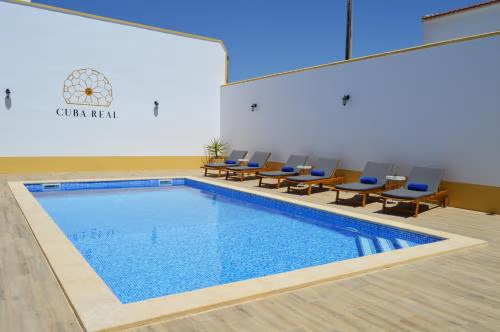 OpenReservations accepted
Cuba Real
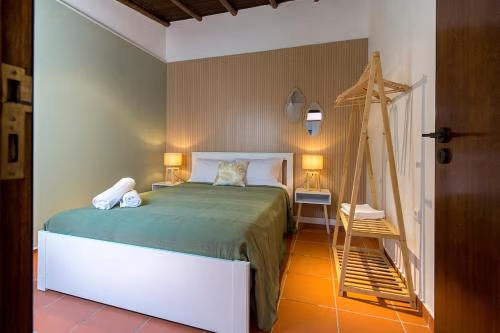 OpenReservations accepted
Casa Formosa
KitchenPlates & UtensilsClotheslineAnd more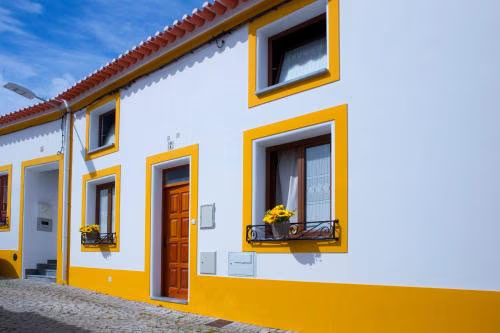 OpenReservations accepted
A Casa dos Girassóis
KitchenCooktopsMicrowaveAnd more
Town 6 of 25