

Town on the Camino
Donostia / San Sebastián
Gipuzkoa, Basque Country, Spain
- places to stay
- 17
- Caminos
- 2
- Elevation
- 3 m
San Sebastián is the breather between two hills: after more than 1,000 metres of climbing from Irún you come down Monte Ulía, and the next morning you head up Igeldo again. In between lie the Concha bay, an old town almost entirely destroyed in 1813 and rebuilt, and 825 kilometres to Santiago. Worth a rest day.
Right now in San Sebastián (as of October 2026)
- Pilgrim hostel: There is no year-round pilgrim hostel. The city's summer hostel in the Ikastola Claret (July and August) is listed in a hostel directory from August 2026 as "permanently closed" at the same time. Don't count on it, and plan for the youth hostel on Ulía or a private hostel.
How long to stay?
Worth a rest day. The stage from Irún over Jaizkibel and Ulía is hard, and afterwards you have a city with a beach, an old town, two hills of its own and a big museum in front of you. In an afternoon you can manage the old town and the churches. If you stay, you have time for the San Telmo museum, Urgull and the sunset at the end of the bay. Note: San Telmo is closed on Mondays.
San Sebastián in Ninja numbers
- 825.1 kilometres are still left from here to Santiago. From Bayonne it is 71.1 kilometres to this point, from Irún 25.6.
- 1,048 metres of ascent lie between Irún and San Sebastián according to our database, and almost as many back down. For a first day, that is a lot.
- 31 August 1813: On this day British and Portuguese troops plundered and destroyed almost the whole town inside the walls. Almost everything you see in the old town is younger.
- Around 835 metres separate the Basilica of Santa María from the Cathedral of Buen Pastor. The two churches look at each other across the whole city.
- 1902 is the year San Telmo opened, the oldest museum in the Basque Country, in a monastery dedicated to the patron saint of sailors.
Arriving: over Ulía into the bay
The day starts in Irún with the climb to the Santuario de Guadalupe and the long crossing of Jaizkibel. In Pasaia a small boat takes you across the harbour mouth, then it is up once more onto Monte Ulía. From there you descend into the city. Below lies the bay of La Concha, framed by Urgull on one side and Igeldo on the other. The old town huddles at the foot of Urgull, between the sea and the river Urumea.
In brief: a city that had to start again
San Sebastián was founded as a town in the Middle Ages by the kings of Navarre. Until 1863 the old town was surrounded by a wall. Its darkest day was 31 August 1813: in the war against Napoleon, British and Portuguese troops took the French-held town, plundered it and destroyed almost everything inside the walls. Only a few buildings survived, among them the church of San Vicente. The town was rebuilt, and the wall was later torn down to make room for the new city.
Today San Sebastián is one of the best-known cities in Spain, famous for its bay and its pintxos. For pilgrims it is the first big city on the Camino del Norte, a World Heritage route since 2015.
The bay between two hills
The Camino del Norte is a path of ups and downs, and San Sebastián shows this more clearly than almost anywhere else. You come in over one hill and leave over the next. In between lies a bay with a beach and a promenade. That makes the city a good place for a pause: here you may simply be a guest for a day before the path leads you back to the cliffs.
Between Urgull and the Concha: what to see
Most of it lies in the old town, within a few hundred metres.
- Basílica de Santa María del Coro: The Baroque church was built between 1743 and 1774 on the foundations of older churches. Its ornate façade carries Saint Sebastian, the city's patron, at the top. For pilgrims it is the first address: at the door you get credenciales and stamps (see Practical tips). Stand in front of the portal and look along Calle Mayor: at the far end, around 835 metres away, stands the cathedral.
- Iglesia de San Vicente: The oldest surviving building in the city, Gothic, built from 1507 to 1574. It is one of the few buildings left standing in 1813. If you want to see what San Sebastián looked like before the destruction, this is the place. Inside are an altarpiece from 1586 by the workshop of the sculptor Ambrosio de Bengoechea and a French organ by Cavaillé-Coll from 1868.
- Plaza de la Constitución: The square at the heart of the old town housed the town hall until the 1940s. Look at the balconies: they still carry numbers from the time when bullfights were held here.
- Museo San Telmo: A 16th-century Dominican monastery, dedicated to Saint Telmo, the patron saint of sailors. Later it was a barracks, since 1902 a museum, and in 2011 it reopened with a new extension at the foot of Urgull. It tells the history and society of the Basque Country, the very region you will walk through over the next days. Open Tuesday to Sunday from 10:00 to 20:00, closed on Mondays (as of October 2026). We have not found a reliable current admission price.
- Catedral del Buen Pastor: The neo-Gothic cathedral was consecrated in 1897 and stands in the new city that grew after the wall was torn down. You can also get a credencial and stamp in the sacristy.
Food and drink
The old town is considered one of the places with the most pintxo bars in the world. Instead of a pilgrim menu you eat at the counter here: a small bite here, another in the next bar.
Honestly
- There is no year-round pilgrim hostel. The youth hostel on Ulía costs around €25 to €29 and should be booked, and the summer hostel is uncertain. Expect to spend more than on most evenings along the way.
- The private hostels are expensive too. A dorm bed costs from about €27 to €32 (as of October 2026).
- You arrive tired. After more than 1,000 metres of climbing from Irún, many have no energy left for a stroll through town. One more reason to stay a day.
- The farewell is steep. The next morning it is straight uphill again, onto Igeldo and on up to 313 metres.
Where pilgrims sleep
The municipal Ulía youth hostel lies on Monte Ulía, a little over 100 metres from the Camino, so still before the city. It is open all year, has 54 places and costs €24.93 in the low season and €29.32 in the high season, bed linen included (as of October 2026). A credencial is required. Call the day before or when you set off from Irún to secure a place. The hostel is not in our database.
In the Ikastola Claret on Avenida de Navarra, the city used to open a pilgrim hostel during the summer holidays, with 60 places, by donation, without a kitchen. Whether it still exists in 2026 is unclear (see above). On Paseo de Ulía our database also lists the small Acogida of the Comunidad Doce Tribus with seven places and no fixed price. We know nothing more about it.
Otherwise there are private hostels in the centre and on the edge of town, dorm beds from about €27 to €32 (as of October 2026).
Ninja tips
- Book Ulía before you set off. The hostel itself advises calling the day before or when you leave Irún.
- Get your stamp at the door of Santa María. Stamps and credenciales are available there every day, but not during mass.
- Look at the axis. From the portal of Santa María you can see down Calle Mayor to the cathedral. Old and new city look at each other.
- Eat pintxos instead of a menu. In the old town the bar counter is the pilgrim menu.
- Go to the end of the bay for sunset. At the Peine del Viento, Eduardo Chillida's iron sculptures in the rock, the city ends in the sea.
- Don't plan San Telmo for a Monday. The museum is closed then.
Practical tips for pilgrims
- Credencial and stamps: in the sacristy of the Cathedral of Buen Pastor (10:30–12:30 and 17:00–20:00) and at the door of the Basilica of Santa María (10:30–19:30, Sundays from 13:30, closed during mass), as of October 2026.
- Pilgrim association: The Friends of the Camino de Santiago in Gipuzkoa have their office at Calle Urbieta 2, basement. Open Thursdays at 19:00 (October to March), Tuesdays and Thursdays at 19:00 (April to September). Phone +34 943 427281.
- Festivals: On 20 January, the day of the city's patron saint, the Tamborrada parades through the city with its drums.
Onward: over Igeldo to Orio and Zarautz
The path leaves the city heading west and climbs immediately, past Igeldo. The highest point of the day is at 313 metres, just under twelve kilometres beyond the city. Then it goes down to Orio, after 15.9 kilometres and 623 metres of ascent. If you keep going, you reach Zarautz after 21.5 kilometres in total with 787 metres of ascent. If you want to take it easy, stay in Orio.
Deep dive: The city that began twice
A short read, in case you want to learn more about San Sebastián. About two minutes' reading.
Between two hills
When you come down from Ulía, you see the whole city at once: the bay like a shell, Urgull with its fortress on one side, Igeldo on the other. In between, beach, promenade, houses. It is one of those places where you understand why people settle by the sea. For you, it is first of all the end of a long day.
A town on the edge
San Sebastián was founded in the Middle Ages by the kings of Navarre, as a port on the edge of their kingdom. The town grew between hill, river and bay, protected by a wall. The church of Santa María already stood in its place then, still Romanesque at the time. In the sixteenth century the Dominicans built a monastery and dedicated it to the patron saint of sailors. Later it became the San Telmo museum.
The day the town burned
At the beginning of the nineteenth century French troops held the town. In the summer of 1813 British and Portuguese soldiers besieged it, and on the thirty-first of August it fell. What followed was no liberation. The soldiers plundered and destroyed almost everything inside the walls. When it was over, only a few buildings of the old town were still standing, among them the church of San Vicente.
The inhabitants rebuilt their town, on the same streets, with new houses. Half a century later they tore down the wall and built a new city next to it, with a cathedral that looks straight at the old basilica. Walking through the old town today, you walk through a new beginning.
The path along the coast
Pilgrims were already travelling west along this coast in the Middle Ages. For a long time this path stood in the shadow of the Camino Francés. Since 2015 the northern routes have been World Heritage, and whoever comes over Jaizkibel and Ulía today descends into this bay at the end of the first day.
What San Sebastián gives you
You are only at the beginning. More than eight hundred kilometres lie ahead of you, and many of them go uphill. This city reminds you that you can start again even after destruction, on the same streets, with new houses. And before you walk on, it invites you to spend a day with nothing you have to do.
Where to stay in Donostia / San Sebastián
Places to stay in Donostia / San Sebastián.
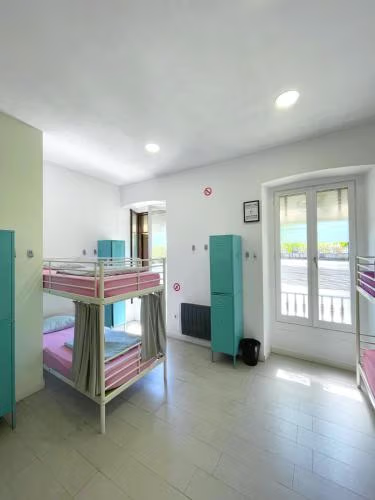 OpenReservations accepted
Downtown River Hostel
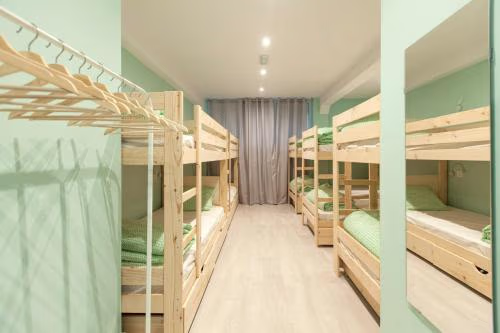 OpenReservations accepted
Balea Hostel
 Open
Acogida Comunidad Doce Tribus


Services in Donostia / San Sebastián
What you can find in town before the next stage.
- ATM
- Café
- Shop
- Tobacco
- Medical clinic
- Pharmacy
- Fountain
- Post office
- Train station
- Bus station
- Restaurant
Source: © OpenStreetMap contributors · updated February 2026
Town 4 of 49