

Town on the Camino
Einsiedeln
Switzerland
- places to stay
- 9
- Camino
- 1
- Elevation
- 881 m
Einsiedeln is the meeting point of the Swiss Ways of St James: since 934 a monastery has stood here above the cell of Saint Meinrad, and in the Chapel of Grace the Black Madonna awaits. Every day at 16:30 the monks sing the Salve Regina. Pilgrims sleep in the monastery from CHF 45 with breakfast, but can only reserve the evening before.
Right now in Einsiedeln (as of October 2026)
- Jubilee year "500 Years of Renewal": In 1526 the monastery had almost died out, then a new abbot came. The Stiftsbibliothek (abbey library) is showing an exhibition on this with manuscripts in which Huldrych Zwingli left notes. Monday to Saturday only with a guided tour, individuals without registration at 14:00 from the Tourist Office. Lectures on the subject on 25 October and 21 November, each at 17:30, CHF 5.
- Hofpforte closes earlier from November: From November to March the monastery gate closes at 18:30 instead of 19:00. If you arrive later, you sleep in a hotel.
- Panorama only until the end of October: The circular painting of the Crucifixion is open from Good Friday to October.
- New chapel of St. Gangulf: Abbot Urban opened it on 3 October 2026, and it has been open to the public since then.
How long to stay?
Worth a rest day, ideally on a weekday. Einsiedeln easily fills a second day: a tour of the monastery and abbey library (Monday to Saturday only), the Panorama and Diorama, the Schafbock at the baker's, plus Lauds, conventual Mass, Vespers and Compline with Gregorian chant. And tomorrow brings the Haggenegg, the highest pass on the Swiss Via Jacobi, which is easier to climb well rested. There is one catch: the monastery takes individual pilgrims for one night. For a second night you will probably need a room in the town.
Einsiedeln in Ninja numbers
- 91.7 kilometres beyond Konstanz lies Einsiedeln.
- 934 is when the monastery was founded, and the library in the same year. Both still exist today.
- 16:30, every day: Vespers and Salve Regina of the monks. It is the most important appointment of your day.
- 14 spouts has the fountain on the Klosterplatz. Pilgrims drink a sip from each.
- 1,414 metres high is the Haggenegg, which you cross tomorrow, 11.8 kilometres from here. It is the highest point of the Swiss Way of St James.
Arriving: over the Etzel to the Klosterplatz
From Rapperswil you come over the lake, the Etzel and the Teufelsbrücke (Devil's Bridge), past the Galgenchappeli into the town. Then the Klosterplatz opens up, one of the largest church forecourts in the world, with arcades, the Marienbrunnen (Mary Fountain) in the middle and the façade of the monastery church behind it. Einsiedeln lies at around 880 metres, and the last kilometres go gently downhill.
For pilgrims from Switzerland and southern Germany, Einsiedeln is traditionally the place of the first stamp, as the monastery itself writes. Stamps are available at the church gate (in the church at the front right), at the Hofpforte (gatehouse), in the monastery shop and at the Tourist Office at Hauptstrasse 85.
In brief: a hermit, a monastery, a Madonna
Around 835 the monk Meinrad moved from Reichenau into the dark forest behind the Etzel and lived there for 26 years as a hermit. On 21 January 861 two robbers killed him. Legend says that two ravens he had tamed pursued the murderers all the way to Zurich and betrayed them. The ravens are still in the monastery's coat of arms today. In 934 Eberhard, a former canon from Strasbourg, turned the community of hermits around Meinrad's cell into a Benedictine monastery.
In the late Middle Ages tens of thousands came for the feast of the Angelic Consecration in September, many from half of Europe, some going on to Rome or Santiago. In 1466 the present miraculous image came into the chapel. The Reformation almost ended the monastery, and in 1798 French troops dissolved it. Both times it came back. The baroque new building you see today was begun in 1704 to plans by Caspar Moosbrugger, and the Asam brothers painted and stuccoed it.
Meeting point for pilgrims
Einsiedeln is not only a destination, it was always also a starting point. In the Middle Ages pilgrims gathered here to move on together. The two main branches of the Via Jacobi, from Rorschach and from Konstanz, meet in Rapperswil or at the latest at St. Meinrad above Einsiedeln. And the baker on the Klosterplatz still sells a pastry that was expressly invented as provisions for pilgrims.
For you that means: here the first section ends for many, and here the way into the mountains begins. From tomorrow it goes over the Haggenegg to Lake Lucerne and on towards the Brünig.
Around the Chapel of Grace: what to see
Almost everything is on the Klosterplatz or a few steps away.
- Monastery church and Chapel of Grace: The church was consecrated in 1735. Around the old Chapel of Grace, Caspar Moosbrugger built an octagon, so that the chapel now stands in the middle of the church. Above it the ceiling painting shows the Angelic Consecration. In the chapel stands the miraculous image, a late Gothic Madonna of linden wood, 117 centimetres high, here since 1466. Her dark face comes, according to the monastery, from candle smoke, and after the French invasion it was deliberately painted black again during restoration. The Madonna has over 30 robes, which are changed regularly. The church is open daily from 6:00 (Sundays from 7:00) to 21:00. Photography is forbidden, and the church is not heated.
- Vespers and Salve Regina: Every day at 16:30 the monks sing Vespers in Gregorian chant in the monastery church, then they process to the Chapel of Grace and sing the Salve Regina there in several voices. If you do only one thing in Einsiedeln, do this.
- Pilgrim blessing: At 16:15 or after Vespers at the Sigismund altar, in the church at the front right. Otherwise you can approach a priest after a Mass.
- Stiftsbibliothek (abbey library): Founded in 934, around 230,000 books and 1,230 manuscripts, a baroque hall from 1716 to 1718. Access only with a tour: the public daily tour of church and library starts Monday to Saturday at the Tourist Office, lasts just under two hours and costs CHF 20 (approx. €21). In the jubilee year 2026 you will see the exhibition on 1526 on the tour.
- Marienbrunnen: The fountain of 1684 has stood in the middle of the Klosterplatz since 1753 and has 14 spouts. Many pilgrims drink a sip from all 14 spouts. The water comes from the area where Meinrad settled in 835.
- Panorama "Crucifixion of Christ": A circular painting of 1893 at Benzigerstrasse 36, with 1,000 square metres of canvas. From Good Friday to October Monday to Friday 13:00 to 17:00, at weekends 10:00 to 17:00, CHF 6 (approx. €6.40).
- Bethlehem Diorama: At Benzigerstrasse 23 stand around 450 carved nativity figures in a landscape of 80 square metres, since 1954. Admission CHF 9 (approx. €9.60), and anyone called Mary or Joseph gets in free. You will find opening hours on diorama.ch.
Eating and drinking
You should try the Einsiedler Schafbock: a honey gingerbread with a lying lamb on top, first mentioned in 1631 and originally baked as long-lasting provisions for pilgrims, including those going to Santiago. The bakery Goldapfel on the Klosterplatz has baked it in the Oechslin family since 1724, and in the Nostalgieladen (nostalgia shop) on Kronenstrasse it shows old baking moulds. For the jubilee year it has its own pilgrim pastry there for CHF 3.40.
In the monastery pilgrims can have dinner at 18:00 in the Küchenstübli for CHF 20 (approx. €21), and you must register by 16:00. In the arcades on the Klosterplatz shops sell regional products such as cheese and candles.
Honestly
- Reserving in advance is not possible. Individual pilgrims can only reserve the bed in the monastery the evening before by phone, or on arrival at the Hofpforte. With 13 beds and heavy demand there is no guarantee.
- If you arrive late, you sleep in a hotel. The Hofpforte closes at 19:00, in the winter half-year at 18:30.
- Einsiedeln is a mass pilgrimage site. Hundreds of thousands come every year, plus coach groups and day-trippers. On the Klosterplatz it is rarely quiet, but in the Chapel of Grace it is.
- The church is cold. It is unheated, in winter sometimes below five degrees. Keep your jacket on.
- The Josefsdörfli is not for you alone. The large accommodation of the Genossame Dorf-Binzen takes only groups of five or more, according to our research.
Where pilgrims sleep
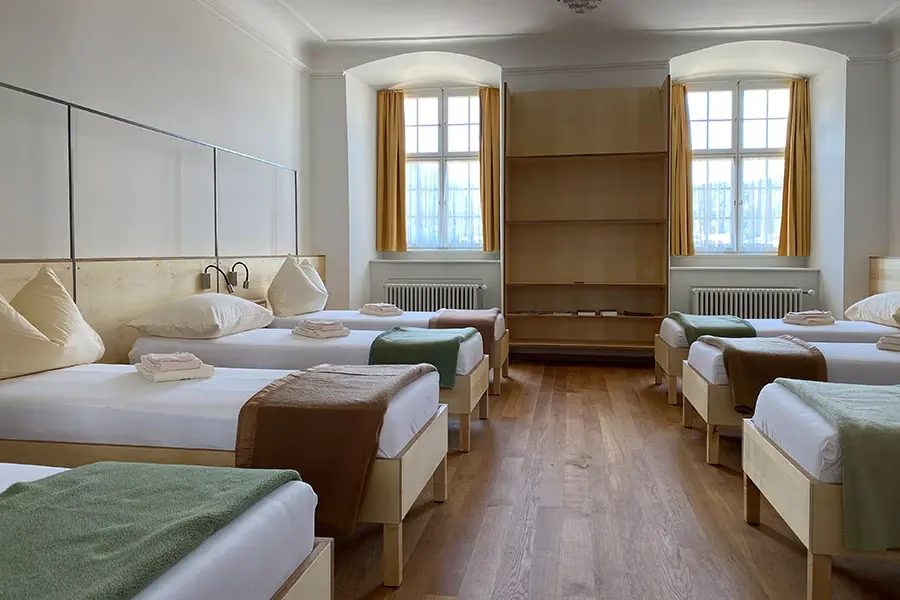
The Kloster Einsiedeln takes pilgrims of the Way of St James all year round, men and women. There are 13 beds: in an eight-bed room for CHF 45 (approx. €48), in a three-bed room for CHF 55 (approx. €59) and in a single room for CHF 60 (approx. €64), each with breakfast and tourist tax (as of October 2026). Shower and toilet are on the floor, and a hygiene sleeping bag liner is compulsory. Individual pilgrims cannot book in advance, "according to old custom": you call the evening before (+41 55 418 61 11) or ask on arrival at the Hofpforte. Breakfast is from 6:45 to 8:30 in the Hofspeisesaal (court dining hall).
If the monastery is full, the Tourist Office will help. The Hotel & Pilgerhaus Allegro has a simpler lodge with shower and toilet on the floor, and we did not find a pilgrim price. There is no donativo hostel in Einsiedeln.
Ninja tips
- Arrive before 16:00: Then everything works out: bed at the Hofpforte, registration for dinner by 16:00, pilgrim blessing at 16:15, Vespers and Salve Regina at 16:30, Mass at 17:30, dinner at 18:00.
- Call the evening before: That you cannot book earlier is no oversight but old custom. Call from Rapperswil.
- Drink from all 14 spouts: At the Marienbrunnen on the Klosterplatz, once all the way round.
- Schafbock for the Haggenegg: It was invented precisely for pilgrims on the way. Take one with you for tomorrow's climb.
- Library on weekdays only: You can only see the Stiftsbibliothek on a tour, and there is none on Sundays.
- Mary or Joseph? Then the Diorama costs you nothing.
- Look closely at the Haggenegg tomorrow: According to tradition, the chapel on the pass stands where the miraculous image was buried from the French in 1798.
When it rains
Einsiedeln is wet. In October an average of around 115 millimetres of rain falls here, significantly more than in Zurich (MeteoSwiss normal values 1991–2020).
- Monastery church: daily from 6:00 (Sundays from 7:00) to 21:00, with services at almost any time of day. But: unheated.
- Tour of monastery and Stiftsbibliothek: Monday to Saturday from the Tourist Office, CHF 20 (approx. €21). In 2026 at 14:00 with the jubilee exhibition.
- Panorama "Crucifixion of Christ": until the end of October, weekdays 13:00 to 17:00, at weekends 10:00 to 17:00.
- Lecture on the 1526 jubilee: 25 October and 21 November 2026, 17:30, CHF 5.
Practical tips for pilgrims
- Services on weekdays: 6:15 and 9:30 Mass in the Chapel of Grace, 7:15 Lauds, 11:15 conventual Mass, 12:05 midday prayer, 16:30 Vespers and Salve Regina, 17:30 Mass, 20:00 Compline.
- Services on Sundays: 7:15 Lauds, 9:30 conventual Mass, 11:00 pilgrim Mass, 16:30 Vespers and Salve Regina, 20:00 Compline (on the first Sunday of the month at 19:00).
- Confession: daily 17:00 to 18:00 in the Confession Church, front left.
- Pilgrim passport: in the monastery shop or by email from the Via Jacobi 4 association (secretariat@viajacobi4.ch).
- Clothing: In the church, shoulders should be covered.
- Train: Einsiedeln has had a rail connection to Wädenswil on Lake Zurich since 1877.
Onward: over the Haggenegg to Schwyz and Brunnen
Tomorrow it gets serious. From the monastery you go southwest, past the Benedictine convent of Au to Trachslau and through the Alptal to Alpthal. Beyond the Malosenbrücke the path climbs steeply to the Haggenegg at 1,414 metres, 11.8 kilometres from Einsiedeln. At the top stand a mountain inn and two chapels. Then it is about eight kilometres down to Schwyz (17.8 kilometres from Einsiedeln) and on via Ibach, the Muota and past Ingenbohl monastery to Brunnen on Lake Lucerne (22.9 kilometres). This section is recommended only in good weather. In spring there may still be snow on the Haggenegg.
What awaits you tomorrow
Depending on your strength, you end in Schwyz or in Brunnen. On the way there you cross the Haggenegg, where according to tradition the Black Madonna was hidden in the ground in 1798. In the evening you then stand at Lake Lucerne, and from Brunnen the boat takes you across to Treib or Beckenried.
Deep dive: The hermit and the Madonna
A long read, in case you want to learn more about Einsiedeln. About seven minutes' reading.
A square that makes you small
When you stand on the Klosterplatz, you have the façade of the monastery church in front of you. The arcades embrace you from both sides, in the middle the fountain splashes with its fourteen spouts, and above it all stand the two towers. The square was laid out in the middle of the eighteenth century, and it is built for crowds. And yet the story of this place begins with a man who wanted to be alone.
Meinrad in the dark forest
Meinrad was born towards the end of the eighth century in the Sülchgau, in what is now Württemberg, probably into an Alemannic noble family. He came early to the monastery school of Reichenau on Lake Constance, became a monk and priest there, and later headed a small school of the monastery on Lake Zurich. Then, around 828, he left. First he built himself a cell at the Etzel Pass, where the chapel of St. Meinrad stands today, which you passed yesterday. Around 835 he moved deeper into the forest, which was then called the dark forest. With the help of an abbess he built a new cell there. Twenty-six years he lived here.
He did not remain entirely alone. People sought him out to ask for advice, to ask for help, to pray. That is how the monastery tells it, and it expressly calls this a legend. On 21 January 861 two men came who were looking for something else. They believed pilgrims had left treasures with the hermit. They killed him. That is why Meinrad is still called a martyr of hospitality. He died because he had kept his door open.
The ravens
Then the legend begins. Meinrad had tamed two ravens, and the ravens pursued the murderers. They flew after them all the way to Zurich and made noise until the people took notice and arrested the men. Whether that is how it was, nobody knows. But the ravens have remained. They are in the monastery's coat of arms, they hang on the inn sign of St. Meinrad on the Etzel, and you will find them in many places in Einsiedeln once you start looking. Meinrad's body was taken to Reichenau and only came back in the eleventh century. His skull is still carried in a procession once a year, on Meinrad Sunday in October.
From a cell to a monastery
After Meinrad's death the cell did not stand empty for long. At the beginning of the tenth century hermits settled there again, among them Benno from Strasbourg. In 934 Eberhard, a canon of the same city, came and turned the hermits into a Benedictine monastery. He built church and monastery and became the first abbot. In the same year the library was founded, which still exists today. The name of the place recalls the beginning: Einsiedeln, the settlement of the hermits. And Meinrad's cell became the chapel from which the Chapel of Grace later emerged.
The night of the angels
About this chapel the second great story of Einsiedeln is told. In the year 948 Bishop Conrad of Konstanz was to consecrate the church and the Meinrad chapel. In the night before the consecration, so it is said, he saw Christ himself consecrate the chapel with angels. When he wanted to begin in the morning, a voice told him that the chapel had already been consecrated by God. This is the Angelic Consecration, and it is still celebrated on 14 September, with a procession of lights across the Klosterplatz in the evening.
The story has a catch, and the monastery does not hide it. It appears in the sources only in the twelfth century. A papal document that is meant to confirm the miracle and supposedly dates from the year 964 is regarded by historians as a forgery of the twelfth century. It was a time when the monastery was quarrelling with its bailiffs and needed good arguments. Whether the angels came that night, you can decide for yourself. That the story brought people here is certain.
Tens of thousands in autumn
From the fourteenth century Einsiedeln became one of the great pilgrimage sites of Europe. Tens of thousands came for the Angelic Consecration, drawn by indulgences, from half of Europe. Some went on afterwards to Rome, some to Santiago. Pilgrims gathered here to continue together. For many, Einsiedeln was therefore what it is for you today: the first great goal and the beginning of the real Way.
In 1464 a fire destroyed the Marian statue of the time. Two years later, in 1466, a new one came into the chapel, a Madonna of linden wood, carved in southern Germany, a good metre tall. She holds the child in her arm, and she is the one you see today.
Almost the end
In the early sixteenth century a young priest named Huldrych Zwingli worked in Einsiedeln. There he criticised how indulgences were handled. A few years later he was the reformer of Zurich. The Zurich pilgrimages stopped, and the monastery emptied. In 1526 only the old abbot was left, eighty-six years old. Then Schwyz stepped in, the protecting power of the monastery, and installed a monk from St. Gallen as the new abbot, Ludwig Blarer. With him the renewal began. Five hundred years later, in 2026, the monastery celebrates this jubilee, and in the library lie manuscripts with Zwingli's own notes.
The baroque
In the seventeenth and eighteenth centuries the monastery did well, and it rebuilt itself. In 1704 the foundation stone was laid to plans by Caspar Moosbrugger, a lay brother of the monastery from Vorarlberg. His boldest idea: he left the old Chapel of Grace standing and built the new church around it, into an octagon. Since then the chapel has stood in the middle of the church space, like a house within a house. From 1725 the brothers Cosmas Damian and Egid Quirin Asam from Munich painted and stuccoed the interior. In 1735 the church was consecrated. A few years later the square in front was laid out, with arcades and the fountain in the middle.
The Madonna on the run
In 1798 French troops marched into Switzerland. In May they reached Einsiedeln, ended the princely abbey and tore down the Chapel of Grace. The monks had hidden the miraculous image in time. A flight began that the monastery itself describes as adventurous and that led as far as the Mediterranean. On the Haggenegg, which you cross tomorrow, stands a chapel that, according to tradition, is built on the spot where the Madonna was buried then. The altarpiece there shows the scene.
When the statue came back, it was restored. Her face and hands had turned dark over the centuries from the smoke of candles and lamps. During the restoration they were deliberately painted black again, just as the pilgrims knew their Madonna. In 1803 the monastery was restored, and by 1818 the Chapel of Grace was rebuilt, as far as possible with the stones of the old one.
Robes and prayers
Today the Madonna owns over thirty robes, the oldest about four hundred years old. Many of them are gifts from people whose prayers were answered. The robes are changed about every two weeks. In 1934, for the monastery's thousandth birthday, she was solemnly crowned. Fifty years later, in 1984, Pope John Paul the Second visited Einsiedeln and consecrated the new altar.
Today
When this text was written, in autumn 2026, about forty monks lived in Einsiedeln. Abbot Urban Federer had been re-elected the year before, as the first abbot in the monastery's history to be elected a second time. Every year hundreds of thousands come, pilgrims, believers, tourists, coach groups. And every afternoon at half past four the monks process from the choir to the Chapel of Grace and sing the Salve Regina, no matter who is listening.
What Einsiedeln gives you
Meinrad went into the forest to be alone, and became the beginning of a place to which millions came. He died because he let someone in. If you sleep in the monastery tonight without having booked beforehand, simply because you knocked, then that is the same open door. And tomorrow morning, with a Schafbock in your backpack, you walk on, like the pilgrims who gathered here six hundred years ago.
Where to stay in Einsiedeln
Places to stay in Einsiedeln.
 OpenReservations accepted
Kloster Einsiedeln - Gästebereich & Wallfahrt
 Open
Genossame Dorf-Binzen Josefsdörfli
 OpenReservations accepted
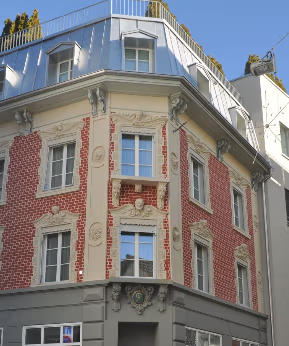
Bed and Breakfast Tulipan


