Town on the Camino
Rapperswil-Jona
Switzerland
- places to stay
- 21
- Caminos
- 3
- Elevation
- 415 m
In Rapperswil you walk across the lake: an 841-metre wooden boardwalk leads to where the pilgrim bridge to Einsiedeln stood from 1358 to 1878. In the old town, volunteers run a pilgrim hostel with twelve beds for CHF 25, cash only and for one night only. Three Ways of St James meet here, and tomorrow Einsiedeln awaits.
Right now in Rapperswil (as of October 2026)
- Pilgrim hostel closes on 31 October: The season runs from 1 April to 31 October. From November to March the phone is not staffed, but the contact form on pilgerherberge.ch works all year.
- Boardwalk with fungal rot: A fungus is eating away at the oak piles of the boardwalk to Hurden. The renovation is expected to cost CHF 4.1 to 6.9 million, and the town council wants to submit a planning credit by the end of 2026. No closure has been announced so far.
- Castle closed on 1 November: On All Saints' Day the castle museum is closed.
How long to stay?
An afternoon is enough, and the hostel doesn't allow more anyway. It takes pilgrims for one night only and opens at 16:00. If you arrive early, you can fit in the old town with the castle, the town church and the rose gardens, and in the evening you can still walk out onto the boardwalk. If you want to see more, plan your castle visit: the museum is closed on Mondays.
Rapperswil in Ninja numbers
- 841 metres long is the wooden boardwalk to Hurden, the longest wooden boardwalk in Switzerland.
- 74.8 kilometres beyond Konstanz lies Rapperswil. It is another 16.9 to Einsiedeln.
- 520 years, from 1358 to 1878, pilgrims crossed Lake Zurich here on a wooden bridge. Then came the Seedamm causeway, and the bridge was torn down.
- 3 Ways of St James come together in Rapperswil: the Via Jacobi from Konstanz, the Via Jacobi from Bregenz and the Schaffhausen-Zurich Way.
- CHF 25 (approx. €27) is what a bed in the pilgrim hostel costs with a pilgrim passport (as of October 2026). Cash, in Swiss francs.
Arriving: at the lake for the first time
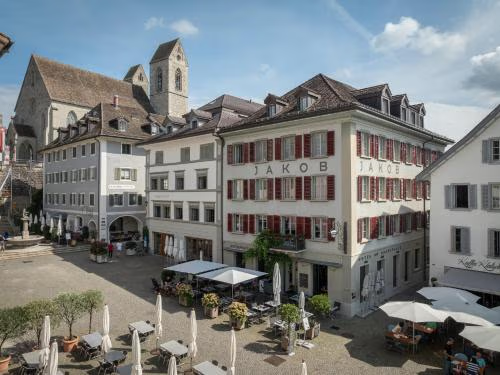
From Steg you come via Büel and Blattenbach, already seeing Lake Zurich below you, and walk around Rüti down to Rapperswil. The old town lies on a peninsula, the castle sits enthroned above, and the boardwalk begins down at the harbour. Rapperswil has been one municipality with Jona since 2007 and is an S-Bahn hub, and on fine days many day-trippers come from Zurich.
In brief: a town at the bridge
The Counts of Rapperswil founded the town in the years after 1220, on the traffic axis to the Gotthard. It is first mentioned in 1229. In 1350 the people of Zurich destroyed town and castle, and in 1354 Duke Albrecht II of Habsburg bought the lordship and rebuilt both. His son Rudolf IV had a wooden bridge built across the lake from 1358 to 1360. It made Rapperswil the gateway to Einsiedeln.
After that the town often changed sides: an imperial city in 1415, then Habsburg again, and from 1464 under the protection of the Inner Swiss cantons. The Capuchins came in 1606, and the Canton of St. Gallen in 1803. In 1870 the Polish Count Władysław Broel-Plater rented the castle and founded a Polish national museum.
The boardwalk: across the lake like the pilgrims
For you, the boardwalk is the heart of Rapperswil. There were already bridges across the lake here in the Bronze Age, and archaeologists have found piles from four millennia. The medieval bridge was 1.45 kilometres long and stood on 564 oak piles. The planks were deliberately laid loose, so that a storm could carry them away without destroying the whole bridge. For pilgrims it was a wobbly pleasure.
In 1878 the Seedamm causeway for rail and road was finished, and the old bridge was pulled down. For 123 years pilgrims had to walk along the causeway, next to the cars. On 6 April 2001 the new wooden boardwalk opened, almost on the same spot as the old bridge. Since then you walk across the water to Einsiedeln again, past the little Heilig Hüsli (Holy Little House), which already stood there in the Middle Ages for the pilgrims on the bridge.
From the harbour to the castle: what to see
The old town is small, and everything is within a few minutes' walk.
- Rapperswil–Hurden boardwalk: 841 metres of oak on 233 piles, opened in 2001. It replaces the pilgrim bridge of 1358 almost on the same spot, and the Via Jacobi leads straight across it from the harbour. It can be walked at any time and costs nothing. Go out there in the evening. Tomorrow morning you will cross it once more, this time with your backpack.
- Heilig Hüsli: The little stone house on a base in the lake is a bridge chapel. A wooden prayer house is first mentioned in 1485, and the stone building you see today dates from 1551. Pilgrims on the old bridge prayed here. After 1878 the chapel stood alone in the lake, and since 2001 you can reach it again via the boardwalk. Inside, you can only see through the grille on the east side.
- Liebfrauenkapelle Hurden: The chapel of 1497 stood at the end of the old bridge on the Schwyz side. Because the path was later moved to the landward side of Hurden, most pilgrims walk past it today. For the detour, after the boardwalk you leave the waymarked path at the information boards on the Frauenwinkel nature reserve, turning left towards the lake, and follow the sign to Restaurant Rössli. The chapel is open.
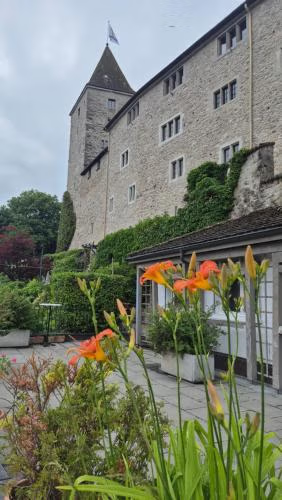
- Rapperswil Castle: The castle of the Counts of Rapperswil from the early 13th century has been a history museum covering more than 700 years since 2024, with a focus on the Habsburgs and the Poles. Tuesday to Sunday 10:00 to 17:00, admission CHF 14 (approx. €15). On the terrace stands the Polish Freedom Column.
- Stadtpfarrkirche St. Johann (town parish church): Right next to the castle. The building goes back to a Romanesque church of around 1220, and after a fire it was rebuilt by 1885. Next to it stands the Liebfrauenkapelle of 1489 with a view of the bay. We did not find opening hours.
- Capuchin monastery: At the Endingerhorn, the plain church dates from 1606. Today an ecumenical community in Franciscan spirituality lives here, the "Kloster zum Mitleben" (monastery for living along). If you want to stay longer, you can live along for a few days. The crypt chapel opposite the church was built by an abbot of Einsiedeln.
- Rose gardens: Rapperswil calls itself the Rose Town, and from May to October more than 20,000 roses bloom. The garden on the Schlossberg and the fragrant rose garden on the roof of the Schanz car park are open all year, and the rose names there are also given in Braille.
Eating and drinking
The hostel offers no meals, but it has a small kitchenette with a double hotplate. A small supermarket is within walking distance. On the Hauptplatz and at the harbour there are many restaurants geared to day-trippers from Zurich. We did not find a speciality you simply must have eaten here.
Honestly
- The hostel is strict. One night only, only twelve beds, only cash in Swiss francs, arrival between 16:00 and 19:00, no meals. In winter it is closed.
- The Polish museum is no longer in the castle. It had to move out in 2022 and has since worked only in reduced form. Older guidebooks are no longer correct here.
- The youth hostel is out of town. It is in Busskirch, according to Zurich Tourism 20 to 30 minutes on foot from the old town.
- The boardwalk is sick. A fungus is eating the piles. It is still open, but construction work is coming in the next few years.
- It gets crowded at weekends. Rapperswil is a day-trip destination for Zurich.
Where pilgrims sleep
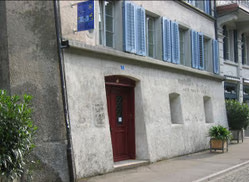
The Pilgerherberge Rapperswil is at Seestrasse 5 in the old town, by its own account near the town's former pilgrim hospice. Former pilgrims of the Way of St James founded it, today it is run by an association of around 200 members, and about 40 volunteers take turns as hospitaleros. One dormitory with twelve beds, two showers, a common room, Wi-Fi. With a pilgrim passport you pay CHF 25 (approx. €27), without one CHF 35 including a new passport, and children up to 16 pay CHF 15. You can rent a sleeping bag for CHF 3 (as of October 2026). It is open from 1 April to 31 October, with arrival between 16:00 and 19:00. If you come later, call the hospitalero. Reservation is online, and the confirmation arrives by email within twelve hours.
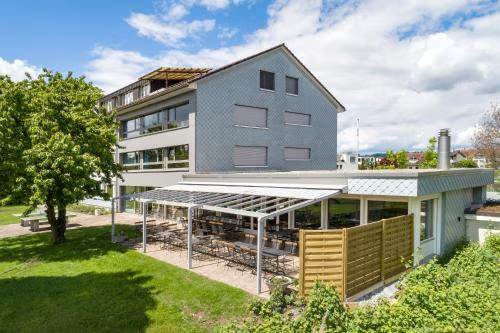
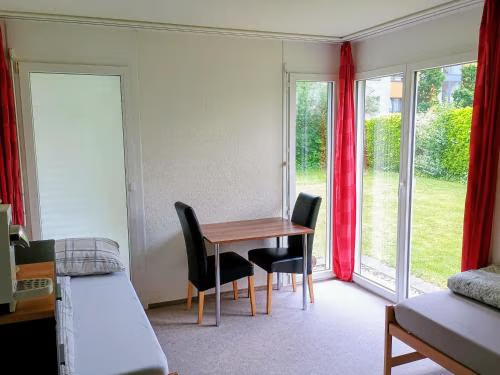
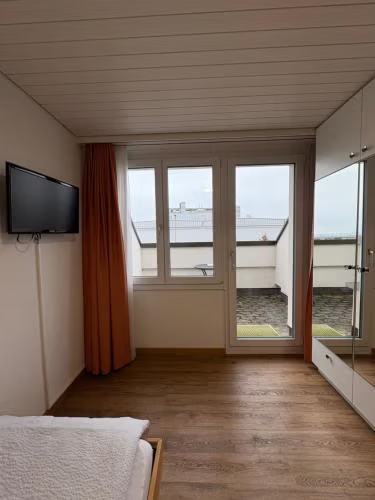
There is also the Jugendherberge Rapperswil-Jona in Busskirch and a few private rooms in Jona, for example with Erika Iten. There is no donativo or parish hostel in Rapperswil.
Ninja tips
- Bring cash: At the hostel you can only pay in cash in Swiss francs. Get money beforehand.
- A coin for the Heilig Hüsli: Pilgrims throw a coin through the grille on the east side of the chapel.
- Detour to the chapel in Hurden: After the boardwalk, left towards the lake, sign "Rössli". A few minutes, and you are standing at the old end of the pilgrim bridge.
- Castle and museum have different closing days: The castle is closed on Mondays, the town museum on Mondays and Tuesdays. By the way, the original altar from the Heilig Hüsli is in the town museum.
- Check your spam folder: The hostel's confirmation comes by email and likes to end up in spam.
When it rains
In October it rains on about ten days at Lake Zurich (MeteoSwiss normal values 1991–2020, Wädenswil station).
- Rapperswil Castle: Tuesday to Sunday 10:00 to 17:00, CHF 14 (approx. €15).
- Rapperswil-Jona Town Museum: in the Breny house of 1492 on the Herrenberg, with a residential tower of 1355. Wednesday to Friday 14:00 to 17:00, Saturday and Sunday 11:00 to 17:00, CHF 6 (approx. €6.40).
Practical tips for pilgrims
- Train: Rapperswil is an S-Bahn hub with connections to Zurich and, with the Voralpen-Express, to St. Gallen and Lucerne.
- Pilgrim passport: If you don't have one, you get one at the hostel, and it is included in the price of CHF 35.
- Other routes: Here the Via Jacobi from Bregenz and the Schaffhausen-Zurich Way end. From Rapperswil all of them continue together on the Via Jacobi to Einsiedeln.
Onward: across the lake and over the Etzel to Einsiedeln
It is 16.9 kilometres to Einsiedeln, and they are demanding. From the harbour you cross the boardwalk to Hurden and on to Pfäffikon. Beyond it a steep climb begins through sunken lanes via Luegeten to the Etzel Pass. At St. Meinrad at 947 metres, Saint Meinrad, according to legend, had his first cell. The chapel of 1698 tells his story in frescoes, and the inn has a signboard with Meinrad and the ravens. Then it goes down to the Teufelsbrücke (Devil's Bridge) near Egg, where Paracelsus was born in 1493, and on to Einsiedeln. A large part of the stage runs on roads.
What awaits you tomorrow
Einsiedeln is the goal this Way has been heading for since Konstanz. A monastery that has stood on the same spot since 934, a Black Madonna in a chapel in the middle of the church, and every afternoon at 16:30 the monks' Salve Regina. If you set off early tomorrow, you will arrive in good time.
Deep dive: Four thousand years across the lake
A short read, in case you want to learn more about Rapperswil. About four minutes' reading.
The narrowest point
Between Rapperswil and Hurden, Lake Zurich is narrow and shallow. Anyone who wanted to go from north to south had to cross the water here. The people of the Bronze Age already knew that. Archaeologists have found remains of bridges in the shallow water, the oldest from around 1700 before Christ. Others date from the Iron Age, from Roman times under Emperor Marcus Aurelius and from the early Middle Ages. The sites are now part of the World Heritage of the prehistoric pile dwellings around the Alps.
A town at the crossing
Around 1220 the Counts of Rapperswil built their castle on the peninsula and a town beside it. It lay on the traffic axis to the Gotthard. In 1350 the people of Zurich destroyed town and castle. Four years later Duke Albrecht the Second of Habsburg bought the lordship and had both rebuilt. His son, Duke Rudolf the Fourth, then did the decisive thing: between 1358 and 1360 he had a wooden bridge built across the lake, about one and a half kilometres long, on 564 oak piles. Before that, ferries had carried people across.
Loose planks
The bridge was part of the pilgrim route to Einsiedeln and on to Santiago. It was not comfortable. The planks were not nailed down but lay loose on the beams. There was a reason for that: when a storm swept across the lake, it was meant to take the planks and not the whole bridge. For pilgrims that meant walking over the water on wobbling planks. Halfway across stood a small chapel, the Heilig Hüsli. It is first mentioned in 1485, then still made of wood, and in 1551 it was rebuilt in stone. There you could pray before going on.
The causeway and the silent chapel
The bridge lasted a good five hundred years. In 1878 the Seedamm causeway was finished, carrying railway and road across the lake. The old bridge was no longer needed and was torn down. The Heilig Hüsli remained standing, alone in the water, with no path to it. Pilgrims now walked along the causeway, next to the trains.
The new boardwalk
More than a hundred years later came the idea of building a footpath across the water again. In August 2000 the builders drove the first piles into the lake bed, and on 6 April 2001 the new wooden boardwalk opened: 841 metres long, made of oak, almost on the same spot as the old bridge. Since then you can reach the Heilig Hüsli again too. When this text was written, in autumn 2026, a fungus had infested the oak piles, and the town was planning the renovation. So the new boardwalk also needs care, like the bridge before it.
What Rapperswil gives you
Tomorrow morning you walk across a lake that people have been crossing at this spot for four thousand years. One day before Einsiedeln, the water lies between you and the goal, and you walk across it.
Where to stay in Rapperswil-Jona
Places to stay in Rapperswil-Jona.
 Open
Pilgerherberge Rapperswil
 Open
Erika Iten
- Open
Oase am Sonnenberg - Reichmuth Marianna