

Town on the Camino
Évora Monte
Portugal
- places to stay
- 5
- Camino
- 1
- Elevation
- 365 m
Évora Monte is a village under a tower you can see from up to 60 kilometres away. Its outer walls are carved with stone ropes and knots, the emblem of the Dukes of Bragança, and in 1834 a civil war ended here with a treaty. For pilgrims it is the end of a very long stage from Évora: an afternoon is enough.
How long to stay?
An afternoon is enough, but make time for the castle hill. You arrive after 47.5 kilometres from Évora, or after a split stage, and the next day there are 25.3 kilometres to Estremoz ahead of you. Everything Évora Monte has to offer sits close together up top: the tower, the wall with the village inside it, the parish church and the pillory. According to one pilgrim guide, the path itself doesn't go up to the castle. An afternoon is enough for the climb and the view, if your legs are still willing.
Évora Monte in Ninja numbers
- 47.5 kilometres is what Camino Ninja measures from Évora to here, with no popular town in between. Along the way you pass Nossa Senhora de Machede, São Miguel de Machede and, 10.7 kilometres before Évora Monte, Azaruja.
- Kilometre 312.3 of the Via Nascente. Tomorrow you pass the halfway point of the route from Tavira to Trancoso, 18.3 kilometres beyond the village.
- 60 kilometres is how far away the tower is said to be visible. So you will probably have had it in front of you for a long time before you arrive.
- 26 May 1834: On this day the convention was signed in Évora Monte that ended the civil war between Liberals and Miguelists.
Arriving: under the tower with the knots
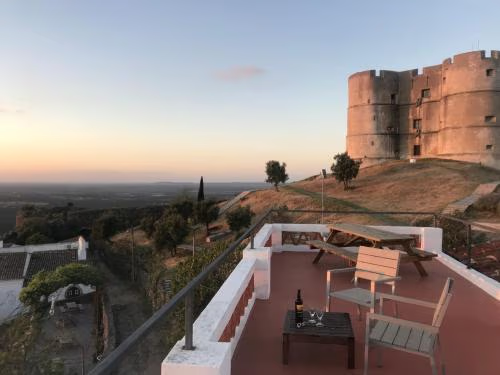
You come in from Évora heading north-east, and at some point the tower appears on its hill above the plain. The castle sits on the edge of the Serra d'Ossa and looks out over the municipality of Estremoz. Below lies the village on the path; up on the hill stands the old walled enclosure with white houses and cobbled lanes. Évora Monte is now a parish in the municipality of Estremoz, and 569 people lived here in 2011.
The place used to be more. Until 1855 Évora Monte was itself the seat of a municipality with five parishes, then it was dissolved and split between Estremoz, Évora, Arraiolos and Redondo. What remains is the tower, which looks far too big for a village of this size.
In brief: knots of stone
Afonso III granted Évora Monte its town charter in 1248, and in 1306 King Dinis had the place fortified. After the change of throne to João I, castle and lands passed to the commander Nuno Álvares Pereira, who later handed them on to his grandson. That is how they became the property of the House of Bragança.
The tower you see today dates from the 16th century. An earthquake destroyed the medieval keep in 1531, and the Dukes of Bragança had a new one built. Which duke that was, Jaime or his successor Teodósio, the sources don't agree. It is just as unclear who designed it: the Arruda family of master builders, who also gave us the Tower of Belém, are named, but there is no document for it. The building is a rectangle with round towers at the corners, three storeys high, separated by cornices carved like ropes. On the outside sits a knot of stone, the emblem of the Bragança. With it goes their motto "Depois de Vós, Nós": after you, meaning after the king, come we. In Portuguese, "nós" means both "we" and "knots".
The Convention of 1834: a knot comes undone
From 1828 to 1834 two brothers fought over the crown in Portugal: Miguel for absolute monarchy, Pedro for his daughter Maria II and a constitution. On 26 May 1834 the convention was signed in Évora Monte that ended the Liberal Wars. Miguel had to go into exile. In the village the Casa da Convenção recalls the treaty, and the entrance to the castle is on the Rua da Convenção too. For a pilgrim this is a rare place: here a war ended not with a battle but with a signature.
On the castle hill: what to see
Everything worth seeing lies close together up top, inside the walls. We haven't measured exactly how far the detour from the path is; the path itself stays down below.
- Castelo de Évora Monte: A national monument since 1910 and now run by the state. Inside, on the first floor, an oval vault on four columns roofs a great hall, and a spiral staircase in the western towers links the storeys. The real reason for the climb is the view over the plain you have come through, and over the one you will cross tomorrow on the way to Estremoz. One pilgrim guide calls the detour a must. According to a 2018 source, the tower was open on Tuesdays from 2 to 5 pm and Wednesday to Sunday from 10 am to 1 pm and 2 to 5 pm, closed on Mondays, and entry cost €1.50 (as of 2018). We haven't found current times.
- Igreja Matriz and pillory: The parish church is dedicated to Nossa Senhora da Conceição and is plain inside. Next to it stands a pillory in the Manueline style, a sign that Évora Monte was once a seat of justice and administration. We haven't found Mass times.
- Casa da Convenção: The house commemorates the treaty of 1834. Whether and when it is open, we haven't found out.
- The lanes within the wall: Cobblestones, whitewashed houses with coloured stripes around the windows, old wooden doors. No entry fee, no opening hours, just a short stroll as far as the wall.
Honestly
- The stage from Évora is very long. Hardly anyone manages 47.5 kilometres with no popular town in between in a single day. If you want to split it, look at Azaruja, 10.7 kilometres before Évora Monte; whether there is a bed there, we haven't checked.
- The castle hill takes effort. The path stays down below, the castle is up above. After a long day that is a climb you think twice about. It is worth it all the same.
- On Mondays you probably won't get into the tower. At least that was the case in 2018. If you arrive on a Monday, you are left with the view from the wall.
- We found nothing reliable on food shops in the village. Stock up in Évora or on the way and carry enough water; the Alentejo is hot in summer.
Where pilgrims sleep
There is no pilgrim hostel in Évora Monte. You can stay in several private guesthouses in the village and on the castle hill, one of which, according to a pilgrim guide, is the only accommodation inside the walls. Book ahead.
Ninja tips
- Go up today, not tomorrow morning. Tomorrow you want to get to Estremoz, and the detour costs time. If you want to see inside the tower, be up there before 5 pm; at least that is how the times were in 2018.
- Look for the knot on the outer wall. Once you know the Bragança motto, you see the tower differently: a ducal house carved itself into stone here as "we".
- Celebrate the halfway point tomorrow. 18.3 kilometres beyond Évora Monte you will have done half of the Via Nascente. Estremoz, 25.3 kilometres further on, is a good place for a rest day.
Onward: to Estremoz
From Évora Monte you continue north-east on the Via Nascente, 25.3 kilometres to Estremoz. According to Camino Ninja there is no other town in between, so take water and provisions with you. In Estremoz the route from Badajoz joins the Via Nascente.
What awaits you tomorrow
Tomorrow you walk into the town where a queen with a pilgrim's staff ended her last journey. In Estremoz Isabel died in 1336, eleven years after her pilgrimage to Santiago, and she was buried with a pilgrim's staff and bag. If you arrive on a Saturday, you will also find one of the biggest markets in the Alentejo on the Rossio.
Deep dive: After you, us
A short read, in case you want to learn more about Évora Monte. About two minutes' reading.
A tower for a village
When you stand at the wall at the top of Évora Monte, there is a tower beside you that doesn't fit the village. It is too big, too magnificent, too carefully carved for a few hundred people. And it was never meant for the village. It was meant to show who the land belonged to.
The dukes and their knot
Évora Monte received its town charter in 1248, and King Dinis had it fortified in 1306. After the change of throne to King João the First, the place went to Nuno Álvares Pereira, the commander, and through his family to the House of Bragança. When an earthquake destroyed the old tower in 1531, the dukes built a new one. They put their knot on the wall, and with it goes their motto: Depois de Vós, Nós. After you, us. The king was meant. The Bragança stood right behind him, and a good hundred years later they were sitting on the throne themselves.
A treaty instead of a battle
Three hundred years later the throne was at stake in Portugal again, and again one brother stood against the other. Miguel wanted to rule as an absolute king, Pedro fought for his daughter Maria and a constitution. The war lasted six years. On 26 May 1834 it was ended in Évora Monte, with a signature under a convention. Miguel went into exile. In 1855 Évora Monte lost its own municipality and became one village among many. Since 1910 the castle has been a national monument.
What Évora Monte gives you
In Portuguese "nós" means two things: we and knots. A ducal house carved its claim in stone with it, and in this place a whole war later came undone. You arrive here after a long day, with knots of your own in your legs and perhaps elsewhere too. Tomorrow you walk on, past the halfway point of the route. Some things come loose along the way, without a battle.
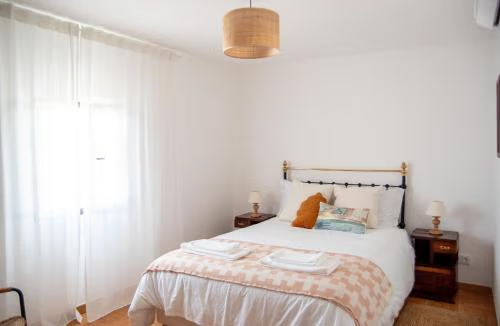
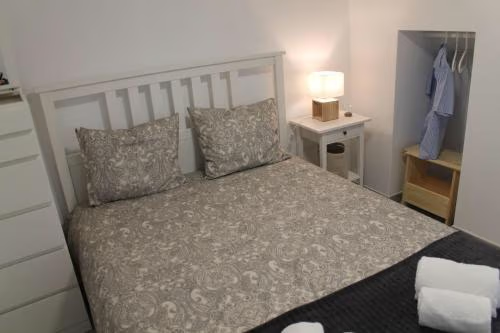
Where to stay in Évora Monte
Places to stay in Évora Monte.
 OpenReservations accepted
Evoramonte Encantada
 OpenReservations accepted
Casa das Bonecas by LovelyStay
KitchenCooktopsMicrowaveAnd more OpenReservations accepted
Casa dos Avós

Town 10 of 25