

Town on the Camino
Guarda
Portugal
- places to stay
- 14
- Camino
- 1
- Elevation
- 1,020 m
Guarda is the watch on the mountain: at 1,056 metres lies the highest town in Portugal, founded in 1199 to guard the border. After 35.8 km and the final climb from Belmonte, a cathedral like a fortress, the old Jewish quarter and the stamp in the museum await you. 42.7 km remain to Trancoso.
How long to stay?
Worth a rest day, especially after this climb. At 35.8 km, the stage from Belmonte is one of the longest at the end of the Via Nascente, and the last kilometres lead uphill into the highest town in the country. Guarda fills a rest day easily: the cathedral with its altar of over a hundred stone figures, the castle keep, the Torre dos Ferreiros as a viewpoint, the Jewish quarter with its crosses on the door frames and the museum, where you also get your stamp. Do not plan the rest day for a Monday: then the museum is closed, according to a travel guide. If you want to move on, tomorrow it is only 23.9 km to Celorico da Beira, mostly downhill.
Guarda in Ninja numbers
- 1,056 metres above sea level: Guarda is the highest town in Portugal. The F for "fria", cold, in the town's nickname is no accident.
- 35.8 km is the distance from Belmonte to here, according to Camino Ninja. On the last 5.3 from Maçainhas it goes uphill.
- 42.7 km remain to Trancoso, the end of the Via Nascente. You stand at kilometre 618.5 of 661.2, so already in the last fifteenth of the way.
- Around 150 years the builders worked on the cathedral, from 1390 to about 1540. Anyone who makes slow progress is in good company here.
- About twelve days a year it snows in Guarda, more often than in any other district capital of Portugal.
Arriving: up to the watch
The day from Belmonte leads through the valley of the Zêzere. At Valhelhas you cross the river on the Ponte Filipina and pass the river beach and the village parish church. After that Famalicão, Fernão Joanes and Maçainhas follow one another, a village known for its bronze bells and the woollen blankets of the area. After Maçainhas the path climbs into the town. A pilgrim site gives around 815 metres for Maçainhas de Baixo and a good 1,000 for Guarda. That is around 200 metres of ascent over 5.3 km, at the end of a long day.
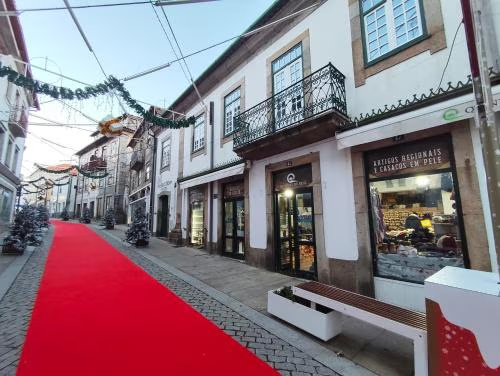
You enter the old town through the Porta dos Ferreiros, a gate from the time of King Dinis in the 13th century. The Torre dos Ferreiros, the tower of the smiths, belongs to it. Up on the hill the Praça Luís de Camões opens out, which everyone just calls Praça Velha. Since the Middle Ages it has been the centre of the town, and the cathedral stands massively above it. Expect wind up here.
In brief: a town as a border post
In 1199 King Sancho I, whom the Portuguese call the Settler, founded the town and gave it a charter modelled on Salamanca. The name says what for: Guarda means watch. The town was to guard the eastern border of the young kingdom. Sancho also brought the bishop's seat up here from the old Egitânia, today's Idanha-a-Velha, and the diocese was created in 1202.
The town has its nickname, the town of the five Fs: forte, farta, fria, fiel, formosa, that is strong, rich, cold, loyal and beautiful. Strong because of the walls, cold because of the height, beautiful because of the panorama. Loyal because of 1383: back then Bishop Álvaro Gil Cabral refused to hand the town over to the King of Castile and sided with João I. In the 20th century the mountain climate made Guarda a health resort for people with lung disease. In the Sousa Martins Sanatorium, which opened in 1907, a patient built a small transmitter in 1946, from which Rádio Altitude grew, according to Portugal Resident the first local radio station in the country.
The watch and its backside
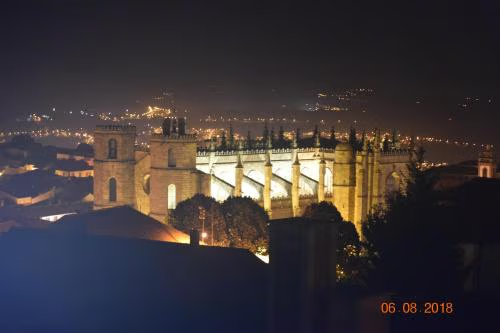
The cathedral of Guarda looks like a castle with church windows: octagonal granite towers, flying buttresses outside, a ground plan in the shape of a Latin cross. It was begun in 1390 under King João I, at the urging of Bishop Vasco de Lamego. It was only finished around 1540, in the era of the Manueline style. In between worked master builders who also stood behind the country's great buildings: Huguet, Diogo de Boitaca, Marcos Pires and the sons of Mateus Fernandes. You can see the kinship with the monastery of Batalha.
Inside, in the choir, stands the altar by João de Ruão, carved in the 1550s from the limestone of Ançã, with more than a hundred figures from the life of Christ in rows stacked one above another. Outside waits the punchline of the town. Among the gargoyles at the back of the building sits one that bends forward and sticks its bare backside towards Spain. People call it the "cu da Guarda". A town that was founded as a watch showed its neighbour in this way what it thinks of it. Walk once around the cathedral and look for it. As a pilgrim who continues north tomorrow, you may grin while you do.
On the watch hill: what to see
Everything important lies close together in the old town and is easy to manage on foot without a rucksack. We found reliable current opening times only in fragments.
- Sé da Guarda: The cathedral on the Praça Velha is the reason you are standing up here. It combines late Gothic with Manueline forms, and next to the Gothic main portal sits a Renaissance side portal. For pilgrims, the main draw is the altar by João de Ruão with its more than a hundred figures: it tells the life of Christ like a picture book in stone, entirely without words. Outside, the "cu da Guarda" faces Spain. According to a travel guide, admission is free. We did not find opening or Mass times.
- Torre de Menagem: The keep is what remains of the castle, with a few pieces of wall on a hilltop above the cathedral. It stands at the highest point of the town, at 1,056 metres. From the top you see, according to Fodor's, over the rocky land to the plains of Castile, that is, in the direction from which Guarda expected danger for centuries. The way up leads past the Solar de Alarcão and the old Santa Clara convent.
- Torre dos Ferreiros: The tower of the smiths next to the gate through which you enter the town is considered the best viewpoint over Guarda. You get up by lift or by the stairs, and the ticket is available at the Posto de Turismo in the Solar dos Póvoas on the Praça Velha. For you it is the view over the town before the long descent begins tomorrow.
- Judiaria: The old Jewish quarter lay inside the walls near the Porta d'El Rei and around the churchyard of São Vicente. Walk through the Rua do Amparo, formerly the Rua Nova da Judiaria, the Rua da Trindade and the Rua de São Vicente. On many door frames, mostly on the right, you see carved crosses. Whether they show that a house was Christianised, or whether they mark the place of the mezuzah that Jews touched with the right hand on entering, has not been settled. In the Rua do Amparo there still stands the door of the house where the night watchman controlled access to the quarter.
- Porta d'El Rei: The King's Gate is the direct access to the Jewish quarter. Look at the stones: the masons' marks are still visible.
- Museu da Guarda: Since 1985 in the old bishop's palace, an early 17th-century building with a seminary and a chapel, right next to the Igreja da Misericórdia. The collections range from prehistory and Roman times through painting and weapons to church art and folk culture. Important for pilgrims: according to the region's pilgrim guide, the Oficina do Peregrino is here, where you get the stamp. According to a travel guide, the museum is closed on Mondays.
- Igreja da Misericórdia and Igreja de São Vicente: The Misericórdia is the town's most important Baroque church, from the 18th century. The cross in front of it stands on the base, shaft and capital of Guarda's old pillory. São Vicente, in the middle of the former Jewish quarter, has a Baroque façade and azulejos inside in the nave and choir.
Food and drink
Guarda lies on the edge of the Serra da Estrela, and you can taste it. The Queijo Serra da Estrela cheese has a protected designation of origin, and there are also Morcela da Guarda, a blood sausage, farinheiras and chouriças, ham rubbed with paprika and salt cod in the style of the Conde da Guarda. At Carnival there is bucho, at Easter filhós and coscoréis. Sweet is the bola parda, and the town has its own pastry, the Dom Sancho. After a day of 35.8 km, that is exactly the right cuisine.
Honestly
- The way here is long, and the end is steep. 35.8 km from Belmonte, and the last 5.3 go uphill. If you can, start very early in Belmonte. You can split the stage in Trinta, 24.9 km after Belmonte and 10.9 before Guarda: there the municipality opened a pilgrim hostel with a dormitory for up to 20 people in July 2020. We could not check whether it is open today, so ask beforehand.
- There is no pilgrim hostel. The youth hostel is the cheapest solution, but according to its website it takes guests only from 18:00. If you arrive in the early afternoon, call ahead and ask whether you can leave your rucksack.
- The town carries its F for "fria" with good reason. Cold and windy, even outside winter, and snow is no exception here. A warm layer belongs in the rucksack for Guarda, even if you come from the hot Alentejo.
- You have to check opening times yourself. For the cathedral and the churches we found no times, and the museum is closed on Mondays. Ask at the Posto de Turismo on the Praça Velha.
- Tomorrow's descent goes into the knees. From a good 1,000 metres in Guarda it goes down 7.1 km to Ramalhosa, which a pilgrim site gives as around 550 metres. Almost 500 metres of descent in one go, largely over the paving of a Roman road. Poles help.
Where pilgrims sleep
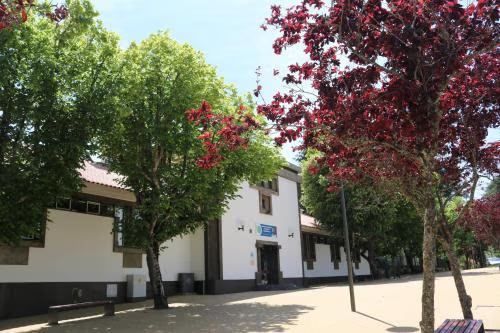
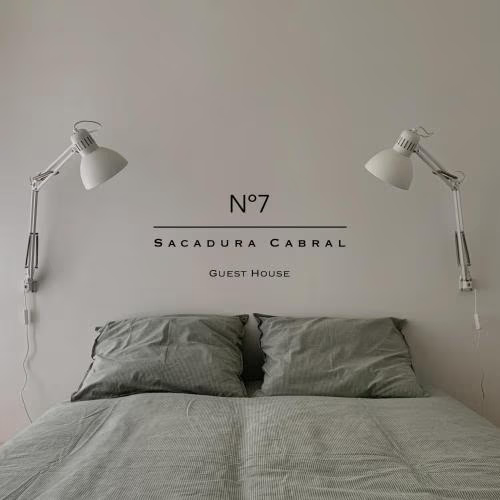
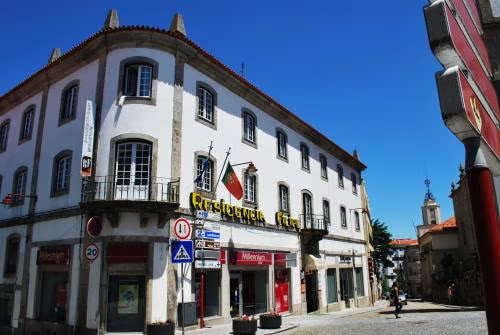
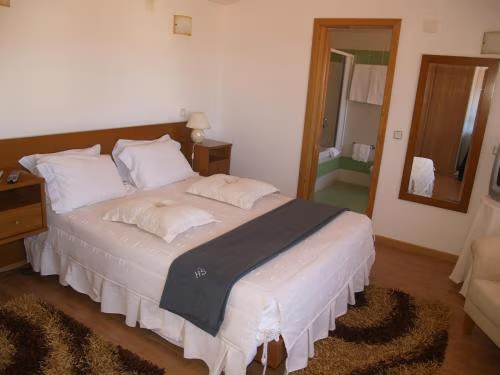
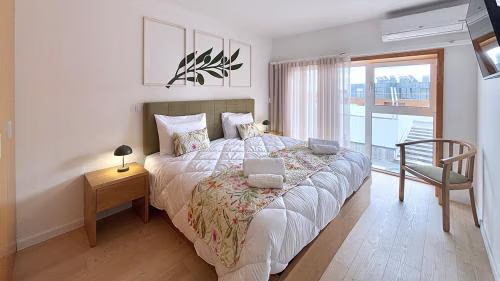
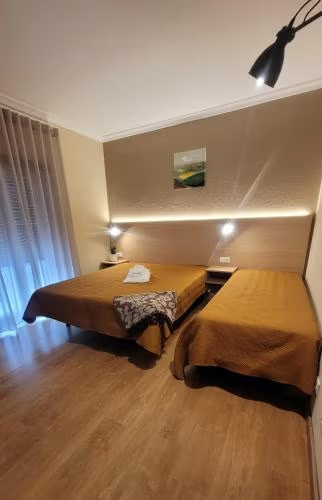
A hostel for pilgrims only, municipal, church-run or donation-based, does not exist in Guarda. The first address for tight budgets is the youth hostel HI Guarda – Pousada de Juventude on the Avenida Alexandre Herculano, between the town park and the polytechnic. It has twin rooms with and without bathroom and rooms with four beds, a guest kitchen and laundry facilities, and reception is staffed around the clock. According to the Pousadas de Juventude website, prices start at €25.00 per night (as of November 2026). Check-in is from 18:00, check-out by 12:00. In addition, Guarda has rooms and holiday flats from private providers, some of them in the centre.
Ninja tips
- Get your stamp at the museum. The Oficina do Peregrino in the Museu da Guarda is the town's port of call for pilgrims. Not on a Monday.
- Buy the tower ticket down on the square. For the Torre dos Ferreiros the ticket is not sold at the tower but at the Posto de Turismo in the Solar dos Póvoas on the Praça Velha.
- Walk once round the back of the cathedral. There the "cu da Guarda" sticks its backside out towards Spain. From the front you cannot see it.
- Watch the right-hand door frames in the Jewish quarter. The carved crosses are small. If you know where to look, you will find them in the Rua do Amparo and the alleys around São Vicente.
- Think of Belmonte and of Trancoso. Guarda belongs, with Belmonte, Covilhã and Trancoso, to the Route of the Jewish Quarters. You began yesterday in Belmonte and come to Trancoso the day after tomorrow: on the last days of the Via Nascente you almost go on a search for traces of your own.
- Look forward to the morning. The descent from Guarda leads almost at once onto a Roman road and stays there almost to Ramalhosa. A pilgrim site counts it among the most beautiful sections of the whole Via Nascente. Walk it in daylight.
Practical tips for pilgrims
- Supplies: Guarda has everything a district capital has: restaurants, supermarkets, banks and cash machines.
- Getting there and away: Guarda has a railway station and bus connections. If you want to stop here or come back later, you are well connected.
- Credencial: Pilgrim passports for the routes in central Portugal are issued by the Associação de Peregrinos Via Lusitana (info@vialusitana.org). Best to get one before the journey.
- Weather: Expect wind and much cooler evenings than in the valley, and in winter snow too.
Onward: down into the Mondego valley
From Guarda, the Via Nascente takes you into the last two stages. The path leaves the town and drops almost at once onto a Roman road. After 7.1 km you reach Ramalhosa, after which the view opens onto the Mondego. After 9.6 km comes Aldeia Viçosa with a river beach, then Rapa after 13.1, Vale de Azares after 16.9 and Aldeia da Serra after 18.9 km. After 23.9 km you are in Celorico da Beira, which lies beneath the Serra da Estrela. From there it is another 18.8 km to Trancoso, where the Via Nascente ends and the Camino Torres continues towards Santiago.
What awaits you tomorrow
Celorico da Beira, a good 500 metres lower, a castle hill above the Mondego and the capital of Serra da Estrela cheese. And a legend that suits a pilgrim with an empty provisions bag: when the castle was besieged in the 13th century and the supplies ran out, an eagle is said to have dropped a trout into the castle courtyard. The commander had it prepared and sent it to the enemy, who withdrew. The trout is still in the coat of arms today.
Deep dive: The town that kept watch
A short read, in case you want to learn more about Guarda. About 4 minutes' reading.
Where you stand
When you stand on the Praça Velha, with your back to the arcades and your face to the cathedral, you stand at over a thousand metres, in the highest town centre in Portugal. The wind that blows around your ears here is part of this town's story. Guarda was not built because it was cosy up here, but because from up here you can see far.
A watch on the border
In the year 1199 King Sancho the First founded the town. He is called the Settler, because after the wars against the Moors he wanted to fill the empty land in the interior with people. Guarda received a charter modelled on Salamanca and a task that is already in the name: watch. The border with León and later Castile was close. The king brought the bishop's seat from the old Egitânia, today's Idanha-a-Velha, up the mountain, and in the year 1202 the diocese of Guarda came into being. A legend tells it differently. A girl named Ana is said to have disguised herself as a soldier to follow a king into the fight against the Moors. Moved, the king is said to have had a castle built on the hill and made the girl the guardian of the place. That is a legend, but one that fits the name.
Loyalty in a difficult year
In the year 1383 King Fernando died, and Portugal was in danger of falling to Castile. The Castilian king was married to Fernando's daughter and wanted the crown. The Bishop of Guarda, Álvaro Gil Cabral, refused to hand the town over to him and sided with the Master of Avis, who became King João the First. Hence the F for fiel, loyal, among the five Fs with which Guarda describes itself to this day. Seven years later, in 1390, under this king the building of the cathedral began, which you see before you.
A hundred and fifty years of granite
Bishop Vasco de Lamego drove the building forward. It was only finished around 1540, about a hundred and fifty years later. In that time taste changed from Gothic to the Manueline style, and now the two stand side by side. Several generations of master builders worked here, among them Diogo de Boitaca and the sons of Mateus Fernandes, names you also know from Batalha. The result is a church that looks like a fortress, with octagonal towers of the granite of the surrounding hills. In the 1550s the sculptor João de Ruão created the altar in the choir, more than a hundred figures in pale stone. And at some point a stonemason placed on the back a gargoyle that holds its bare backside towards Spain. Who commissioned it and when exactly, we do not know. But you understand the town better once you have seen it: loyalty inwards, mockery outwards.
The quarter behind the King's Gate
Not far from the cathedral, behind the Porta d'El Rei, the Jewish community of Guarda lived for centuries. In the thirteenth century King Dinis gave the Jews of the parish of São Vicente a charter of their own. At the end of the fourteenth century about two hundred people lived in the quarter, and fifty years later it is estimated at six to eight hundred and fifty. There were tailors and shoemakers, tanners and smiths, doctors and goldsmiths, a synagogue, at first in a rented house, later in a building of its own. In the year 1465 the gate of the quarter was closed after protests by Christians. In 1492 Jews expelled from Spain came across the border here too. A few years later came forced baptism in Portugal and finally the Inquisition. What remains are the crosses on the door frames of the Rua do Amparo. Whether they are a sign of conversion or the place where a mezuzah once hung, the interpretations dispute. Perhaps both are true, depending on the house.
The cold air as a remedy
The height that made Guarda a fortress later made it a health resort. Because the mountain climate was considered healing, the Sousa Martins Sanatorium for people with tuberculosis opened in 1907. In 1946 a patient there built a small transmitter, from which Rádio Altitude grew, the first local radio station in Portugal.
What Guarda gives you to take along
Today you climbed up, tomorrow it goes down again, and in two days the Via Nascente is over. Guarda is the highest point where you stop once and look back. The town was built to keep watch. Perhaps that is a good thought for the last days: look after yourself, after your knees on the descent and after what this path has shown you. And when you walk past the cathedral, glance behind. Even a watch may have humour.
Where to stay in Guarda
Places to stay in Guarda.
 OpenReservations accepted
HI Guarda - Pousada de Juventude
 OpenReservations accepted
Nº7 Sacadura Cabral
 OpenReservations accepted
Residencia Filipe
Town 23 of 25