

Town on the Camino
Hontanas
Burgos, Castilla y León, Spain
- places to stay
- 7
- Camino
- 1
- Elevation
- 874 m
Hontanas is the village that hides: on the bare Meseta you only see it when you are almost inside, down in a hollow around a mighty church tower. The name probably comes from “fontana”, spring. You sleep in a medieval pilgrim hospital, 30.9 kilometers past Burgos. One evening is enough.
How long to stay?
One evening is enough. Hontanas is one street, one church and four albergues. You arrive after the Meseta, find shade and water, look into the church and have dinner with other pilgrims. In the morning you have a short way to go: the ruins of San Antón and Castrojeriz are less than nine kilometers away.
Hontanas in Ninja numbers
- 30.9 kilometers from the cathedral in Burgos to here, most of them on the treeless plateau.
- 45 meters is how far the path drops over the last half kilometer down into the village. That is exactly why you don't see Hontanas coming.
- 461.4 kilometers are left from here to Santiago on the Camino Francés.
- 1999 is the year the entire village center was placed under heritage protection.
Arriving: suddenly a village
From Hornillos del Camino the path climbs to 936 meters and then runs across the open Meseta, with no tree and no village. For ten kilometers it looks as if nothing more is coming. Then the path tips into a hollow, and the church tower appears below you. You walk in along the Calle Real, the same street pilgrims came through in the Middle Ages.
In brief: an oasis with a hospital
Hontanas came into being around 1200. Its name probably comes from “fontana”: after the dry plateau there were springs here, and so a reason to stay. According to tradition the village belonged to a prelate from Burgos, and a Gothic arch is all that remains of his palace next to the church. For pilgrims, the Hospital de San Juan stood on the Calle Real, popularly called “Mesón de los Franceses”, the inn of the French, because back then almost every pilgrim was called a “Frenchman”. Pilgrims sleep in the building again today.
Hidden in the hollow: what to see
Everything lies along the one street.
- Iglesia de la Inmaculada Concepción: The tower that brought you into the village belongs to a 14th-century church, begun in Gothic style and later rebuilt in neoclassical style. Inside stands a Baroque altar by Fernando de la Peña, a sculptor from Cantabria, along with a processional cross of enameled copper from the 13th century. On the neighboring house you can make out the Gothic arch of the old bishop's palace. We found no opening or Mass times.
- Hospital de San Juan: The medieval pilgrim hospital is now the municipal albergue. Look for the pointed arch; old storage silos were found in the floor. Whoever sleeps here sleeps where pilgrims have slept for centuries.
- Molino del Cubo: An old mill where the valley narrows, with its machinery and dam still in place. Sparrows and owls nest in it today. We could not reliably find out how far it lies from the path; ask in the village.
Food and drink
The village has a bar, a restaurant and a bakery. The small shop is open only from mid-March to mid-October. Castilian cuisine here, as in the whole province, means lamb, blood sausage from Burgos and fresh cheese.
Honestly
- In winter it is quiet. Three of the four albergues and the shop close from late October to late March. Then only the municipal albergue remains, and you need your own supplies.
- No ATM, no pharmacy. Get cash in Burgos.
- The stage before is long and shadeless. If you are on the Meseta at midday in summer, you arrive here parched.
Where pilgrims sleep
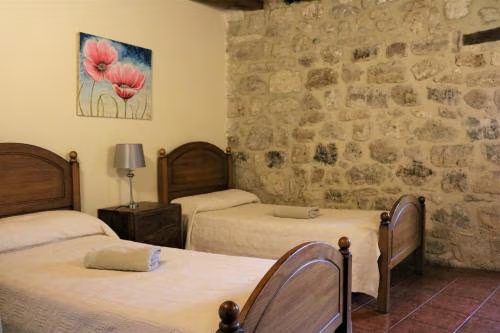
The Albergue municipal Antiguo Hospital de San Juan belongs to the municipality, which leases it out, and is said to be open all year; a bed costs from €15 (as of October 2026). There are also three private albergues that open from late March to late October: El Puntido, Juan de Yepes and Santa Brígida, with beds between €14 and €17 and private rooms. There is no donativo or parish albergue in Hontanas.
Ninja tips
- Bring cash. The next ATM is in Castrojeriz, 8.9 kilometers on.
- Water for the Meseta. Between Hornillos and Hontanas there is only San Bol, a single albergue just off the path; fill your bottles in Hornillos.
- Look out for the tower. On the plateau it is the first thing you see of Hontanas. When it appears, it is only half a kilometer more.
Practical tips for pilgrims
- Doctor: consultation Tuesdays and Thursdays from 11:30 to 13:00.
- Shopping: shop only mid-March to mid-October, bakery in the village.
- Bus: a bus to Burgos runs only on Mondays and Fridays.
- Festivals: on August 16 the fire of San Roque, into which people throw a stick and ask for protection for the animals; on December 8 the patron saint's festival.
Onward: through the valley to San Antón
The path follows the valley downhill. After 5.6 kilometers you walk under the arches of the ruins of San Antón: from 1146 the Antonians ran a hospital here for the sick with “Saint Anthony's fire”, a poisoning caused by infected rye. In the niches of the arch the monks left bread for pilgrims who arrived after the gates had closed. Another 3.3 kilometers, and you are in Castrojeriz (km 323.6). The whole stage measures 8.9 kilometers and runs gently downhill.
What awaits you tomorrow
Castrojeriz, the “long town”: over two kilometers of main street beneath a castle hill, with a collegiate church whose image of Mary, according to legend, Saint James found in an apple tree. Beyond it waits the Alto de Mostelares, about 140 meters of climbing over just under two kilometers.
Deep dive: The village in the hollow
A short read, in case you want to learn more about Hontanas. About three minutes' reading.
The spring as a reason
The Meseta between Burgos and Castrojeriz is a plateau without shade. Anyone traveling here in the Middle Ages walked for hours without a village and without water. Hontanas lies in a hollow where water runs together, and its name probably recalls exactly that: Fontana, the spring. The village came into being around 1200, and it never grew big. When this text was written, in autumn 2026, about seventy people lived here.
The inn of the French
On the main street, the Calle Real, stood the Hospital de San Juan. People called it the Mesón de los Franceses, the inn of the French. For the people of Castile, the pilgrims from the north were simply French, no matter where they really came from. The house has survived the centuries, with its pointed arch and old storage pits in the floor. Today it is a pilgrim albergue again, and it belongs to the municipality.
Church and palace
The Church of the Immaculate Conception was built in the Gothic style in the fourteenth century and later remodeled. Its tower is strikingly mighty for a village of this size, and on the plateau you can see it long before the houses. Next to the church stood a palace which, according to tradition, belonged to a prelate from Burgos, the lord of the village. A Gothic arch is what remains of it. Since 1999 the entire village center has been under heritage protection.
What Hontanas gives you
Hontanas teaches the Meseta. For hours you see nothing, and then the goal is suddenly there, below you, where you did not expect it. Many pilgrims say the Meseta is empty. Hontanas shows you that it hides things, and that sometimes you have to be very close before you can see them.
Where to stay in Hontanas
The places pilgrims rate highest in Hontanas come first.
- Top #1
 ClosedReservations accepted
Albergue Santa Brígida - Yepes
- Top #2
 ClosedReservations accepted
Albergue El Puntido
- Top #3
 OpenReservations accepted
Hotel Rural Villa Fontanas


Services in Hontanas
What you can find in town before the next stage.
- Café
- Shop
- Fountain
- Restaurant
Source: © OpenStreetMap contributors · updated September 2025
Town 19 of 49