

Stage town on the Camino
Hornillos del Camino
Burgos, Castilla y León, Spain
- places to stay
- 8
- Camino
- 1
- Elevation
- 825 m
Hornillos del Camino is a one-street village of around 60 people, 20.5 kilometres beyond Burgos: a single main street, a church, a fountain with a rooster on top and more pilgrim beds than houses on the square. For many, this is where the first day on the Meseta ends. An evening is enough, and nobody here wants more.
How long to stay?
An evening is enough. Hornillos is a place to arrive, do your washing and sleep. You can see the church, the fountain and the old hospital in a quarter of an hour, and the rest of the afternoon is yours. Next morning you set off early towards Hontanas.
Hornillos in Ninja numbers
- 20.5 kilometres lie behind you since Burgos, with only 152 metres of climbing.
- 921 metres is the highest point of the day, 2.7 kilometres before the village. After that you drop down to 824 metres.
- 471.8 kilometres are still left from here to Santiago on the Camino Francés.
- Around 60 people live in the village; on a summer evening far more pilgrims sleep here.
- 1657 is the year the high altar of the parish church of San Román was completed.
Arriving: down into the hollow
Beyond Burgos the land empties. Via Tardajos and Rabé de las Calzadas you climb onto the high plateau. 2.7 kilometres before the end you reach the highest point at 921 metres, then the path drops and Hornillos lies below in its hollow: one long street with the church at its end.
In brief: kilns, lepers and pilgrims
The name probably comes from "Forniellos", small kilns once fired here. In the 9th century the village lay on a line of watchtowers protecting the young Kingdom of Castile. Aymeric Picaud mentions Hornillos in the Codex Calixtinus, the 12th-century pilgrim guide. In 1156 King Alfonso VII founded the Malatería de San Lázaro here, a house for lepers and pilgrims. In the Middle Ages there were up to three hospitals; the Hospital del Sancti Spiritus survives, with a chalice and crossed keys on its lintel. In 1471 the village passed to the monastery of San Pedro de Cardeña.
The street as a village: what to see
Everything lies on the Calle Real, which you walk along anyway.
- Iglesia de San Román: The parish church at the end of the street. Its high altar was built between 1652 and 1657. Whether it is open depends on the day; we have not found opening hours.
- Fuente del Gallo: The fountain on the square in front of the church, crowned by a rooster. The rooster is also the emblem of the Fiestas del Gallo on the last weekend of July.
- Hospital del Sancti Spiritus: Of the old pilgrim hospital, the lintel with chalice and crossed keys remains. It reminds you that pilgrims were cared for here eight centuries ago.
- Ermita de Santa María: The Gothic chapel is a remnant of the old monastery.
Honestly
- Hornillos is not much more than a place to sleep. If you want things to do, you will find them in Burgos or a few hours on in Castrojeriz.
- No cash machine, no pharmacy. Get cash and medicines in Burgos.
- Bread only comes by van. The village has no bakery; bread arrives with a travelling baker around 10 am, meat only on Tuesdays and Fridays.
Where pilgrims sleep
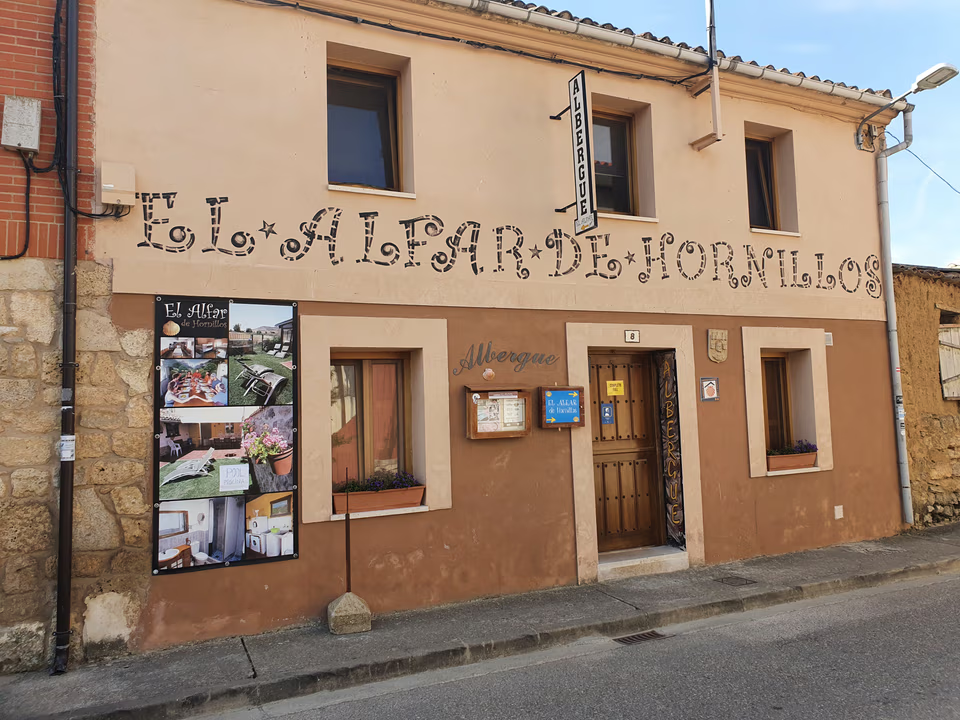
The public hostel, Albergue de peregrinos de Hornillos del Camino, is in the middle of the village; a bed costs €13 to €15 (as of September 2026). There are also private hostels such as El Alfar de Rosalía and Hornillos Meeting Point, both around €15 in the dorm and closed in winter. There is no donation-based hostel in the village.
Ninja tips
- Shop at the village store for tomorrow. It is the only shop in the village.
- Fill your bottles in the morning. Until Hontanas, only the turn-off to the Arroyo San Bol lies on the way.
- Take a close look at the rooster. It sits on the fountain in front of the church, and most people walk past it tired.
Onward: across the plateau to Hontanas
Beyond the village the path climbs back onto the Meseta. After 5.5 kilometres the path to the Arroyo San Bol branches off, after 10.4 kilometres you reach Hontanas. If you want to go further, you reach Castrojeriz after 19.3 kilometres.
What awaits you tomorrow
Hontanas, a village of a good 60 people whose centre has been protected as a historic ensemble since 1999. The name probably comes from its springs, the "fontanas", and after 10.4 kilometres of plateau it is the first place of the day to stop. Beyond it you reach the ruins of the monastery of San Antón.
Deep dive: A village that lives on the road
A short read, in case you want to learn more about Hornillos del Camino. About two minutes' reading.
A village in a line
Hornillos has no centre in the usual sense. It is a street with houses on it, and that street is the Way of Saint James. As early as the ninth century the village lay on a line of watchtowers with which the young Kingdom of Castile secured its border. Later pilgrims came through, and the village lived from them. In the twelfth century the author of the pilgrim guide in the Codex Calixtinus wrote its name down.
A house for the sick
In the year 1156 King Alfonso the Seventh had a house for lepers set up here, the Malatería de San Lázaro. It took in the sick and pilgrims, and at times there were up to three such houses in the village. What remains is the Hospital del Sancti Spiritus, or more precisely its lintel with a chalice and two crossed keys. When you walk past it, you walk past a door through which pilgrims have entered for centuries.
What Hornillos gives you
Hornillos has no great buildings to offer you. It offers you a square, a fountain, a church and a street on which, tomorrow morning, everyone will walk in the same direction. Perhaps at the start of the Meseta that is exactly right: a place that wants nothing from you except that you rest.
Where to stay in Hornillos del Camino
The places pilgrims rate highest in Hornillos del Camino come first.
- Top #1
 ClosedReservations accepted
Albergue El Alfar de Rosalia
- Top #2
 OpenReservations accepted
Albergue Hornillos Meeting Point
- Top #3
 OpenReservations accepted
Aura Jacobea


Services in Hornillos del Camino
What you can find in town before the next stage.
- Café
- Shop
- Medical clinic
- Fountain
- Restaurant
Source: © OpenStreetMap contributors · updated November 2025
Town 18 of 49