

Town on the Camino
Klausen
Germany
- place to stay
- 1
- Caminos
- 2
- Elevation
- 227 m
Klausen grew out of almost nothing: around 1440 a day labourer called Eberhard placed a Pietà barely 20 centimetres tall in a wayside shrine, and today more than 100,000 pilgrims come every year. Here the Eifel-Camino meets the Mosel-Camino, and the Eberhardsklause is one of only two pilgrim hostels on the way to Trier.
Right now in Klausen (as of October 2026)
- Hostel in winter sleep: The Eberhardsklause pilgrim hostel closes from 1 November to 28 February. It reopens in March.
- End of the pilgrimage season: The pilgrimage season runs from May to October. On 25 October 2026 at 18:00, an organ concert in the pilgrimage church closes the season.
How long to stay?
An afternoon is enough. It is only 7.9 kilometres from Osann-Monzel, and what makes Klausen special lies around a single square: the pilgrimage church with its Chapel of Grace, the Antwerp altar and the Abtsgarten. You can only see the old monastery library on a guided tour, which you have to request in advance. Staying the night is still worth it, because the Eberhardsklause is one of only two pilgrim hostels on the whole route and one of the cheapest beds between Koblenz and Trier.
Klausen in Ninja numbers
- 20 centimetres is the height of the oak image of grace that draws more than 100,000 people to Klausen every year.
- Three paces long, two wide, three high was the hermit's cell Eberhard built next to his shrine in 1442. The village is still named after it.
- Around 700 miracles were written down by the canons between 1444 and 1536.
- 35 beds in the Eberhardsklause, one of only two pilgrim hostels along the 157 kilometres of the Mosel-Camino (as of October 2026).
- 47.8 kilometres to go, according to Camino Ninja, to the Abbey of St. Matthias in Trier.
Arriving: over the heights into the Salm valley
On the Mosel-Camino you leave Osann-Monzel via Brunnenstraße in Monzel and climb towards the Monzeler Hüttenkopf. At the barbecue hut you keep left and walk through the forest to the Minheim shelter at around 425 metres. From there you look across the Wittlicher Senke and over Burg Landshut to the Hunsrück. A track takes you to Neu-Minheim, where you can already see the church tower of Klausen, and then there is one last climb. According to Camino Ninja it is 7.9 kilometres from Osann-Monzel.
The Eifel-Camino comes in from Wittlich. At the foot of the pilgrimage church stands the pilgrim stele, consecrated on 23 April 2010. Here the two routes join and run with shared waymarks all the way to Trier.
In brief: an image, a cell, a monastery
Around 1440 Eberhard, a day labourer from Esch, placed a small Pietà in a wayside shrine at an uninhabited spot. In 1442 he built himself a hermit's cell next to it. Soon people came, telling of prayers answered. In 1444 a chapel replaced the little shrine house, and on 25 March 1449 a first church was consecrated. Eberhard died in 1451. From 1456 Augustinian canons of the Windesheim Congregation were brought in; they founded a monastery here and looked after the pilgrimage. The present church was consecrated in 1502.
In 1802 the French dissolved the monastery, and the monastery church became the parish church. The pilgrimage stayed. Today around 1,500 people live in Klausen and its districts of Krames and Pohlbach.
Twenty centimetres of beginning
Klausen is a lesson in how small something can start. A man with no possessions, an oak figure the size of a hand, a hut you could barely lie down in. Out of that came a church regarded as the most important late Gothic building of the Mosel-Eifel, a monastery with one of the great libraries of the Electorate of Trier, and a place of pilgrimage that the tourist boards call the largest in the Diocese of Trier.
For you as a pilgrim, Klausen is a rare place: nowhere else on the whole Eifel-Camino does the pilgrim trail reach back so surely into the Middle Ages. The Mosel-Camino itself only opened in 2008, but people have been arriving in Klausen on foot for almost six hundred years. From the seventeenth century until the 1980s, 200 to 330 processions came every year, mostly from the Eifel and the Hunsrück. You are not the first here with dusty shoes, you are one of very many.
Around Augustinerplatz: what to see
Everything is close together, around the church and the old monastery buildings.
- The pilgrimage church of Maria Heimsuchung: A two-aisled hall church with red buttresses, octagonal pillars and a net vault. Look up: the keystones show apostles, saints and the coats of arms of craftsmen. The choir was consecrated in 1474, the whole church in 1502. Inside are Gothic choir stalls, a pulpit from 1774, Rococo confessionals and a Rieger organ from 2007. The heart of the church is the Chapel of Grace, closed off by the relocated rood screen. This is where the image of grace stands, an oak Pietà from around 1440, only about 20 centimetres tall. Next to it stands a larger sandstone Pietà from the seventeenth century. Once you have found the small figure, you understand the place.
- The Antwerp altar: The high altar was made in Antwerp around 1480 and is considered one of the earliest surviving Antwerp retables anywhere. Almost a hundred carved and gilded figures tell the Passion of Christ. The Lamentation group beneath the cross is carved from a single piece of wood. Who carved the altar is not certain; the names given are Johann Eltusch and Peerken von Rosselder. The outer wings were lost when the monastery was dissolved.
- The monastery library: The room above the sacristy dates from the end of the fifteenth century. Its wall paintings from the beginning of the sixteenth century show a Crucifixion and 19 larger-than-life figures, perhaps a clue to how the books were arranged. The canons spent four hours a day copying books. You can only get in on a guided tour, about 90 minutes, for a donation. Open tours take place a few times a year, and groups of up to 20 can ask all year round (as of October 2026).
- The Abtsgarten: The abbot's garden goes back to the founding years of the monastery. In 1769 it was laid out anew on three terraces with a pavilion, and since 2005 it has been replanted. On the upper level labelled herbs grow, and you look down into the Salm valley, where the trail takes you tomorrow.
Food and drink
On the ground floor of the hostel is the village shop, which has supplied the village since 2007. There you get provisions for the next stage and breakfast in the morning. According to the hostel, the shop is the only place to buy food in the village. Dinner is not guaranteed: one pilgrim wrote in October 2026 that the only restaurant is closed on Mondays and Tuesdays, another guest found none at all. Ask when you book. Klausener Zuckerpfeifen, sugar whistles, are the local souvenir.
Honestly
- In winter there is no pilgrim bed. From November to February the Eberhardsklause is closed. Then you rearrange the stage and sleep in a guesthouse in Osann-Monzel or Klüsserath.
- Check-in only during shop hours. You check in at the village shop, and on several days it is only open until midday. If you arrive later, arrange it in advance.
- You can't cook. The hostel is not self-catering, and dinner in the village is uncertain. Buy what you want to eat in the evening at the village shop during the day.
- The library is usually closed. The painted library room is only open for guided tours. If you want to see it, call the parish office in advance.
Where pilgrims sleep
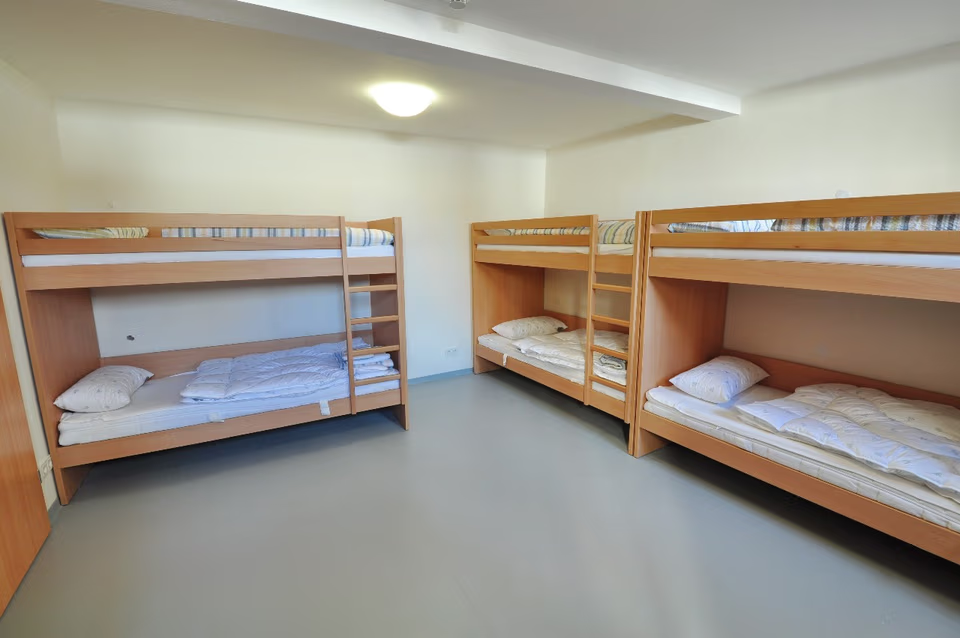
- Pilgerherberge Eberhardsklause: The municipality converted the former Hotel Eberhardsklause into a village centre and opened it in February 2012, with the village shop, the municipal office and the hostel. 35 beds in double and multi-bed rooms with shower and WC, a bed from €30 with breakfast (as of October 2026). Bookings are made by email, and a bed at short notice is not guaranteed. Bring your pilgrim passport, the hostel wants to see it. Open from March to October.
The previous pilgrim hostel behind you is in Traben-Trarbach. Ahead of you there are none until Trier; you sleep in guesthouses, B&Bs and at wine estates.
Ninja tips
- Find the small figure: In front of the big altar it is easy to forget. Go into the Chapel of Grace and look for the image of grace, it is hardly bigger than your hand.
- Provisions for the forest: There is nowhere to stop for food or drink between Klausen and Klüsserath. Fill your bottles at the village shop, two litres is good.
- Photo at the stele: At the pilgrim stele at the foot of the church the Eifel-Camino and the Mosel-Camino meet. Whoever comes from Andernach and whoever comes from Koblenz stand at the same stone here for the first time.
- The Heiliger Kommholmich: In the church lies the tombstone of the knight Philipp von Ottenesch, who died in 1535. By tradition, unmarried women visit it when they are looking for a husband. In the village he is called the Heiliger Kommholmich, roughly Saint Come-and-Get-Me.
- Culture in the evening: Since 2013 volunteers have organised concerts and readings in the pilgrimage church. Check before you arrive whether something is on that evening.
- Ask about the library in advance: If you want to see the library, call the parish office a few days ahead and ask whether a tour is coming up.
Practical tips for pilgrims
- Parish office: Katholisches Pfarramt Maria Heimsuchung, Augustinerplatz 2, phone 06578 218. Ask here about tours and service times.
- Pilgrim stamp: We have not found a fixed stamping point. Ask at the hostel or the parish office.
- Pilgrim passport and certificate: You can get the passport in advance from the St. Jakobusbruderschaft Trier. For the Trier pilgrim certificate you have to document the last 100 kilometres with stamps.
- Village shop: Monday, Thursday and Saturday 7:30 to 12:00, Tuesday, Wednesday and Friday 7:30 to 17:00, Sunday 7:30 to 12:00 and 14:00 to 17:00 (as of October 2026). Phone for the hostel: 06578 985859.
- Stopping early: Bus line 304 runs to Wittlich.
Onward: through the forest to the Moselle
You leave Klausen through the district of Krames, past the Blasiuskapelle, and walk south on field and forest paths to the forest chapel on the Hansenberg. There you cross the road, follow a surfaced track and turn sharp right to the Klüsserath shelter. After about half an hour in the forest you reach the first vineyards of Klüsserath and descend on asphalt tracks to the Salm, which flows into the Moselle here. According to Camino Ninja it is 9.9 kilometres to Klüsserath, 27.1 kilometres to Schweich and 47.8 kilometres to Trier.
What awaits you tomorrow
Klüsserath lies where the Salm flows into the Moselle. In the parish church of St. Maria Rosenkranzkönigin from 1783 is the tomb of the crusader Richard von Hagen from the fifteenth century. And in the Haus der Krippen almost a hundred nativity scenes from all over the world are on show all year round. After a village that grew out of a single figure, you come to one that collects a hundred.
Deep dive: A hermit's cell that became a place of pilgrimage
A long read, in case you want to learn more about Klausen. About thirteen minutes' reading.
A church tower above the forest
If you come from Monzel, you first see it near Neu-Minheim: a church tower that looks far too big for a village. Below it lies Klausen, a place of about 1,500 inhabitants spread over three districts. And in it stands a church regarded as the most important late Gothic building between the Moselle and the Eifel, with an altar from Antwerp and a monastery library that was the subject of a doctoral thesis as recently as 2015.
If you want to understand why, you need not look for a prince or a bishop. At the beginning of this place stands a man who owned nothing, and a figure no bigger than a hand. Everything else grew out of that.
At the foot of the church, since 23 April 2010, stands a pilgrim stele. Two routes meet here, the Eifel-Camino from Andernach and the Mosel-Camino from Koblenz. Both are young; the Mosel-Camino opened in 2008. But at this spot they run into a trail that is almost six hundred years old. On the whole Eifel-Camino there is no other place where pilgrimage reaches back so far.
A day labourer and a wayside shrine
Around 1440 a man named Eberhard set up a wayside shrine, twelve feet high, at a spot where nobody lived. In it stood a small Pietà, the Mother of God with her dead son on her lap. The image of grace that stands today in the chapel of the church, a Pietà from the fifteenth century, is made of oak and about 20 centimetres tall.
Who was Eberhard? The sources call him a day labourer from Esch, others a smallholder and winegrower. He was certainly not rich. According to tradition he had a vision, sold what he owned and bought a bell, a candlestick and an image of the Virgin. Whether it happened exactly like that, we do not know. What is certain is that in 1442 he built a hermit's cell next to his shrine, a dwelling that by tradition was three paces long, two wide and three high. There he lived as a hermit.
1442 is also the year in which the place is first mentioned. It takes its name from this hut: Eberhardsklausen, the cell of Eberhard. To this day it is called Klausen. There are not many places named after the home of a poor man.
A quarrel over a small image
Eberhard did not stay alone for long. People came, prayed before his image and said their prayers had been answered. And where people come, a quarrel soon follows.
The land on which the cell stood belonged to Krames, and Krames belonged to the parish of Piesport down on the Moselle. The parish priest there, Johann Ordonis, had the image taken to his parish church of Sankt Michael. The Bishop of Trier finally allowed the image to return, and Eberhard hung it back in its old place.
That was not the end of the quarrel. In the chapel a Father Nikolaus celebrated Mass without permission. Ordonis sued him before the church court in Trier. The court found the priest guilty, but he was not punished. And people tell of a woman named Anna von Esch who is said to have been healed after communion in the chapel, which had not yet been consecrated. The pilgrims kept coming, and there were more of them.
The hut becomes a church
In 1444 Archbishop Jakob von Sierck allowed the little shrine house to be replaced by a chapel. By tradition it was five paces long and five wide. Soon more space was needed. From 1446 a church went up, led by a master builder from Antwerp named Cluys, twenty-six paces long and twelve wide, with a two-storey tower. On 25 March 1449, the feast of the Annunciation, Jakob von Sierck consecrated it, and Mary became its principal patron.
Eberhard lived to see it. He died in 1451. What he had started was already bigger than himself: next to his hut stood a church consecrated by an archbishop, and more people were coming than one hermit could look after.
The men from Windesheim
In 1456 the Trier cathedral chapter called in members of a religious order to look after the pilgrims, and very particular ones: Augustinian canons of the Windesheim Congregation. This was a reform order from the Netherlands, linked to a movement of piety called the Devotio moderna, the new devotion. Discipline and humility were their guiding principles, and books were their tools. The first canons came from the monasteries of Niederwerth near Koblenz and Böddeken.
On 14 September 1459 Archbishop Johann von Baden handed the shrine over to them, with all rights, goods and revenues, as the charter puts it. In 1461 the monastery was admitted to the Windesheim association. The day labourer's cell had become a monastery that would last until 1802, more than three hundred and forty years.
The canons kept building. The choir of the present church was consecrated in 1474, the whole church in 1502. It is a two-aisled hall with red buttresses and a net vault. On the keystones up above you see not only apostles and saints but also the coats of arms of craftsmen.
A hundred figures from Antwerp
Around 1480 an altar came to Klausen that is now considered the treasure of the place. It comes from Antwerp, which at the time was known for its carved altars. The Klausen altar is regarded as one of the earliest surviving examples of these Antwerp retables.
Almost a hundred carved and gilded figures tell the Passion of Christ. Beneath the cross stands the Lamentation group, and it is carved from a single piece of wood. Who made the altar is not known for certain. The names given are a Master Johann Eltusch and a Peerken von Rosselder.
When you stand in front of it, notice what is missing. A winged altar has wings that can be closed. The outer wings of this altar were lost when the monastery was dissolved. What you see is the shrine that remained. And perhaps you notice that the church has two images of the same subject: the great altar with its hundred figures and the small image of grace in the chapel, a mother with her dead son. The altar is more splendid. People came for the small figure.
The chronicler from Bernkastel
On 29 May 1481 a young man entered the monastery who would make sure we know so much about this place. Wilhelm von Bernkastel had studied in Deventer, a centre of the new devotion, and had been won for Klausen there by the prior Jan van Eindhoven. In 1485 he was ordained a priest. He stayed until his death on 6 March 1536, more than fifty years.
Wilhelm wrote a Latin chronicle of his monastery, and above all he wrote down what the pilgrims told him who came to give thanks. For the years 1444 to 1490 Wilhelm collected around a hundred miracles, and for the years after that, up to 1536, around six hundred more. His manuscript survives and is kept today in the Stadtbibliothek Trier. In 1640 and 1647 printed miracle books from Klausen appeared.
In these reports craftsmen, parents and village priests appear by name. You learn where they came from, what they suffered from, what they vowed and what they brought.
Wax the weight of a child
A few of these stories are worth listening to. In 1495 parents from Sûre, two miles before Saint-Hubert, brought their daughter of about three. The child had been born with twisted limbs and could not even crawl. The parents had vowed to bring the Mother of God wax the weight of their child. The girl, so the book says, got well.
In 1501 a carpenter had struck his knee with an axe. The wound festered so strangely that he suspected sorcery. He vowed neither to play nor to sing nor to work until his pilgrimage. On the fourth day he was healed, and he hung up his crutches in Klausen. Such offerings hung in the Chapel of Grace, which Wilhelm called the memoria, the place of remembrance.
Not every story ends with healing. On 20 May 1510 a smith named Michel from Consthum asked for help for his eight-year-old daughter, who had been bitten by a rabid dog. He promised to walk barefoot to Klausen and to bring a sheep. The girl came round once more and then died peacefully. The father came anyway and fulfilled his vow, grateful, it says, for so good an end.
The places in these reports lie in the Ardennes and in Luxembourg, near Saint-Hubert, Vianden and Wiltz. Klausen drew pilgrims from a wide area, across borders that ran differently then than they do today.
The dark side of the miracle book
An honest picture of this place includes a story people would rather not tell. Wilhelm's miracle book is strikingly often about witchcraft. The researcher Zender counted about seventy such stories in some fifty years of records.
In the early reports it is mostly people vomiting foreign objects, worms, leather, iron, bone splinters, supposedly put into them by witchcraft. In 1512 a man named Tylo reported on his son, who was to learn shoemaking in Vianden. Two women had visited him at night, after which he vomited everything, until after a vow he spat out a ball of hair. The hair was hung up in the chapel, with an inscribed tablet. At first Wilhelm wrote cautiously. He often doubted that it had all really happened, and considered a deception of the devil possible.
Then he read the Hammer of Witches, the book that appeared in 1486 and 1487 and fuelled the witch hunts. In the margins of his earlier entries he wrote that he had not yet known the books of Sprenger and Nider at the time. And he noted: Clara sunt dicta in Malleo Maleficarum, it is clearly stated in the Hammer of Witches. From then on he wrote matter-of-factly about old women who had confessed and been burned. He mentions twelve witch burnings, and some of the women's names are known only from his book.
What do you do with a legacy like that? You cannot talk it away. A place where people sought comfort also recorded persecution, soberly and without objection. Zender proposed a sober interpretation: the accusation of witchcraft could relieve parents of their own guilt when a child had fallen out of the cradle or suffocated in the parents' bed. And there is another trace in Wilhelm's book. He reports two women who had been captured and escaped through the help of Mary. He did not write down their names, so as not to put them in danger again. The same man who recorded the burnings without objection protected two who escaped with his silence. Both stand in one book.
A library above the sacristy
The canons from Windesheim were people of books. Each of them spent four hours a day copying books in his cell, and more in his free time on Sundays and holidays. In this way a library grew that in the fifteenth century was one of the most important in the whole Electorate of Trier. It also held a copy of the Hammer of Witches.
Towards the end of the fifteenth century the library got its own room, directly above the sacristy. At the beginning of the sixteenth century it was painted, with a Crucifixion and nineteen larger-than-life figures. Perhaps the books were arranged according to these figures. That this room survives makes Klausen special for experts too.
The historian Marco Brösch studied the surviving books in a doctoral thesis at the University of Trier. He found that about one book in ten was written in German rather than Latin. He found binding waste, that is, remnants of old manuscripts reused in other books, among them Hebrew fragments and the remains of a collection of saints' lives written by a scribe named Cundpato in Freising in the ninth century. And he found a sermon by Nicholas of Cusa that no one had known until then. The great cardinal and scholar came from Kues, according to Camino Ninja just under nineteen kilometres back along the trail. And the two places cross paths once more: in 1830 Matthias Martini, rector of the Cusanus Hospital in Kues, compiled the list of the priors of Klausen.
The end of the monastery
Wars did not pass Klausen by. On 20 October 1735, in the War of the Polish Succession, imperial troops under Friedrich Heinrich von Seckendorff defeated a French army here. In 1769 the abbot's garden was laid out anew on three terraces, with a small pavilion.
The end came with French rule. In 1802 the monastery was dissolved. The church became the parish church, and the books were scattered. Wilhelm's miracle book is now in the Stadtbibliothek Trier, and an edition of Flavius Josephus printed in Verona in 1480, which once belonged to the canons, is today in the university library of Aberdeen in Scotland. The outer wings of the Antwerp altar were also lost at this time.
And yet not everything broke off. In 1803 a parish was formed from the villages of Krames and Pohlbach. Its first parish priest was Karl Kaspar Lintz, the last head of the dissolved monastery. He stayed until 1816. The last head of the monastery went on caring for the pilgrims, now as a village priest.
Processions, sisters and motorbikes
The pilgrimage survived the dissolution. From the seventeenth century until the 1980s, 200 to 330 processions came to Klausen every year, mostly from the Eifel and the Hunsrück. Since 1950 around 120,000 pilgrims a year and about 700 groups have been counted. More recent figures speak of more than 100,000. The tourist boards call Klausen the largest place of pilgrimage in the Diocese of Trier, others the second largest. It is big either way.
In 1927 the parish became the seat of a deanery. In an old travellers' inn on Bernkasteler Straße, Dominican sisters lived in their convent of Mater Dolorosa until they moved to Lower Saxony in 2000. On 15 August 2008 a new Dominican convent was founded in Klausen, Sankt Katharina von Siena. And from 1981 onwards, for decades, the parish priests here were Dominicans.
The pilgrimage has also found new forms. Since 1997 there has been a motorbike pilgrimage every year at the start of the motorcycle season, and since 2014 farmers have brought their tractors to be blessed. Since 2013 volunteers have organised concerts and readings in the church, and since 2007 it has had a new organ. And unmarried women, so people say, visit the tombstone of the knight Philipp von Ottenesch, whom the village calls the Heiliger Kommholmich.
Two routes at one stone
Since 2012 Klausen has had a pilgrim hostel. In February 2012 the municipality opened a village centre in the former Hotel Eberhardsklause, with a village shop, a municipal office and a hostel with 35 beds, explicitly intended for pilgrims on the Eifel-Camino and the Mosel-Camino to Trier. It is one of only two pilgrim hostels on the whole Mosel-Camino. Once again a house bears Eberhard's name and takes in people who come on foot.
The two routes that meet here continue together to Trier, to the Abbey of Sankt Matthias, which is regarded as the only apostle's tomb north of the Alps. From there you can walk on, all the way to Santiago, if you want. From Klausen, according to Camino Ninja, it is another 47.8 kilometres to this apostle's tomb.
What Klausen gives you
Klausen does not tell a story of power. No king founded this place, no bishop planned it. A man with no possessions set up a small figure and built himself a hut next to it in which he could barely lie down. People came because they were looking for comfort, and they have been coming for almost six hundred years.
You do not have to believe in miracles to be touched by that. You can simply go into the Chapel of Grace and look for the small figure. It is hardly bigger than your hand. Around it grew a church, a monastery, a library, a village. And at a stone outside the door, two routes meet today.
Perhaps what you take from here is that great things often start small, with a single step, a single decision, a wayside shrine at an empty spot. And that you may look honestly, at the dark too, without losing the good. Tomorrow you walk down through the forest to the Moselle. It is still just under fifty kilometres to Trier.
Where to stay in Klausen
Places to stay in Klausen.
 OpenReservations accepted
Pilgerherberge Eberhardsklause
Services in Klausen
What you can find in town before the next stage.
- Café
- Shop
- Fountain
- Restaurant
Source: © OpenStreetMap contributors · updated April 2026