

Town on the Camino
Traben-Trarbach
Germany
- places to stay
- 20
- Camino
- 1
- Elevation
- 126 m
Traben-Trarbach is two towns and a bridge: from the Grevenburg you walk down into old Trarbach, where one of only two pilgrim hostels on the Mosel-Camino stands next to the church. Around 1900 the town was Europe's most important wine-trading centre after Bordeaux. According to Camino Ninja, Trier is 73.5 kilometres away.
Right now in Traben-Trarbach (as of October 2026)
- Buddha Museum: Open only until 1 November 2026, Tuesday to Sunday 10:00 to 18:00, last admission 17:00. After that it closes for the winter.
- Christmas market underground: The Mosel-Wein-Nachts-Markt in the historic wine cellars runs from 20 November 2026 to 2 January 2027, at weekends from Friday to Sunday and on a few extra days.
- Bus to Wittlich: The B53 between Ürzig and Lösnich is closed from 19 October until 30 November 2026 (expected). Bus line 350 between Wittlich and Traben-Trarbach takes a detour via Zeltingen, so expect delays.
How long to stay?
Worth a rest day. The stage from Bullay is one of the hardest on the Mosel-Camino, and the next day to Osann-Monzel is short. In between, a day fits nicely in a town with castle ruins above and wine cellars below: the Mittelmosel-Museum, where Goethe spent the night, the Brückentor, the Grevenburg and the underground world of the wine merchants. From April to early November the Buddha Museum adds to the list.
Traben-Trarbach in Ninja numbers
- 73.5 kilometres separate you, according to Camino Ninja, from the apostle's tomb in St. Matthias in Trier. More than half of the Mosel-Camino is behind you.
- 2 pilgrim hostels is all the Mosel-Camino has on its 157 kilometres, and one of them is here, in the old Latin school (as of October 2026).
- 18 million litres of wine were traded by the town's roughly 100 wine merchants and cellars in 1899, about half of Germany's harvest at the time.
- 40 of 220 houses were still standing in Trarbach when the great town fire of 21 July 1857 was over after about four hours.
- Up to 8,000 forced labourers built the fortress of Mont Royal above the Moselle loop for Louis XIV from 1687. Ten years later it was torn down again before it was finished.
Arriving: over the Grevenburg into old Trarbach
On the Mosel-Camino you come from Bullay, via the Marienburg, Zell and Enkirch. Route descriptions put the stage at about 23 kilometres with more than 700 metres of climbing. In Starkenburg, 2.7 kilometres before the end according to Camino Ninja, you stand on the rocky ridge above the Moselle, with a Protestant Baroque church and the remains of the castle where a countess held an archbishop in 1328.
Then it is downhill: past the Bismarckhütte, along the Moselsteig to the Himmelspforte, the best view of the town, and on to the Grevenburg. Opposite you see Traben and the ridge of Mont Royal. The access road to the castle has a 20 percent gradient, then old steps lead down into Trarbach. Through the Kirchgasse you climb up to the pilgrim hostel next to the Protestant church.
In brief: counts, the French and wine merchants
Traben is first mentioned in 830; Emperor Louis the Pious gave it to the minster in Aachen. Trarbach on the other bank was the town of the Counts of Sponheim: around 1350 they moved from the Starkenburg to the new Grevenburg above the town. In 1557 the county became Lutheran, and Trarbach remained a Protestant island in the middle of the Catholic archdiocese of Trier. From 1687 Louis XIV built the fortress of Mont Royal opposite, and in 1734 the French blew up the Grevenburg.
The town grew rich on wine. Around 1900 it was Europe's most important wine-trading centre after Bordeaux, and large parts of the old town are honeycombed with cellars. In 1904 Traben and Trarbach became one town, and the wine merchants' money turned it into an Art Nouveau town.
Two banks, one bridge
Traben lies on the left bank of the Moselle on the Eifel side, Trarbach on the right bank on the Hunsrück side. For almost fifty years both hoped for a bridge. Construction only began on 7 May 1898, to designs by Bruno Möhring, and on 20 December 1899 the bridge opened. It cost 707,000 marks.
On the Trarbach side Möhring placed a gate in front of it, his first commission here. On 13 March 1945 the bridge was blown up, but the gate survived. For you as a pilgrim the bridge has a simple meaning: you sleep in Trarbach, and you get your stamp in Traben.
From the castle to the river: what to see
The hostel is in the middle of old Trarbach, and you can reach most things on foot without your pack. Mont Royal needs an excursion of its own.
- The Brückentor: Möhring's gatehouse of 1899, in red sandstone with slate, is the town's landmark. Look at the stonework by the Traben sculptor Bernhard Wendhut: on the south side a dancing winegrower couple above the archway, and by the steps to the Moselle promenade a column with a raven guarding its young in the nest. Inside there has been a tavern since day one.
- The Protestant church of Trarbach: The church in the Kirchgasse is first mentioned around 1330 and dates from the fourteenth to the sixteenth century. It burned in the town fire of 1857. It is open and has an organ built by Johann Michael Stumm in 1748 and reconstructed in 2010. Next to it stands the Latin school of 1573, where you sleep if you stay in the pilgrim hostel.
- The Grevenburg: Count Johann III of Sponheim had it built from 1350; it was besieged four times and blown up in July 1734. What survives is mainly the west wall of the commander's house. The ruin is freely accessible at any time. In the evening the climb is worth it again for the view over both banks.
- The Mittelmosel-Museum: The Baroque Haus Böcking at Casinostraße 2 was built in the middle of the eighteenth century for Johann Adolf Böcking, tax collector of the county of Sponheim. Goethe spent the night here in November 1792. You see the family's living rooms, the Goethe room and the original plans of the Mont Royal fortress. Open since April 2026 Tuesday to Friday 10:00 to 17:00, at weekends 12:00 to 16:00.
- The Buddha Museum: In the former Julius Kayser winery, which Möhring designed around 1906 as an Art Nouveau building, the museum has shown about 2,000 Buddha figures from many Asian countries since 2009, the largest 3.90 metres tall. In an alcove you can try out meditation postures, and from the roof garden you look out over the Moselle. Admission €15 (as of October 2026), open until 1 November 2026.
- The underground world: Beneath the old town lie the vaults of the old wine merchants, some longer than 100 metres and spread over several storeys. The Premium-Unterwelt-Tour costs €29 with four wines and runs from June on the second and last Saturday of the month. You can book at the Tourist-Information.
Food and drink
Here you drink what made the town rich: Riesling from the steep slopes. The best way to get to know it is a tasting in the underground cellars. Wine has been served in the Brückentor since 1899, and on the Grevenburg there is a castle tavern whose opening hours we could not find. If you sleep in the pilgrim hostel, breakfast is included.
Honestly
- The descent is hard on the knees. After a long day with more than 700 metres of climbing come the steep castle road and then the old steps. Take a break at the Grevenburg before you go down.
- Only one real pilgrim hostel. In season the Moselle towns are full. Call ahead.
- Tourist town, tourist prices. That goes for here and for Bernkastel-Kues tomorrow. If you want to save money, plan your next stage end in Osann-Monzel.
- In winter the town sleeps. The Buddha Museum is open only from late March to early November, and the Premium-Unterwelt-Tour only starts in June. If you come in winter, check beforehand what is open.
Where pilgrims sleep
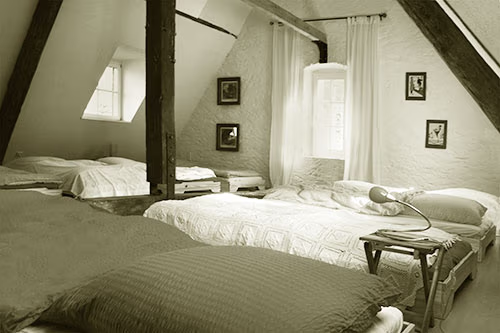
- Pilgerherberge Mosel „Alte Lateinschule“: in the Latin school of 1573 next to the Protestant church in the Kirchgasse, right on the route. Ulrike Böcking has run it since 2011. You need a pilgrim passport, and breakfast is included. Book by phone or email; the contact details are in the app.
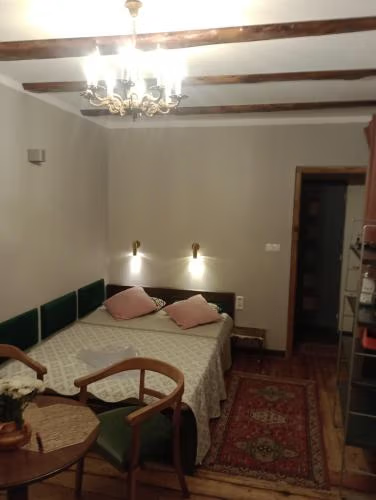
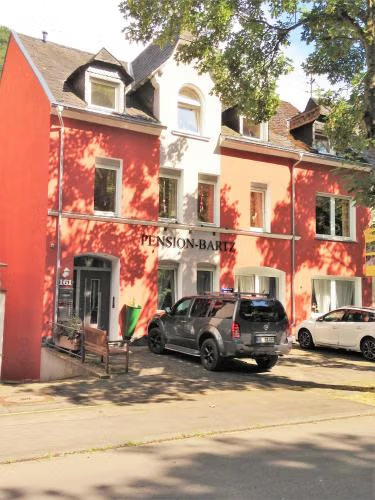
There are also two budget alternatives. The Mosel-Jugendherberge on the Hirtenpfad has reopened after a modernisation in summer 2026, every room has its own bathroom, and a bed in a shared room costs from €29 with breakfast according to Camino Ninja. There is also a small private hostel with dorm beds from €29 that you can book through booking platforms. The other beds are guesthouses, hotels, wine estates and holiday flats.
Ninja tips
- Stop at the Himmelspforte: Just before the descent, on the Moselsteig, is the finest view of the town. From here you see both banks, the bridge and Mont Royal at once.
- The stamp is on the other side: You get your pilgrim stamp at the Tourist-Information by the station in Traben, Am Bahnhof 5. Cross the bridge and take in the Brückentor on the way.
- Goethe's wine: Goethe arrived by boat in the dark in November 1792 and later wrote of the evening with the Böckings: „wir genossen des köstlichsten Moselweins“. Try it in one of the old cellars.
- Find the fire ash: At Mittelstraße 7 a black lump of melted fire ash is set into the gable wall. This is where the town fire broke out on 21 July 1857, after which Trarbach rebuilt its streets on a grid.
- Underground in Advent: If you arrive at a weekend between 20 November and 2 January, spend the evening at the Christmas market in the old wine cellars.
Practical tips for pilgrims
- Pilgrim stamp: at the Tourist-Information, Am Bahnhof 5, phone 06541 83980.
- Pilgrim passport: For the Mosel-Camino it is issued by the St. Jakobusbruderschaft Trier, by post or at the pilgrim office in Trier. Get it in advance; the hostel wants to see it.
- Getting here and away: The Moselweinbahn runs from Traben-Trarbach to Bullay, where you connect to the Koblenz–Trier line. Bus 350 goes to Wittlich.
- Water: Fill your bottles in town. There is none on the heights between the stage towns.
Onward: over the Graacher Schanzen to Bernkastel-Kues
You leave Trarbach at the Protestant church through the Kirchgasse, Gerberstraße, Wildbadstraße and Bernkasteler Straße as far as the Gymnasium. Then you climb steeply up onto the heights. Via the Taubenhaus and the Graacher Schanzen you reach Bernkastel, 6.7 kilometres according to Camino Ninja, and cross the Moselle bridge to Bernkastel-Kues. After that the route continues through the vines via Lieser and the Brauneberg.
What awaits you tomorrow
Tomorrow is a recovery stage. According to Camino Ninja it is 17.8 kilometres to Osann-Monzel, where most Camino Ninja pilgrims end this stage and beds are cheaper than in the two tourist towns. On the way, in Kues, the St.-Nikolaus-Hospital awaits, founded by Nicholas of Cusa in 1458 for 33 men in need. In its chapel lies the cardinal's heart. The rest of him is buried in Rome.
Deep dive: Two banks, one wine and a bridge
A long read, in case you want to learn more about Traben-Trarbach. About fifteen minutes' reading.
Down from the Himmelspforte
When you come from Starkenburg, you have almost finished one of the hardest days of the Mosel-Camino. You set off from Bullay this morning, over the Marienburg, through Zell and Enkirch, over the Bummkopf and the Rottenblick. Now you walk past the Bismarckhütte, which is still waiting to be rebuilt, and along the Moselsteig to a viewpoint called the Himmelspforte, the gate of heaven. Below you lies a town in two parts. Left and right of the Moselle, joined by a bridge, a railway station on one side, a castle ruin on the other. Opposite rises a ridge in the Moselle loop. On it once stood a fortress that was meant to be among the largest in France.
Then comes the road to the Grevenburg, steep, with a 20 percent gradient. From the castle old steps lead down into the lanes of Trarbach, and through the Kirchgasse you climb to the Protestant church. Next to it stands a house with a stair tower, built in 1573 as a Latin school. Today it is a pilgrim hostel.
This text tells how two villages on a river became one town. It is about a countess who held an archbishop captive, a king who was looking for the way to the Rhine, a fire, a great deal of wine and an architect from Berlin. And it takes you all the way into a bunker inside the mountain that made headlines once more in this century.
A manor for Aachen and a castle on the ridge
The oldest record comes from the left bank. In the year 830 Traben is mentioned, and Emperor Louis the Pious, a son of Charlemagne, gave the place to the minster in Aachen. Trarbach on the right bank did not yet play much of a role. Its story begins a little higher up, on the rocky ridge you walked along today.
Where the village of Starkenburg lies now, the Romans had already built a fort. Around the year 412 the Franks probably destroyed it. From 1125 the Counts of Sponheim sat on the ridge, more precisely the line known as the Rear County. In the year 1200 the name appears in a charter for the first time, as Starkenberg. The castle lay exactly on the border between two parishes, Enkirch and Traben, and therefore had two feudal lords. The Enkirch part was granted by the Archbishop of Trier, the Traben part by the distant abbey of Corvey on the Weser.
The countess and the archbishop
The most famous resident of the Starkenburg came from the Vosges. Loretta, born around 1300 into the House of Salm, married Count Henry the Second of Sponheim-Starkenburg in 1315. Eight years later she was a widow with three sons. When her father-in-law also died in 1324, she took over the regency for her young son John. The county was in a difficult position, with disputes over territory, poor harvests and little money.
Her most powerful neighbour was Baldwin of Luxembourg, Archbishop of Trier and Prince-Elector. In May 1328 Baldwin was travelling by ship on the Moselle, through Sponheim territory. There was a standstill agreement between him and the countess. Even so, Loretta and her retinue took him by surprise and brought the archbishop to the Starkenburg, which was considered impregnable. There she negotiated hard, and in the end she obtained a ransom and the fulfilment of her political demands.
For this she faced excommunication. Loretta asked Pope John the Twenty-Second for absolution and penance, and Baldwin himself supported her petition. The hostage became a political friend. It is said that she later used the ransom to build the Frauenburg near Birkenfeld, to which she retired when her son married in 1331 and took over the government. She died in 1346 and was buried in the Cistercian abbey of Himmerod in the Eifel. In Traben-Trarbach a circular hiking trail still bears her name.
The counts' castle above Trarbach
Her son John the Third ruled the county for 67 years. He was called the Noble and, because his eyesight failed in old age, the Blind. It was he who brought the family down from the ridge. Around 1350 he had a new castle built above Trarbach, the Grevenburg, the counts' castle. In 1357 it is mentioned by name for the first time. After that the Starkenburg was run only by castle officials and slowly fell into decay.
John also had a church built in Trarbach and installed an abbot from Himmerod, the abbey where his mother is buried as well. The abbot had to say Mass in Trarbach every day, and when the count was away, three times a week. John died on 30 December 1398 and was also laid to rest in Himmerod. In 1437 the line of counts died out. The Grevenburg became the seat of the officials of their heirs, the Margraves of Baden and the Counts Palatine, who ruled the county jointly.
The church in the Kirchgasse
The Protestant church you sleep next to is the main church of Trarbach. It is first mentioned around 1330. Whether it is the church John had built, or an older one that he enlarged, the sources do not say clearly. Work on it went on from the fourteenth into the sixteenth century. It has two unequal naves, and the west tower probably has a Romanesque core. Its site is called Auf Kästel, and some see in the name a hint of a Roman predecessor building.
In 1557 the Count Palatine Frederick the Second introduced the Lutheran Reformation in the county. This made Trarbach something rare on the Moselle: a Protestant town surrounded by the Catholic archdiocese of Trier. The church district of Trarbach later counted as one of three Protestant islands on the Moselle. In 1573 the Latin school was built next to the church, and in 1672 Trarbach received a Lutheran consistory. At times Protestants and Catholics in Trarbach shared one church, a so-called simultaneum. Files on this run from 1677 to 1817.
In the town fire of 1857 the church burned too. Today it is open, and its treasure is the organ. Johann Michael Stumm built it in 1748, a member of the family of organ builders from the Hunsrück. It was rebuilt in 1935 and reconstructed in 2010. How the instrument survived the fire, or whether it only came here later, we have not been able to find out.
On the other side of the bridge stands the Protestant Peterskirche of Traben. A charter concerning it dates from 1491; it is partly late Romanesque, partly late Gothic, and was enlarged in 1968 and 1969. The Catholic church of Sankt Peter und Paul in Traben is younger, a neo-Romanesque church of slate built from 1910 to 1912. This too shows that Catholics only became numerous here late on.
A king looks for the way to the Rhine
In the seventeenth century the small county lay between the front lines. In the Thirty Years' War the Grevenburg was captured several times, and Spanish troops added casemates and an outwork in front of the gate. Around 1680 Louis the Fourteenth of France laid claim to the area, as part of his policy of claiming whole stretches of land along the border for France.
In 1681 his war minister Louvois sent out an engineer officer named Thomas de Choisy. He was to find a site on the way to the Rhine. Choisy chose the ridge in the Moselle loop opposite Trarbach. On 24 March 1687 Vauban, commissioner general of the French fortifications, was commissioned with the design. On 23 May he presented it to the king and received 12,000 silver thalers for it. In June Louis gave the fortress its name, Mont Royal, the royal mountain. On 25 July 1687 the foundation stone was laid.
What followed was enormous. Up to 8,000 people did forced labour. The fortress covered 50 hectares, was 1,600 metres long, and its rampart was almost three kilometres long and up to 20 metres high. On top of that came an entire garrison town. In 1690 it supplied 8,450 soldiers, 3,000 horses and 1,500 civilians. There was the largest arsenal in France, barracks for more than 4,000 soldiers and a hospital with about 1,000 beds. The Grevenburg on the other bank was turned into an outer fortress.
Mont Royal was never finished. On 30 October 1697 France concluded the Peace of Rijswijk, and afterwards the fortress had to be demolished before construction was complete. The troops withdrew, and the civilian population was resettled in Saarlouis. Ten years of work by thousands of people were taken down again. What you find on the ridge today are a few remains of walls.
Besieged four times, blown up once
The Grevenburg still had almost four decades ahead of it. In the War of the Spanish Succession the French under Tallard took it in 1702. In 1704 Frederick of Hesse-Kassel, on the orders of the Duke of Marlborough, overpowered the French garrison, and afterwards the Dutch occupied the badly damaged castle. In 1714 the Electorate of Trier became its owner and had it repaired in 1730 to protect Koblenz and the Rhine.
In the War of the Polish Succession the French came back. After a three-week siege they took the Grevenburg for the fourth and last time. The estates of the Archbishopric of Trier refused to pay for rebuilding, and so the castle was blown up in July 1734. Large sections crashed into the valley. What remains is mainly the west wall of the commander's house, which you can see from far away, and below it the foundations.
Goethe arrives in the dark
In the eighteenth century Trarbach became a town of merchants. From 1747 trade restrictions fell away. The Protestant merchants had connections to the Netherlands and to England. In the middle of the century Johann Adolf Böcking, tax collector of the county of Sponheim, had a Baroque house built on the riverbank, to plans by the chief building director Christian Ludwig Hautt from Zweibrücken. Six generations of the family lived in it.
In November 1792 the house received a guest who would make it famous. Johann Wolfgang Goethe came by boat on the Moselle, in the autumn of a year in which the campaign against revolutionary France had failed. In his Kampagne in Frankreich he wrote: Nun überfiel uns die Nacht, bevor wir Trarbach erreichen oder auch nur gewahren konnten. Night fell before they could reach Trarbach or even see it. Storm and current made the journey hard. And then: Endlich stiegen wir in Trarbach glücklich ans Land, at last they happily went ashore. With the Böckings, as he wrote, he enjoyed des köstlichsten Moselweins, the most exquisite Moselle wine.
In the museum one room is now called the Goethe room. In 1837 the future Prussian king Frederick William the Fourth was a guest, and according to the town the French poet Apollinaire too. Since 1955 the house has been the Mittelmosel-Museum. It was founded by the local historian Ernst Willen Spies, who brought the original plans of the Mont Royal fortress back from Paris during the Second World War. A dining room is lined with 1,100 Delft tiles that once came up the Moselle as ballast on ships. And the house survived 1857.
The summer Trarbach burned
On 21 July 1857 a fire broke out in the Mittelstraße. It was summer, the half-timbered houses with their clay walls had dried out, and fresh hay and straw lay in the lofts. The wind blew from the Moselle into the side valley of the Kautenbach and carried the sparks from roof to roof. And the town's two best fire pumps had just been lent to the neighbouring town of Zell.
After about four hours it was over. Of 220 houses, 40 were still standing, and of all 355 buildings, 55. Only at the town entrances and on the riverbank could some be saved, among them Haus Böcking. Two days later the Bonner Zeitung reported around 250 houses destroyed, the church among them. According to the reports nobody died. The cause was never established. A legend says children had been frying eggs in a loft.
It was a summer of fires on the Moselle. Two days after Trarbach, Bernkastel burned, and on 12 August Traben. Afterwards Trarbach rebuilt itself with streets at right angles, and half-timbering was banned and disappeared from the townscape. And at Mittelstraße 7 a black lump of melted fire ash is still set into the wall, at the spot where it all began.
A town on cellars
The new Trarbach was built on wine, quite literally. In the second half of the nineteenth century the merchants dug cellars under both parts of town until large areas of the centre were hollowed out. Some vaults are more than 100 metres long, some extend over several storeys. Demand for Riesling from Great Britain and overseas was huge. In 1870 Traben was connected to the railway, and exports grew further.
In 1899 the town had around 100 wine merchants, wine estates and large cellars. That year they traded about 18 million litres of wine, roughly half of the entire German harvest. In Europe, so they say here, only Bordeaux was bigger. The wealth of those years created a prosperous middle class, and a spa and bathing business was added.
The boom was short. From 1901 poor harvests, new laws on wine sales and cheap foreign wines hit the merchants, and the First World War ended the great era. The cellars have remained. More than 10,000 people go down on tours every year, and in Advent a Christmas market is held in them, underground.
A bridge after fifty years
What the two wine towns lacked was a fixed connection. For almost fifty years the sister towns hoped for a bridge. In 1848 French engineers offered to stretch wire-rope bridges across the Moselle. In 1854 someone drew a stone bridge with ten arches. After Traben was connected to the railway in 1870, the matter was discussed again.
In the end it was built to designs by an architect from Berlin, Bruno Möhring, born in Königsberg in 1863. He had specialised in the artistic design of iron structures, especially bridges. On 7 May 1898 the first sod was cut, on 10 August the foundation stone was laid for the piers in the river, and four months later all the piers were standing. In August 1899 the last arch was closed, and on 20 December 1899 the bridge opened, 239 metres long. It cost 707,000 marks.
On the Trarbach side, early in 1899, Möhring built a gate that looks like the entrance to a medieval castle and yet belongs entirely to its own time, with towers, slate and red sandstone. The sculptural work was done by Bernhard Wendhut from Traben. He placed a dancing winegrower couple above the archway and a raven with its young in the nest on a column. From the start there was a wine tavern in the gate. In 1904, five years after the bridge, Traben and Trarbach became one town.
A Berliner on the Moselle
While the bridge was being built, Möhring got to know the wine merchants and hoteliers of the two towns, and they became his clients. In 1900, at the World's Fair in Paris, he designed the German wine exhibition and the wine restaurant in the German House. Back on the Moselle he built the Hotel Clauss-Feist for Richard Feist from 1901 to 1903, today the Art Nouveau hotel Bellevue, outside with Moselle slate and sandstone, inside pure Art Nouveau.
In 1904 the Villa Huesgen was finished, for the wine merchant Adolph Huesgen, who because of his imposing appearance was called the Moselle Bismarck. Möhring designed the house, the interiors and the garden as a single whole. In the garden hangs a copper plate with a lion's head that Huesgen had bought at the World's Fair in Paris. In 1905 came the Villa Breucker, whose porch recalls a Japanese pagoda. And around 1906 the Julius Kayser winery was built, considered the only winery in Europe built in the Art Nouveau style.
Möhring became one of the most important Art Nouveau architects in Germany. He built bridges in Berlin and Bonn and later planned high-rises when most of his colleagues still rejected them. He died in Berlin in 1929. In 2003 Traben-Trarbach put up a monument to him, and the old Kayser winery today has the address Bruno-Möhring-Platz 1.
Eleven minutes past nine
The Art Nouveau buildings largely survived the Second World War; the bridge did not. On 13 March 1945, at 9:11 in the morning, it was blown up, in the last weeks of the war. The gate remained standing, and it still stands in its pre-war state today. In 1947 and 1948 the bridge was rebuilt.
The mountain opposite had its own twentieth-century story too. From 1929 to 1937 the remains of the Mont Royal fortress were partly excavated, in the end with the Reich Labour Service. The regime of the day hoped this would have a propaganda effect against France. After the war the ruins were opened up again for visitors.
A bunker in the mountain
After the war the Bundeswehr, the German armed forces, moved onto Mont Royal. From the late 1970s the barracks housed the military geophysics office, later the geoinformation office, and deep in the mountain lay a bunker with five levels, up to 25 metres deep, in which the Bundeswehr ran a data centre. In 2012 the office moved out, and in April 2013 the Bundeswehr handed over the site.
In June 2013 a Dutchman named Herman Johann Xennt bought it for 450,000 euros. In it he ran a service that hosted websites and advertised that it would keep them online regardless of content. In September 2019 hundreds of police officers searched the bunker and seized 886 servers. Darknet drug markets, data fencing and attacks on computers are said to have run on them, almost 250,000 offences in all.
On 13 December 2021 the regional court in Trier convicted eight defendants of forming and belonging to a criminal organisation, sentencing the main defendant to five years and nine months. The court acquitted them of aiding and abetting the offences committed on their servers. And here lies the question that is still argued over: is the person who rents out the space responsible when crimes happen inside it? The court found that the defendants knew their customers were using the servers for crimes. According to reports, the judgment said: Eine generelle Kenntnis, dass illegale Dienste gehostet werden, reicht aber für den Gehilfenvorsatz nicht. General knowledge that illegal services are being hosted is not enough for intent to aid. The prosecution had wanted more, and the defence denied there was a criminal organisation at all. You do not have to decide this. But on the mountain where a king once built his fortress, there is now a bunker that has belonged to the state of Rhineland-Palatinate since 2023. In June 2024 the state wanted to sell it at full value. Whether that has happened since, we have not been able to find out.
Buddhas in the winery, pilgrims in the Latin school
The town's most recent history is quieter. In 2000 the entrepreneur Wolfgang Preuß, a Buddhist from Mainz, bought the old Kayser winery. He had it restored as faithfully as possible, with natural stone, and in 2009 the Buddha Museum opened in it. He collected around 2,000 figures from Burma, China, India, Cambodia, Laos and Thailand over some twenty years. The largest is 3.90 metres tall and weighs two tonnes. That Buddhas should sit of all places in a Moselle winery is one of the lovely surprises of this route.
And then came the pilgrims. In the summer of 2008 two private individuals, Karl-Josef Schäfer and Wolfgang Welter, laid out the Mosel-Camino from Koblenz to Trier, with yellow shells on a blue background. Since 2011 the old Latin school next to the church has been a pilgrim hostel, run by Ulrike Böcking. In the same year an annual pilgrims' meeting began in Traben-Trarbach, around the feast of Saint James on 25 July. In 2012 it included a concert in the Peterskirche entitled Auf den Wegen nach Santiago de Compostela and, on the Sunday, a pilgrims' service in Starkenburg. Today the Latin school is one of only two pilgrim hostels on the whole route.
What Traben-Trarbach gives you
Traben-Trarbach is a town that was built twice, above and below. Above stand the counts' castles and the walls of a king who never finished. Below lie the cellars of the merchants who grew rich on wine until the war came. In between flows the Moselle, and across it runs a bridge that both banks waited fifty years for.
Perhaps you will take one image away with you. In the evening you walk from the hostel in the Kirchgasse down to the river, across the bridge to Traben and back through the gate, beneath the winegrower couple who have been dancing above the arch since 1899. Tomorrow you climb back onto the heights, over the Graacher Schanzen to Bernkastel and Kues, to a cardinal of whom only the heart came home. Trier is still 73.5 kilometres away. One of the hardest days is behind you.
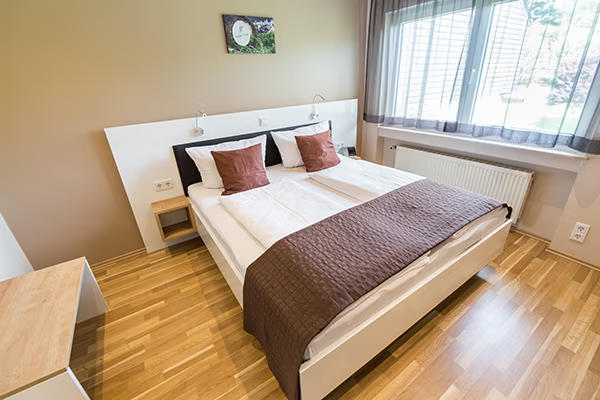
Where to stay in Traben-Trarbach
Places to stay in Traben-Trarbach.
 Open
Pilgerherberge Mosel "Alte Lateinschule"
 OpenReservations accepted
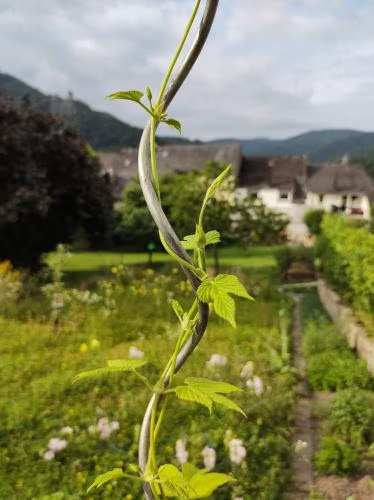
Monkey Factory - Mini Home-Stay Hostel
 Open
Mosel-Jugendherberge Traben-Trarbach



Services in Traben-Trarbach
What you can find in town before the next stage.
- ATM
- Café
- Shop
- Medical clinic
- Pharmacy
- Fountain
- Train station
- Bus station
- Airport
- Restaurant
Source: © OpenStreetMap contributors · updated April 2026