

Town on the Camino
Koblenz-Stolzenfels
Germany
- places to stay
- 8
- Caminos
- 2
- Elevation
- 105 m
Koblenz-Stolzenfels is where the Mosel-Camino begins: a district on the Rhine below a neo-Gothic palace that the Prussian king Frederick William IV had built from a castle ruin. The Lahn-Camino ends here, and from here it is 157.2 kilometres to the apostle's tomb in Trier.
How long to stay?
An afternoon is enough. Stolzenfels is a place to start, not a place to linger. If you arrive the day before, you have time for the palace above the village, which you can only see inside on a guided tour, and for an evening in Koblenz, where most pilgrims sleep. The next morning the path climbs straight away.
Koblenz-Stolzenfels in Ninja numbers
- 157.2 kilometres separate you from Trier on the Mosel-Camino.
- 425 metres is the height you reach on the very first day, 9.1 kilometres after the start in the forest, having set off by the Rhine at 105 metres.
- 1842 is the year Frederick William IV moved into the rebuilt palace.
- 6 euros is the admission to the palace; according to the operator, the reduced price of 5 euros applies to everyone until further notice (as of October 2026).
Arriving: on the Rhine below the palace
The Mosel-Camino does not begin on the Mosel but on the Rhine: on the bank at Stolzenfels, a district in the south of Koblenz. If you come along the Lahn-Camino, you have already arrived, because it ends exactly here, via Lahnstein. Everyone else comes out from Koblenz; according to one pilgrim's account, by bus.
From the Rhine you climb past the parish church of St. Menas up to the palace and on into the Koblenz city forest. So on your first day you swap the Rhine for the Mosel.
In brief: from toll castle to royal palace
Around 1244 the Archbishop of Trier, Arnold of Isenburg, had a castle built here, and tolls on the Rhine were levied at it until 1412 at the latest. In 1688 French troops destroyed the castle, after which it served as a quarry. In 1802 the ruin passed to the city of Koblenz, which gave it in 1823 to the Prussian crown prince, the later King Frederick William IV. From 1836 it was rebuilt to plans by Karl Friedrich Schinkel, and in 1842 the king moved in with his court. Together with the park by Peter Joseph Lenné, the operator calls it the most important testimony of Prussian Romanticism on the Rhine.
At the starting point: what to see
Both lie right on the route; the palace takes time.
- Stolzenfels Palace: The castle of the archbishops of Trier, which a Prussian king turned into a dream of the Middle Ages. For pilgrims it fits: the Mosel-Camino leads to Trier, and the castle once belonged to the very archdiocese whose apostle's tomb you are walking to. You can only see the inside on a German-language guided tour, which is included in the admission; for other languages there is an accompanying booklet. We did not find opening hours, so check the operator's website beforehand.
- The palace park: The palace has a landscape park with a pergola garden, a flowerbed in the shape of a Gothic rose window, a fountain and a viaduct.
- St. Menas: The parish church at the foot of the palace was finished in 1833 in rubble stone in the neo-Romanesque style, designed by Claudius von Lassaulx. According to a hiking portal it is the only church north of the Alps dedicated to the Egyptian martyr Menas.
Honestly
- You will hardly sleep in Stolzenfels itself. The accommodation is in Koblenz, so you travel there the evening before and come back in the morning.
- The first day starts with the longest climb. In the first 9.1 kilometres you go from the Rhine up to 425 metres.
- The palace can only be seen on a tour. If you want to set off early, you will see it from outside.
Where pilgrims sleep
There is no pilgrim hostel in Stolzenfels. The accommodation Camino Ninja shows for the starting point is in the city of Koblenz: hotels and guesthouses in every price range. So plan for a journey out in the morning.
Ninja tips
- Visit the palace the day before. A guided tour takes time you will not have on your first walking day.
- Get your first stamp along the way. We did not find a stamp point in Stolzenfels; the tourist information in Karden stamps your pilgrim passport on the second day.
- Take water. The first kilometres run through forest, and no shop on the way to Alken is documented.
Onward: over the Hunsrück to the Mosel
From the palace the path climbs through the Koblenz city forest, via Waldesch and Naßheck up to 425 metres, and then down to the pilgrimage church of Bleidenberg and to Alken on the Mosel: 17.6 kilometres with 443 metres of ascent and 463 metres of descent.
What awaits you tomorrow
Tomorrow you reach the Mosel. Just before Alken you pass the pilgrimage church of Bleidenberg, 1.2 kilometres before the end of the stage. After a day in the forest, your first view of the river is the reward.
Deep dive: A king, a ruin and a pilgrim way
A short read, in case you want to learn more about Koblenz-Stolzenfels. About three minutes' reading.
A castle for tolls
In the Middle Ages the Rhine was one of the most important trade routes in Europe, and whoever owned land on its banks made people pay to pass. Around the year 1244 the Archbishop of Trier, Arnold of Isenburg, had a castle built on this spot. Its main purpose was the toll. Until 1412 at the latest, money was collected here from the ships sailing up and down the Rhine.
Ruin and quarry
In 1688 French troops destroyed the castle after they had besieged Koblenz in vain. Afterwards the people of the area took whatever stones they needed. For more than a hundred years Stolzenfels was a ruin. In 1802 it passed to the city of Koblenz.
A king's dream
In 1823 the city gave the ruin to the Prussian crown prince Frederick William, who later became king. He loved the Middle Ages, or what the nineteenth century took them to be. From 1836 he had the castle rebuilt to plans by Karl Friedrich Schinkel, and he wanted to keep as much of the old walls as possible. Peter Joseph Lenné laid out the park. In 1842 the king moved in with his court, in historical costume, as the story goes.
What Stolzenfels gives you
You begin your journey at a place that has been reinvented twice: first as an archbishop's castle, then as the palace of a king who dreamed of a past age. A pilgrim way is something like that too. The Mosel-Camino has been waymarked since the summer of 2008; it is young, but it follows an old goal. At the end, in Trier, the only apostle's tomb north of the Alps is waiting. You have a good week to get there.
Where to stay in Koblenz-Stolzenfels
Places to stay in Koblenz-Stolzenfels.
 OpenReservations accepted
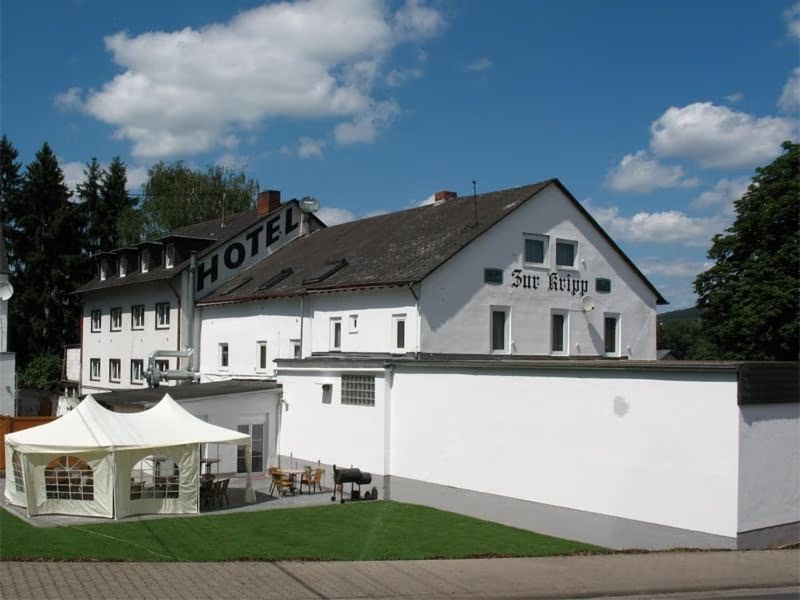
Hotel Restaurant Zur Kripp
 OpenReservations accepted
bestprice Hotel Koblenz
 Open
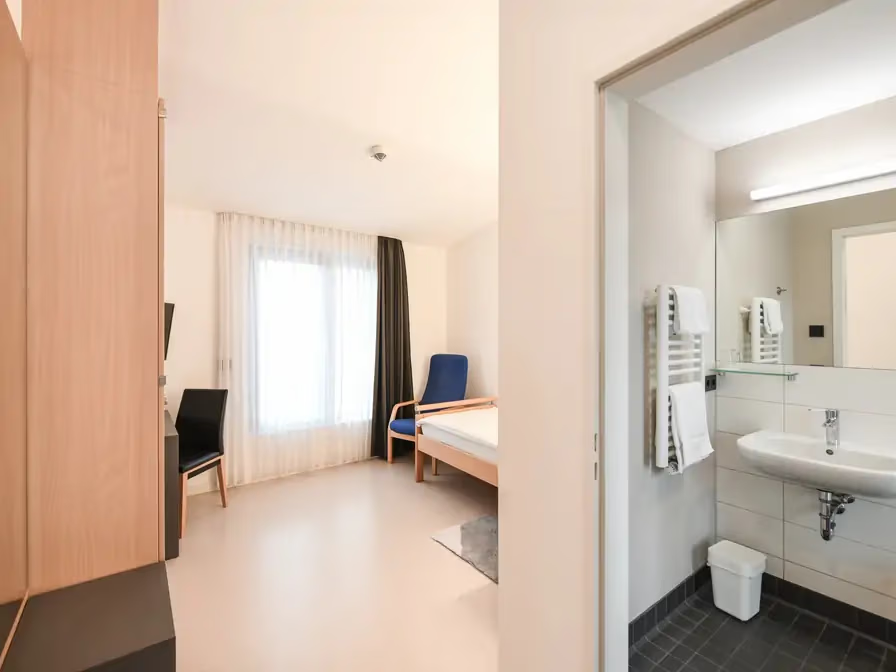
Peter-Friedhofen-Haus


Services in Koblenz-Stolzenfels
What you can find in town before the next stage.
- ATM
- Café
- Shop
- Pharmacy
- Fountain
- Post office
- Train station
- Bus station
- Airport
- Restaurant
Source: © OpenStreetMap contributors · updated April 2026
Town 1 of 13