

Town on the Camino
Leça da Palmeira
Distrito do Porto, Região do Norte, Portugal
- place to stay
- 1
- Camino
- 1
- Elevation
- 11 m
Leça da Palmeira is where the Senda Litoral truly reaches the sea: 12.1 kilometers beyond Porto, over the lift bridge of the port of Leixões, then past rocks, a chapel from 1392 and two buildings by Álvaro Siza. Port and old refinery lie right next to it. A stop, not a stage end.
Right now in Leça da Palmeira (as of October 2026)
- Lift bridge closed: The Ponte Móvel de Leixões between Matosinhos and Leça has been closed since October 7, 2026 because of a defect in the northern part of the bridge. For pedestrians the port authority is running buses. We found no announcement of a reopening by the end of October.
- Sea-water pool in summer only: The Piscina das Marés is open only from June to September.
How long to stay?
One hour is enough. For almost everyone Leça is a place to pass through, only 12 kilometers after the start in Porto and without a pilgrim albergue. Take the time for the chapel of Boa Nova on its rock and for a look at the two Siza buildings on the promenade. If you love architecture, plan a summer day for the sea-water pool; everyone else walks on north.
Leça da Palmeira in Ninja numbers
- 12.1 kilometers you have walked since the cathedral of Porto, almost without any climb.
- 271.3 kilometers from here to Santiago on the Senda Litoral.
- 1392 is when Franciscans founded the hermitage from which the chapel of Boa Nova grew. It is the oldest thing you pass today.
- 46 meters is the height of the Leça lighthouse, the second highest in Portugal, with 225 steps.
- 14.5 kilometers to the next public pilgrim albergue in Vila Chã.
Arriving: over the lift bridge
You come from Matosinhos and cross the Leixões harbor basin on a lift bridge that opened in 2007. If it is closed, a bus takes you from one end of the bridge to the other; walking around the port is not a sensible option. Then the Way leads through the Rua Hintze Ribeiro to the coast and north along the promenade. On the median strip of the Avenida da Liberdade stands an azulejo panel with a quatrain by the poet Emmanuel Rodrigues da Rocha, who wrote many of his poems at the lighthouse. Behind you cranes and cruise terminal, ahead of you beach, rocks and Siza's concrete.
In brief: the palm pilgrims
The name Leça is derived from a Roman villa on the river Leça. The addition Palmeira probably goes back to the *palmeiros*, pilgrims from the Holy Land who came ashore here and rested. The place is documented since 1081, and in the 13th century an important church of the Archangel Michael stood here. In 1392 Franciscans built the hermitage of São Clemente das Penhas on the rock by the sea, today's chapel of Boa Nova. From 1638 a fort against pirates was added, in 1884 construction of the port of Leixões began, today the second largest seaport in Portugal. In 1970 the refinery went into operation, and in April 2021 it was shut down. And in between, between 1958 and 1973, a young architect from Matosinhos built his first works on the beach of Leça: Álvaro Siza.
At the edge of the sea: what to see
Everything lies along the promenade, in the first three kilometers beyond the bridge.
- Piscina das Marés: Siza built the sea-water pool into the rocks on the beach, planned from 1960, finished in 1973, a national monument since 2011 and renovated from 2019 to 2021. It lies about 70 meters off the Way. It is open only from June to September; in autumn you see it from the promenade, and precisely then you understand how flat it lies among the rocks.
- Capela da Boa Nova: The small chapel on the rocky spur above the Praia da Boa Nova stands right on the Way. It goes back to the Franciscan hermitage of 1392. Behind the chapel a staircase leads to a viewing platform. Whether it is open inside, we did not find out.
- Casa de Chá da Boa Nova: Siza's first building, built from 1958 to 1963, lies next to the chapel on the rocks, barely above the water, a national monument. Today it is a restaurant with two Michelin stars, open Tuesday to Saturday. For pilgrims it is a building to look at. Siza's works have been on Portugal's tentative list for World Heritage since 2016; UNESCO deferred the application in July 2025.
- Leça lighthouse: Built in 1926, 46 meters high, automatic since 1979, three flashes every 14 seconds. You see it from the promenade; we did not find regular visiting hours.
Food and drink
Leça traditionally lives from fishing and is known for fish and seafood. We did not find any specific pilgrim eateries. For a break with a wide choice, the center of Matosinhos is better, which you cross a kilometer earlier.
Honestly
- Industry next to the beach. Port, cruise terminal and the site of the closed refinery shape the view; from Boa Nova on you walk along industrial installations.
- The bridge is a bottleneck. In 2018, in summer 2026 and again since October 2026 it was closed. Then you wait for the bus.
- Siza in autumn only from outside. The pool is closed, the tea house is a starred restaurant.
- No pilgrim albergue. If you want to sleep here, you pay hotel or apartment prices.
Where pilgrims sleep
We did not find a documented pilgrim albergue in Leça da Palmeira, whether public, church-run or private. You sleep more cheaply in the hostels of Matosinhos, a kilometer back, or you walk on: in Labruge, 12.2 kilometers farther, there is an albergue, and in Vila Chã after 14.5 kilometers the public pilgrim albergue.
Ninja tips
- Take the metro to Mercado. Many pilgrims start the coast at the Mercado metro station in Matosinhos and save themselves the eleven kilometers from Porto. From there it is one kilometer to Leça.
- Bridge closed? Take the bus. The shuttle buses for pedestrians leave from the end of the bridge; bicycles are allowed on board.
- Climb up behind the chapel to the platform. From there you see tea house, rocks and lighthouse all at once.
- Stop at the quatrain. The azulejo panel on the Avenida da Liberdade stands right on the Way, with the lighthouse in the background.
- Alternate between sand and boardwalk. On the next kilometers sand is tiring; walk on the wooden boardwalks where there are any. Cyclists must use the promenade.
Practical tips for pilgrims
- Stamp: We did not find a stamp location in Leça. Get your stamp in Porto or Matosinhos.
- Getting here: Metro from Porto to Mercado (Matosinhos), then on foot over the bridge.
Onward: on boardwalks to the north
The Senda Litoral stays flat by the sea, mostly on wooden boardwalks and promenades, in places in sand. Beyond Boa Nova it passes the refinery site to Aldeia Nova (km 16.6), then via Praia de Angeiras (km 22.8) and Labruge (km 24.3) to Vila Chã (km 26.6). It is 21.8 kilometers from here to Vila do Conde.
What awaits you tomorrow
Whoever starts today in Porto or Matosinhos usually sleeps in Vila Chã, a fishing village where women once led the boats out as captains. The public albergue lies in the former kindergarten, right next to the small fishing museum.
Deep dive: A place for pilgrims who wanted to go elsewhere
A short read, in case you want to learn more about Leça da Palmeira. About three minutes' reading.
The name
Whoever walks through Leça da Palmeira walks through a place name that perhaps comes from pilgrims, just not from pilgrims to Santiago. Palmeira, according to the common interpretation, comes from the Palmeiros, the pilgrims who returned from the Holy Land and carried a palm branch as their sign. Here, at the mouth of the Leça, they are said to have come ashore and rested. This is not proven. But it is a beautiful thought that on the way to Santiago you are walking through a place named by returnees from Jerusalem.
The monks on the rock
In 1392 Franciscans built a hermitage on the rocky spur by the sea and dedicated it to Saint Clement. It lay at the outermost edge, between rock and surf, and later a beacon stood there too. The monastery to which the chapel belonged has disappeared. The chapel still stands, and the Way leads directly past it.
A port, a refinery, an architect
In the nineteenth and twentieth centuries Leça became the backyard of a great port. In 1884 construction of Leixões began, in 1970 came the refinery, whose towers still stand above the beach, although it was shut down in 2021. And into the middle of this landscape a young architect from the neighboring town set his first buildings. Álvaro Siza built the tea house on the rocks next to the chapel between 1958 and 1963, and by 1973 the sea-water pool in the cliffs farther south. Both buildings do something unusual: they subordinate themselves to the rocks. Whoever sees the pool in winter, empty, among the stones, understands why it was proposed for World Heritage.
What Leça gives you
When this text was written, in autumn 2026, the lift bridge stood still once again, and pilgrims rode the bus across the harbor basin. Leça is not a beautiful place in the usual sense. It is an edge: between city and sea, between industry and art, between the first day and the rest of the Way. From here on the sea is your companion, all the way to Galicia.
Where to stay in Leça da Palmeira
Places to stay in Leça da Palmeira.
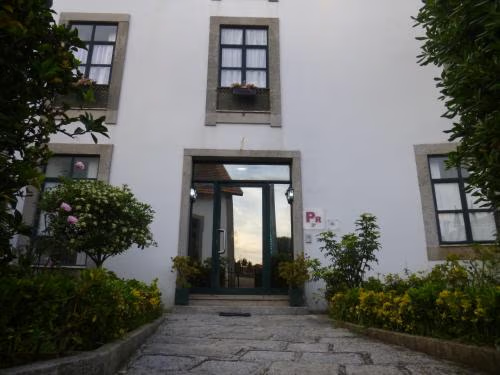 OpenReservations accepted
Residencialusobrasileira
Services in Leça da Palmeira
What you can find in town before the next stage.
- ATM
- Café
- Shop
- Medical clinic
- Pharmacy
- Fountain
- Post office
- Train station
- Airport
- Restaurant
Source: © OpenStreetMap contributors · updated April 2026
Town 3 of 33