

Stage town on the Camino
Porto
Distrito do Porto, Região do Norte, Portugal
- places to stay
- 51
- Caminos
- 5
- Elevation
- 59 m
Every year more than 50,000 pilgrims start the Camino Portugués in Porto, and those coming from Lisbon take their first long break here. The old town on the slopes above the Douro is steep, beautiful and busy. From the cathedral you walk to Santiago along the coast or inland, 244 to 283 kilometres away.
Right now in Porto (as of October 2026)
- Go to the pilgrim office: Since 2026 there has been an Oficina do Peregrino right next to the cathedral on Rua da Pena Ventosa. A team of volunteers answers your questions knowledgeably, and you can get your credencial, stamp, luggage storage and backpack transport there. We recommend it without reservation. It is open daily 7–12 and 15–17 until 31 October, and from 1 November only 10–12.
- Tourist tax: €3 per person per night (from age 13, maximum 7 nights). Under the city's rules, pilgrims staying in hostels are exempt. Since the end of September 2026 the city has been considering an increase.
- Metro construction: The new Linha Rosa from São Bento is not expected to open until the first quarter of 2027. Construction for the Linha Rubi in Vila Nova de Gaia will continue until 2028, including at the Santo Ovídio roundabout, where pilgrims from Lisbon arrive.
How long to stay?
Worth a rest day, so at least one full day before you start. If you land in the evening and want to set off the next morning, you'll find the counters closed. Credencial, first stamp, metro ticket and the decision between coast and inland all need sorting out before you shoulder your pack. And the city is worth it: the cathedral with its figure of Saint James, the tile pictures in São Bento station and the view from the Luís I bridge all lie within a good kilometer and a half, but on slopes and stairs that take time. If you come from Lisbon, you have about 300 kilometers behind you. Then Porto is the right place for a real rest day with laundry, gear and an evening by the river. Staying longer pays off if you're interested in museums, wine or the Douro valley.
Porto in Ninja numbers
- 51,580 pilgrims began their journey in Porto in 2025. That puts Porto among the most important starting points of all the Caminos, so you're starting in good company.
- 244 kilometers is the distance, according to Camino Ninja, from the Sé along the Caminho Central to the cathedral of Santiago. Via the Senda Litoral it is about 283 kilometers.
- Over a million visitors a year crowd into the Lello bookshop. For pilgrims, there are nicer ways to spend an hour.
Arriving and setting off
Most pilgrims arrive by plane. Metro line E (violet) takes you from the airport to Trindade in the center in a good half hour. Pilgrims from Lisbon reach the city on foot via Vila Nova de Gaia. They walk down the Avenida da República and then across the upper deck of the Luís I bridge. The Douro lies below you, the old town rises ahead, and the cathedral sits enthroned at the very top. After the bridge, you turn left past the city wall and the equestrian statue of Vímara Peres and climb up to the Sé.
The Sé do Porto on the Penaventosa hill is the starting point. From here you have three options. The Camino Portugués Central leads north through Maia to Vilarinho and on via Barcelos and Ponte de Lima to Tui. The Portuguese Coastal Way runs close to the sea via Matosinhos and Viana do Castelo. The Senda Litoral always stays right on the water, first along the Douro to Foz, then on boardwalks along the Atlantic. Many combine them: along the coast to Vila do Conde, then across to the Central.
In brief: the port that gave Portugal its name
There was already a settlement on the cathedral hill before the Romans. The Romans called the place on the river Cale, and the port was Portus Cale. That name later became the name of an entire country: Portugal. In the year 868, Vímara Peres, a retainer of the king of Asturias, reconquered the area and founded the County of Portucale. He is the rider that pilgrims from Lisbon walk past on the way to the Sé.
In 1415 the ships that began Portugal's Age of Discovery sailed from here to Ceuta. Later, trade with England and port wine made the city rich. In the nineteenth century, Porto withstood a year-long siege and has been known ever since as "the Unvanquished". Since 1996 the old town has been a World Heritage Site.
The first lord of Porto came from Santiago
In 1120, Countess Teresa, mother of Portugal's first king, gave the city of Porto to her bishop Hugo. That made him the lord of the city, and his successors ruled Porto until the late Middle Ages. Hugo was no local. He had been a canon and archdeacon at the cathedral of Santiago de Compostela, a man from the circle of the great Archbishop Gelmírez, and had co-written the "Historia Compostellana", the chronicle that celebrated Santiago's rise to a pilgrimage metropolis.
So the city you set out from was built up by a man from the city where you will arrive. When Hugo came to Porto, he brought the veneration of the apostle with him. Later the cathedral had a chapel of Saint James with an arm relic, a pilgrim hospital and a figure of Saint James that you can still see today. When you get your first stamp at the Sé, you close a circle that began nine hundred years ago.
Before you set off: what to see
Everything important lies between the cathedral and the river, within a good kilometer and a half, but along steep lanes and stairs. Give yourself a day without your backpack for it.
- Sé do Porto: From the outside the cathedral looks more like a fortress than a church: two massive towers and battlements, with a Romanesque rose window beneath. The present building dates from the twelfth century onwards. In 1387, King João I and the Englishwoman Philippa of Lancaster were married here. That wedding began the oldest surviving alliance in Europe. The Gothic cloister is lined with blue-and-white tiles from the eighteenth century. Mass is celebrated daily at 11:00, after which the church is freely accessible. The full tour with cloister and treasury costs €4 with a credencial. For pilgrims this tour is especially worthwhile. Since 2019 the museum has housed a gilded wooden figure of Saint James as a pilgrim from the early sixteenth century, with hat, shell, staff and an open book. It is regarded as one of the most important figures of Saint James in Portugal and stood forgotten in a storeroom for a long time. In the old cloister, a shell is carved into one of the columns. This is where the chapel of Saint James stood, in which an arm relic of the apostle was kept in the sixteenth century. Take the time before you set off. It is your first Saint James on this Camino.
- Estação de São Bento: The station stands where a convent stood until the end of the nineteenth century, and opened in 1916. In the entrance hall, the painter Jorge Colaço assembled around 20,000 tiles into huge pictures between 1905 and 1916. Entry is free, you simply walk in. In ten minutes the walls tell the story that will accompany you on your way: the wedding of João I and Philippa, the departure for Ceuta in 1415 with Henry the Navigator, and scenes from rural northern Portugal, which you will walk through in the coming days. Take a close look at the farmers, ox carts and grape harvests. The day after tomorrow you'll see them for real.
- Ponte Luís I: The double-decker iron bridge over the Douro opened in 1886. You often read that it was built by Gustave Eiffel. In fact it was designed by Théophile Seyrig, his former partner, and that is where its resemblance to Eiffel's bridge a little upriver comes from. Today only the metro and pedestrians use the upper deck, and cars and pedestrians the lower one. If you come from Lisbon, this is your arrival bridge, and hardly any Camino has a more spectacular one. If you start here, walk across to Gaia the evening before and look back at the old town at sunset. From up there you can see the hill with the cathedral where your Camino begins tomorrow.
- Torre dos Clérigos: The Baroque tower by Nicolau Nasoni was completed in 1763 and is a good 75 meters high. You climb about 240 steps, and from the top you see the whole city, the river and, in clear weather, the Atlantic. The architect, an Italian who spent his life in Porto, is buried in the crypt, and nobody knows exactly where. Buy your ticket online, the queues are long. For you as a pilgrim the climb has a practical purpose: from up here you can see where you are going tomorrow. To the west lies the coast, which the Senda Litoral and the Coastal Way follow, to the north the sea of houses through which the Central leaves the city. Many pilgrims make their choice right up here.
- Ribeira and the port wine cellars of Gaia: The Ribeira is the old harbor quarter on the Douro: colorful houses piled up the slope, terraces on the quay and in front of them the rabelos, the flat wooden boats that used to bring the wine down from the Douro valley. Opposite, in Vila Nova de Gaia, stand the warehouses of the big port wine houses. Many offer guided tours with tastings. Port wine is the story of why Porto became rich. In 1703 a treaty with England secured Portuguese wine lower duties than French wine. In 1756 the Marquês de Pombal had the growing region on the Douro precisely demarcated, one of the first protected wine regions in the world. For an evening before your start, when you don't have to get up early, a glass on the quay is just right. Watch your valuables on the terraces of the Ribeira, pickpockets are active here.
- Igreja de São Francisco and Palácio da Bolsa: From the outside, the Gothic Franciscan church from the fourteenth century is plain. Inside it is almost completely covered in gilded carvings, hundreds of kilos of gold leaf on wood. Bones lie in the catacombs below. Today it is more a museum than a church, with an admission fee to match. Next door stands the Palácio da Bolsa, the old stock exchange, built on the site of the monastery cloister that burned down during the siege of 1832. Its Arab Room is modeled on the Alhambra. For pilgrims, São Francisco is a strong contrast. Here you see the wealth that trade and colonies brought to Porto, before you set out on a way on which a backpack is all you need. When you step back into daylight after the gold, you'll notice how light such a backpack actually is.
- Mercado do Bolhão: The great market hall of 1914 was lavishly renovated and reopened in 2022. Downstairs there is fruit, fish, cheese, sausage and bread, upstairs stalls and small restaurants. This is where you stock up for the first stages. A piece of cheese, dried figs, bread and fruit cost little at the market and weigh little. On the first stage, whether on the coast or inland, you'll be glad of a picnic that you didn't have to buy at a gas station.
Food and drink
Porto eats hearty. The Francesinha was invented in 1953 by a man returning from France: a toast filled with meat and sausage, baked with cheese and drenched in a sauce of tomatoes and beer, usually with fries. Afterwards you need no dessert and actually no dinner either. The Tripas à moda do Porto, tripe with white beans, gave the locals their nickname "Tripeiros". According to legend, in 1415 the city gave up all its meat for the fleet to Ceuta and kept only the offal. There is no proof, but people here tell it with pride.
To drink there is of course port wine. But also try a Vinho Verde, the young, lightly sparkling wine from the Minho, which is exactly the region you will be walking through in the coming days. The pastéis de nata you see on every corner, by the way, are a Lisbon specialty. They taste good in Porto all the same.
Honestly
- The cathedral is not the place for pilgrim questions. At the Sé's counter you're usually dealt with quickly and not very kindly, and hardly anyone answers questions. According to a report from April 2026, it also only stamps credenciales bought in its own shop. For your credencial, stamp and advice, go to the pilgrim office next door.
- The way out on the Central is tough. The first 10 to 15 kilometers through Maia go over cobblestones, along roads with traffic and through industrial areas. Pilgrims still describe it in 2026 as loud and in places dangerous. If you don't feel like it, take the metro for a stretch or take the coast.
- Porto is tiring on foot. Steep lanes, stairs and smooth paving cost energy that you actually wanted to save for the first stage.
- The well-known places are overcrowded. There are long queues in front of the Lello bookshop and the Clérigos tower, and on the Ribeira cruise groups crowd in. Early in the morning or late in the evening is better.
- Pickpockets are a real issue. In early 2026 the number of reports rose again compared with the previous year, especially on the Ribeira and in the metro.
- Porto is expensive for pilgrims. A bed in the pilgrim hostel costs almost twice as much as in the hostels a day or two later, and most sights charge €10 and more for entry.
Where pilgrims sleep
- Albergue de Peregrinos do Porto: the only real pilgrim hostel in the city, in a house of the Santa Casa da Misericórdia and run by volunteer hospitaleros. About 50 beds for €18 to €20 per night, check-in from 14:30. It is in the Cedofeita district directly on the Caminho Central, just under three kilometers from the Sé. Book in good time, it is often full.
- If you come from Lisbon: Many stay overnight before the city in the small parish hostel of Grijó (14 beds, €7) and walk across the bridge fresh the next morning.
There is no donativo hostel in Porto. When the pilgrim hostel is full, many move to the youth hostel or one of the numerous hostels in the city center, with beds from about €22.
Ninja tips
- One day, one ticket: With the Andante Tour 1 for €7.75 you can ride metro, bus and suburban trains for 24 hours. The historic tram and the Guindais funicular are not included.
- No market on Sundays: The Mercado do Bolhão is open Monday to Friday from 8 to 20 and on Saturday until 18. If you start on a Monday, buy your picnic on Saturday.
- Free sunset: From the Jardim do Morro on the Gaia side or from the Passeio das Virtudes above the Ribeira you can watch the sun set over the Douro. Many locals bring a drink.
- Into prison, for free: The Centro Português de Fotografia is housed in the old Cadeia da Relação prison right next to the Clérigos tower and costs no admission. The cells with their thick bars are more impressive than some exhibitions.
- Tap water is good: You can drink the tap water in Porto without worry. Fill your bottle before you start.
- Protect yourself on the coast: On the Senda Litoral there is almost no shade, and the wind often comes from the front. Sunscreen, a cap and a windbreaker belong at the top of your backpack.
- Start early on the Central: When you walk through Maia, set off before 9:00. There is less traffic on the roads then.
When it rains
Porto gets a good 1,100 millimeters of rain a year, on about 105 days, most of it in November. When the sky opens, there is plenty to keep you dry.
- Museu Nacional Soares dos Reis: the oldest art museum in Portugal in a city palace, €10, Tuesday to Sunday 10–18.
- Mercado do Bolhão: covered, with small restaurants on the upper floor.
- Port wine cellars in Gaia: guided tour with tasting from about €22, a good hour under cover.
- Palácio da Bolsa: guided tour only, €12, for the Arab Room.
- São Bento station: The tile hall costs nothing, and you can look at it in peace while the rain falls outside.
- Centro Português de Fotografia: free, in the old prison.
Practical tips for pilgrims
- Credencial: Buy it at the pilgrim office next to the Sé. Volunteers there will also explain the routes, stages and albergues, and many pilgrims stay a while to get advice. In winter the office is only open in the morning, so plan your morning around it.
- First stamp: You'll get it at the pilgrim office, along with your credencial.
- Metro and Andante: Buy a rechargeable Andante card at the airport. The ride to the center currently costs €2.30 in Zone 4 (as of October 2026). At some stations, including the airport, you can also pay contactless by credit card.
- Hills and paving: The old town is steep, and the cobblestones are slippery in the rain. Walk without your backpack on the day of arrival and get used to your shoes.
- Walk or ride on the first day? Pilgrims argue about this in every forum. Most advise starting at the Sé and walking along the Douro toward the coast, because the path is beautiful and not nearly as urban as you'd think. On the Central, by contrast, the way out through Maia is rather monotonous, with traffic and narrow sidewalks. If you want to shorten it, take the metro out for a stretch. For the coast, many take the blue line to Matosinhos.
- Boardwalks on the coast: On the Senda Litoral you walk for many kilometers on wooden planks. Take the rubber tips off your poles, they catch in the gaps, and watch out for cyclists.
- Luggage: The pilgrim office accepts luggage for storage and is a drop-off point for backpack transport. That is handy if you want to be on your way on the day of arrival.
- Valuables: Carry your passport and credencial on your body, not at the top of your backpack.
Onward: coast or inland?
On the Central it is a good 25 kilometers to Vilarinho. The first half leads through suburbs and industrial areas of Maia, then it becomes more rural, with farm tracks and villages as far as the monastery of Vairão. After that come São Pedro de Rates, the place with the oldest Camino tradition in Portugal, and Barcelos with its famous rooster.
On the coast you walk along the Douro to the mouth at Foz, past the Castelo do Queijo to Matosinhos and then on boardwalks through dunes and fishing villages toward Vila do Conde. The path is flat, bright and windy, with hardly any shade. In return you have the sea beside you. Both ways lead to Santiago, and both are right.
What awaits you tomorrow
On the Central, most Camino Ninja pilgrims spend their first night in Vairão. There you sleep in an old monastery that is already mentioned in a charter in 974 and where nuns lived until 1891. Its church was "turned around" in the eighteenth century, and the entrance has been where the altar used to stand ever since. The hostel in the monastery building has about 50 beds for €10, volunteer hospitaleros and often a shared dinner. Bring cash.
On the coast, Vila do Conde is the first big goal. The Santa Clara monastery towers over the town, founded in 1318 by Afonso Sanches, according to tradition after a pilgrimage to Compostela. An aqueduct with 999 arches leads right up to its walls. Because the municipal hostel is closed, many coastal pilgrims sleep earlier in Vila Chã or Labruge.
Deep dive: The port that gave a country its name
A long read, in case you want to learn more about Porto. About twenty minutes' reading.
A hill above the river
When you stand in front of the cathedral of Porto, you are standing on the oldest part of the city. The hill is called Penaventosa, the windswept rock, and long before the Romans people lived here in a fortified settlement. From up here they overlooked the Douro at the last place before its mouth where it could be crossed easily and ships could moor safely. Down at the river lay the port, up on the hill the protection. That is the basic shape of Porto to this day.
The Romans called the place Cale and the port Portus Cale. The town lay on the great road that connected Olissipo with Bracara Augusta, that is, Lisbon with Braga. If you walked up from Lisbon, you roughly followed this road. If you start here, you follow it further north. The pilgrim ways of Portugal are, over long stretches, the old Roman roads, and Porto was their port.
Over the centuries Portus Cale became Portucale, and Portucale became the name of a country. There are not many cities that have given their name to an entire state. Porto is one of them. The people here know it, and you can tell.
Suebi, Visigoths and a rider
After the Romans came Germanic peoples. The Suebi founded a kingdom in the northwest of the Iberian Peninsula, and Porto became a center of Christianization. Then came the Visigoths, and then, in the early eighth century, the Muslim armies from the south. Porto changed hands several times. In the year 868, Vímara Peres, a retainer of King Alfonso III of Asturias, took the area for good and founded the County of Portucale.
This is the same world in which the tomb in Santiago had been found a few decades earlier. The small Christian kingdom of Asturias grew southward, and with it grew the veneration of the apostle. Vímara Peres now rides in bronze beside the cathedral. Pilgrims from Lisbon walk past him when they climb from the bridge up to the Sé.
A countess, a bishop and Santiago
In the late eleventh century, King Alfonso VI of León gave the County of Portucale to his daughter Teresa and her husband Henry of Burgundy. Their son Afonso Henriques would later become the first king of Portugal. But at first the matter was something smaller: the city of Porto and its bishop.
The diocese had been left without a bishop in the turmoil of the preceding centuries. Around 1113 it was restored, with a bishop named Hugo. Hugo came from Santiago de Compostela. There he had been chaplain, canon and finally archdeacon, one of the confidants of Diego Gelmírez, the ambitious bishop who made Santiago the pilgrimage metropolis of Europe. Hugo had co-written the "Historia Compostellana", a chronicle that celebrated the deeds of Gelmírez and the glory of the apostle.
In 1120 Countess Teresa gave this Hugo the city of Porto. He became its lord, with all rights. Three years later he granted it a charter meant to promote trade, and so laid the foundation for the Porto of the merchants. The bishops remained lords of the city until the late Middle Ages.
There is a beautiful thought in this story. Almost all pilgrims who start in Porto today want to go to Santiago. And the city they start in was built up by a man from Santiago. He brought the veneration of Saint James with him to the Douro. A will from 1450 mentions an altar of Saint James in the cathedral. An inventory from 1579 lists an arm relic of the apostle in a chapel of the old cloister. A shell is carved into a column there. And in the cathedral treasury stands today the gilded figure of Saint James the pilgrim with his open book. So the Camino to Santiago does not begin here by chance. It leads back to the place the first lord of this city came from.
A cathedral and a wedding
The cathedral as you see it today was built from the second half of the twelfth century. It is fortified, with battlements and massive towers, because a bishop's city on a contested border had to be able to defend itself. Over the centuries a Gothic cloister, Baroque altars and a loggia by the Italian Nicolau Nasoni were added, who also built the Clérigos tower.
In 1387 a wedding took place in this cathedral that still shapes Europe today. King João I of Portugal married Philippa of Lancaster, the daughter of an English duke. A year earlier Portugal and England had concluded the Treaty of Windsor, and the wedding sealed it. From it came the oldest alliance still in force in the world. Philippa brought English habits to the Portuguese court and bore sons who went down in history as "the Illustrious Generation". One of them was born in Porto in 1394: Henry, later called the Navigator.
Pilgrims, shoemakers and a hospital
In the Middle Ages, too, people set out from Porto for Santiago. Two main routes led north, via Braga or via Ponte de Lima to Valença and Tui. In 1307 the shoemakers' guild of Porto founded a hospital for pilgrims to Santiago, the Hospital dos Palmeiros. It stands to reason that the shoemakers in particular looked after the people who wore out their soles the fastest.
The pilgrims from Porto had to reach the city before nightfall, because the gates were closed in the evening. In the footwear of their time they walked north for weeks. Kings also walked this way. In 1325 Queen Isabel of Portugal made the pilgrimage to Santiago, the holy Rainha Santa, who laid down her crown in Santiago. In 1502 King Manuel I followed. And there were ordinary citizens who made their wills before they left, because they were not sure whether they would come back.
A pilgrim made of wood
The traces of Saint James in the cathedral of Porto are quiet, but they are there if you know where to look. In the old cloister, the oldest part of the complex, there was once a chapel of Saint James. An inventory from 1579 lists a relic there, part of the apostle's arm. In 1499 this chapel was the first seat of the Misericórdia of Porto, a brotherhood for the sick, the poor and travelers, before it moved to Rua das Flores in 1559. A shell is carved into one column of the Romanesque arches. Walk through the cloister with open eyes, and you will find it.
The hatmakers' guild of Porto had Saint James as its patron, perhaps because the broad-brimmed pilgrim hat was his hallmark. In the Corpus Christi procession they carried his image through the city. At the end of the seventeenth century, Bishop Fernando Correia de Lacerda had a large retable with twenty-four painted panels made for the altar of Saint James in the cathedral. It was later taken apart and scattered to the winds. Eleven of the panels hang today in the Grão Vasco Museum in Viseu, and a painting of Saint James the Moor-slayer is in the church of Santa Maria de Lamas, south of Porto.
But the finest piece survived, though by a detour. It is a gilded wooden figure from the early sixteenth century, just under one and a half meters tall, in the style of Flemish sculptors. It shows Saint James as a pilgrim, with hat, shell, staff and bag, and in his hand an open book, the Gospel he is to proclaim. For over two centuries the figure stood by the baptismal font of the cathedral. Then it vanished into a storeroom, where it was rediscovered only in the twentieth century. Since December 2019 it has stood in the cathedral museum and is regarded as one of the most important figures of Saint James in Portugal.
It is a story that suits the Camino itself: a figure that was long forgotten, waited in the dark and was found again, just like the Portuguese Camino itself. When you stand in front of it, look at the open book. Most figures of Saint James show the pilgrim. This one also shows the messenger who brings news.
A prince who never went to sea
On 4 March 1394 a boy was born in Porto who would change Portugal: Henry, the third son of King João I and Philippa of Lancaster. Tradition says he was born in the Casa do Infante, the old royal customs house down by the river. There is no proof of that, but the house bears his name to this day. It was built in the fourteenth century, served as a customs office and mint, and during excavations from 1995 Roman mosaics were found beneath it. Today it is a museum, and whoever goes in stands on two thousand years of city history, layer upon layer.
Posterity called Henry the Navigator, although he himself hardly went to sea. He was an organizer, a financier and a driving force. He sent captains down the African coast, year after year a little further into the unknown, past capes beyond which, in the belief of the time, the sea boiled or the world ended. What he began led, decades after his death, Vasco da Gama to India and Pedro Álvares Cabral to Brazil.
There is a quiet kinship between these seafarers and the pilgrims who set out from Porto today. Both leave the familiar behind without knowing exactly what awaits them. Both trust in signs, the seafarers in stars and coastlines, the pilgrims in yellow arrows. And both, when they return, come home with stories that they can hardly explain to those who stayed behind.
Shipyards, Ceuta and tripe
In the fifteenth century Porto became a city of ships. The shipyards on the Douro built the fleet with which Portugal conquered Ceuta on the North African coast in 1415. That was the beginning of an age in which Portugal opened up the sea routes to Africa, India and Brazil. Henry the Navigator, born in Porto, became the face of this era.
The city tells a legend about this that earned it a nickname. When the fleet for Ceuta was being fitted out, the people are said to have donated all the meat for the ships and kept only the offal for themselves. From this came the Tripas à moda do Porto, tripe with beans, and the inhabitants are still called "Tripeiros", tripe eaters, today. Historians are skeptical. According to one version of the legend, the nickname was already thirty years older. But the people of Porto like to tell the story because it says something about them: generous when it matters, and unashamed to eat what others would throw away.
The saint with the light in the night
On the second or third day on the Camino Central you reach São Pedro de Rates, a small village with a large Romanesque church. It tells a story that will sound familiar. According to legend, Saint James himself sent a disciple named Peter to northern Portugal to preach. On a visit he consecrated him as the first bishop of Braga. Peter is said to have been beheaded later when he tried to turn people away from the faith of the Romans.
Centuries later, in the ninth century, a hermit named Felix lived on a hill in the area. He saw a light again and again at night. When he followed it, he found the body of Peter. A monastery arose over the spot, and the Romanesque church you see today stands in its place. The relics remained there until 1552, then they were taken to the cathedral of Braga.
Do you notice the similarity? A hermit, a light in the night, the rediscovered tomb of a disciple of an apostle, and all this in the same century in which the hermit Pelayo in Galicia saw the lights above the tomb of Saint James. Historians regard the link between Peter of Rates and Saint James as pure tradition. But it shows how much the people of the northwest of the Iberian Peninsula wanted to connect their saints with the apostle. Rates is still regarded as one of the oldest pilgrimage places on the Portuguese way, and when you stay overnight there, you sleep in a place where people have been waiting for pilgrims for over a thousand years.
The way grows quiet
From the seventeenth century on, fewer pilgrims walked to Santiago, for the same reasons as everywhere in Europe: the Reformation, wars and a Church that took a more critical view of pilgrimages. In Portugal something of its own was added. In 1917 three shepherd children in Fátima reported apparitions of Mary. In the decades that followed, Fátima became the country's great pilgrimage destination, and the way to Santiago faded into the background for the Portuguese. The shell markers on old churches remained, but hardly anyone followed them anymore.
An Italian builds a tower
The city owes many of the buildings that shape Porto today to a man from Tuscany. Nicolau Nasoni came to Porto in 1725, actually as a painter, and stayed for the rest of his life. He built the loggia at the cathedral, palaces, churches and country houses and brought Italian Baroque to the north of Portugal. His main work is the Clérigos church with its tower, which was completed in 1763. At a good 75 meters it was for a long time the tallest structure in the city and a landmark for the ships coming up the Douro.
Nasoni died in Porto in 1773, impoverished, it is said. As he had wished, he was buried in the crypt of his church, but nobody knows exactly where today. A man who gave the city its landmark lies beneath it, nameless.
For you as a pilgrim, the tower has a lovely meaning. For the sailors it was what the yellow arrows will be for you: a sign that tells you where you are and where you are going. If you climb it on the last evening before your start, you see the city you will leave and the land to the north that you are about to enter.
Port wine and the English
While the pilgrims became fewer, Porto became rich, and with wine. In the war against France, in the late seventeenth century, the English looked for a substitute for French wine. In 1703 the Methuen Treaty secured Portuguese wine in England significantly lower duties than French wine. English merchants settled in Porto, bought wine from the Douro valley, fortified it with brandy so that it would survive the sea voyage, and shipped it from Gaia. That is how port wine as we know it today came about.
In 1756 the Marquês de Pombal, the king's powerful minister, had the growing region on the Douro precisely demarcated and the trade placed under a royal company. This made the Douro valley one of the first protected wine regions in the world. Not everyone liked that. In 1757 an uprising against the new company broke out in Porto, popularly called the "Revolt of the Drunkards". Pombal had it put down bloodily.
Boats, warehouses and an English club
For a long time the wine came to the city on the river. The rabelos, flat wooden boats with a large square sail and a long steering oar at the stern, brought the barrels down from the steep vineyards of the upper Douro, through rapids and narrow gorges. It was a dangerous journey, and many boatmen lost their lives on it. Only the railway and trucks, and later the dams on the river, ended this work. The rabelos that lie at anchor off Gaia today bear the names of the wine houses and are above all a memory.
In Vila Nova de Gaia the wine was stored in long, cool halls, the lodges, until it was mature and shipped to England. Many of the big port wine houses still bear English or Scottish names. The English merchants formed a community of their own in Porto, with their own church, their own cemetery and their own clubhouse, the Feitoria Inglesa, the Factory House, built at the end of the eighteenth century on Rua do Infante Dom Henrique. There the traders met, ate, drank and did business. The house still belongs to the port wine firms.
The alliance that began in 1387 with the wedding in the cathedral thus continued in the wine trade. When you sit on the quay of the Ribeira and look at the warehouses of Gaia, you see six hundred years of history between Portugal and England. And when you drink a glass of port wine, you are basically drinking a result of this history: a wine that was made stronger so that it would survive the sea voyage north.
The Unvanquished
The nineteenth century began for Porto with a catastrophe. In March 1809 Napoleon's troops under Marshal Soult advanced on the city. Thousands of people fled across the Douro over the Ponte das Barcas, a bridge of boats tied together. The bridge collapsed under the load. Estimates speak of around 4,000 dead. A memorial plaque on the Ribeira commemorates it.
In 1820 the liberal revolution began in Porto, which was to bring Portugal a constitution. When a civil war broke out between liberals and absolutists, the liberal Dom Pedro landed in 1832 at Mindelo, north of Porto, exactly on the coast along which you walk on the Senda Litoral. He occupied the city and was besieged there for a year. Hunger, cholera and bombardment struck the population, but Porto did not surrender. Since then the city has been called "a Invicta", the Unvanquished. Dom Pedro, in gratitude, bequeathed his heart to Porto. It still lies in a vessel in the Igreja da Lapa and is shown only on rare occasions, most recently in September 2026 for three days.
An emperor for two countries
Dom Pedro, the man whose heart lies in the Igreja da Lapa, had a life that hardly fits into a single paragraph. When Napoleon's troops occupied Portugal in 1807, the royal family fled to Brazil, and the young Pedro grew up in Rio de Janeiro. When his father returned to Portugal, Pedro stayed in Brazil and declared its independence in 1822. He became emperor of Brazil. Later he gave up the Brazilian throne, returned to Europe and fought for the Portuguese crown on behalf of his daughter. In doing so he was besieged in Porto for a year.
He died in 1834, at only 35, in the same palace near Lisbon in which he was born. He bequeathed his heart to the city that had not let him down. Since then Porto has kept it in a vessel in the Lapa church. In 2022, for the two hundredth anniversary of independence, it was flown to Brazil and received there with military honors, as if a head of state were visiting.
But Brazil and northern Portugal are linked by more than a heart. In the nineteenth and twentieth centuries, hundreds of thousands emigrated from the poor north to Brazil. Some came back rich and built themselves magnificent houses in their home villages, often with a palm tree in the garden as a sign that they had been in the tropics. They were called the Brasileiros. When you walk through the villages of the Minho in the coming days and see a palm tree in front of a conspicuously large house, think of them. They too once set out with little luggage.
A river that begins in Spain
The Douro, on which Porto lies, is not a Portuguese river, at least not from the start. It rises almost nine hundred kilometers away in the mountains of the Spanish province of Soria and is called the Duero there. It flows through the high plateau of Castile, past Soria, Aranda and Zamora. In Zamora it is crossed by the Vía de la Plata, the great Camino from the south of Spain. Then for a long stretch it forms the border between Spain and Portugal, cuts through the mountains in deep gorges and finally becomes the Douro in Portugal, on whose steep slopes port wine grows. This wine landscape on the upper Douro has been a UNESCO World Heritage Site since 2001.
When you stand on the quay of the Ribeira, water flows past you that fell as rain on the high plateau of Castile, under bridges over which other pilgrims have walked to Santiago. The river connects what the border divides, much like the Camino itself. Many pilgrims on the Portuguese way come from countries that fought one another for centuries, and now walk side by side.
At the end of its journey the Douro opens into the sea at Foz. If you take the coastal route, you walk with it on the first morning along exactly this last stretch, from the quay of the Ribeira to the mouth, where the river water disappears into the Atlantic. Then you turn north, and the river stays behind. It has arrived. You are only just beginning.
Iron over the Douro
In the late nineteenth century the railway came, and with it the great iron bridges. In 1877 the Maria Pia bridge opened for the railway, built by the firm of Gustave Eiffel. In 1886 followed the Luís I bridge, designed by Théophile Seyrig, Eiffel's former partner. Because the two look so alike, many also attribute the second to Eiffel. For pilgrims from Lisbon, the Luís I is the moment when Porto opens up: the river far below, the old town on the slope opposite, the cathedral at the very top.
In 1916 the São Bento station opened, on the site of a convent that had been demolished after the death of the last nun. Jorge Colaço covered the hall with 20,000 tiles and told the history of Portugal on them, from the knights of the Middle Ages to the farmers of the Minho. When you stand there, you see in blue and white almost everything that is in this text.
Blue and white
One thing you will see again and again on the Portuguese way: tiles. The azulejos, whose name probably comes from Arabic, came to Portugal via Spain in the fifteenth and sixteenth centuries and became a national art here. In the seventeenth and eighteenth centuries blue and white prevailed, inspired by the Chinese porcelain that Portuguese ships brought to Europe. Entire church walls, cloisters and house facades were covered with them.
In Porto you can see the whole range in a single day. In the cloister of the cathedral, tile pictures from around 1730 tell scenes from the Song of Songs. The Capela das Almas on Rua de Santa Catarina has been covered on the outside since 1929 entirely with blue-and-white pictures from the lives of Saint Francis and Saint Catherine. And in São Bento station, Jorge Colaço told the history of Portugal on 20,000 tiles.
For pilgrims the tiles have a special meaning, because you will find them on your own way too. In the north of Portugal, small wayside shrines stand at crossroads and village entrances, the alminhas, the little souls. Many show on tiles the poor souls in purgatory, stretching their hands upward between flames and asking passersby for a prayer. For centuries travelers have walked past them, and some stop. When you see one, perhaps stop once too. It is a very old way of thinking of others while on the road.
The return of the pilgrims
For a long time the Portuguese Camino was almost forgotten. Only with the Holy Year of 1993 did associations in Valença, Ponte de Lima and elsewhere begin to mark the ways again. Yellow arrows appeared on house walls and boundary stones, as they had earlier on the Camino Francés. Pilgrims from abroad discovered the way, at first a few, then more and more. In 2022 the Portuguese state officially recognized the coastal route, over 138 kilometers from Porto to Valença.
Today Porto is, after Sarria, the second most important starting point of all the Caminos. In 2025 more than 51,000 pilgrims began their Camino here, and more than half of all pilgrims on the coastal route start in Porto. In 2026 a pilgrim office of its own opened right next to the cathedral. The city that once belonged to a bishop from Santiago now sends tens of thousands to Santiago year after year.
The first day
For most of those reading this text, Porto is not a destination but a beginning. More than 51,000 people set out from here in 2025, more than from any other place except Sarria. Many of them have never seen a pilgrim way. They come with new shoes, a backpack that is too heavy and an app on their phone, and on the first morning they stand somewhat uncertainly in front of the cathedral.
The first day is rarely the most beautiful. Whoever starts on the Central walks for hours through the suburbs of Maia, along roads, through industrial areas, and wonders where the Camino that everyone raves about actually is. Whoever starts on the coast has it easier, with the river and then the sea beside them, but even there the kilometers are long and the backpack heavier than expected. In the evening the feet hurt, and the first blister announces itself on a heel.
That is normal, and it is part of it. Almost every pilgrim says that the body needs a few days to understand what is now being asked of it. Then walking becomes easier, the backpack feels familiar, and at some point you notice that you are looking forward to the morning. The best advice for the first day is therefore a very old one: Walk slower than you think. Take a break earlier than you need to. Drink before you are thirsty. And look back now and then. On the evening of the first day you will stand on a rise and see Porto lying behind you, smaller than in the morning, and you will realize that you did that on foot.
You can tell how quickly this change came from small things. Only a few years ago, pilgrims in Porto had to search for where they could get a pilgrim passport at all. Today there is a pilgrim office right next to the cathedral, run by an international federation of pilgrim associations, with the building provided by the city. There you get stamps, information and a place to rest, and you can drop off your backpack. The coastal route, which hardly anyone knew twenty years ago, is by now walked by more pilgrims than some of the classic Spanish ways. More than half of them start here.
The people of Porto have gotten used to pilgrims. They see them in the morning with their shells on their backpacks climbing the stairs to the cathedral and in the evening sitting exhausted by the river. Some old people still remember the time when a pilgrim in the city was a rarity, a figure from the stories of their grandparents. Now pilgrims are part of the cityscape like the tram and the gulls. Porto, which for so long was above all a city of trade and work, has become a city again from which people set out on foot for Santiago. Bishop Hugo would probably have liked that.
What Porto gives you
Porto is a city of departures. From here the ships sailed to Ceuta, from here the wine barrels went to England, from here the emigrants left for Brazil. And from here the pilgrims set off today. It is fitting that your way begins in a city that lives from setting out.
When you stand at the Sé on the morning of your first day, the fresh stamp in your credencial, look down at the river once. The Douro flows west into the sea. You walk north. For the next two weeks you will do the same thing every day: get up, pack, walk. At the beginning everything will seem new, the arrows, the hostels, the people with shells on their backpacks. After a few days you'll notice how natural it becomes. And at some point, perhaps shortly before Santiago, you will ask yourself where the time went.
The people of Porto say of their city that it is the one that works while Lisbon amuses itself. Perhaps that is why it fits so well that you set out from here. A Camino is also work, for the legs, for the head, sometimes for the heart. Porto gives you solid ground for it: a hill on which people have lived for over two thousand years, a cathedral built up by a man from Santiago, and a river that shows you that everything arrives somewhere.
Bom caminho.
Where to stay in Porto
The places pilgrims rate highest in Porto come first.
- Top #1
 Open
Albergue de Peregrinos do Porto
- Top #2
 OpenReservations accepted
The Passenger Hostel
- Top #3
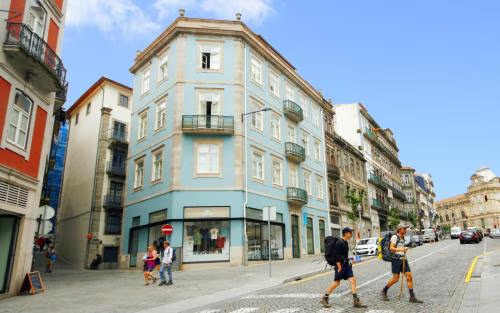
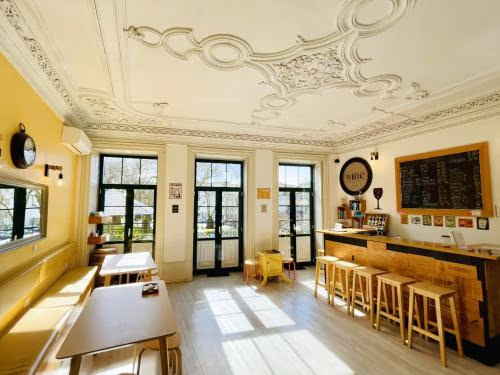
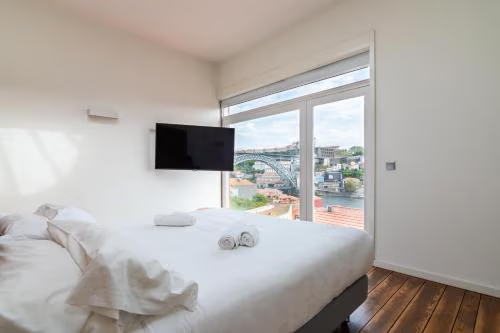
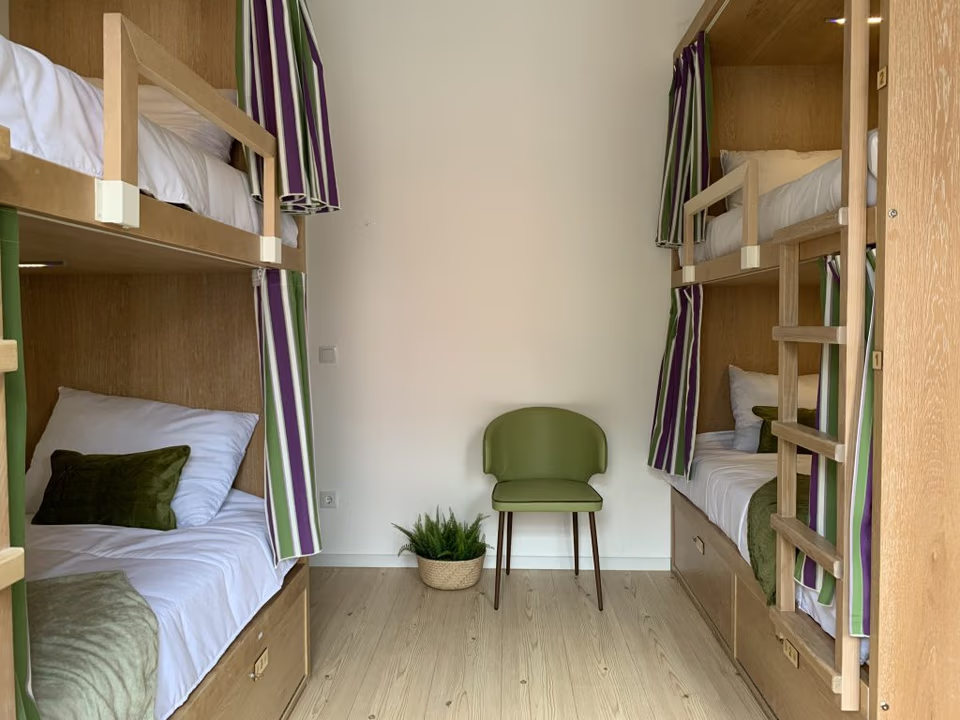 OpenReservations accepted
Lost Inn Porto Hostel

Services in Porto
What you can find in town before the next stage.
- ATM
- Café
- Shop
- Tobacco
- Medical clinic
- Pharmacy
- Fountain
- Post office
- Train station
- Bus station
- Airport
- Restaurant
Source: © OpenStreetMap contributors · updated April 2026