

Stage town on the Camino
Mérida
Badajoz, Extremadura, Spain
- places to stay
- 21
- Caminos
- 2
- Elevation
- 228 m
Mérida is the foundation of the Vía de la Plata: the Romans counted the miles of their road to Astorga from here, and you enter the city over a bridge with 60 arches. The Camino Mozárabe ends here, and Santiago's archbishop's title came from here. Santiago is still around 760 kilometres away. Worth a rest day.
Right now in Mérida (as of October 2026)
- Pilgrim hostel: The Molino de Pancaliente hostel is closed in August. According to one pilgrim portal it also closes from 21 December to 6 January, while another source lists it as open all year. Call ahead.
- Winter hours: Since 1 October the Roman sites are open from 9:00 to 18:30 until 31 March, according to the tourism website, no longer until 21:00.
- Roman museum: The Museo Nacional de Arte Romano has a new extension, inaugurated on 4 February 2026.
How long to stay?
Worth a rest day. Mérida's Roman buildings are spread across the whole city: theatre and amphitheatre, Alcazaba, bridge, temple, aqueduct, plus the crypt of Santa Eulalia and a museum that one pilgrim on the forum called one of the coolest he had ever seen. One pilgrim counted 30,000 steps on his rest day just sightseeing. The stage from Torremejía is short, so you arrive early and already have your first afternoon. The catch: you may only stay one night in the pilgrim hostel. For a rest day you need a hostal. And don't plan it for a Monday, when the museum is closed.
Mérida in Ninja numbers
- 792 metres is the length of the Roman bridge you walk in on, with 60 arches. Since 1991 it has belonged to pedestrians only.
- 209.5 kilometres are behind you since Seville, according to Camino Ninja. Astorga is still a good 491 away.
- Around 760 kilometres to Santiago, according to Camino Ninja, whether you take the Camino Francés from Astorga or the Camino Sanabrés from Granja de Moreruela.
- 1,544 pilgrims slept in the municipal hostel in 2023 up to 20 October. Most come in spring; July and August are too hot.
- 1120 is the year Mérida lost its archbishop's title to Santiago. So you are walking to the city that holds it today.
Arriving: over the Romans' bridge
Coming from Torremejía on the Vía de la Plata, you walk just under 17 kilometres according to Camino Ninja, the first kilometres partly along the N-630 national road and around 15 kilometres without a village and without shade. Before the city you pass under the N-630 through a tunnel and come into a park by the Guadiana. Then you step onto the Puente Romano. Cars no longer use it, so you have the bridge to yourself. At the far end stands the Capitoline Wolf, the emblem of Rome.
For the pilgrim hostel, turn left after the bridge onto the Paseo Romano, cross the roundabout at the end of the modern Puente Lusitania and follow the Avenida José Fernández López for about 350 metres. According to a pilgrim portal there are no signs. The old town is around 800 metres away.
If you are coming on the Camino Mozárabe from Córdoba and Medellín, you have reached your goal. The last stage from Torrefresneda is long and has a lot of tarmac, and it too ends at the Roman bridge. From Mérida both routes head north together.
In brief: a capital for veterans
In 25 BC Emperor Augustus had a city founded here for the discharged soldiers of two legions: Augusta Emerita, "the city of the veterans". The site was decided by the ford in the Guadiana, where the bridge was built. Mérida became capital of the province of Lusitania, later of the Visigothic kings. In 713 the city fell to the Moors after around fourteen months of resistance, and in 835 the emir of Córdoba had the Alcazaba built to control the rebellious city.
In 1230 Alfonso IX of León reconquered Mérida and gave it to the Order of Santiago. The city did not regain its old size for a long time. The railway arrived in 1864; since 1983 Mérida has been capital of Extremadura, and since 1993 its Roman sites have been a UNESCO World Heritage Site. Just under 60,000 people live here today.
What Santiago owes Mérida
You are walking to Santiago, but for centuries it was the other way round: Santiago needed Mérida. In Visigothic times an archbishop sat here, the head of a whole church province. After the Moorish conquest the title lay dormant. In 1120 Pope Calixtus II transferred it to Compostela at the urging of the ambitious bishop Diego Gelmírez. Since then Santiago has been an archdiocese, with a dignity that comes from here.
The Order of Santiago also had one of its most important houses here. After 1230 the knights settled in the Alcazaba, and Mérida became the seat of their Priory of San Marcos de León. In 1242 they elected Paio Peres Correia Grand Master here, the man who went on to take part in the conquest of the Algarve for Portugal. And the road itself: the Romans counted their miles on what later became the Vía de la Plata from Mérida. When you pass one of the round milestones still standing by the path, it is counting from here.
On Roman ground: what to see
For most sites there is a combined ticket, which is also valid over several days: theatre and amphitheatre, circus, Alcazaba, the Morería excavation, the crypt of Santa Eulalia and the Casa del Mitreo. According to the city's tourism website it costs €17 (reduced €8), the theatre and amphitheatre alone €13, any other site €6 (as of March 2024, check prices on site). Children up to 12 go free.
- Puente Romano: The bridge was built in the last decades before Christ, together with the city. It is a good 790 metres long and spans the Guadiana where a natural island divides the river. Three of its 60 arches only reappeared at the end of the 1990s. A flood swept away the central section in 1603, and it was rebuilt by 1611. Cars drove across until 1991. For you it is your first impression of Mérida: for two thousand years travellers have entered the city on exactly these stones. Go back onto the bridge in the evening.
- Alcazaba: Right next to the bridge stands the Arab fortress of 835, almost square, around 130 metres per side, with ten-metre-high walls of reused Roman granite blocks. It controlled the way from the bridge into the city. Go down to the cistern: a double staircase leads to water that seeps in from the Guadiana, beneath Visigothic pillars. For pilgrims the north corner matters. After 1230 the knights of the Order of Santiago lived there, and their church and a two-storey cloister survive from the sixteenth century. Part of the combined ticket.
- Teatro and Anfiteatro: Agrippa, Augustus' general, had the theatre built around 16 to 15 BC. It originally held about 6,000 people. The stage wall with columns and statues that you see today dates from the end of the first century. Every summer plays are performed here again at the classical theatre festival. Next door lies the amphitheatre for gladiator and animal fights. Sit on the tiers for a few minutes: after days on the Roman road, here you see what it was built for.
- Basílica de Santa Eulalia: Eulalia was a girl from Mérida who died as a martyr, not far from this church. Over her grave a tomb was built in the fourth century, then a basilica that the poet Prudentius praised for its marble and mosaics. In the early Middle Ages people came here on pilgrimage from Western Europe and North Africa. Long before Santiago was a destination, Mérida was one. Beneath the church, in the crypt, you can see Roman houses, fourth-century graves and the saint's first mausoleum (part of the combined ticket). In front stands the Hornito, a small chapel where pilgrims could pray at any hour without entering the church. Built into it are pieces of a Roman temple of Mars. Here you stand at a place pilgrims came to when nobody was yet talking about an apostle's tomb in Galicia.
- Museo Nacional de Arte Romano: Rafael Moneo designed the museum, which opened in 1986. In February 2026 its extension, also by Moneo, was inaugurated, now linking both buildings. One pilgrim on the forum called it "one of the coolest museums" he had ever seen. Here you see what the Romans left behind in the city you are walking through, and if you still have energy after your arrival day, it is the best place for the hot afternoon hours. Admission €3, free on Saturdays and Sundays from 14:00, the Visigothic collection always free. Closed on Mondays. From October to March open Tuesday to Saturday 9:30 to 18:30, Sunday 10:00 to 15:00 (as of March 2024).
- Acueducto de los Milagros: You see these arches on the morning you set off. 73 pillars of granite and brick, up to 25 metres high, 830 metres long across the Albarregas valley. "Milagros", miracles, is what the aqueduct is called, because people marvelled that it had survived so many centuries. One pilgrim wrote that it is "spectacular in the early morning light". He is right, and the path runs right past it.
Food and drink
The cuisine of Extremadura is the cooking of the dehesa and of shepherds: migas extremeñas, fried breadcrumbs with torreznos (crispy pork belly) and peppers, caldereta de cordero, a lamb stew, plus grilled Ibérico pork, ham from acorn-fed pigs and cheese from the dehesa. For tapas, head to Calle José Ramón Mélida, where the Roman museum also stands, to the Plaza de España and to the streets around the theatre.
Honestly
- The hostel is only good for one night. It is small, takes no reservations and, according to a notice, only lets you stay longer with a doctor's certificate. If you plan a rest day, book the second night in a hostal from the start. Rooms there usually cost €30 to €50 (as of October 2026).
- Admission adds up. If you want to see everything, you pay for the combined ticket and the museum. But the combined ticket already pays off from three sites.
- The way out is confusing. Leaving the city and after the Proserpina reservoir, the waymarking is unclear according to a pilgrim portal. Keep the Ninja app running.
- Tomorrow is long. It is 36 kilometres to Alcuéscar, almost 20 of them without a village and without supplies. If you don't want that, split the stage (see below).
Where pilgrims sleep
- Albergue de peregrinos Molino de Pancaliente: the municipal pilgrim hostel in an old mill by the Guadiana, open since 2004 and run by the Friends of the Camino in Mérida. One dormitory, €10 a night with fresh bed linen (as of October 2026). No reservations, one night only, credencial required. Check-in according to the pilgrim portals from 11:30 to 13:00 and from 17:30. There is a kitchen with a microwave, a washing machine and dryer, and heating in winter. Bring your own towel. It is closed in August (see box).
There is no donativo hostel in Mérida. For a second night, or if the hostel is full, you will find hostales and guesthouses in the city. On holidays it gets tight: over the long May weekend in 2025, 58 pilgrims slept in the hostel within a few days.
Ninja tips
- Book the second night in advance: If you take a rest day, reserve the hostal before you arrive, especially at weekends. One pilgrim paid €35 on a normal night and €80 on a busy Saturday.
- Credencial in an emergency: The hostel sells pilgrim passports for €3, in case you start here or yours is full.
- Museum free at weekends: On Saturdays and Sundays from 14:00 the Roman museum costs nothing.
- Combined ticket over two days: The combined ticket is valid on one or several days. Split the sites between arrival day and rest day.
- Leave early for the aqueduct: Set off early on the morning you leave. Then you see Los Milagros in the first light and walk the long stage before the midday heat.
- Supplies from the city: The beach bars at the Proserpina reservoir usually only open at midday. Shop in Mérida; the next reliable supplies are in Aljucén.
- Mozárabe pilgrims: If your route ends here, pilgrims on the forum recommend getting your last stamp at Santa Eulalia and visiting the crypt. There is no separate certificate for the Mozárabe in Mérida.
Practical tips for pilgrims
- Hostel: According to a pilgrim portal you have to be out by 8:00, and the doors close at 22:00. Register laundry before midday. There is a bike repair shop 50 metres from the hostel (Monday to Saturday mornings).
- Closing days: The Roman museum is closed on Mondays. The Roman sites are open daily except on 24, 25 and 31 December and 1 January.
- Festival: On 10 December Mérida celebrates its patron saint, Santa Eulalia.
- Getting there and away: Mérida has a railway station with trains to Madrid, Seville and Badajoz and a bus station with services to Seville, Cáceres and Salamanca. Good for joining or breaking your walk.
- Shopping: The city has a grocery, butcher, baker, pharmacy and cash machine.
Onward: north through the dehesa
You leave Mérida heading north on the Avenida José Fernández López, cross the Albarregas and have the Los Milagros aqueduct beside you. After 6 kilometres, according to Camino Ninja, you reach the Proserpina reservoir. The dam is a good 400 metres long; whether it is Roman or early medieval, researchers disagree. In summer it is a swimming spot. Then come El Carrascalejo (13.7 km) and Aljucén (16.5 km), both with a hostel. Aljucén is the last place for supplies; then it is almost 20 kilometres through the Cornalvo Natural Park, dehesa with holm oaks and cork oaks, to Alcuéscar (36 km). On the way you cross from the province of Badajoz into the province of Cáceres.
If you are heading for Santiago, you have two options: continue on the Vía de la Plata to Astorga and join the Camino Francés there, or switch to the Camino Sanabrés at Granja de Moreruela. According to Camino Ninja, both are around 760 kilometres long.
What awaits you tomorrow
Alcuéscar is the end of a long day, and one of the special hostels of the Vía de la Plata is waiting there: the Casa de la Misericordia. A religious community that cares for 75 people in need of care also takes in pilgrims. You give what you can, and there is usually a shared dinner at 19:30 and the pilgrim blessing. If 36 kilometres is too much for you, stay in Aljucén, 16.5 kilometres from Mérida, with a municipal hostel.
Deep dive: The city Santiago got its title from
A long read, in case you want to learn more about Mérida. About twenty-five minutes' reading.
On the bridge
If you reach Mérida on the Vía de la Plata, you enter the city the way people have entered it for more than two thousand years: over a bridge. It is almost eight hundred metres long and has sixty arches. Beneath it flows the Guadiana, wide and shallow, and in its middle lies a natural island that splits the river into two arms. Right here, where the water was shallow and the rock beneath it firm, the Romans built their bridge. And because the bridge stood here, the city grew up here. The great roads from the west and the road to the north all had to use this crossing. The bridge did not come to the city. The city came to the bridge.
What you have under your feet, though, is not all of a piece. The bridge is a patchwork of two thousand years, and every patch tells of a crisis. In 483, under the Visigoths, it was repaired, and that was probably not the first repair. In the ninth century the emir Muhammad the First of Córdoba had a pier destroyed to crush an uprising of the townspeople. In 1603 a flood tore away the middle section. It was not rebuilt until 1611, with five arches, and under Philip the Third a monument to the restoration was set on top of it. In the war against Napoleon several arches were destroyed so that the French troops could not get across. In 1860 the next flood swept away a chapel of Saint Anthony by the bridge.
Three of the sixty arches had disappeared for so long under mud and riverbank scrub that they were only found again in the late 1990s, when the riverbank was redesigned. And until 10 December 1991 cars and lorries drove over it. On that day the new Puente Lusitania opened, and since then the old bridge has belonged to those who come on foot. In other words, to you. The 10th of December, by the way, is also the feast day of Eulalia, the saint of this city. You will hear a good deal more about her.
The city of the discharged
In the year 25 before Christ the legate Publius Carisius received orders from Emperor Augustus to found a colony here. It was meant for soldiers who had just come through the wars against the Cantabrians in northern Spain, veterans of the Fifth Legion, known as the Alaudae, the larks, and of the Tenth Legion Gemina. Its full name was Colonia Iulia Augusta Emerita. Emeritus means discharged, retired, as in an emeritus professor today. Over the centuries Emerita became Mérida. Whether a native settlement stood here before is not known.
The city of the discharged quickly became important. It was the capital of the province of Lusitania, which covered today's Portugal and part of western Spain. In the fourth century it even became the seat of government for the whole Diocese of Hispania, that is, for every province of the Iberian Peninsula. The Gallic poet Ausonius drew up a ranking of the famous cities of the empire at the time. He placed Mérida ninth, ahead of Athens.
What you see scattered across the city today is what remains of that greatness: theatre and amphitheatre, the circus for chariot races, the temple wrongly attributed to Diana although it served the cult of the emperors, the arch named after Trajan, aqueducts and houses.
A road to the north
The road you walk north on linked the capital of Lusitania with Asturica Augusta, today's Astorga. In a Roman road register from the imperial period, the Itinerarium Antonini, it is simply called Iter ab Emerita Asturicam, the road from Emerita to Asturica. The stations are listed there too, among them Norba Caesarina, today's Cáceres, then Cáparra and Salmantica, today's Salamanca.
When the road was built is not entirely clear. A milestone near Astorga is attributed to Augustus. The Spanish humanist Antonio de Nebrija wrote in 1507 that a certain Licinius had first paved it and that Emperor Trajan had renewed it. Later emperors repaired it. In 1995 the researcher Carmen Puerta Torres recorded and studied 189 milestones of the road. The Romans counted their miles in two sections, one starting here in Mérida, the other in Salamanca. Milestone number two still stands today, about three kilometres beyond the northern edge of the city. When you pass one of these round stones, it is counting from here.
And the name? The Vía de la Plata has nothing to do with silver. Silver was never traded along this road. In the Arab period it was called al-Balat, the paved road, a word that lives on in place names such as Albalat and Albalate. In popular speech it eventually became Plata, silver. Columbus and Nebrija were already using the name around 1500. A misunderstanding that sounds so lovely that nobody wanted to correct it.
The old Roman road only became a pilgrim road when the Christian kingdoms pushed their frontier south. From then on people walked it to Santiago from the south, on the Camino de Santiago de la Plata. The A-66 motorway now largely follows its line, and the GR-100 long-distance trail was laid out along it. Mérida has one of three interpretation centres for the Vía de la Plata; the other two are in Monesterio and in Baños de Montemayor.
Theatre, arena and a Medea
The theatre was built by Marcus Agrippa, the general and closest confidant of Augustus, who was regarded as the patron of the colony. Several inscriptions name him. Above one entrance his name can still be read, with the note that he was consul for the third time. That gives the year of the inauguration, around 16 to 15 before Christ. About six thousand people found seats here. The splendid stage wall with its two rows of columns and statues was built in the course of the first century after Christ, and under Emperor Constantine the whole theatre was remodelled once more between 333 and 337.
A few decades later it was over. When Christianity became the state religion, the theatre was abandoned, because Christians considered plays immoral. Parts collapsed, others disappeared under earth. For centuries only the top rows of seats rose out of the hill, with seven collapsed entrances. People called them the seven chairs, las siete sillas. It was said that seven Moorish kings had sat on these chairs and decided the fate of the city. That is a legend, but one that shows how foreign the place had become to people.
In 1910 the archaeologist José Ramón Mélida began excavating. He found the seats plundered and the stones of the stage wall deliberately thrown down. And then something happened that Mérida still celebrates as its moment of birth: on 18 June 1933 a play was performed in the theatre again, for the first time in a millennium and a half. On the programme was Seneca's Medea, by a Roman who himself came from Hispania. The lead role was played by the great actress Margarita Xirgu, and the play had been translated by the philosopher Miguel de Unamuno, who had offered to do it himself. That performance grew into the classical theatre festival held every summer. The stage wall you see today was rebuilt from 1962 under the architect José Menéndez-Pidal.
Right next door lies the amphitheatre, inaugurated in the year 8 before Christ, as inscriptions inside it show. About fourteen thousand people watched gladiators fight here, and men against wild animals. In the middle of the arena a cross-shaped pit is cut into the ground, probably covered with wood, which held cages and stage machinery. Earlier scholars believed the arena had been flooded for staged naval battles. Only excavations from 1919 onwards disproved that. In a passage on the south side an inscription suggests that some rooms were dedicated to the goddess Nemesis.
Water across the valley
A city of this size needed water, and the Romans fetched it from far away. Mérida had several aqueducts. The most famous crosses the valley of the small Albarregas river to the north, and you walk past it on the morning you set off. The arcade is 830 metres long and 25 metres high at its deepest point. 73 piers still stand. They are built in a way you will recognise immediately once you look for it: five courses of granite blocks, then five courses of brick, then granite again, like a striped cake. Inside is concrete, Roman poured mortar.
The aqueduct ended at the highest point of the city, inside the walls, where a fountain has been found. Its water came, according to tradition, from the Proserpina reservoir, whose dam you pass a few kilometres later. The people gave it the name Los Milagros, the miracles, because they were amazed that it survived so many centuries, as if God himself had held it up.
How old it really is remains disputed. For a long time it was considered a work of the first century. A brick was dated with a physical method to around the year 290, in the time of Emperor Diocletian. It is assumed that the arches were renewed then. A study by the Autonomous University of Madrid even proposed the fourth or fifth century, the time of the Visigoths. That met with opposition in Mérida, including from the mayor at the time, Antonio Rodríguez Osuna. The Proserpina dam is a similar case: Roman, says tradition; perhaps later, say some researchers. When you walk past it, you are walking past an open question.
A girl called Eulalia
And now to the woman without whom Mérida would be one Roman ruin town among many. Most of what we know about Eulalia comes from tradition, and that is how it has to be told. She is said to have been born in Mérida around the year 292, into a Christian family. When Emperor Diocletian banned Christian worship, she was about twelve years old. According to tradition her parents took her to a country estate on the Albarregas to keep her out of danger. She ran away, back to the city, and stood before the governor. He first tried gifts and promises, then showed her the instruments of torture and demanded that she offer bread and incense to the gods. She refused. She was beaten and burned with torches, and she died, thirteen years old. Tradition gives the date as 10 December 304. Some sources even place her martyrdom half a century earlier, under Emperor Decius.
The most powerful version of this story was written by the poet Prudentius, a Christian from Hispania, less than a hundred years after her death. In his book on the crowns of the martyrs he devotes an entire hymn to her. In it the girl spits at the judge, knocks over the images of the gods and calmly counts her wounds in the fire while she prays. The gods are nothing, Prudentius has her say, and the emperor Maximian is nothing too. As she dies, a white dove is seen rising from her mouth. The executioners flee in terror. Then snow falls and covers the small body and the ground around it, until the Christians can bury her a few days later.
Whether it happened like that, nobody can say. But the dove and the snow have remained her signs ever since. In pictures Eulalia usually carries a palm and a small oven, often accompanied by a dove that stands for her soul. One of the earliest depictions is not in Spain but in Italy, in the mosaics of Sant'Apollinare Nuovo in Ravenna. That is how far her name had travelled.
A tomb Europe walked to
Over her grave, outside the city walls, the Christians built a tomb monument in the fourth century, and from it a basilica grew in the fifth. Prudentius describes it with admiration: its marble, its mosaic floors, its gilded coffered ceilings. And he tells how pilgrims came there to pray. Augustine, the great Church Father in North Africa, preached sermons in her honour. In the early Middle Ages Mérida was one of the great pilgrimage destinations of Western Europe. People came from all over Western Europe and from North Africa.
How powerful this tomb was is shown by two stories from the chronicle of Hydatius, a bishop from the northwest of the peninsula. In the late 420s a Suevic leader named Heremigar plundered the region and laid hands on Eulalia's basilica. Shortly afterwards he drowned in the Guadiana while fleeing. Hydatius writes that the arm of God threw him into the river. Seen soberly, he had been beaten by the Vandals. And when, around the year 456, the Gothic king Theodoric the Second stood before Mérida, he refrained from plundering the city, according to Hydatius, because warnings from the saint held him back.
Gregory of Tours, the Frankish bishop and historian, heard of another miracle in Gaul at the end of the sixth century: on her feast, in the middle of December, trees blossomed at her tomb, and the blossoms were taken as a sign of a year of plenty. When you stand in the crypt today, you are standing at the place these stories mean. Mérida was a pilgrimage destination centuries before anyone in Galicia found an apostle's tomb. When Santiago began, Mérida was already old.
Masona and the house for strangers
Where pilgrims come, they need a roof. In Mérida it was a bishop called Masona who built one, and we know his story from an unusual book: the Lives of the Holy Fathers of Mérida, written in the seventh century by a deacon of the city. It tells of five bishops and along the way gives one of the liveliest glimpses into everyday life in Visigothic Spain, what people ate, how they dressed, how they learned.
Masona was a Goth. He came from the Arian church, the confession of the Gothic upper class, and became a Catholic. His biographer writes that he was indeed a Goth, but devoted to God with all his heart. Around 580 he had a xenodochium built outside the city gates, a house for strangers, with a hospital beside it. Doctors went through every quarter of the city, looking for the sick and bringing them in. The house was explicitly open to Jews as well, and Masona was kind to pagans. But the guests were above all pilgrims who came from far away to Eulalia's tomb. Masona gave the house its own estates so that it could feed itself. To the townspeople and the peasants he handed out wine, grain, oil and honey, and he deposited 2,000 gold coins with a deacon, from which people in need could borrow money. A little bank for the poor, in the sixth century.
You can still see the remains of this pilgrim house. They lie on the Calle de San Lázaro, in an old burial ground outside the Visigothic walls. You can make out a long building with an apse at the end, crossed by two wings with three aisles each, where the rooms lay. The foundations are so thick that a second storey with a gallery is assumed. The site can be viewed from outside. If you sleep in a pilgrim hostel today, this is one of its ancestors.
Masona also had to fight for his city. In 582 the Arian king Leovigild entered Mérida, installed an Arian bishop called Sunna and tried to win Masona back, with persuasion, threats and money. Then he demanded Eulalia's tunic, the city's holiest relic, for a church in his capital Toledo. Masona outwitted the king and kept it. For that he was banished. Only after three years, in 585, was he allowed to return, and people said that Leovigild had seen a vision of Eulalia. In 588 Sunna and his allies planned to murder Masona. A count called Witteric betrayed the conspiracy, Witteric, who later became king himself. The following year, at the Third Council of Toledo, at which the Visigothic kingdom became Catholic, Masona sat first among the Catholic bishops.
The church over the tomb
The Basílica de Santa Eulalia stands where it all began, outside the old walls, near the place where Eulalia died according to tradition. Researchers consider it the first Christian church built in Hispania after the peace that Emperor Constantine granted the Church. It is the heart of Christian Mérida, the way a cathedral would be elsewhere.
Look at how it grew. At the very bottom lie Roman houses from the first to the third century. Once they were abandoned, the site became a Christian cemetery in the fourth century, and a tomb monument rose over Eulalia's grave. Around this late Roman mausoleum the Visigoths built their basilica, and its upper end survives to this day. It still closes the apse behind the high altar. Some of the capitals and columns in the church come from the Visigothic building.
Under Moorish rule the basilica fell into decay. After the reconquest the knights of the Order of Santiago rebuilt it around 1235 on the old ground plan and partly with the old stones, and by around 1270 today's church was finished. It became the chapter church of the order, its spiritual centre in the city. What you see is a church with three naves ending in three semicircular apses, with a Romanesque door in the facade, a pointed arch over the entrance to a chapel that is already thinking in Gothic, with coffered ceilings and side chapels by the high altar. In the seventeenth century Baroque forms were added. It is the only entirely medieval building in the city. Inside, people venerate the image of Eulalia and a Mother of Sorrows, Nuestra Señora del Mayor Dolor.
Since 1990 archaeologists have been digging beneath the church, and the result is the crypt you can visit: a walk through almost two thousand years, from the Roman houses past the early Christian graves to the first mausoleum of the saint. Of what Prudentius saw, the marble, the mosaics, the gold of the ceilings, nothing survives. What survives is the place.
In front of the church stands the Hornito, the little oven. Tradition says Eulalia was burned here. In fact it is a votive chapel built in 1495 on the orders of two visitors of the Order of Santiago, so that pilgrims could pray at any hour without having to enter the church. In 1612 marble pieces from a Roman temple of Mars were added. The old dedication can still be read: consecrated to Mars, by Vettilla, wife of Paculus. Stones from a pagan temple, fitted together into a place of prayer for pilgrims passing through. It is also tradition that ties Eulalia's name to many other spots in the city: a memorial stone of 1612 where she is said to have been whipped at a column, an obelisk of 1652 made from Roman rubble and a house next to the Arch of Trajan where she is said to have lived.
But this church has a quiet twist: Eulalia herself no longer lies here. Around 780, it is reported, King Silo of Asturias had her body taken north, to Oviedo. There she rests in a coffin of Arab silver donated by King Alfonso the Sixth in 1075, and Asturias has made her its patron saint. The road her bones took north is the same one Mérida's importance would take. In 2014 the Vatican officially raised the church to the rank of basilica, announced on 10 December, her feast. On those days the city is out on the streets. The celebrations run from 8 to 10 December; on the 9th the faithful walk over on pilgrimage from the neighbouring town of Arroyo de San Serván, and on the 10th the procession moves through the streets.
The end of a world
After the Romans came others. In 412 the Alan king Atax took the city and ruled from here. In 440 the Suevic king Rechila conquered it and made it the capital of his kingdom. Then came the Visigoths, and under King Agila the First in the middle of the sixth century Mérida was for a time even their royal seat, before Toledo became the capital. The bishops of Mérida were metropolitans, chief shepherds of a church province with twelve dioceses, among them Lisbon, Coimbra, Évora, Salamanca and Ávila. In 666 the bishops of the province met here for a council whose decrees have survived.
In November 712 a Muslim army under Musa ibn Nusair stood before the walls. With its strong Roman walls, Mérida was a hard nut to crack. The defenders under a duke named Sacarus made sorties and inflicted heavy losses on the attackers. Musa hid troops in a quarry at night and lured the Visigoths into an ambush. With a battering ram his men broke into a tower, but behind the ashlar they hit mortar so hard they could get no further. The defenders killed them, and the tower was afterwards called the Martyrs' Tower. On 28 June 713 a delegation asked for peace, and on 30 June the city surrendered. The inhabitants were allowed to go on living as before but had to hand over the property of those who had fallen or fled.
Under the rule of Córdoba, Mérida stayed rebellious. The Christians of the city rose again and again; between 805 and 835 several campaigns failed to subdue them. In the end Emir Abd al-Rahman the Second had the Alcazaba built in 835, right at the bridgehead, and had the old city walls pulled down. The fortress was meant to watch the city, not protect it. Its builders used the stones lying around, Roman granite blocks and Visigothic pillars. Around 875 a rebel named Ibn Marwan founded a new town, Badajoz, and settled it with people from Mérida. Some historians suspect the archbishop moved there too at that time. Christian Mérida did not vanish entirely: in 862 a bishop Arnulfo from Mérida took part in a council in Córdoba. But the great days were over.
How Santiago became an archbishopric
Now comes the story that ties Mérida to your destination, and it plays out almost entirely in the north. In 1100 a cleric called Diego Gelmírez was elected bishop in Compostela. He was ambitious and well connected, with the powerful abbey of Cluny and with Rome, and he had a mission: the apostle's tomb was to have a church worthy of its rank. A simple bishop's see was not enough for him. He wanted an archbishopric.
The problem: archbishoprics could not simply be invented. In the northwest there already was one, ancient Braga in today's Portugal. Gelmírez first tried to take Braga's dignity away. He won partial victories, early on the pallium from the pope, the mark of honour of archbishops, although Compostela was not yet one, and independence from any other archbishop. But stripping Braga of its rank was beyond him.
Then the situation in Rome changed. In 1119 a Burgundian became pope, Calixtus the Second. He was a brother of Count Raymond of Burgundy and therefore an uncle of the young Alfonso who would later become King Alfonso the Seventh of León and Castile. Gelmírez was one of this boy's most important supporters. Relations were, as one historian drily writes, fluid. And Gelmírez found an elegant way out. If he could not have Braga, then a dignity that nobody was exercising at the moment: that of Mérida, the old metropolis of Lusitania, which had been under Muslim rule for four centuries.
With a bull of 26 February 1120, Calixtus the Second transferred the rights of the archbishopric of Mérida to Santiago, at first as a temporary arrangement, until Mérida was freed and its see restored. Gelmírez became archbishop and also papal legate for the church provinces of Mérida and Braga. On paper his new province included dioceses as far south as Lisbon and Évora, some of which were not yet under Christian rule at all, and in practice Salamanca, Ávila and Coimbra. In 1124 the transfer became permanent.
It did not come free. The Historia Compostelana, the chronicle from Gelmírez's circle, does not even hide it: in the struggles over Mérida's rights, money played a key role. Payments and gifts were made, as it was put, for goodwill. A letter from a cardinal mentions a canon named Pedro who brought gold to Rome to placate the Curia, which was very angry. What the archbishopric cost in total can no longer be worked out. And there was resistance. When Gelmírez summoned his bishops to a council in Compostela in January 1121, the bishops of Braga, Lugo, Mondoñedo and Coimbra stayed away. They were suspended.
And so the cathedral you are walking towards is the church of an archbishop whose title comes from the south, from the city you are standing in now. The Historia Compostelana is a partisan source, written to glorify Gelmírez. But that the title came from Mérida is beyond question.
Theft or rescue?
The pope had set a condition: the dignity was to remain in Santiago only until Mérida was reconquered. In 1230 that day came. And then happened what was perhaps predictable. On 29 October 1230 Pope Gregory the Ninth called on the archbishop of Santiago to restore the dioceses of Mérida and Badajoz. Archbishop Bernardo did in fact appoint a canon of Santiago named Alfonso as bishop of Mérida. After a few months he withdrew the appointment and handed the city and its lands over to the Order of Santiago. Mérida got no bishop. The dignity stayed in Galicia.
Was it theft? From Mérida's point of view, a lot speaks for it. The city lost a rank it had held since late antiquity and did not get it back once the condition was met. Accounts of the city's history explicitly name the resistance of the archbishops of Compostela as one of the reasons. Even the archbishop of Toledo, Rodrigo Jiménez de Rada, a rival of Santiago, noted at the great council in Rome in 1215 that the metropolitan right of the ancient and famous city of Emerita had been transferred.
Was it rescue? There are reasons for that too. When Gelmírez received the title, there had long been no archbishop of Mérida who could have exercised it. The city had been under Muslim rule for four centuries. After 1230 Mérida was a place in the borderlands, administered by an order of knights, no longer a great city. An orphaned title was filled with life in Compostela, at a tomb to which all of Europe was now walking. You can see it both ways, and both are probably true.
The story has a late ending. For centuries Mérida belonged in church terms to the territories of the military order, later to the diocese of Badajoz, which from 1873 was subordinate to the archdiocese of Seville. Only on 28 July 1994 did Pope John Paul the Second create the church province of Mérida-Badajoz and make it an archbishopric again. On 12 October 1994 the first archbishop, Antonio Montero Moreno, took possession of his see, not in a church but in the Roman theatre, before some 4,500 people. After 874 years Mérida had its rank back. Santiago kept its own.
A king who died a pilgrim
The man who reconquered Mérida in 1230 was King Alfonso the Ninth of León. In the spring of that year he took the city after a long siege, having defeated an army of Ibn Hud that was coming to its relief. Shortly afterwards Badajoz and Elvas fell too.
And then he did what you are doing now. He set out for Santiago de Compostela to thank the apostle for his protection in these wars. He never arrived. In Villanueva de Sarria he fell seriously ill, and on 24 September 1230 he died in Sarria, aged fifty-nine, a pilgrim on the way. He was buried, as his will had laid down, in the cathedral of Santiago, next to his father, King Ferdinand the Second. When you are in Santiago, the man who conquered Mérida lies in the same church that bears Mérida's title.
The knights of the sword cross
The conquered city went to the Order of Santiago. The order arose around 1170; whether in León or in Uclés is disputed. Its first rule dates from 1171, its first master was Pedro Fernández, a follower of King Ferdinand the Second, and in 1175 Pope Alexander the Third recognised it as a religious order. Its first task was to protect pilgrims on the way to Santiago, then the fight against the Muslim kingdoms in the south. You will meet its emblem often along the way: a red cross whose lower arm ends in a sword blade.
Mérida became the seat of the priory of San Marcos de León. The knights settled in the northern corner of the Moorish Alcazaba. In 1242 they gathered here and elected a Portuguese man as master for life: Paio Peres Correia. Under him the order conquered large parts of southern Portugal down to the Algarve, and under him the new church of Eulalia was completed around 1270. If you have walked the Camino from Faro, you have crossed land that was conquered under this man.
At the end of the fifteenth century Alonso de Cárdenas, the last great master of the order, helped the city back on its feet. From 1563 to 1600 the knights turned their seat in the Alcazaba into a convent, with a church and a cloister on two floors. By then the order had already lost its independence; in 1523 the office of master passed permanently to the Crown. But in the Alcazaba you can still walk through the cloister of the knights who were once charged with protecting people like you.
Decline and return
For centuries Mérida did not regain its old greatness. Many people from the city left for the Americas. Two cities on the other side of the ocean bear its name today, Mérida in Venezuela and Mérida in Mexico. The war against Napoleon between 1808 and 1814 destroyed much of its historic and artistic heritage. In 1838 the state handed over the church of Santa Clara as the first museum for the Roman finds. Today it houses the Visigothic collection, one of the most important collections of Visigothic sculpture in Spain, and it is free to enter. In 1864 the railway arrived, and Mérida became a junction.
The twentieth century brought both rediscovery and violence. In 1910 the excavations at the theatre began; in 1933 plays were performed there again. On 10 August 1936, in the first weeks of the Civil War, the rebel troops took Mérida, and harsh repression followed in the conquered territory. Between the 1950s and the 1970s the city roughly doubled in size with industry. In 1983 it became the capital of the new region of Extremadura, and in December 1993 UNESCO declared its Roman sites a World Heritage Site.
And then there is the museum. In 1975 Mérida's collection became the National Museum of Roman Art, the first national museum outside Madrid. The architect Rafael Moneo built it a home meant to feel like a Roman building itself, with high arches and light from above. It opened on 19 September 1986. Moneo dedicated it to his father, who died while it was being built. During construction a Roman road was found on the site. The museum holds more than 36,000 pieces, among them a bust of Augustus as high priest, mosaics and a model of the ancient city. On 4 February 2026 its extension was inaugurated, again by Moneo, connecting the two buildings. Mérida is still building on its foundations.
Today's pilgrims
And the pilgrims? They came back, quietly. Since 2004 there has been the hostel in the old mill on the Guadiana, run by the Friends of the Way of St James in Mérida. In 2023, up to 20 October, 1,544 pilgrims slept there. Most come in spring; in summer it is too hot. For those coming from Seville, Mérida is the first big goal after a good two hundred kilometres. For those coming on the Camino Mozárabe from Andalusia, it is the end of their way and the beginning of a new one.
Pilgrims who finish their Mozárabe here recommend to one another that they get the last stamp at Santa Eulalia and go down into the crypt. That closes a circle almost fifteen hundred years old. Already in the sixth century strangers with dusty feet stood here, cared for by Masona's doctors, praying at the tomb of a thirteen-year-old girl. That they came here for this and not to Galicia was a matter of course back then.
What Mérida gives you
In Mérida you think of Rome first, not of Santiago. And yet hardly any place on the way is so closely bound to Santiago. The archbishop's title, the knights with the sword cross, the king who died a pilgrim, the road that carries you north, and the pilgrims who came to Eulalia long before there was a Camino.
Perhaps that is the insight Mérida gives you: every path stands on an older one. The Romans built the road, the Christians used it to walk to their saints, and you walk it today for your own reasons. No place holds on to its importance forever. Mérida was a capital and became borderland, was a pilgrimage destination and became a waypoint, lost its title and got it back after 874 years. The stones have stayed.
When you walk past the arches of Los Milagros in the half-light tomorrow morning, think of how many set out from here before you. Soldiers, traders, bishops, a king who never arrived, and pilgrims whose names nobody knows. The stones under your feet carried them all. Today they carry you.
Where to stay in Mérida
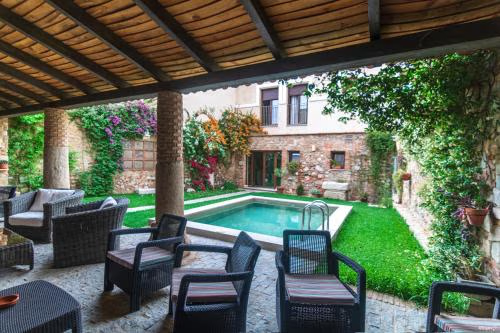
Places to stay in Mérida.
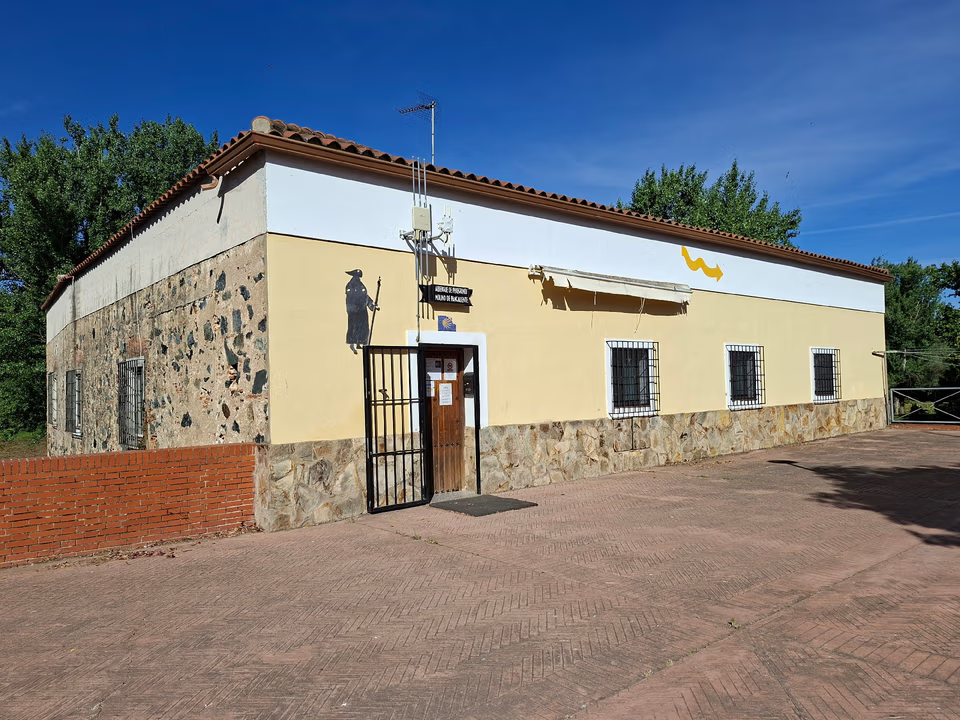 OpenReservations not accepted
Albergue de peregrinos Molino de Pancaliente
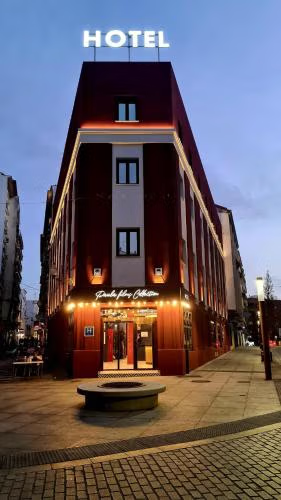 OpenReservations accepted
Hotel Paula Films Collection
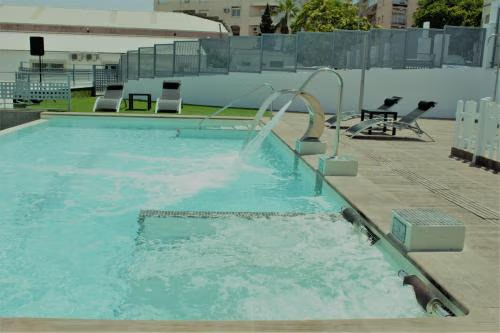 OpenReservations accepted
Deluxe Hostels & Suites Merida

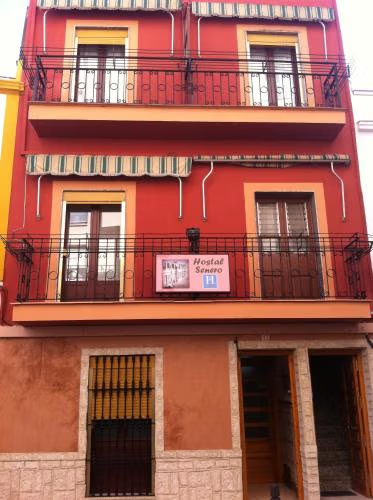



Services in Mérida
What you can find in town before the next stage.
- ATM
- Café
- Shop
- Tobacco
- Medical clinic
- Pharmacy
- Fountain
- Post office
- Train station
- Bus station
- Airport
- Restaurant
Source: © OpenStreetMap contributors · updated March 2026