

Town on the Camino
Nisa
Portugal
- places to stay
- 4
- Camino
- 1
- Elevation
- 307 m
Nisa is the town of white pebbles: women press quartz into red clay, the Rua de Santa Maria is paved with it, and ceramic shells show you the way. As early as 1218 the Templars founded an albergaria here. An afternoon is enough; tomorrow you walk 19.8 kilometres down to the Tagus.
How long to stay?
An afternoon is enough, but give yourself half an hour more tomorrow morning. It is only 15.4 kilometres from Alpalhão, so you arrive early. What matters lies close together in the small old town: two medieval gates, the Misericórdia with its Templar prehistory, the pillory, the fountains. But the finest Santiago site in Nisa is not in town; it lies on your way out, up at the Senhora da Graça. You pick it up tomorrow on the way.
Nisa in Ninja numbers
- 443.6 kilometres is how far you have walked since Tavira according to Camino Ninja, and 217.6 remain to Trancoso. The last third begins.
- 1218 is when the Templar master Pedro Alvitis founded an albergaria, a hostel, in Nisa. There is no pilgrim hostel today.
- 480 million years is the age of the quartzite of the Serra de São Miguel, from whose veins comes the white quartz for Nisa's pottery. Tomorrow the Tagus breaks through the same stone.
- Around 220 metres of descent await you tomorrow: according to Camino Ninja's waypoints, Nisa lies at a good 300 metres, the bridge over the Tagus at around 85.
- 1917 is when a flag advertising petrol hung from Nisa's pillory. Since 1968 it has stood in its present place.
Arriving: through the back door of the plain
The stage from Alpalhão is one of the gentle ones: the way follows the Ribeira de Figueiró on an old paved track, crosses the N18 and runs between holm oaks and olives over the plateau. Shortly before the town you pass the Capela de Santo António, with the cross of the Order of Malta in its vault, and you enter Nisa at the Largo da Fonte da Cruz. Watch the waymarks: the signs of the Via Nascente are ceramic shells here, a bow to the town's pottery tradition.
Nisa is a small district town in the Portalegre district, with cafés, shops, a pharmacy, a bank and a post office. The old town with its palaces around the Praça da República and the Praça do Município is quickly crossed, and that is exactly why it is worth walking slowly.
In brief: Templars, settlers and a name from France
In 1199 King Sancho I gave the Order of the Templars the territory of the Açafa on the Tagus. A widespread theory says the Templars brought settlers from southern France and named the places after their homeland: Nisa after Nice, Arez after Arles, Montalvão after Montblanc, Tolosa after Toulouse. It is not proven, but it is a nice explanation for why King Manuel's town charter of 1512 spells the name with two S. An older charter is said to have burned in 1704 in the War of the Spanish Succession.
According to a local monograph of 1956, the first settlement lay up on the hill of the Senhora da Graça. After it was destroyed in a quarrel between King Dinis and his brother Afonso, Nisa arose anew on its present site, with walls and gates from the late 13th century. King João I gave the town the title "Notável", the remarkable. Walls and gates have been a national monument since 1922.
White stone in red clay
If you see a jug in Nisa that looks as if someone had scattered flowers of sugar grains on it, that is Olaria Pedrada, the "stoned pottery". The potter turns the vessel from red clay, dug here, on a foot-driven wheel. His wife then presses small splinters of milky quartz into the surface, mostly in flower patterns. That is how the Naturtejo Geopark describes it. The clay is about 2.5 million years old, laid down by a Tagus that still flowed across the Alto Alentejo at the time. The quartz comes from the veins in the quartzite of the Serra de São Miguel.
The jugs, cantarinhas and bilhas were made to keep water cool, in an area where it is often over 40 degrees. If you have walked up from the south in the heat, you understand the idea at once. Today people buy them more as a sign of the region. The same white quartz also lies as paving in the Rua de Santa Maria, which leads to the main church, and it gleams again tomorrow when you see the quartzite walls of the Portas de Ródão. Nisa is also known for its embroidery: alinhavados, felt appliqué, bobbin lace, frioleiras. The artist Joana Vasconcelos created her "Valquíria Enxoval" with embroiderers from Nisa, and it can be seen in a hall of the Cine-Teatro.
Between two gates: what to see
Everything lies within a few minutes' walk; we did not find opening or service times for any of the sites.
- Igreja da Misericórdia: This is where Nisa's pilgrim story begins. In 1218 the Templar master Pedro Alvitis founded an albergaria on this spot; after the end of the Templar order in 1312 it passed to a local brotherhood. The Misericórdia was founded in 1520, its church was built in the first quarter of the 16th century, the choir received rococo furnishings at the end of the 18th century, and ceiling and altar were gilded in 1791. If you sleep in a guesthouse tonight, you have still arrived in the tradition of this house.
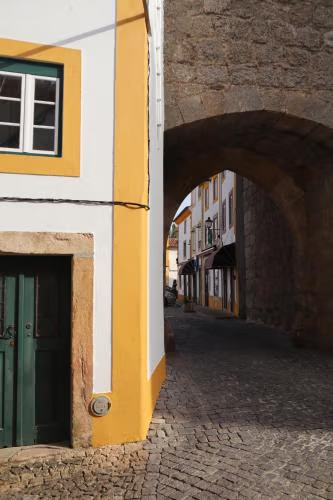
- Porta da Vila and Porta de Montalvão: The two main gates date from the late 13th century. The Porta da Vila is flanked by two battlemented half-towers, and a clock tower was added later; in the keystone sit the Portuguese coat of arms in a form from before 1485 and the town's coat of arms. The Porta de Montalvão has a plain pointed arch. The regional pilgrim guide also mentions a Porta de Santiago, part of which survives.
- Igreja Matriz de Nossa Senhora da Graça: The main church stands on the Rua de Santa Maria, whose paving is decorated with white quartz pebbles. Walk to it deliberately along this street.
- Pelourinho: The pillory has an octagonal, pyramid-shaped shaft, a capital with coats of arms and, at the top, an armillary sphere with a hand holding a sword. It replaced an older Manueline pillory, served in 1917 as a flagpole for petrol advertising and in 1938 as a notice board. Since 1968 it has stood in its present place.
- Museu do Bordado e do Barro: The small museum shows embroidery and stoned pottery, their origin, how they are made and beautiful pieces. If you look at only one thing indoors, make it this, because it explains what you see on the street. We did not find opening hours.
- Fonte da Pipa: A fountain of 1706, still in its original place and lower than the street. The regional pilgrim guide recommends the Roteiro das Fontes, the fountain trail, and this fountain is its finest piece.
Food and drink
Order Queijo de Nisa, the sheep's cheese the town is known for, as a starter, with the local sausages, which carry a protected geographical indication. Also typical are sopa de cachola, feijão das festas, migas and fish soup. If you come at the end of July, you will meet "Nisa em Festa" with regional products and crafts.
Honestly
- The albergaria is history. In 1218 Nisa had a hostel; today it has no pilgrim hostel. You sleep in a pension or a guesthouse.
- The Santiago traces are scattered. The Igreja de Santiago is a ruin, and its figure of Santiago Matamouros now stands in the Ermida de Nossa Senhora dos Prazeres. If you expect a great shrine of Saint James, you will be disappointed; if you search, you will find a gate, a street and a ruin.
- You have to ask about opening times. For the churches and the museum we found no reliable times.
- Tomorrow's stage is harder than its 19.8 kilometres. The regional pilgrim guide reckons 473 metres of ascent and 666 metres of descent. A little before São Simão, according to Camino Ninja's waypoints, the way drops almost 90 metres in one kilometre, and then climbs again.
- The Termas da Fadagosa are not an evening stroll. Nisa's thermal spring lies eleven kilometres outside town.
Where pilgrims sleep
There is no pilgrim hostel in Nisa. You spend the night in one of the small guesthouses and pensions of the old town; we have not found prices documented. In one simple pension the owner was himself a pilgrim, according to a pilgrim guide, and knows the way in the area. When you book, ask whether you can set off early, because the stage to the Tagus demands an early start.
Ninja tips
- Make the detour to the Senhora da Graça tomorrow morning. A good 500 metres off the way, on the hill where the first Nisa stood, lies the Ermida de Nossa Senhora da Graça with a Roman altar stone in its wall. In front of it stand the Cruz Alta of 1638 and the ruins of the Igreja de Santiago. From the Cabecinho viewpoint you see as far as the Serra de São Mamede and the Serra da Estrela, which you are walking towards.
- Fill your bottles at the Praça da República. The regional pilgrim guide recommends this before setting off. Pé da Serra, the village of the parish of São Simão after 8.7 kilometres, has no worthwhile supplies.
- Follow the ceramic shells. The waymarks in Nisa are made of clay, not just yellow arrows.
- Take a piece of cheese for the road. There is no shop that we know of until Vila Velha de Ródão.
- Watch out for cattle outdoors. The hiking map of the area warns of cows with calves and asks you to leave pasture gates as you found them.
Practical tips for pilgrims
- Stamp: We did not find a fixed stamp point. Ask at the Câmara Municipal (+351 245 410 000) or at the parish.
- Shopping and money: Supermarket, cash machine, post office and pharmacy are in town.
- Emergency: Centro de Saúde +351 245 410 160, Bombeiros +351 245 412 303, otherwise 112.
- Easter: Around Easter the Romaria to the Ermida de Nossa Senhora da Graça draws people up the hill you pass tomorrow.
Onward: down to the Tagus
You leave Nisa via the Praça do Município and walk on the M526 towards the Senhora da Graça, past the Capela de São Lourenço. Beyond the hills the way crosses the Ribeira de Nisa at the Porto das Carretas on a concrete footbridge that replaces the old stepping stones. After 8.7 kilometres you come to São Simão, whose village Pé da Serra the way skirts. Then cork oaks give way to eucalyptus and pines, the way crosses the N18 and drops to the Tagus. After 19.8 kilometres you are in Vila Velha de Ródão. At the Tagus the Alentejo section of the Via Nascente ends, which Camino Ninja describes together with Turismo do Alentejo e Ribatejo.
What awaits you tomorrow
The Portas de Ródão. The Tagus has dug its way through a wall of quartzite here, a gorge 260 metres deep, on whose rocks the largest griffon vulture colony in Portugal breeds. You see them ahead of you already on the descent. Then you cross the bridge, and you are no longer in the Alentejo.
Deep dive: A hostel older than the walls
A short read, in case you want to learn more about Nisa. About three minutes' reading.
A land for knights
When you stand in front of the Misericórdia in Nisa, you stand in front of a house older than the town wall. In 1199 King Sancho the First gave the Order of the Templars a large piece of land on the Tagus, the Açafa. The knights were to secure the border on the river and populate the land. Whether they really brought farmers from southern France for this, and whether Nisa is named after Nice for that reason, is a theory, not established history. What is certain is that the Templars sat and built here.
The house of 1218
In 1218 the master of the Templars, Pedro Alvitis, founded an albergaria in Nisa. The word lives on in today's albergue: it was a house for travellers, the poor and the sick who had nowhere else. When the Templar order was dissolved at the beginning of the fourteenth century, a local brotherhood took over the house. In 1520 the townspeople founded a Misericórdia, a brotherhood of mercy, and built the church you see today. At the end of the eighteenth century ceiling and altar were gilded. The house of the knights had become a house of the townspeople, but the task remained the same.
Saint James on the hill
The apostle had a church of his own in Nisa. It stood up on the hill of the Senhora da Graça, where the first Nisa is said to have lain, next to a tall cross of 1638. Today it is a ruin. Its figure, a Santiago Matamouros, Saint James as a horseman, was moved to another chapel. What remains are the name of a street in the north of the town and the remnant of a gate that was called Porta de Santiago. That is little, but it is enough to know that long before you, people here thought of the apostle.
What Nisa gives you
In Nisa women press white pebbles into damp clay, one after another, until a pattern emerges. That is not a bad image for what you are doing now. No single step is special, and yet many small ones become something you can recognise from afar. Tomorrow you walk down to the river and see the stone these splinters come from, as a rock wall.
Where to stay in Nisa
Places to stay in Nisa.
 OpenReservations accepted
Casa da Porta da Vila
 OpenReservations accepted
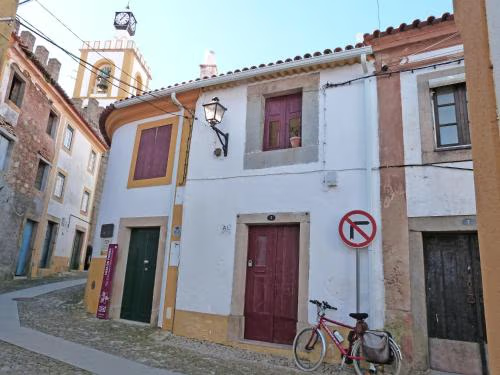
Casa Medieval de Nisa
 OpenReservations accepted
Casinha do Arco
Town 17 of 25