

Town on the Camino
Vila Velha de Ródão
Portugal
- places to stay
- 5
- Camino
- 1
- Elevation
- 90 m
In Vila Velha de Ródão you cross a bridge from 1884 out of the Alentejo and into the Beira Baixa. Right beside the town, the Tagus has cut through a 260-metre-deep wall of quartzite, the Portas de Ródão, where griffon vultures circle and a Templar tower keeps watch. An afternoon is enough, and from here the way climbs.
How long to stay?
An afternoon is enough, if you spend it on the climb up to the castle. From Nisa it is 19.8 kilometres with a long descent, so you arrive early in the afternoon. That leaves time for what makes Ródão special: the path up to King Wamba's tower, about 40 minutes each way from the bridge according to one pilgrim guide, with a view into the gorge. If you still have energy afterwards, look in at the rock art centre or take a boat into the Portas. The town itself is an industrial railway town with no old quarter to fill a second day.
Vila Velha de Ródão in Ninja numbers
- 463.4 kilometres is how far you have walked since Tavira according to Camino Ninja, and 197.8 remain to Trancoso. Under 200 for the first time.
- Around 85 metres above sea level is where the way crosses the bridge over the Tagus, as low as it gets all the way to Trancoso. The highest point of the whole Via Nascente waits near Guarda, at around 1,024 metres.
- 260 metres deep is the gorge of the Portas de Ródão, cut into quartzite some 480 million years old.
- More than 20,000 rock engravings were found in the Tagus valley by students from 1971 onwards. More than 80 per cent of them have lain under water since the Fratel reservoir was built.
- 31.5 kilometres to Castelo Branco, the next popular stage town.
Arriving: across the river into another province
The last kilometres from Nisa lead downhill, along the N18 and down to the Tagus. On the way the view opens onto the Portas de Ródão; in spring you often see griffon vultures here, and the shy Bonelli's eagle. Then you walk across the bridge. The pilgrim guide of the Centro region calls it a metal bridge from 1884, while the Alentejo one speaks of granite piers from the country's first great era of road building.
With the Tagus, the Alentejo part of the Via Nascente ends, which Camino Ninja describes together with Turismo do Alentejo e Ribatejo. On the north bank the Beira Baixa begins, and with it the Centro region. Vila Velha de Ródão is a small municipal town on the Beira Baixa railway line, shaped by industry, above all pulp and paper. The basics are there, with a pharmacy, a post office and a health centre.
In brief: a watchtower on the border river
No town charter for Ródão has survived. In 1199 King Sancho I gave the Templars the land of the Açafa on the Tagus, and it is assumed that they gave Ródão a charter, as they did for their other castles. Their work is the watchtower above the gorge, probably built in the 12th or 13th century; a Templar cross is still carved above the old entrance on the upper floor. The tower guarded the Tagus as a border, first against the Muslims, later against Spain, and artillery still stood here in the Seven Years' War and during the first French invasion of 1807. On the pillory in town sit the Cross of Christ and the armillary sphere.
Much older are the traces by the river. On the terrace of Vilas Ruivas archaeologists found quartzite tools about 60,000 years old, and at the mouth of the Enxarrique, by the Ródão quay, stone tools and bones of deer, horses, aurochs, elephants and rhinoceroses from some 34,000 years ago. The town's most famous son is the painter and ceramicist Manuel Cargaleiro.
Where the Tagus breaks through the rock
The Portas de Ródão are a gate that the river opened itself. Some 480 million years ago this was sea floor of quartz-rich sand, which turned into hard quartzite. About 300 million years ago, as the supercontinent Pangaea formed, it was squeezed into a great U-shaped fold. And roughly 2.6 million years ago the Tagus changed course and used the weak points where faults cross to saw its way through the wall. The result is a gorge 260 metres deep, a natural monument since 2009, covering 965 hectares in the municipalities of Vila Velha de Ródão and Nisa.
On the cliffs breeds the largest colony of griffon vultures in Portugal, along with black storks and Bonelli's eagles. For you as a pilgrim this is a rare moment: for weeks you have walked across open plains, and suddenly you stand in a landscape that shows you how slow and how stubborn water can be. The quartz that the potters in Nisa press into their clay, you see here as a wall.
At the gate of the Tagus: what to see
We only found opening times for the tower; ask in town for everything else.
- Castelo de Ródão, King Wamba's tower: The watchtower of granite and schist stands on the north bank high above the gorge. It has two storeys, a metal staircase leads up, entry is free, and it is open all year. From the Miradouro do Castelo dos Mouros you look over the Tagus between the cliffs, the fold and the old gold mine on the opposite bank. According to one pilgrim guide, a waymarked path leads up from the bridge in about 40 minutes. A few metres from the tower stands the Ermida de Nossa Senhora do Castelo, a small chapel that means a great deal to the people of the town.
- Centro Interpretativo da Arte Rupestre do Vale do Tejo (CIART): The centre for the rock art of the Tagus valley opened in 2012 and was renovated and extended in 2024 for more than a million euros. It explains one of the most important collections of post-glacial rock art in Europe, spread over more than 40 kilometres of river valley, which you can hardly see outside any more because it lies beneath the reservoir. We did not find opening times or admission.
- Boat trip into the Portas: A restaurant in town, the Vila Portuguesa, offers boat trips to the Portas. One pilgrim guide gives Tuesday to Sunday with the last trip at 3pm, but without a date. Phone ahead if you want to manage this on the day you arrive.
- Foz do Enxarrique: The site at the mouth of the Enxarrique lies by the Ródão quay and is protected as a monument of public interest. About 34,000 years ago people lived here among elephants and rhinoceroses on the Tagus. What you see is the riverbank, not the find; it is a place for thinking, not a museum.
Honestly
- Ródão is not a pretty little town. The church is plain, and the town lives from industry. The reason to stay here is the landscape by the river, not the streets.
- The farewell is loud. According to one pilgrim guide, you walk the first four kilometres out of town on asphalt, with big factories in view. After that it becomes a track through pine forest, and the views get much better.
- The next stage is long and empty. It is 31.5 kilometres to Castelo Branco. According to pilgrim guides, Atalaia and Sarnadas de Ródão have no notable services, and the last eight kilometres into Castelo Branco run on asphalt through industrial and commercial areas.
- The castle path takes strength. After 19.8 kilometres and the descent to the river, the roughly 40 minutes up to the tower are a real climb. Go without your rucksack.
Where pilgrims sleep
There is no pilgrim hostel in Vila Velha de Ródão. You sleep in one of the guesthouses or apartments in town; we have no confirmed prices. According to one pilgrim guide, the nearest accommodation for pilgrims is a simple hostel in Amarelos, just before Castelo Branco, telephone +351 272 989 560; call ahead to ask whether it is open. In Castelo Branco, after 31.5 kilometres, there is the HI Castelo Branco - Pousada de Juventude.
Ninja tips
- Look up on the way down. In spring you often see griffon vultures over the Portas. From the tower you can watch them glide on the warm updrafts.
- Find the Templar cross. It is carved into the lintel above the former entrance on the upper floor of the tower. Most visitors only look into the gorge.
- Shop tonight for tomorrow. According to pilgrim guides, there are no notable services until Amarelos, just before Castelo Branco. In Amarelos there is a bakery.
- Start early. The four kilometres of asphalt between the factories are best walked in the cool, and at 31.5 kilometres the stage is long.
- The train as an emergency exit. Vila Velha de Ródão has a station on the Linha da Beira Baixa. If you have to skip a stage, you can get away from here.
Practical tips for pilgrims
- Stamp: We did not find a fixed stamp point. Ask at the Câmara Municipal (+351 272 540 300) or at the Junta de Freguesia (+351 272 541 011).
- Health: Centro de Saúde +351 272 540 210, pharmacy in town, emergency number 112.
- Water: We have not found a confirmed public drinking-water point in town. Carry enough from Nisa.
Onward: up into the Beira
From Vila Velha de Ródão you climb out of the Tagus valley again. After 9.1 kilometres you reach Atalaia, after 14.0 Sarnadas de Ródão. On the way the route changes from the flat landscape of the Alentejo to the hillier country of the Beiras, and according to Camino Ninja's waypoints it climbs from around 90 to a good 350 metres by Sarnadas. After 31.5 kilometres you reach Castelo Branco, the capital of the Beira Baixa.
What awaits you tomorrow
Castelo Branco. The town received its castle and wall in the middle of the 13th century, and its cathedral dates from the 13th century. In the museum of sacred art stands a figure of Saint James the Greater from the 16th century, and a museum of its own is dedicated to Manuel Cargaleiro, the artist from Vila Velha de Ródão. So you will meet him again tomorrow.
Deep dive: King Wamba's horn
A short read, in case you want to learn more about Vila Velha de Ródão. About three minutes' reading.
A king who was never here
The tower above the gorge is popularly called Castelo do Rei Wamba. Wamba was a king of the Visigoths, who ruled from 672 to 680. He had nothing to do with the tower: it was built centuries after him, probably by the Templars in the twelfth or thirteenth century. But the people along the Tagus gave him a story all the same, and it is worth telling. It is a legend.
The legend
Wamba, so they say, was often out hunting or at war, and his queen stayed alone in the castle. On the other side of the river ruled a Moorish king. He won her heart, and she went over to him across the Tagus. Wamba disguised himself as a beggar, went into his rival's land and let himself be captured. Before his death he was allowed one wish. He wished to blow his horn one last time. He blew so long and so loud that his warriors on watch heard him, came across the river, beat the army of the Moors and brought the queen back to Ródão.
What really stood here
The story of the tower is more sober. In 1199 King Sancho the First gave the Templars the land on the Tagus. They built a watchtower from which one could see far along the river, and above its entrance they carved their cross into the stone. The Tagus was a border, and a border needs someone who stays awake. Later artillery stood here against Spanish and French armies. At the beginning of the nineteenth century the tower was rebuilt, and in 2007 it was restored.
What Ródão gives you to take along
Beneath the tower the river has, over millions of years, sawn through a wall harder than almost anything in this region. It needed no strength to do so, only time and a direction. You know this by now. You have more than four hundred and sixty kilometres behind you, and ahead lie the mountains of the Beira and the highest point of the whole way. Set off tomorrow morning like the river: slowly, stubbornly, northwards.
Where to stay in Vila Velha de Ródão
Places to stay in Vila Velha de Ródão.
 OpenReservations accepted
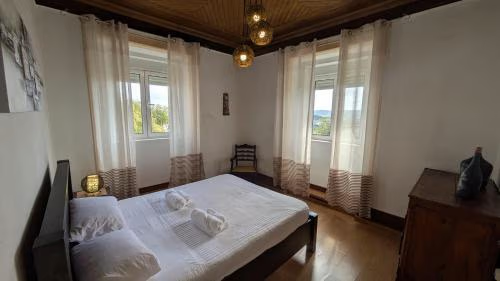
Rei Wamba GuestHouse
 OpenReservations accepted
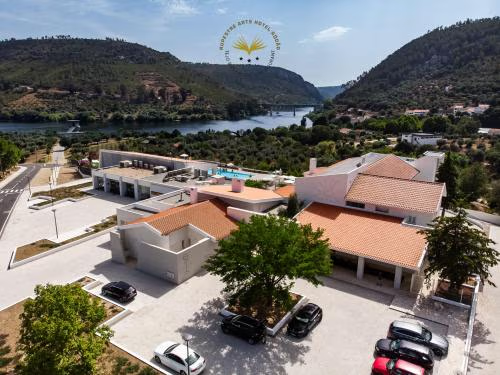
Rupestre Arts Hotel Ródão
 OpenReservations accepted
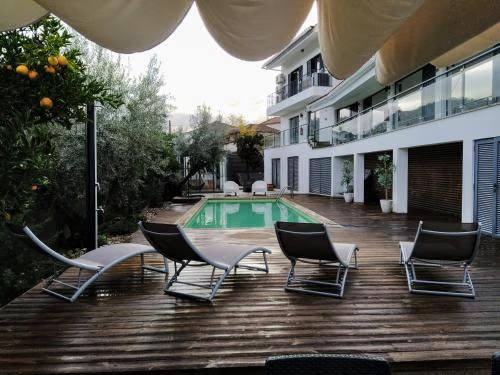
Vilaportuguesa
Town 18 of 25