

Town on the Camino
Pasai Donibane
Gipuzkoa, Euskadi, Spain
- places to stay
- 2
- Caminos
- 2
- Elevation
- 7 m
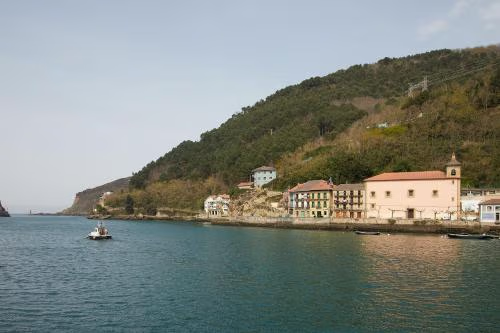
Pasai Donibane is where the Camino del Norte crosses water for the first time: a fishing village made of a single lane on the bay of Pasaia, 17.0 kilometres from Irún. A small boat takes you over to San Pedro for just under 2 euros. Above the village a tiny donation-based hostel waits with a view over the bay.
How long to stay?
An afternoon is enough, and for most it becomes a long break. After the descent from Jaizkibel, Pasai Donibane is perfectly placed for lunch, and it is only 8.6 kilometres more to San Sebastián. If you have had enough after the hard first day, you will also find a bed here: the small Santa Ana hostel opens at 16:00. Then the evening on the Plaza de Santiago is yours.
Pasai Donibane in Ninja numbers
- 17.0 kilometres lie behind you since Irún, most of them along the slope of Jaizkibel with no bar and no shop.
- 833.7 kilometres to Santiago from here on the Camino del Norte.
- About 2 minutes is the crossing to Pasai San Pedro. The boat runs every day all year, roughly every five to ten minutes, and costs just under 2 euros (as of 2026).
- About a hundred steps lead up from the lane to the hostel. In return you see the whole bay from above.
- 1843 was the summer Victor Hugo lived here and called the place a little radiant paradise.
Arriving: steeply down to the water
After about twelve kilometres of forest track on Jaizkibel, the Way crosses a road and then drops steeply, partly on asphalt, partly down steps. Shortly after you enter the village, the hostel at the Ermita de Santa Ana is signposted, 300 metres to the left. The Camino itself goes down steps to the bay, then left along the lane to the Plaza de Santiago and the landing stage. A square named Santiago, and a boat: the first day has a sense of symbolism.
In brief: a village made of one lane
Pasai Donibane is a single narrow, winding street, also called Donibane. It runs from the marina to the Basílica del Cristo de la Bonanza, lined with fishermen's houses and baroque town palaces. At the start stands the 17th-century Palacio Arizabalo, the old town hall. In between, small squares open towards the water; the best known is the Plaza de Santiago with its brightly painted houses. Opposite, on the other side of the bay, lies Pasai San Pedro. In the summer of 1843 Victor Hugo lived here and wrote about it in his travel notes on the Pyrenees.
The lane by the water: what to see
Everything lies on the one street; you can't miss anything if you walk it once from end to end.
- Plaza de Santiago: The village's best-known square, with colourful fishermen's houses, bars and terraces by the water. This is where the boat leaves, and this is where pilgrims eat, because the hostel has no kitchen.
- The ferry across the bay: Not a building, but the experience of the day. Two minutes on the water, and you are in San Pedro. On a walking route, a boat like this is a small celebration.
- Victor Hugo House: The writer lived in the house at Donibane kalea 63 in 1843. It holds a small museum and the tourist office, but according to the tourism website it is currently closed for renovation (as of October 2026).
- Iglesia de San Juan Bautista: The parish church is dedicated to the patron of this part of town, John the Baptist, whose Basque name is part of the village's name. We did not find opening hours.
- Basílica del Cristo de la Bonanza: It stands at the end of the lane. If you have time, continue from here along the coast to the Bonanza arch and the Santa Isabel castle.
Honestly
- The descent is hard on the knees. After the long forest track comes a steep section on asphalt and steps. Take it slowly.
- The hostel is basic. No kitchen, no washing machine, little space, and if you sleep upstairs you go down stairs to the toilet. Pilgrims praise the location and the quiet, but criticise the wait until it opens at 16:00.
- Early start. According to pilgrims, wake-up is around 7:00, and everyone should be on the way by 8:00.
- The museum is closed. The Victor Hugo House is being renovated; we did not find a reopening date.
Where pilgrims sleep
The Santa Ana hostel is in the annex of the Ermita de Santa Ana above the village, in the Barrio Larrabide. It is run by the association of Friends of the Ways of St James in Gipuzkoa with volunteer hospitaleros, takes in pilgrims only and lives on donations (donativo). According to our data it has 14 places. It reopened after a break on 21 March 2025, and check-in is from 16:00. We found no information on a winter closure, so ask ahead if in doubt. The only other place to stay in the village starts at around 190 euros in our data (as of October 2026).
Ninja tips
- Stay here when San Sebastián is full: The municipal Ondarreta pilgrim hostel in San Sebastián has been permanently closed since 2026. That makes Santa Ana one of the few pilgrim beds this close to the city.
- Dinner on the Plaza: Since the hostel has no kitchen, you eat down in the village. The bars on the Plaza de Santiago are there for exactly that.
- Take the Ulía steps in stages: Right after the landing stage in San Pedro, more than 300 steps await. Use the landings to catch your breath.
Onward: across the bay and over Monte Ulía
The boat drops you in Pasai San Pedro. From there you walk along the bay, past the shipyard museum, and climb more than 300 steps past the lighthouse at the harbour entrance. At the top a lonely path follows the cliffs of Monte Ulía, past the Faro de la Plata lighthouse from 1855, then descends through the forest with views of San Sebastián. After 8.6 kilometres you are in the city.
Deep dive: Crossing over
A short read, in case you want to learn more about Pasai Donibane. About two minutes' reading.
A village by the water
Pasai Donibane has never had much room. Between the mountain and the bay there was just enough space for one street, and along that street fishermen built their houses and wealthy families their palaces. Anyone who wanted to get to the other side took a boat. Little has changed since.
A poet in summer
In the summer of 1843 Victor Hugo lived here. In his travel notes he called the place a little radiant paradise, and he wrote that the Basque language was a homeland for the people here. Back then, women rowed him across the bay. Today a small motorboat makes the trip, but the way across the water has remained.
What Pasai Donibane gives you
On the first day of the Camino del Norte you walk twelve kilometres through the forest, with no bar and no shop, and then suddenly you are standing at a landing stage, waiting. The Camino does not go around the bay but across it, and for that you need someone to take you over. That is not a bad lesson for the start of a long journey. Along the Way you will often depend on someone helping you onward.
Where to stay in Pasai Donibane
Places to stay in Pasai Donibane.
 ClosedReservations not accepted
Albergue de peregrinos Santa Ana
 OpenReservations accepted
Donibanea
Services in Pasai Donibane
What you can find in town before the next stage.
- Café
- Shop
- Tobacco
- Medical clinic
- Pharmacy
- Fountain
- Train station
- Restaurant
Source: © OpenStreetMap contributors · updated February 2026
Town 3 of 49