

Town on the Camino
Valença
Distrito de Viana do Castelo, Região do Norte, Portugal
- places to stay
- 20
- Caminos
- 3
- Elevation
- 74 m
Valença is your last evening in Portugal: a fortress town with twelve bastions high above the Minho, facing the cathedral of Tui. By day, linen shops and day-trippers fill the lanes; in the evening the walls belong to the pilgrims. Tomorrow you cross the bridge of 1886 into Spain and lose an hour.
Right now in Valença (as of October 2026)
- Rubiães hostel closed in winter: If you are coming from the south: the hostel in Rubiães, one stage before Valença, is closed for construction work from 15 November 2026 to 31 January 2027. Plan the stage before it accordingly.
- Church under restoration: The Igreja de Santa Maria dos Anjos in the fortress is being restored in 2026.
How long to stay?
An afternoon is enough. The fortress is small enough to walk around in two hours, with views from the bastions over the river and across to Tui. It is most beautiful in the evening, when the day visitors have gone and the sun sets over the Minho. There is too little here for a whole rest day, and if you want to go far the next day, you will often do better sleeping in Tui because of the time difference.
Valença in Ninja numbers
- 1 hour is what you lose on the bridge to Tui. Spain is one hour ahead of Portugal.
- 3.5 kilometers is the distance from Valença to Tui, according to Camino Ninja.
- Around 121 kilometers is the distance from here to Santiago, according to Camino Ninja.
- 42 miles is what the Roman milestone in front of the church of Santo Estêvão shows, counted along the Roman road from Braga to Tui, the forerunner of your path.
Arriving: fortress or bridge
At the big roundabout with the fountain in Valença you have to decide. To the left it goes up to the fortress and the hostel. Straight ahead, the Avenida de España leads directly to the bridge to Tui. Pilgrims report that the waymarks in front of the fortress sometimes disappear and that apps show different routes: one around the outside and one through the fortress, up a steep stone ramp, through the lanes and out again through the gates. The Porta da Gaviarra in the north is the exit pilgrims take toward the bridge.
In brief: a fortress against the neighbor
The first walls date from the thirteenth century. Until the fifteenth century the place was called Contrasta, after that Valença. The fortress took its present form in the seventeenth and eighteenth centuries: two fortress sections separated by a moat, with four gates and twelve bastions. Valença was under fire in the war with Spain from 1640 and was taken by Spanish troops only once. Napoleon's General Soult had a gate blown up as he withdrew. Today the fortress is a candidate for World Heritage status.
On the walls: what to see
- The bastions: Walk once along the walls. From the Bastion do Carmo you look across the Minho to Tui, to the cathedral you will walk to tomorrow. The widest views are from the bastions do Socorro and Santa Ana.
- Igreja de Santa Maria dos Anjos: The fortress's main church was founded around 1276, has a Romanesque portal and is a national monument. It stands right at the pilgrim exit, the Porta da Gaviarra. Next to it is the Capela da Misericórdia with a small museum of sacred art. The church is being restored in 2026.
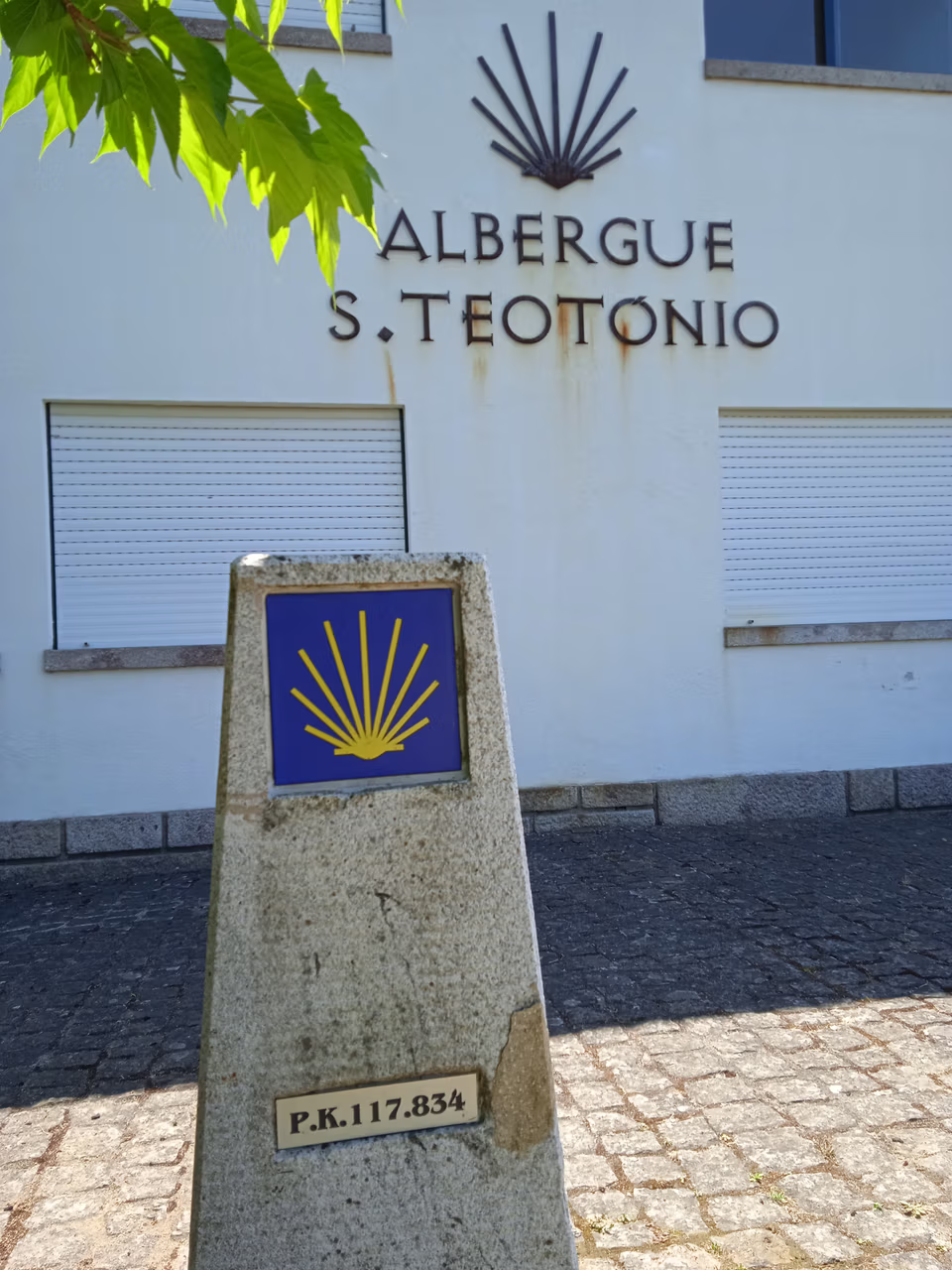
- São Teotónio: In front of the Baroque chapel of Bom Jesus stands the statue of the town's patron saint. Teotónio was born nearby around 1082 and is regarded as the first saint of Portugal. His first teacher was his uncle, abbot of a monastery near Tui. The hostel bears his name.
- Igreja de Santo Estêvão and the milestone: In front of the church stands a Roman milestone from the first century. It stood on the road from Braga to Tui. So the Romans walked this way long before there were pilgrims.
- Ponte Internacional: The iron bridge over the Minho is 399 meters long, with cars below, the railway above, and a footpath at the side. It was inaugurated in 1886. You often read that it was built by Gustave Eiffel. In fact it was built by the Spanish engineer Pelayo Mancebo. When you cross it, you are in Spain.
Food and drink
On the Minho you find lamprey, as arroz de lampreia. Also typical of Valença are salt cod dishes such as Bacalhau à São Teotónio, and oven-roasted kid and lamb. For dessert there are the convent sweets called "Valencianos". A tip: inside the fortress the restaurants are more expensive and sometimes full, while outside the walls you eat more cheaply.
Honestly
- The fortress is a shopping center. In the lanes, one shop for towels and bed linen follows the next, and during the day many Spanish day visitors come to shop. You only get real fortress atmosphere in the evening.
- The waymarking is unclear. At the fortress pilgrims easily lose the way, because the arrows disappear and the apps show different routes.
- The walls are crumbling. In January 2023 part of the wall collapsed after a storm. We have not found out whether everything has been repaired.
Where pilgrims sleep
- Albergue de peregrinos São Teotónio: the town's hostel, open since 2005, all year round, for €8 per night. It accepts pilgrims only, has a kitchen, washing machine and garden, and also issues credenciales. It lies a little off the route, about 400 meters away.
There is no donativo or parish hostel in Valença. In the fortress there are also hostels with dormitories from around €20 to €25.
Ninja tips
- The lost hour: If you set off in Valença at 7 o'clock, it is already 8 o'clock in Tui. If you want to go far the next day, sleep in Tui instead. If not, cross the bridge at sunrise.
- On the walls in the evening: You see the sunset over the Minho best from the bastions, once the day visitors have gone.
- Check navigation beforehand: Look at the Ninja map to decide whether you want to go through the fortress or around the outside to the bridge. On the ground the arrows are not clear.
- No luggage storage at the station: The Valença railway station has no left-luggage service.
Practical tips for pilgrims
- Two stamps a day from Tui: On the last 100 kilometers you need at least two stamps a day. That applies from Tui. Get one in Valença anyway.
- Credencial: If you are only starting here, you get it at the hostel.
Onward: across the bridge to Spain
From Valença you walk over the Ponte Internacional to Tui, a good three kilometers to the cathedral. After that the Camino Portugués Central takes you through Galicia to Santiago. The Portuguese Coastal Way, which comes along the Minho via Caminha and Vila Nova de Cerveira, joins the Central here.
What awaits you tomorrow
Right behind the bridge lies Tui with its cathedral, consecrated in 1225 and standing above the river like a castle. For many pilgrims the Camino only begins there: Tui is the third-largest starting point of all the Caminos. So from here it gets busier.
Deep dive: The fortress across the river
A long read, in case you want to learn more about Valença. About fifteen minutes' reading.
The last evening in Portugal
When you stand on the walls of Valença in the evening, the Minho lies below you, and over there, on the other side, stands the cathedral of Tui. Only the river lies between them, and yet between them lie a border, a language and an hour. Tomorrow you cross over. Today you are still in Portugal.
This view is the key to Valença. The town was built to look exactly there, at the town on the far bank. For centuries Tui was the neighbour nobody trusted, and Valença was the answer to it. The cannons still standing on the walls today point north, at the river and at Galicia. Whoever lived here lived facing the border.
Today you hardly feel that border. Spaniards come over to shop, commuters go back and forth, and pilgrims walk across the old iron bridge without anyone asking for their passport. But the walls have remained, and with them a story of kings and saints, of sieges and of a queen on pilgrimage. This text tells that story.
Contrasta, the town opposite
At the beginning stood a name that already said everything. Around 1200 the Portuguese king Sancho the First had the first walls built on the hill above the Minho. The place was called Contrasta. The word means, as the Portuguese reference works explain, a place that stands opposite another. The other was Tui, the Galician bishop's city on the far side of the river.
The story behind it is also a family story. Sancho had married his daughter Teresa to Alfonso the Ninth, King of León, to which Galicia then belonged. When that marriage broke down, Sancho commissioned a follower named Paio Carramundo to resettle the land on the south bank and lay out a fortified place opposite Tui. Contrasta did not last long. The Leonese destroyed it, according to one source in 1212 under Alfonso the Ninth himself. The Portuguese king Afonso the Second then had the place resettled, and in 1217 it was raised to a municipality.
When Contrasta became Valença, the sources tell differently. Most sources name King Afonso the Third and the year 1262. A Portuguese reference work, on the other hand, attributes the new name only to Afonso the Fifth, in the second half of the fifteenth century. All that is certain is that the place was called Valença in the end, and that it was later given the addition do Minho, after the river on which it lies.
The road of the Romans
But the hill was inhabited long before the kings. In the surrounding area there are rock carvings and megalithic tombs, and before the Romans people lived here in fortified hilltop villages, the castros. Then came the Romans, and with them the roads. Two passed Valença: a military one, the great road from Braga to Astorga, listed in a Roman road register as the nineteenth route, and a trade road that ran closer to the coast.
A witness of that time stands inside the walls today, in front of the church of Santo Estêvão: a Roman milestone from the first century. Its inscription names the Emperor Claudius, who had the road renewed, and a number: forty-two miles, counted from Braga, which is about 62 kilometres.
For you as a pilgrim this stone is more than an antique. Between Ponte de Lima and Padrón the Portuguese Way largely follows this old Roman road. If you came up on the Central from Ponte de Lima, you have been walking in its tracks, and after Tui and further north it will stay with you too. The Romans brought soldiers and traders onto this road. You bring only your backpack.
The saint from Ganfei
Anyone visiting Valença meets one name everywhere: Teotónio. The public albergue bears it, so does a salt-cod dish of the region, and in front of the baroque Capela do Bom Jesus stands his statue. He is the town's patron, and the day of his death, 18 February, is still its holiday.
Teotónio was born around 1082 in Ganfei, a village that today belongs to the municipality of Valença. In Ganfei there was an old Benedictine monastery whose founding is attributed to Saint Martin of Dume or Saint Fructuosus in the sixth century. His parents were called Oveco and Eugenia and were considered wealthy and devout. His first teacher was his uncle Crescónio, abbot of a Benedictine monastery near Tui, on the other side of the river. When Crescónio became Bishop of Coimbra in 1092, he took the ten-year-old boy with him.
After his uncle's death in 1098, Teotónio went to Viseu, where another uncle was prior of the cathedral chapter. There he became a priest and eventually archpriest of the whole town. He was regarded as a good preacher and an advocate of the poor. Every Friday he said a Mass for the souls of the dead, then led a procession to the cemetery and had alms distributed to the poor.
He was also uncomfortable to deal with. It is told that in Viseu he preached against living together outside marriage in front of the widowed ruler Teresa, the mother of the later first king, and her lover. When Teresa once asked him to keep the Mass shorter, he is said to have replied that the Mass was offered to a greater sovereign, and its length would not change.
A pilgrim to Jerusalem
Teotónio was a pilgrim himself, and perhaps that is where he is closest to you. Twice he went to the Holy Land. For the first journey he gave up his office in Viseu. He made the second journey with a large group of pilgrims, and tradition describes it precisely: about ten weeks of travel to the port of Bari in southern Italy, six weeks of waiting for a favourable wind, a storm off Cape Malea in the south of Greece and three weeks at sea to Jaffa. In the Holy Land he visited Nazareth, Mount Tabor, the Sea of Galilee, Bethlehem and, in Jerusalem, Calvary.
This journey changed him. Back in Portugal he wanted to found a community living under the Rule of Saint Augustine. On 28 June 1131 construction of the monastery of Santa Cruz began in Coimbra, and on 22 February 1132 the community took the habit there, seventy-two men, with Teotónio as the first prior. Santa Cruz became one of the most important monasteries in Portugal.
Teotónio became an adviser to Afonso Henriques, the first King of Portugal. The king credited his victory at the Battle of Ourique to the prior's prayers, and Teotónio used his influence: he persuaded the king to release Mozarabic Christians whom his troops had captured on raids into Moorish territory. He declined the bishoprics of Viseu and later of Coimbra that he was offered. Saint Bernard of Clairvaux, who had heard of him, sent him a shepherd's staff.
After about thirty years as prior, Teotónio withdrew to live as a hermit. He died on Saturday, 18 February 1162, in Coimbra. The king is said to have said: "His soul will be in Heaven before his body is in the tomb." Teotónio is regarded as Portugal's first saint; his veneration was later confirmed by Pope Benedict the Fourteenth. A boy from a village on the Minho, taught by an abbot from Galicia, died a saint in Coimbra: that too is a story of this border, where people were always connected, even when the kings were at war.
The queen on the way
Some hundred and sixty years after Teotónio's death, a famous pilgrim passed through Valença. Isabel of Aragon was the wife of King Dinis. She is called the Rainha Santa, the holy queen. In 1325, shortly after her husband's death, she set out for Santiago. Her route led north via Águeda and Barcelos to Valença, and people have spoken ever since of the Caminho da Rainha Santa, the way of the holy queen. According to tradition she spent the night in Valença before crossing into Galicia.
In Compostela, it is said, she laid her crown on the Apostle's altar. The Church of Compostela gave her a pilgrim's staff, and this staff was later found in her tomb in the convent of Santa Clara in Coimbra. In her will she left large sums for pilgrim hospitals in Portugal.
Others followed her. In 1502 King Manuel the First made the pilgrimage from Lisbon to Santiago and donated a lamp to the cathedral. And in 1669 Cosimo the Third de' Medici, later Grand Duke of Tuscany, came from Portugal and entered Spain at Tui, directly opposite Valença. Whether he spent the night in Valença, we do not know. On 4 and 6 March 1669 he prayed at the Apostle's tomb in Santiago.
How these pilgrims crossed the river, we found no precise information. In any case there was no bridge for a long time to come. The sources only tell us that the Gaviarra gate in the north of the fortress used to be the main gate and led down to the riverbank and the ferry. Today it is the gate through which pilgrims leave the fortress towards the bridge.
Churches behind the walls
Two old churches stand inside the walls. The more important is the Igreja de Santa Maria dos Anjos, the church of Saint Mary of the Angels, right next to the Porta da Gaviarra. It was founded and consecrated around 1276. Its main portal has Romanesque forms; outside it is plain, inside richly furnished: a single nave, a wooden floor edged with granite, a carved and painted high altarpiece and an old baptismal font. Over the centuries baroque and neoclassical elements were added. Beside the façade stands the Capela da Misericórdia from the eighteenth century with a small museum of sacred art. The church is a national monument, and when this text was written, in autumn 2026, restoration work was under way.
The second is the Igreja de Santo Estêvão, the church of Saint Stephen, in front of which the Roman milestone stands. It too is Romanesque in origin, from the thirteenth century, but was rebuilt in the neoclassical style in the eighteenth century. One reference work mentions a restoration in 1792. Inside, pictures tell the life of Saint Stephen.
We found no church of Saint James or pilgrim hospital with a documented history in Valença. Pilgrims were always passing through here, on their way to the river and to the shrine on the other side.
A star of stone
What you see today is no longer the medieval town wall but a fortress of the early modern age. Little remains of the buildings of the thirteenth century. Some stones still bear masons' marks from Romanesque and Gothic times, and at the Gaviarra gate a keystone with a medieval coat of arms is said to survive.
The great turning point came in 1640. In that year Portugal broke away from the Spanish crown, under which it had stood for sixty years, and a war of almost thirty years followed. Valença was once again on a front line, and Spanish artillery fired on the town. The Visconde de Vila Nova de Cerveira, military governor of the province between the Douro and the Minho, had the defences rebuilt according to the latest rules of fortification. The design came from the French military engineer Miguel de l'École. Exactly when the work began is unclear: one source gives 1641, another 1661. What is certain is that it dragged on for decades. Only in 1713 did the master builder Manuel Pinto de Vilalobos declare the fortress complete.
The result is a bastion fortress in the style named after the famous French military engineer Vauban. That Vauban himself built here, as you sometimes read, is not supported by any of the sources we found. The fortress consists of two parts on two hills: the larger Recinto Magistral in the north with the old town, and the Coroada in the south. A ditch separates them, and the Porta do Meio, the middle gate, joins them. Ten bastions and two half-bastions jut out from the walls like the points of a star. They bear the names of saints and titles of Mary: Santa Ana, São Jerónimo, Santa Bárbara, Carmo, Socorro, Lapa, Esperança and others. Add to that outworks, sentry boxes, gun ports and powder magazines. One of them, the Paiol do Açougue, was built in 1774.
Cannons above the river
The war came quickly. In 1643, when the rebuilding had only just begun, Spanish troops attacked Valença and were driven back. Further attacks followed, according to one source in 1657 and again in 1668, shortly before Spain recognised Portugal's independence.
How dangerous the situation was becomes clear if you look downstream. In September 1658 a Spanish army from Galicia under the Marqués de Viana defeated the Portuguese troops near Vila Nova de Cerveira. The Portuguese commander was the Count of Castelo Melhor, and he lost the battle. In January 1659, after a long and costly siege, Monção fell, upstream of Valença. In those years the border on the Minho was a real front, and Valença stood right in the middle of it.
Taken or not?
Here you come up against a question the sources do not answer in agreement: did Valença ever fall in these wars?
A Portuguese reference work says yes. The town, it says, was taken by Spanish troops only once and then recaptured by the Count of Castelo Melhor. Another source gives the year 1654 for this. A castle website, by contrast, writes that Valença was never taken until 1809, and that only Napoleon's troops got in.
We cannot resolve this contradiction. Perhaps it was only a brief occupation that some chroniclers do not count as a conquest. All that is certain is this: at the end of the war Valença was Portuguese, and it has remained so. For a town built to hold out, that is perhaps the most important result.
The French, civil war and the Republic
In 1809 the French came. In the war against Napoleon, Marshal Soult marched his army through the north of Portugal, and after local resistance he took Valença. In doing so he had the Porta do Sol blown up, the Sun Gate, which until then had been the main entrance to the fortress. Today the tourist information office is there.
Peace did not follow. In 1828 Valença was drawn into the civil war between the supporters of absolute monarchy and the Liberals, who wanted a constitution. The town took the Liberal side and was captured by troops of the absolutist King Miguel. Later the Liberals took it back with the help of English forces under Admiral Charles Napier. In the middle of the nineteenth century Valença was caught up once more in Portugal's political struggles, and only after that did peace return.
According to one source, the fortress even had to fight once more in the twentieth century: in 1912 Valença is said to have defended the Republic, proclaimed two years earlier, against an attack by monarchists. In 1928 the fortress was declared a national monument. Today it is a candidate for World Heritage status.
The bridge
For centuries there was no bridge between Valença and Tui. Only in 1879 did Portugal and Spain agree to build a bridge that would carry road and railway at the same time. The design came from Pelayo Mancebo y Ágreda, a Spanish engineer and member of parliament from La Rioja. The bridge is an iron lattice box, 399 metres long. Cars drive below, pedestrians walk along the sides, and the train runs on top. It went into service in 1884, and on 25 March 1886, almost a year and a half later, it was formally inaugurated.
Perhaps someone has told you that the bridge is by Gustave Eiffel. You hear it often, on pilgrim blogs too, and it sounds good: the bridge looks like a work from Eiffel's era, and Eiffel did indeed build bridges in Portugal. But the attribution is a legend. The English Wikipedia says cautiously that the bridge was inspired by Eiffel's works. It was built by Pelayo Mancebo.
The old bridge is no longer the only one today. In 1995 a new motorway bridge opened further south, and heavy lorries may no longer use the old one. On 17 March 2020 it was temporarily closed because of the pandemic; a border people had forgotten was suddenly back. There are now plans for a lane for bicycles and e-scooters. For pilgrims, though, it is what it has been for more than a hundred years: the way into Spain. When you stand in the middle, you are neither in Portugal nor in Spain, but above the Minho.
A town made of two towns
On 10 February 2012 Valença and Tui did something their ancestors would hardly have believed: they declared themselves a Eurocidade, a Eurocity, two towns in two countries working together. The fortress built against Tui is now part of a partnership with Tui.
In 2021 about 13,600 people lived in the municipality of Valença. The town has always been a trading place. In the past, boats on the Minho brought timber from Monção and salt from Aveiro and Setúbal. Today the customers come from Galicia, and in the lanes of the fortress one shop for towels and bed linen follows another. As early as 2007 there were about 170 shops, and at some times more than eighty percent of the customers were Spanish.
The pilgrims are back too. In 2005 the São Teotónio albergue opened, and in the first half of 2010 more than 3,500 pilgrims already stayed overnight in Valença. Portugal has determined that the Caminho Português da Costa, which comes via Caminha and Vila Nova de Cerveira along the sea and the Minho, ends here. So two Portuguese ways meet here before crossing the river together.
What Valença gives you
Valença was built to say no. No to Tui, no to León, no to Spain, no to Napoleon. Its walls are a no in stone, ten bastions and two half-bastions long. And yet, when you stand on its walls today, this town is above all a place of crossing. The saint the pilgrim albergue is named after learned as a child from an abbot on the other side. A queen went north from here to lay down her crown. And a bridge that two countries built together carries you across tomorrow.
When you set off tomorrow morning, you lose an hour on the bridge. That is the only thing you lose here. Stop for a moment in the middle and look back at the walls that were turned against the other bank for so long. Then cross over. Some borders become bridges over time. Perhaps you know that from your own life too.
Where to stay in Valença
The places pilgrims rate highest in Valença come first.
- Top #1
 OpenReservations accepted
Bulwark Hostel
- Top #2
 OpenReservations not accepted
Albergue de peregrinos São Teotónio
- Top #3
 OpenReservations accepted
Alojamento da Vila
 - valença guesthouse.jpg?tr=w-960,c-at_max,f-avif,q-85)



Services in Valença
What you can find in town before the next stage.
- ATM
- Café
- Shop
- Medical clinic
- Pharmacy
- Fountain
- Post office
- Train station
- Bus station
- Restaurant
Source: © OpenStreetMap contributors · updated January 2026