

Town on the Camino
Portilla de la Reina
Spain
- places to stay
- 3
- Caminos
- 2
- Elevation
- 1,222 m
Portilla de la Reina is a mountain village of about 70 inhabitants at 1,243 metres, wedged between conglomerate rocks in the Montaña de Riaño. Two routes meet here: the Camino Vadiniense to Riaño and the Camino Lebaniego Leonés over the Puerto de San Glorio to Potes. Beds are scarce, so call ahead.
How long to stay?
An afternoon is enough. Portilla is a stage town, not a destination. If you come down from the Vadiniense over the Horcada de Valcavao, you have a long mountain day behind you and mostly want a bed and a meal. If you set off towards San Glorio, you start early. For a walk around the village, half an hour is enough.
Portilla in Ninja numbers
What the numbers say about the town:
- 1,243 metres above sea level is Portilla. To the Puerto de San Glorio on the Leonés you still climb around 400 metres in a good nine kilometres.
- 37.6 kilometres on the Camino Lebaniego Leonés to Potes; on the Camino Vadiniense it is a good 50 kilometres via Fuente Dé according to Camino Ninja.
- About 70 people live here, one of nine villages of the Tierra de la Reina.
Arriving: from above
From the Vadiniense you come down a long mountain road after the highest point of the route, the Horcada de Valcavao at around 1,790 metres; there are no supplies along the whole stage. The albergue is at the start of the village right on the route, the Casa rural El Invernal de Picos at the village entrance. The Yuso flows through the village, and the N-621 leads from here up to the Puerto de San Glorio.
In brief: a village between rocks
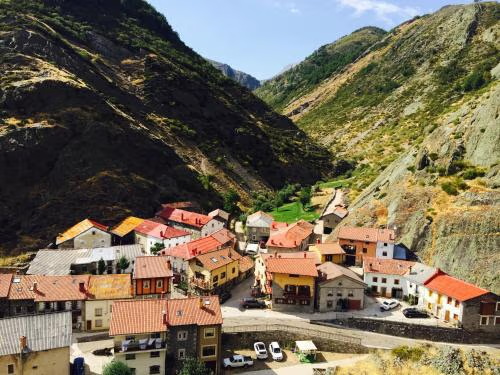
Around Portilla stand four conglomerate rocks that the locals call Cuervo, Cuesta, Cruz and Cincho; a castle is said to have once stood on the Cincho, but this is not documented. In 1755 King Ferdinand VI granted the town the title of villa, and in 1857 it became part of the municipality of Boca de Huérgano. The area lived from merino sheep and transhumance; a festival in August still commemorates this. Where the "de la Reina" in the name comes from, we have not found out.
Rocks and river: what to see
There is not much, but the village is worth a short walk.
- Iglesia de Santo Tomás: The parish church in the Barrio de la Iglesia on the bank of the Yuso; one source dates it to the 14th century, others give no date.
- The four rocks: Cuervo, Cuesta, Cruz and Cincho frame the village. In the evening light, once you have arrived, you see why people built here: the rocks protect the valley.
- Las Eras rest area: The rest area on the edge of the village is the right place to take your shoes off.
Honestly
What you should know:
- Beds are scarce and not always available. The albergue has only private rooms and, according to pilgrim reports, was temporarily closed at times, and once fully booked in August 2024. Call the day before: +34 987 740 473.
- No shop. We did not find a grocery shop. You are better off bringing provisions for the next day with you.
- Cash. According to a pilgrim report, the restaurant does not take cards.
- No dormitory. If you are used to albergue prices, you pay room prices here.
Where pilgrims sleep
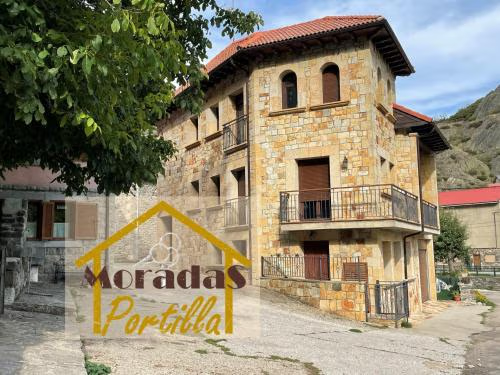
There is no classic pilgrim albergue with a dormitory. The Albergue de Portilla rents private rooms; the Junta de Castilla y León gives 18 beds in nine double rooms, our database 8 places. It has a restaurant and offers half and full board. Besides that there is the Casa rural El Invernal de Picos, which takes pilgrims when it is not rented out, and the holiday apartments of Moradas Portilla.
Ninja tips
Small things that make the evening better:
- Reserve the day before: In Portilla there are hardly any alternatives; the nearest beds are in Boca de Huérgano.
- Set off early towards San Glorio: Fog often rolls in at the pass. If you are up there early, you have the best chance of a view.
- In fog at the pass: Take the main track, not the shortcut.
Onward: two routes from Portilla
The Camino Vadiniense leads south via Boca de Huérgano to Riaño and on to Mansilla de las Mulas on the Camino Francés. The Camino Lebaniego Leonés goes east via Llánaves de la Reina to the Puerto de San Glorio and then down through the Liébana to Potes, 37.6 kilometres, best walked in two days.
What awaits you tomorrow
If you walk the Leonés, after nine kilometres you stand on the border between León and Cantabria, at the Puerto de San Glorio at 1,615 metres. From there it is a detour of a good two kilometres to the bear monument at the Collado de Llesba, where the Picos de Europa open up in clear weather. After that it is only downhill.
Deep dive: The gateway to the Tierra de la Reina
A short read, in case you want to learn more about Portilla de la Reina. About 2 minutes' reading.
A landscape with a queen's name
Portilla belongs to the Tierra de la Reina, a small landscape of nine villages in the north-east of the province of León, which also includes Llánaves de la Reina. Many places have "de la Reina" in their name. Which queen is meant is told by some stories, but no source we have found can confirm it.
Sheep on the way
For a long time the merino sheep passed through here in summer, on their migrations between the pastures in the south and the mountains. This coming and going shaped the village. Even today, on the Saturday after San Roque in August, Portilla holds a festival in honour of the merinos and transhumance.
What Portilla gives you
Portilla is a place between two routes. Some come down and are glad to have arrived, others set off, up to the pass. In the evening they often sit at the same table. Here you decide whether to walk the long arc of the Vadiniense or the short, steep line over San Glorio to the monastery.
Where to stay in Portilla de la Reina
Places to stay in Portilla de la Reina.
 OpenReservations accepted
Albergue de Portilla
 OpenReservations accepted
Moradas Portilla
 OpenReservations accepted
El Invernal de Picos
Town 4 of 5