

Town on the Camino
Povoa de Varzim
Distrito do Porto, Região do Norte, Portugal
- places to stay
- 18
- Caminos
- 2
- Elevation
- 4 m
Póvoa de Varzim is a fishing town that became a seaside resort. For generations its fishermen signed with their own marks, the Siglas Poveiras, which you can still find set into the ground in front of the town hall. The parish albergue is right in the centre. An afternoon is enough; tomorrow you walk along the dunes to Esposende.
Right now in Póvoa de Varzim (as of October 2026)
- The albergue in winter: The São José de Ribamar pilgrim albergue is closed on Mondays. Whether it is open in winter is unclear: one source says March to November, another says all year. From December, call ahead.
- Ponto das Almas on 30 November: Every year at dawn, people walk along the beach to the Capela de Santo André and pray for the dead the sea has kept.
How long to stay?
An afternoon is enough. You can manage the town hall square, the museum and the fishermen's church in one afternoon, with time left for the promenade. If you come from Vila do Conde, you only have a few kilometres in your legs and can look around at leisure in the afternoon. If you come straight from Porto, you have a very long day behind you and mostly want a shower and a bed. Póvoa doesn't need a rest day, but it does need you to keep an eye on the ground.
Póvoa de Varzim in Ninja numbers
- 243.8 kilometres to Santiago from here on the Senda Litoral, according to Camino Ninja. On the Caminho Português da Costa it is 224.6.
- 54 families received the town charter from King Dinis in 1308. Today about 64,000 people live in the municipality (as of 2021).
- 105 fishermen drowned in a storm on 27 February 1892, just a few metres from the shore.
- 20 percent more pilgrims and visitors walked the coastal route in 2025 than the year before.
Arriving: along the coast from the neighbour
Póvoa de Varzim and Vila do Conde lie close together. According to Camino Ninja, only 5.7 kilometres separate them on the Senda Litoral and 3.5 kilometres on the Caminho da Costa, through the fishing quarter of Caxinas. The pilgrim albergue is central, on Avenida Mouzinho de Albuquerque, close to the route. The metro runs from here to Porto; line B ends in Póvoa.
In brief: from Villa Euracini to seaside resort
The name goes back to a Roman Villa Euracini; the town is first mentioned in 953. King Dinis granted the charter in 1308, King Manuel I a new one in 1514, together with the pillory that still stands on the town hall square. Póvoa lived from the sea: since at least 1506 its fishermen sailed as far as Newfoundland. In February 1892 a single storm killed 105 of them. In the early twentieth century holidaymakers discovered the long sandy beaches, and the casino opened in 1934. Since then Póvoa has been both, a fishing town and a seaside resort.
Siglas Poveiras: the fishermen's script
The fishermen of Póvoa had their own marks, the Siglas Poveiras. Each family used them to mark boats and property; they served as signatures and appeared in churches and on graves. Scholars speak of a form of proto-writing. They have not disappeared entirely; some families still use them today. People like to say the marks came from the Vikings, who raided here in the tenth century. Whether that is true is disputed.
You can find the marks in the paving in front of the town hall, next to the town's coat of arms. And in the museum, whose exhibition on the siglas won the European Museum of the Year Award in 1980. For a pilgrim there is something familiar about it: for days you too have been following signs that others painted for you.
Signs in the town: what to see
Everything important is in the centre and on the coast just north of it.
- Praça do Almada: The town hall square was laid out from 1791, and the neoclassical town hall was occupied in 1807. In front of the entrance, the coat of arms and Siglas Poveiras are set into the ground; on the west side stands the Manueline pillory of 1514. Right next to it, the writer Eça de Queirós was born in 1845; a statue from 1952 commemorates him. The tourist office is also near the square.
- Museu Municipal de Etnografia e História: The museum, founded in 1937, is housed in a seventeenth-century manor house on Rua Visconde de Azevedo. Here you understand what you see outside: the siglas, a reconstructed Poveiro boat and a room on the disasters at sea. It holds the town's first lifeboat from 1864, named after the rescuer Cego do Maio and in service for more than sixty years. We couldn't find opening hours or admission prices.
- Igreja da Lapa: The fishermen built this church themselves between 1770 and 1772. Behind it stands a small lighthouse that guided the boats home. When things went badly at sea, the families came here.
- Capela de Santo André: This sixteenth-century chapel stands north of the town on Cape Santo André, between the beaches of Quião and Santo André. After the disaster of 1892, Saint Andrew became even more important to the fishermen. Every year on 30 November, at dawn, people walk along the beach to the chapel, circle it and pray for the drowned. A small pilgrimage in the middle of your big one.
Food and drink
Póvoa is a fishing town, and on the beach there are restaurants serving fresh fish and seafood. If you want to save money, cook in the pilgrim albergue's kitchen: according to pilgrims, the supermarket is just around the corner.
Honestly
- Porto to Póvoa is too long. According to Camino Ninja it is 39.6 kilometres on the Senda Litoral. If you can, stop earlier, for example in Vila do Conde.
- The albergue is noisy. Several pilgrims write that the dormitories facing the street get loud at night. Pack earplugs.
- Closed on Mondays. If you arrive on a Monday, you'll find the door locked and have to sleep in a private place.
- It's crowded in summer. Póvoa is a seaside resort. In summer the beach and promenade are full of holidaymakers, and if you want a private bed, book early.
Where pilgrims sleep
- Albergue de peregrinos São José de Ribamar: the albergue of the São José de Ribamar parish, since 2013 on the first floor of a parish building in the centre. Only for pilgrims with a credencial, no reservations, €10 (as of October 2026), closed on Mondays. There is a kitchen; bed linen is disposable only, and there are no blankets. Since late 2025 the albergue has had a new manager, whom many pilgrims praise for his welcome.
Private hostels near the route charge from about €15 in a dormitory and can be booked on the usual platforms. In summer it pays to reserve early.
Ninja tips
- Bring a sleeping bag: The parish albergue only has disposable linen and nothing to cover yourself with.
- Fill up on water: Pilgrims found no drinking fountains between Póvoa and Esposende, not even along the boardwalks. Fill all your bottles in the morning.
- Look down: The siglas in front of the town hall are easy to miss. Look for them next to the coat of arms.
- Watch out at the football pitch: Just before A Ver-o-Mar the waymarking is confusing. At the large football pitch without grass: if it is on your right, take the small bridge. If it is on your left, turn left at the end of the pitch and go straight on over a different bridge and a short stretch of sand.
- The metro as a joker: Line B runs from Póvoa to Porto. If you still want to see something in Porto or split the long first stage, you can use it.
Practical tips for pilgrims
- Shopping: Supermarkets, pharmacies and cash machines are in the centre near the route. Buy water and food for tomorrow here.
- Check-in: At the parish albergue, from 14:00 to 20:00 according to Gronze. If you arrive earlier, use the time for the museum and the town hall square.
- Tourist office: It is near Praça do Almada.
Onward: along beaches and dunes to the north
You leave town along the beach promenade, Avenida dos Banhos, and walk by the sea to A Ver-o-Mar. After that, boardwalks lead through the dunes, past an old windmill near Aguçadoura. Beyond Aguçadoura the route leaves the coast and follows the narrow M-501 road for a while, between fields and greenhouses, with hardly any shoulder. Via Apúlia and a stretch of pine forest you reach Fão. There you are joined by pilgrims who have switched from the Camino Portugués Central at São Pedro de Rates to the coast. The iron bridge takes you to Esposende, according to Camino Ninja 20.8 kilometres from Póvoa on the Senda Litoral and 20.1 on the Caminho da Costa.
What awaits you tomorrow
Tomorrow is a day by the sea, flat and windy, with boardwalks across the dunes. At the end you cross the Cávado on an iron bridge from 1892 and arrive in Esposende, a small town at the river mouth, with a fort that has carried a light since 1866.
Deep dive: A town that wrote in signs
A long read, in case you want to learn more about Póvoa de Varzim. About twenty minutes' reading.
Signs in the pavement
Stand on the Praça do Almada and look down. In front of the town hall, set into the paving, are the town's coat of arms and, next to it, small figures made of strokes, crosses and hooks. They look like the letters of a language you don't know. They are not letters. They are the Siglas Poveiras, the family marks of the fishermen of Póvoa. For generations people here signed with them, marked their boats with them, put them on their graves.
On the same square stands the pillory that King Manuel the First granted the town in 1514, and a statue of the writer Eça de Queirós, who was born right next door. So this is a square where three kinds of writing stand side by side: a king's charter, the novels of one of Portugal's greatest authors, and the signs of the fishermen. Today Póvoa de Varzim is a seaside resort with long beaches and a big casino. But look more closely and you'll find, beneath the resort, a fishing community quite unlike any other.
The town on the hill
The story doesn't begin on the beach but inland. On the hill of the Cividade, in the district of Terroso, less than five kilometres from the coast and a good 150 metres up, people founded a fortified settlement in the Bronze Age, somewhere between 900 and 800 before Christ. The Cividade de Terroso grew into a small town with three rings of walls built from large granite blocks stacked without mortar. At its height a few hundred people lived there.
From up there the inhabitants traded with Phoenicians, Carthaginians, Greeks and Romans, who exchanged cloth and wine for gold and tin. Then Rome itself arrived. After the death of the Lusitanian leader Viriathus in 138 before Christ, the general Decimus Junius Brutus marched north and destroyed the settlement. But people were drawn down to the coastal plain. There a Roman estate grew up, the Villa Euracini, with a fish factory, salt pans and a burial ground.
The Cividade was excavated from 1906 onwards, paid for by António dos Santos Graça, the man who would later also study the siglas. After the death of the archaeologist Rocha Peixoto in 1909, stones from the ancient town were carried down and used to pave streets in Póvoa. The Cividade is fenced, entry is free, and a small museum at the entrance explains the site.
Euracini becomes Varzim
Over the centuries the name Euracini turned into Uracini, Veracini, Verazim and finally Varzim. The place is first mentioned on 26 March 953, in the time of Countess Mumadona Dias. This coast was not a quiet one. In the 960s Vikings attacked, in 997 the Moors, in 1015 and 1016 Norman pirates. There are hints that Norsemen afterwards settled here.
In the Middle Ages nobles, military orders and kings fought over the harbour. On 9 March 1308 King Dinis gave a charter to fifty-four families and so founded the municipality around today's Praça Velha. Póvoa means something like settlement, a newly founded place. As early as 1312 Dinis gave the town to his illegitimate son Afonso Sanches. He handed it on to the Convent of Santa Clara in neighbouring Vila do Conde, which he had founded himself. The convent's power over the town grew, and in the end the townspeople asked King Manuel the First to put a stop to it. In 1514 Póvoa received a new charter, self-government and the pillory that still stands on the town hall square today. The rivalry with Vila do Conde has never quite gone away. To this day the fishing quarters of Caxinas and Poça da Barca, where many families from Póvoa live, belong administratively to the neighbour, although Póvoa has long claimed them.
A script without letters
The Siglas Poveiras are not writing in the strict sense. They don't stand for sounds or words. Specialists speak of a form of proto-writing. Each sign belonged to a family and was passed from father to son, following a rule of its own: the basic sign went to the youngest son, because by local custom he was the heir. His older brothers received the sign with small added strokes, the piques. The eldest got one stroke, the second two, and so on. Anyone who could read the signs was reading a family tree. Researchers have studied hundreds of these marks and traced them back to eighty-four original families.
The signs were everywhere. People cut them into wood with a razor and painted them on boats and beach huts. Fish caught in someone else's net were marked with blows in the shape of the net owner's sign and delivered to him. Merchants kept their credit books with them. At their wedding, Poveiros wrote their sign on a table in the main church; examples survive in the Igreja Matriz and in the Igreja da Lapa. A table in the old Misericórdia church bore thousands of signs and was lost when the church was demolished. Later it became customary to put the sigla on the gravestone as well.
And the fishermen carved their signs into the doors of chapels on beaches and hills, as a waymark or as a vow, to find luck with the local saint. Such signs have been found at the chapel of Nossa Senhora da Bonança, on the beach at Esposende, where you arrive tomorrow, and on Monte Santa Trega in Galicia, above A Guarda, which the coastal route passes. A sculpture honouring the siglas was unveiled there on 23 September 1991. When you walk along the foot of that mountain in a few days' time, remember: Poveiros were there before you.
The first person to study the signs thoroughly was António dos Santos Graça. In 1952 he published his book Epopeia dos Humildes, the epic of the humble, with hundreds of siglas. The town museum, which he had founded in 1937, later held an exhibition on the signs and won the European Museum of the Year Award for it in 1980. The siglas haven't disappeared entirely. The beach attendants in the northern quarter still mark their belongings with them, and the Casa dos Pescadores, the fishermen's house, still accepts the signs as a valid signature.
The disputed question: did the signs come from the north?
Where do the siglas come from? The most popular answer is: from the Vikings. Some accounts even call their Scandinavian origin generally accepted and attribute the signs at least partly to Norsemen who are said to have settled here in the tenth and eleventh centuries. The researcher Octávio Lixa Filgueiras found house marks from the Danish island of Funen in the National Museum in Copenhagen that resembled the signs from Póvoa. He compared individual siglas with runes, the harpoon, for example, with the rune of the god Tyr. He and the writer Raul Brandão also considered Póvoa's traditional fishing boat, the Lancha Poveira with its flat bottom and lateen sail, to be a descendant of the Viking ships.
Then there were older observations that should be read with caution today. In 1876 the writer Ramalho Ortigão wrote that the fishermen of Póvoa were a race of their own on the Portuguese coast. In 1908 Fonseca Cardoso considered them a mix of Teutons, Jews and above all Normans. An American work on the races of Europe noted in 1938 that there were more blond people among them than usual. That is the language of the racial science of the time, not proof of anything.
Honestly: the Viking origin has not been proven. Similarity is not descent. What is documented are Viking and Norman raids on this coast, the parallels with Funen, and the fact that for centuries the fishing community married mostly among itself. That explains well why such an old system survived here. Where it originally came from is still debated by specialists. You're welcome to keep telling the Viking story. Just add that it's a theory.
Fishermen, pilots and shipbuilders
What is certain is that the Poveiros were outstanding seafarers. By 1506 at the latest they were fishing off Newfoundland. In the sixteenth century they sailed as pilots and sailors on Portuguese ships, and under King John the Third the royal shipyard in Lisbon recruited carpenters from Póvoa. In the seventeenth century shipbuilding flourished in the Ribeira near the fortress; about a third of the population lived from it.
In the eighteenth century the coast silted up, the big shipyards disappeared, but fishing grew. The Royal Academy of Sciences in Lisbon called the Poveiros the most skilful fishermen between Cape São Vicente and Caminha. In 1789 there were 1,340 fishermen. Two years later Queen Maria the First sent her inspector general Almada, who reorganised the town and gave it a centre with the large town hall you see on the Praça do Almada.
Even before that, from 1770 to 1772, the fishermen had built a church of their own, the Igreja da Lapa by the harbour. Behind it stands a small lighthouse that guided the boats home. When things went badly at sea, families came here. The church and the light belong together. One was for the soul, the other for the journey home.
The main church: God, taxes and fishermen's signs
The Igreja Matriz stands on the Praça Velha, where King Dinis founded the municipality in 1308. It is dedicated to the Immaculate Conception, Nossa Senhora da Conceição, the town's patron. The old parish church of Santa Maria de Varzim from the eleventh century had become too small for the growing town. On 1 June 1736 King John the Fifth allowed tax revenue to be used for fifteen years towards a new building. The townspeople added something of their own, a levy on meat and wine.
The foundation stone was laid on 18 February 1743. The work was directed by the architect Manuel Fernandes da Silva from Braga until his death in 1753. After that three master builders finished it, Domingos da Costa, João Moreira and José Fernandes Lucas. The church was consecrated on 6 January 1757, though it wasn't quite finished.
From outside you see a Baroque façade with two tall bell towers, the royal coat of arms above the portal and a niche with a stone figure of the Virgin. Inside there is a single long nave with a barrel vault, supported by three strong arches. Along the sides stand nine altars of gilded woodcarving with eighteenth-century statues of saints. The Rococo high altar, with six columns, was carved between 1755 and 1758 by André Ribeiro Soares da Silva. Among the church's treasures is a seventeenth-century figure of Nossa Senhora da Boa Viagem, Our Lady of the Good Voyage. In a town whose men went to sea, that name has a ring of its own. And in a piece of furniture in the sacristy you'll find siglas carved by the town's fishermen.
The bronze doors came only for the two hundred and fiftieth anniversary, paid for partly by Poveiros abroad, above all by a parish priest in Copacabana in Rio de Janeiro.
Saint James came by sea
There is a chapel in Póvoa that speaks directly to you as a pilgrim. It stands on a triangular square that today is called Praça da República and is popularly known as Largo de Santiago. It was founded in 1582 by a seafarer, Diogo Peres de São Pedro, and his wife Maria Fernandes de Faria, as a chapel of Saint Roch, at the crossroads where the way to the harbour branched off. Then something happened that suits this town: a figure of Saint James was found on the beach, possibly from the fifteenth century. Devotion to it grew so strong that the chapel eventually changed its name. Today most people know it as the Capela de Santiago. In 1741 a confraternity of Saint James was founded here.
An apostle washed ashore from the sea sounds familiar. The great legend of Santiago tells how the body of James arrived on the Galician coast in a rudderless boat. In Póvoa it is only a figure, and the sources don't say when or how it came to the beach.
In front of the chapel stands a fountain with the scallop shell of Saint James. For pilgrims on the coastal route it is a stop. From here the waymarks lead through Rua da Junqueira, Rua da Alegria and Avenida dos Banhos to the beach and onto the boardwalks heading north.
A bishop ordained by the apostle
The municipality of Póvoa de Varzim also includes a place you'll know if you came on the Camino Portugués Central or will come one day: Rates, a good eleven kilometres east of the town centre. Here stands one of the oldest and best-preserved Romanesque churches in Portugal, São Pedro de Rates, a national monument since 1910. Count Henry of Portugal, the father of the first Portuguese king, founded a monastery here around 1100, on the site of an older place of worship.
The church is dedicated to a saint whose story is closely tied to James. According to tradition, the apostle came to the northwest of the Iberian Peninsula in the year 44 and, in the hills of Rates, consecrated a man named Pedro as the first bishop of Braga. Pedro preached, was beheaded by followers of the old Roman religion and buried. Centuries later, so the legend goes, a hermit named Félix, a fisherman, kept seeing a light on a hill at night, went there and found the body. The hill is still called Monte de São Félix. A light in the night, a hermit and a forgotten grave: it is almost the same story that is told of the discovery of the tomb of James in Santiago.
Historically none of this holds up. According to the sources, James celebrated Easter in the year 44 in Jerusalem, where he was executed shortly afterwards. The Bollandists, Catholic scholars who have been examining the lives of saints for centuries, called the link purely traditional. The archbishops of Braga were nonetheless glad to use the legend: if their first bishop had been consecrated by the apostle himself, then their diocese was older than all others in Hispania. The relics lay in Rates until 1552 and were then moved to Braga Cathedral, where they still are. Rates itself became an important place on the Portuguese Way of Saint James. And the neighbouring village of Balazar became a place of pilgrimage itself in the twentieth century, because of Alexandrina Maria da Costa, who died in 1955 and was beatified by Pope John Paul the Second.
27 February 1892
Off the coast of Póvoa lies a sandbank, and for centuries it was the fishermen's enemy. Many died there. But one day stands above all others. On 27 February 1892 the fleet was caught in a severe storm. Seven Lanchas Poveiras were wrecked, just a few metres from the shore, and 105 fishermen drowned.
Less than two months later, on 21 April 1892, the Royal Institute for the Rescue of the Shipwrecked was founded under Queen Amélie. It still exists and has a station in the harbour of Póvoa. The politician David José Alves made his name at the time by helping to resolve the crisis after the disaster. Because the sandbank remained dangerous, some fishermen moved to Galician ports. The sheltered harbour the town had asked the king for as early as 1857 was only built from 1939 onwards.
The disaster also shaped the town's faith. To the north, on Cape Santo André, stands a sixteenth-century chapel. Saint Andrew, himself a fisherman from the Sea of Galilee and brother of Peter, is known to the Poveiros as the Pescador das Almas, the fisher of souls. People believe he lifts the souls of the drowned from the depths of the sea and guides them across. After 1892 devotion to him grew even stronger. A rock nearby, the Penedo do Santo, has a hollow that the fishermen take to be the saint's footprint. And it is said that whoever doesn't visit the chapel in their lifetime must do so after death.
Every year on 30 November, Saint Andrew's Day, groups walk along the beach at dawn to the chapel. They circle it and pray for the dead, above all for those the sea has kept. This is called the Ponto das Almas. The chapel lies north of the town, in the direction you'll be walking tomorrow.
The Blind Man of Maio
A generation before the great disaster, a fisherman named José Rodrigues Maio lived in Póvoa, born on 8 October 1817. People called him Cego do Maio, the Blind Man of Maio, because of a small defect in one eye. He wasn't blind. When fishermen got into trouble at sea, he turned his small boat and rowed out to them. He is said to have saved more than eighty people this way, without pay; he only got an official post towards the end of his life. Mayor Aires Pereira said of him that he practically lived at sea, with his two sons who always went with him. An admiral, Silva Pereira, summed it up in one sentence: he saved others without asking anything in return.
The state awarded him the Order of the Tower and Sword, the country's highest honour. King Luís the First personally pinned on him the gold medal of the Royal Humanitarian Society of Porto. When the first lifeboat came to Póvoa in 1864, named after its benefactor Mozer, the Cego do Maio joined its crew in his later years. The boat was later renamed after him, and the name passed on to later lifeboats. It was in service for more than sixty years. Today it is the largest object in the town museum, in a room devoted to the history of disasters at sea.
José Rodrigues Maio died on 13 November 1884, eight years before the storm that took 105 of his people. His bust stands on the Passeio Alegre, paid for by public donations, looking out to sea. His portrait hangs at town council meetings, and the council remembers him whenever someone dies at sea.
Bathers, gamblers and poets
It began with health. From 1725 Benedictine monks used Póvoa's iodine-rich seawater for cures. In the nineteenth century the town became a summer destination for wealthy families from the Minho and for Portuguese who had made their fortune in Brazil. In 1875 the railway arrived from Porto. Hotels, theatres and above all gambling rooms sprang up. At times there were seventeen of them, often in the back rooms of cafés. The most famous was called Café Chinês.
One of the keenest gamblers was the novelist Camilo Castelo Branco. He wrote part of his work at the Hotel Luso-Brasileiro. Later the poet José Régio wrote most of his books at the Diana Bar on the beach, which is now a beach library. Construction of the casino began on 28 February 1930, in a style inspired by the Parisian architect Charles Garnier. It opened four years later, and the Grande Hotel was built next to it. In 2006 it was the casino with the second-highest revenue in Portugal, and it awards a literary prize. For years Póvoa has also hosted the literary festival Correntes d'Escritas, which has made the town known internationally.
The boy whose mother wasn't in the register
The town's most famous son was born on 25 November 1845 in a house on the Praça do Almada: José Maria Eça de Queirós. His birth was a minor scandal. His parents, the lawyer José Maria Teixeira de Queirós and Carolina Augusta Pereira d'Eça, were not married. So the mother's name was left out of the birth record. The child was baptised not in Póvoa but in the church of São João Batista in neighbouring Vila do Conde. When the boy was four, his parents married. Even so, he grew up mainly with a nanny and for a long time with his grandmother in Aradas near Aveiro.
That child became one of Europe's great storytellers. In novels such as O Crime do Padre Amaro, O Primo Basílio and Os Maias he took Portuguese society apart, sharply, ironically and precisely. He was a diplomat, lived in Havana, England and Paris, and died in August 1900 in Neuilly near Paris. The town has not forgotten him: in 1906 a bronze plaque was put on his birthplace, and in 1952 Poveiros who had emigrated to Rio de Janeiro gave their home town the statue that stands on the square today. It is the work of Leopoldo de Almeida.
Ala-arriba: Póvoa today
The Poveiros have a word for what holds them together: ala-arriba, upwards. It stands for the spirit of pulling together and helping one another. It is also the title of a film by José Leitão de Barros that made the community known throughout Portugal in the 1940s. In 1926 the Casa dos Pescadores was founded here, the first fishermen's house in Portugal.
Today 64,320 people live in the municipality, according to the 2021 census, and in summer the population triples. On 29 June the town holds its big festival in honour of Saint Peter, with a night in which the neighbourhoods compete against each other in processions. The traditional boats have almost disappeared since the middle of the twentieth century, pushed out by modern technology and trawlers. Instead, more and more people arrive with a backpack and a shell. According to a report by the Lusa news agency, around twenty percent more pilgrims walked the coastal route in 2025 than the year before.
What Póvoa gives you
In Póvoa, for centuries, people used signs to say who they were and where something belonged. One stroke more or less revealed which brother you were. A sign on a chapel door said: I was here, I asked for something. You yourself have been following signs for days that others painted for you, yellow arrows and shells on house walls and lamp posts. You don't know the people who put them there. And still you rely on them.
Perhaps you'll take a simple question with you from here: what sign do I leave behind? Not on a chapel door, but with the people you meet along the way. Tomorrow morning you'll walk north, towards Cape Santo André, where people pray for those who never came home. Perhaps you'll stop on the beach for a moment. Whether you pray, think of someone or simply look out to sea is up to you. Your way leads on to the north.
Where to stay in Povoa de Varzim
The places pilgrims rate highest in Povoa de Varzim come first.
- Top #1
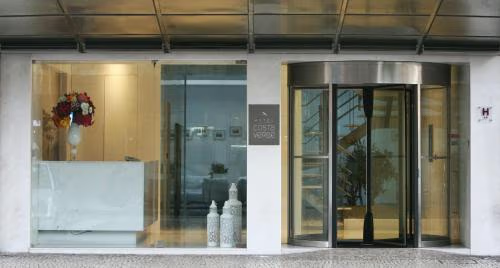 OpenReservations accepted
Hotel Costa Verde
- Top #2
 OpenReservations accepted
Hostel Sardines & Friends
- Top #3
 OpenReservations accepted
Big House


Services in Povoa de Varzim
What you can find in town before the next stage.
- ATM
- Café
- Shop
- Tobacco
- Medical clinic
- Pharmacy
- Fountain
- Post office
- Train station
- Bus station
- Restaurant
Source: © OpenStreetMap contributors · updated April 2026