

Stage town on the Camino
Puente la Reina
Navarra, Spain
- places to stay
- 22
- Caminos
- 2
- Elevation
- 349 m
In Puente la Reina the ways become one: just before the town the Camino Aragonés from the Somport flows into the Camino Francés, and at the edge of town an eleventh-century bridge, built by a queen for pilgrims, takes you across the Arga. Santiago is still 686 kilometres away. An afternoon is enough.
How long to stay?
An afternoon is enough. Puente la Reina is one street with a bridge at the end, and that's exactly how you should experience it: check into your albergue, walk the Calle Mayor down to the bridge without your pack, look into whichever churches are open, and in the evening go back to the water once more. The town doesn't offer enough for a rest day. If you need one, you're better off in Pamplona or Estella.
Puente la Reina in Ninja numbers
- 686 kilometres to Santiago from here. From now on it's the same path for everyone.
- About 2.5 kilometres lie between Óbanos, where the two ways merge, and Puente la Reina.
- 165 kilometres is the length of the Camino Aragonés from the Somport to here.
- A good 500 pilgrims were counted at the Somport in the last reliable survey, in 2015. In Saint-Jean and Roncesvalles, 38,500 started in the same year. The first way of the old pilgrims' guide is today the emptiest.
Arriving: where two ways become one
From Pamplona you come over the Alto del Perdón, through Uterga and Muruzábal to Óbanos. Here the Camino Aragonés, coming from the Somport via Jaca and Sangüesa, ends and flows into the Camino Francés. At the edge of Óbanos a sculpture marks the spot. Then you cross a road and walk through the Arga valley to Puente la Reina.
Before the town entrance stands the Monumento al Peregrino, a pilgrim figure from 1965 bearing the sentence: „Y desde aquí, todos los caminos a Santiago se hacen uno solo.“ And from here on, all the ways to Santiago become a single one. The sentence goes back to the pilgrims' guide in the twelfth-century Codex Calixtinus. Then you pass under an arch connecting the church del Crucifijo with the convent, and you're in the Calle Mayor. It leads you through the whole town to the bridge.
A town that grew from a bridge
In the eleventh century a queen of Navarre had a bridge built here over the Arga so that pilgrims could cross the river safely. Which queen it was is not certain: tradition names Muniadona, wife of Sancho the Great, or Estefanía, wife of García de Nájera. The town took her name: Puente la Reina, the Queen's Bridge. In Basque it's called Gares.
King Alfonso the Battler brought Frankish settlers to the river, and in 1122 they received their town charter. They laid out the town as a rectangle, with the Calle Mayor in the middle. The street follows the Camino to the bridge. So Puente la Reina really is built around the Way, and you can feel it to this day. The bridge has been a protected monument since 1931.
On the Calle Mayor: what to see
Everything important lies on your route, from the town entrance to the bridge. We didn't find opening hours for the churches.
- Iglesia del Crucifijo: The first church at the town entrance. In the twelfth century the Templars founded a hospice for pilgrims here and built this church, originally called Santa María de los Huertos. A Gothic nave was added in the fourteenth century. After the end of the Templars, everything passed to the Knights Hospitaller. The church holds the crucifix it is named after today. The Camino passes under the arch connecting church and convent.
- Iglesia de Santiago: The church of St James on the Calle Mayor dates from the twelfth century and was later remodelled. Look out for the portal with its many-lobed arches, and the tower. Inside stands the Santiago Beltza, the black St James, a wooden figure of the apostle. It's called that because it was blackened with soot when it was found.
- San Pedro and the Virgen del Txori: In the church of San Pedro stands a figure of the Virgin that used to stand in a tower in the middle of the bridge, until the tower was torn down around 1843. Legend has it that a little bird, „txori“ in Basque, kept flying up from the river and washing her face with water. Ever since, she has been called the Virgen del Txori.
- The Puente Románico: The Romanesque bridge is the reason the town exists. In the evening, walk across and back once more without your pack. You'll cross it anyway the next morning, but by then your mind will already be on the stage.
Food and drink
We didn't find a reliable source for a speciality of Puente la Reina. Camino Ninja pilgrims praise the many restaurants near the albergues. Some albergues offer dinner themselves, Jakue for example as a buffet and Santiago Apóstol with a pilgrim menu.
Honestly
- The albergue on the hill is far. Santiago Apóstol lies beyond the town centre, up a steep hill. Many Camino Ninja pilgrims like the albergue but find the walk there hard after a long stage. And for an evening in town you have to go back down.
- Cheap means cramped. At the Padres Reparadores, many pilgrims sleep in small rooms, say Camino Ninja pilgrims. In return there's a garden that almost everyone praises.
- Thin walls at Jakue. The albergue at the town entrance is well kept but noisy, even in the private rooms.
- The descent from the Perdón takes it out of you. On the way here, after the Alto del Perdón, comes a descent over loose gravel that surprises many.
Where pilgrims sleep
- Albergue de los Padres Reparadores: the big albergue at the town entrance on Calle del Crucifijo, right on the route, with garden and kitchen. From €9 (as of October 2026), the cheapest in town.
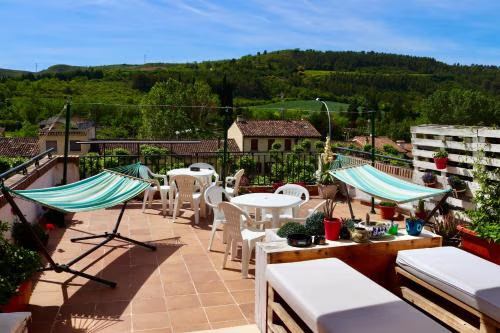
- Albergue Santiago Apóstol: at the edge of town on the hill, with lots of space, a large laundry area, a bar and a view. Dorm beds about €10 to €15 (as of October 2026).
- Albergue Jakue: at the town entrance on the Camino, albergue and hotel in one, with a dinner buffet.
There are also smaller private albergues such as Albergue Puente with a terrace, Amalur and Estrella Guía, with dorm beds from about €11 to €25 (as of October 2026).
Ninja tips
- Take in Eunate: In Muruzábal a marked path branches off to the octagonal church of Santa María de Eunate. The detour costs about three kilometres, and you come back via Óbanos. Admission €2, €1.50 for pilgrims. You get the stamp in the house next to the church.
- A photo at the monument: The pilgrim figure before the town entrance is where the sentence „todos los caminos … se hacen uno solo“ stands. If you came over the Aragonés, this is your finish-line photo.
- Laundry at Santiago Apóstol: If you sleep on the hill, use the large laundry area. Several Camino Ninja pilgrims point it out.
- Cross the bridge twice: once in the evening without luggage, once in the morning as you set off. It's worth it both times.
- Quickly to Pamplona: If you have to stop here, the bus takes about 25 minutes to Pamplona. There you'll find trains, long-distance buses and a small airport.
Practical tips for pilgrims
- Shopping: Puente la Reina has all the services you need as a pilgrim. Buy supplies for the next day, as the villages on the way to Estella are small.
- Stamps: at the albergues and, when they're open, in the churches.
- Óbanos: The village before Puente la Reina has a pharmacy, ATM, shop and tourist office. In July of even-numbered years, the villagers perform the „Misterio de Obanos“ there, a legend about a pilgrim.
Onward: over the bridge to the west
You leave town over the Romanesque bridge. Then the route goes via Mañeru (4.9 kilometres) and Cirauqui (7.6 kilometres) to Lorca (13.1 kilometres) and Villatuerta (17.9 kilometres). After 21.7 kilometres you reach Estella. All distances.
What awaits you tomorrow
The pilgrims' guide in the Codex Calixtinus had nothing but praise for Estella: „fértil en buen pan y excelente vino, así como en carne y pescado“, fertile in good bread and excellent wine, in meat and fish. And of the river it wrote that the water of the Ega was sweet, healthy and extraordinary. On the old pilgrim street of Estella stands the church of Santo Sepulcro, and beside its steps a St James greets you who is himself shown as a pilgrim.
Deep dive: Where the ways become one
A long read, in case you want to learn more about Puente la Reina. About fifteen minutes' reading.
A sentence on a plinth
Just before you enter Puente la Reina, a pilgrim monument stands beside the path. Since 1965 it has carried a sentence: "Y desde aquí todos los caminos a Santiago se hacen uno solo". And from here on, all the roads to Santiago become one.
The sentence is an echo. It goes back to a text from the twelfth century, the oldest pilgrims' guide we know. A cleric from France, whom tradition calls Aymeric Picaud, wrote it down, and today it is the fifth book of the Codex Calixtinus. Right at the beginning it says: "Cuatro son los itinerarios que conducen hacia Santiago", four roads lead to Santiago, "que en Puente la Reina, en tierras españolas, confluyen en uno solo". At Puente la Reina, in Spanish lands, they flow together into one.
The Codex names three of these roads after saints along their course: the road of Saint Faith, that of Saint Leonard of Limoges and that of Saint Martin of Tours. They meet before the Pyrenees, at Ostabat, and those who walk them climb over the pass of Cize to Roncesvalles. The fourth road comes from the south of France and crosses the mountains further east, at the Somport. From there, the author writes, it is three short stages to Puente la Reina: from Borce at the foot of the pass to Jaca, from Jaca to Monreal, and from Monreal to Puente la Reina.
So when you stand here, you are standing at a place where the Middle Ages sorted out the Way. Before it, many roads; after it, one.
The meeting in Óbanos
Strictly speaking, the two routes don't meet in Puente la Reina but a good two kilometres earlier. In Óbanos the Camino Aragonés ends on the village square and merges into the Camino Francés. At the edge of Óbanos stands a sculpture with the plain name "Un camino", a way, created by Patxi Alduna and Pepe L. Tazón. It marks the spot. But the Codex names Puente la Reina, and so it has stayed: the village has the meeting point, the town has the fame.
Anyone coming from the Somport has very quiet days behind them. In 2015 a little over 500 pilgrims were counted at the Somport; in Saint-Jean and Roncesvalles there were around 38,500 in the same year. From Óbanos both streams walk together. For some coming off the Aragonés, that's a small shock. For others it's a relief to have company again at last.
Óbanos itself has a proud history. In the thirteenth century it was the most frequent meeting place of the infanzones, a league of the lesser and middle nobility of Navarre that kept watch so the kings would not abuse their power. Their seal bore a Latin motto: "Pro libertate patria gens libera state", for the freedom of the land, stand firm, you free people. It was Queen Joan the Second and her husband Philip of Évreux who finally dissolved the league.
Felicia and Guillén
In Óbanos they tell a pilgrim story darker than most. Felicia, a princess from Aquitaine, returns from a pilgrimage to Santiago and wants nothing more to do with life at court. She serves, unrecognised, at the manor of Amocáin, in the valley of Egüés in Navarre. Her brother Guillén searches for her and finds her. Beside himself that she has betrayed her rank, he kills her.
Then comes remorse. Guillén makes the pilgrimage to Compostela himself, guided by a monk. Afterwards he stays on as a hermit at the hermitage of Arnotegui above Óbanos and cares for the pilgrims. According to tradition, he died there as a martyr on the path up to the chapel. A skull held to be his is set in silver, and once a year wine is blessed with it. Felicia has her legend too: a white carnation is said to have bloomed on her grave, and her body is still venerated in the church of Labiano.
The legend became a play. In 1962 Santos Beguiristáin Eguílaz wrote a short text that children read out at the bonfire of Saint Guillermo. People came in crowds, and they were advised to arrive having eaten and in no hurry. In the summer of 1965 it grew into the "Misterio de Obanos", a stage play about the Way of St James, performed in the open air on the village square, with three to four hundred performers, most of them from the village. There have been long pauses and new beginnings. The president of the foundation behind the Misterio has proposed a return in 2027. Whether it will happen, we could not confirm in the autumn of 2026.
It's a strange story for a pilgrims' road: a murder, a pilgrimage as penance, a life spent serving strangers. But perhaps it explains why people walk. Not everyone walks because they are happy.
A church with eight corners
If you came along the Camino Aragonés, you may already know it. From the Camino Francés it is a detour from Muruzábal: Santa María de Eunate stands alone in open country, about two kilometres from Muruzábal, in the valley of Valdizarbe. It was built in the second half of the twelfth century in the Romanesque style, on a plan that forms a not quite regular octagon. Outside, it is ringed by 33 arches, a kind of cloister under the open sky. The north portal, which faces the path, is richly decorated.
There is a lot of whispering about Eunate. It is often said the Templars built it. There is no document to prove it. What is documented is something else, and it matters more to you: scallop shells have been found in graves inside the church. Because the church also lies far from any village, it is thought there was once a hospice for pilgrims here. So whoever was buried here may well have been on the road like you.
A little to the west, in Torres del Río, there is by the way a church of the Holy Sepulchre with very similar forms, only without the ring of arches. You'll pass it in a few days.
The Queen's Bridge
And then the bridge. It gave the place its name, Puente la Reina, the Queen's Bridge, and without it this town would probably not exist. In the eleventh century a queen had it built over the Arga so that pilgrims no longer had to wade through the river. Which queen that was is not known for certain. Tradition wavers between Muniadona, also called Doña Mayor, the wife of King Sancho the Great, and Estefanía, the wife of his son García of Nájera. Doña Mayor is named most often.
The bridge is about 110 metres long, its roadway about four metres wide. How many arches it has, not even the sources agree. Some count seven, one of them hidden underground, others six, others again five. What's certain is this: whoever crosses it today walks over a bridge that pilgrims were already crossing almost a thousand years ago. It has been a protected monument since 1931.
The Codex knows this crossing too. It speaks of the land of the Navarrese reaching as far as the bridge over the Arga and beyond. And it says that through Puente la Reina flow the Arga and also the Runa, a river that comes from the Pyrenees towards Pamplona. The scholar José María Jimeno Jurío even suggested that the town's Basque name, Gares, might go back to this old river name, to a bridge over the Runa. Others derive Gares from gari, the Basque word for wheat. Neither is certain.
The bird and the Madonna
In the middle of the bridge there used to be a tower, and in a niche in it stood a statue of Mary, the Virgen del Puy. She is recorded there until 1834. In the nineteenth century people told how a little bird, txori in Basque, brought water from the river in its wings every day and washed her face with it. That is why they called her the Virgen del Txori, the Virgin of the Bird.
Around 1843 the tower was demolished. The figure was taken to the church of San Pedro, a Gothic church from the fourteenth century, about a hundred metres from the Calle Mayor. She still stands there today. You don't have to believe in the bird. But the story says something about how people here felt about their bridge: it wasn't just a structure. It had a guardian.
A town for strangers
Before the town there was a village here that spoke Basque and was called Garesch, also written Garex or Garez. Then came King Alfonso the First, known as the Battler. He gave settlers from France, the so-called Franks, a founding privilege on the bank of the Arga, where the old village lay. In 1122 they received the town charter of Estella. In the course of the twelfth century a rectangular town grew up near the bridge, with a main street and two parallel streets.
That main street is the Calle Mayor, and it is the Camino. When you walk through Puente la Reina, you walk through a town planned around the Way: it enters at one end, runs right through the middle and leaves the town at the other end over the bridge. A wall with towers surrounded the old town, and of some towers you can still see remains. At night the gates were shut. And until not long ago, forty strokes of the bell were rung every evening, a ritual from the time when the town closed itself up for the night.
Not all strangers were welcome. Until the fourteenth century Jews and agotes, an excluded group, lived in Puente la Reina, with their own quarter and their own synagogue. In 1328, after the death of the king, violent pogroms broke out, as they did in Estella the same year.
Knights by the river
Where there were pilgrims, the military orders soon followed. The Templars are recorded in Puente la Reina. King Alfonso the Battler had even left them his kingdom in his will, but nobody carried out that last wish. His successor García Ramírez did at least give the Temple the village of Murugarren.
At the entrance to the town, according to tradition, the Templars founded a hospice for pilgrims and a church. When the order was dissolved in 1312, its property was meant to go to the Knights Hospitaller. In Puente la Reina, however, that took until 1443. A good hundred and thirty years between decision and takeover: that says a lot about how slowly the mills of the Middle Ages ground.
In 1469 Juan de Beaumont and others founded a convent with six chaplains at this church, and later the church belonged to the Order of Saint John. Since 1919 church and convent have belonged to the Priests of the Sacred Heart, known here as the Padres Reparadores. Next to their convent today is the large Padres Reparadores hostel. And the Camino passes under an arch that links church and convent. So you enter Puente la Reina under an arch that belongs to an old pilgrims' church.
A cross like a tree
The church in question is today called the Iglesia del Crucifijo. It used to be called Santa María de las Huertas, Saint Mary of the Gardens. It was built in the twelfth century in late Romanesque style and enlarged in the fourteenth century. Inside stands a Madonna and Child from the twelfth century. But most people come for the cross.
It is no ordinary crucifix. Christ does not hang on a cross of beams but on a cross shaped like a Y, which looks like a tree stripped of its bark. Experts speak of a crucifix of sorrows, a crucifijo doloroso, and assign it to the Gothic, to a tragic current in the art of the Rhineland, with Italian influence. One of them, Luis Vázquez de Parga, saw in its tree shape the image of the Tree of Life.
Where the cross comes from is the real question. The experts largely agree that it comes from the German Rhineland, or at least was shaped by it. On the dating they differ: Vázquez de Parga thought of the years around 1400, others of the beginning of the fourteenth century, the art historian Ángela Franco Mata of the years 1315 to 1320. And then there is the legend: German pilgrims are said to have brought the cross, perhaps after their pilgrimage to Santiago, and left it here.
Did pilgrims bring the cross?
The story is too good not to tell. People like to imagine a cross being carried over the Pyrenees and staying exactly where all the ways become one. Some experts have found the tradition credible. The Navarrese researcher José María Muruzábal Aguirre disagrees. He writes: "Pienso que esta legendaria atribución surgiría en Navarra y no sería traída por los peregrinos alemanes." In other words, he thinks the legend arose in Navarre and that the cross was not brought by German pilgrims.
In his article Muruzábal points to a bequest. In 1328 a family named Martija left something "a la obra del Crucifijo de Santa María de las Huertas", that is, for the work of the crucifix of Santa María de las Huertas. So by 1328 at the latest there was a work here that people called the Crucifijo. He also mentions another old tradition, according to which the cross was the third one carved by Nicodemus, the man from the Gospel who buried Jesus. He finds that far-fetched as well.
What remains is, honestly, an open ending. The cross is German in character, Gothic and old. How it came to Navarre, nobody knows. Whether a pilgrim carried it or a merchant, whether it was ordered or given, there is no paper to say. You may stand before it and pick your own version. Just know that it is a version.
Santiago the Black
Halfway along the Calle Mayor stands the church that belongs to the apostle, the Iglesia de Santiago. Its origins lie in the twelfth century. From that time come the outer walls and a plain portal at the back, with a monogram of Christ in the tympanum. The main portal facing the street was added at the start of the thirteenth century. It has five richly decorated arches, and the innermost is lobed into eight curves, like a flower, with angels around Christ. It teems with figures: demons standing for the sins, fighting scenes, winged lions, two crossed fish, a knight battling a dragon, a man driving a sword into a lion. Much of it is badly weathered. Art historians see a kinship with portals in Estella and in Cirauqui, which you'll walk through tomorrow.
Inside, the church is a building of the sixteenth century. From 1543 to 1566 the masters Martín de Oyarzábal and Lázaro de Iriarte rebuilt it in Gothic style, with star vaults. You'll hear the name Martín de Oyarzábal again the day after tomorrow: a master builder of that name also created the cloister of the monastery of Irache beyond Estella. The upper part of the tower was only added by Santos Ángel de Ochandátegui in the years 1776 to 1778.
And then, against the north wall, stands the man this is all about: Santiago Beltza. Beltza is Basque for black. The figure is made of wood, carved from a single tree trunk, as narrow as the trunk allowed. It shows James as a pilgrim, with a staff and a hat decorated with shells. The eyebrows are arched, the eyes slanted, the mouth slightly open. Where the name comes from is explained in different ways: because of the dark complexion, says one account; because of the soot that had blackened the figure before it was restored, says the other. On its age, too, the accounts differ. The most detailed description dates the figure to the second half of the fourteenth century and calls it late Gothic; other sources call it Romanesque. It originally stood on the medieval high altar.
Opposite stands a stone Saint Bartholomew, also from the fourteenth century. In the Baroque high altar, commissioned in 1665, you see James as a pilgrim once more, and in the lower part two reliefs: the Mother of God appearing to him in Zaragoza, and his beheading in Jerusalem. Standing in this church, you are surrounded by James, as pilgrim, as preacher, as martyr. It's a good place to pause for a moment before the Way sends you on over the bridge.
An author who didn't like the Navarrese
The Codex that made Puente la Reina famous is not a friendly book, at least not about the people here. The author describes the land of the Navarrese as rich in bread, wine, milk and livestock. About the people themselves, though, he writes harshly: "Son un pueblo bárbaro, diferente de todos los demás en sus costumbres y naturaleza", a barbarous people, unlike all others in their customs and nature. He mocks their food, their dress and their language. He does at least concede that they are brave in battle, and he praises them for devoutly paying their tithes and giving generously to the Church.
He tells of an experience elsewhere that fits this verdict. At Lorca, by a river called the Salado, he and his companions met two Navarrese sitting on the bank sharpening their knives. Asked whether the water was safe to drink, they said yes. The pilgrims watered their horses, two of them died on the spot, and the two men skinned them then and there. The author calls the river deadly and warns everyone not to drink from it. Lorca lies on your way to Estella. You may read the account as an early example of how bad experiences on a journey quickly turn into verdicts on whole peoples. Today you've probably met with something different in Navarre.
Wars and festivals
The calm of the Calle Mayor is deceptive. In the nineteenth century, during the Carlist Wars, Puente la Reina stood loyally by the pretender Don Carlos. Liberal and Carlist troops fought each other near the town, and on the hill of San Guillermo, near the hermitage of Arnotegui, the Liberals built a fort whose ruins still stand. In 1874 the Carlist pretender set up his headquarters in the town before leaving to defend Estella.
Today the loudest days are in July. From 24 to 29 July the town celebrates its Fiestas de Santiago. If you arrive during those days, you'll notice that the apostle here doesn't only stand in church.
What Puente la Reina gives you
Tomorrow morning you'll walk down the Calle Mayor and over the bridge. On the other bank lies the way to Estella, and at Lorca you'll cross the river the Codex already warned against. From here on, everyone heading for Santiago walks the same way, whether they set out in Arles or in Le Puy, in Saint-Jean or only in Pamplona.
Perhaps that is this place's gift. A queen whose name nobody knows for sure built a bridge for strangers. A cross whose origin nobody knows for sure hangs at the entrance to the town. And a black James has stood for centuries in a church on the main street. Not everything has to be settled for it to hold. The bridge has held for almost a thousand years, and it doesn't ask where you come from. Only whether you want to cross.
Where to stay in Puente la Reina
The places pilgrims rate highest in Puente la Reina come first.
- Top #1
 ClosedReservations accepted
Albergue Puente
- Top #2
 ClosedReservations accepted
Albergue Jakue
- Top #3
 OpenReservations accepted
Hotel Jakue



Services in Puente la Reina
What you can find in town before the next stage.
- ATM
- Café
- Shop
- Tobacco
- Medical clinic
- Pharmacy
- Fountain
- Post office
- Restaurant
Source: © OpenStreetMap contributors · updated November 2025
Town 6 of 49