

Stage town on the Camino
Pamplona
Navarra, Spain
- places to stay
- 39
- Caminos
- 3
- Elevation
- 447 m
Pamplona is the first big city on the Camino Francés: over a 12th-century bridge and through the Portal de Francia you walk into an old town that in 1423 grew together from three feuding quarters into one city. Santiago is still 710 kilometres away. A rest day is worth it, just not on a Sunday.
Right now in Pamplona (as of October 2026)
- Cathedral on winter hours: From the last week of October, the cathedral museum with the cloister is open Monday to Saturday from 10:30 to 16:00, closed on Sundays.
- Albergues closing: The donativo albergue Betania has been closed since 15 October, and Casa Paderborn closes after 31 October. The municipal albergue Jesús y María stays open, except over Christmas until 7 January.
- Pilgrim info point: The Friends of the Camino in Navarra give advice at Calle Mayor 6 until 31 October, Monday to Friday from 16:00 to 20:00.
How long to stay?
Worth a rest day, just not on a Sunday. After three stages over the Pyrenees and through Navarrese villages, Pamplona is the first city where you can fill a whole day without your pack: the cathedral with its Gothic cloister and the tomb of a royal couple, San Saturnino with the figure of St James at its portal, the Calle Mayor, the Ciudadela and, in the evening, the pintxo bars around the Plaza del Castillo. For blisters, laundry and shopping you'll find everything a city has to offer. Don't plan your day off for a Sunday, because then the cathedral is closed to visitors. And avoid the days of San Fermín in July unless you booked well in advance.
Pamplona in Ninja numbers
- 710 kilometres to Santiago from here. You have a good 66 behind you since Saint-Jean, roughly one twelfth.
- Almost 4 kilometres of walking through the city, from the Magdalena bridge to the university campus.
- €3 instead of €5 is what you pay as a pilgrim for cathedral, cloister and museum (as of October 2026).
- 207,777 inhabitants lived in Pamplona in 2024. After the villages of the first days, that's a small culture shock.
Arriving: over the Magdalena bridge and through the France Gate
Coming from Zubiri, you first walk a long way along the Arga through woods, then it turns urban: from Trinidad de Arre it's another 4.4 kilometres through Villava and Burlada, and all of it is built-up area. In Trinidad de Arre the Camino de Baztán from Bayonne joins as well.
After Burlada the path follows the riverbank through gardens to the Puente de la Magdalena, a 12th-century bridge. This is where pilgrims enter the city. Then you walk along the city wall to the Portal de Francia, the France Gate from the eighteenth century. The Calle del Carmen climbs past the Navarrería, with a view of the cathedral towers, then the Calle Mercaderes leads to the Plaza Consistorial. From the balcony on the town hall's Baroque façade, the San Fermín festival is opened every year on 6 July. The municipal albergue is just a few steps off the route, near the cathedral.
Three towns in one
In the Middle Ages, Pamplona wasn't one town but three. Around the cathedral lay the Navarrería, the old bishop's town. Next to it, in the eleventh century, the Burgo San Cernin was founded by Frankish merchants from southern France. The name is the Occitan form of Saturnino, the saint from Toulouse. Then there was the Burgo San Nicolás. Each quarter had its own rights and its own walls, and the neighbours fought each other. In 1276 the Navarrería was destroyed and its people massacred.
Only on 8 September 1423 did King Carlos III, with the Privilegio de la Unión, make one city out of the three burgos and have the walls between them torn down. When you walk down the Calle Mayor today, the old main street of San Cernin, you are walking through the town of the Franks who lived off the Camino. Seen that way, Pamplona is a city the Way of St James helped to build.
The first city on the Way: what to see
Most of it lies right on the Camino or a couple of lanes away. You can do it all on foot, without your pack, in one day.
- Catedral de Santa María la Real: The Romanesque cathedral collapsed in 1391, only the façade remained standing. The present Gothic church was built from 1394 to 1501, and the façade in front of it was designed by Ventura Rodríguez in 1783. The kings of Navarre were crowned here in the Middle Ages. Inside lies the tomb of Carlos III, the king of the union, and his wife Leonor, made in 1419 by Jehan Lome from Tournai. The cloister from the thirteenth and fourteenth centuries is the best place in town to do nothing for an hour. In the old refectory, the Occidens museum shows church art from Navarre. Admission €5, €3 for pilgrims, closed on Sundays. At 11:15 you can climb up to the María bell, but you need to collect a number beforehand (as of October 2026).
- San Saturnino (San Cernin): The church of the Frankish settlers stands right on the route, on the Calle Mayor. Beside the entrance to the atrium stand two figures from around 1330 to 1340, San Saturnino and Santiago, which once belonged to the portal. Above the door you see the Last Judgement. This is also where the Virgen del Camino, the Virgin of the Way, is venerated. In season, pilgrims meet here in the evening for a guided visit, prayer and Mass with a pilgrim blessing (see Practical tips). According to legend, Saturnino preached in Pamplona and converted Fermín, the later patron saint of the city.
- Calle Mayor and San Lorenzo: The Calle Mayor was the town's main street. You pass Renaissance and Baroque palaces, among them the Palacio del Condestable and the Palacio de Ezpeleta. At number 20 is Ultreia, an exhibition centre about the Camino with films about Pamplona as „la primera del Camino“, the first on the Way. At the end of the street stands San Lorenzo with the chapel of San Fermín.
- Santo Domingo: The sixteenth-century church has a carved Renaissance figure of St James. Not far from the municipal albergue is the Santo Domingo market. This is where you shop for the next day.
- San Nicolás: The church of the third burgo was built in 1117 and still looks like a fortress, with a tower from the fourteenth century. It tells you more about the age of the feuding quarters than any museum.
- Ciudadela and Taconera: As you leave the old town, you walk through the Taconera gardens from 1888. Almost 300 animals live in the old moat, among them ducks, swans, peacocks and deer. Then you walk around the Ciudadela, a Renaissance fortress of whose five bastions three survive. With a pack on your back, it's a peaceful farewell to the city.
Food and drink
Pamplona is a pintxo city. You'll find the bars with small bites on the counter around the Plaza del Castillo and in the lanes San Nicolás, San Gregorio, Estafeta and Navarrería. Try something with Idiazábal, the region's sheep's cheese. Many bars also offer a pilgrim menu. Café Iruña is known as Hemingway's café and is an institution in town.
Honestly
- The way in is long and urban. The last 4.4 kilometres from Trinidad de Arre lead through suburbs and are entirely built-up. The reward is the Magdalena bridge. Until then, only patience helps.
- The big albergue is loud. In the old church of Jesús y María every sound echoes, as many Camino Ninja pilgrims say. Bring earplugs or look for a smaller albergue.
- San Fermín changes everything. From 6 to 14 July, Jesús y María and Betania are closed, prices rise sharply, and many places require minimum stays. Plan to pass through Pamplona before or after.
- The cathedral is closed on Sundays. If you arrive on Saturday evening and leave early on Sunday, you won't see the cloister or the museum.
- The way out is long too. It's 5.3 kilometres to Cizur Menor, through parks, the Iturrama district and the university campus. Factor that distance into your next stage.
Where pilgrims sleep
- Albergue Municipal Jesús y María: the municipal albergue on Calle Compañía near the cathedral, in a deconsecrated sixteenth-century church. Since 2007, wooden cubicles with two or three bunk beds each stand in the side aisles, more than a hundred places in total. It is run by the ASPACE Navarra foundation as a social employment enterprise. €12 per night (as of October 2026). From May to September no reservations and one night only; otherwise you can book. The washing machine is free, and laundry dries in the courtyard.
- Casa Paderborn: the small albergue of the Camino friends from Paderborn, Pamplona's twin town, in a city-owned house on the Arga since 2006. After the Magdalena bridge, walk about 280 metres to the left. 26 places, €9.50, €13 with breakfast, no reservations. Volunteer hospitaleros, often from Germany, take turns in pairs every three weeks. Open from March to October.
- Albergue Betania: the diocese's albergue on Calle Recoletas, at the edge of the old town, about 80 metres from the route. 20 places, donativo, with a shared dinner and a reflection afterwards. No reservations. Open from late March to mid-October, except in the first half of July.
There are also private albergues in the old town, with dorm beds from about €19 to €25 (as of October 2026), mostly bookable and often with pod beds and curtains.
Ninja tips
- Show your credencial, save €2: At the cathedral museum pilgrims pay €3 instead of €5. That includes the cloister, the church and the museum.
- Earplugs for Jesús y María: In the old church every sound echoes, and more than a hundred people sleep in one room.
- Get to Casa Paderborn early: The German albergue by the river is small and popular, and Camino Ninja pilgrims report it was already full at opening time. It lies by the river before the old town, so you save yourself the climb.
- Advice from volunteers: Since 2026 the Friends of the Camino in Navarra have run an info point at Calle Mayor 6. There, volunteers advise pilgrims, not tourism staff. For practical questions about the Camino, it's the better address.
- Up to the bell: At 11:15 there's a guided climb to the cathedral's great María bell. Get your number as soon as it opens at 10:30.
- The deer in the moat: When you leave town in the morning, look into the Taconera moat. Peacocks and deer as a farewell from a big city.
- Shop before the Perdón: The Santo Domingo market is near the municipal albergue. Buy what you need for the next stage here, because the bar on the Alto del Perdón is only open from April to October.
Practical tips for pilgrims
- Stamps: at the cathedral, at Ultreia on Calle Mayor 20 and at the albergues. Ultreia was open daily from 10:00 to 14:00 in summer 2026; we didn't find the winter hours.
- Pilgrim blessing: From mid-April to 10 October 2026, Monday to Saturday at 18:00, there was a pilgrim welcome at the town hall door with a free guided visit of San Saturnino, prayer at 18:30 and Mass with a pilgrim blessing at 19:00. We haven't found the dates for 2027 yet.
- Tourist information: Calle San Saturnino 2, in summer 2026 Monday to Saturday 10:00 to 18:00, Sunday 10:00 to 14:00.
- Sunday: The cathedral is closed to visitors. Plan your sightseeing for Monday to Saturday.
- Starting in Pamplona: The city has a train station, a bus station and a small airport. If you start here, you can sleep in Jesús y María on your first night.
Onward: over the Alto del Perdón
You leave the old town at the Plaza de Recoletas, walk through the Taconera, around the Ciudadela and out across the campus of the University of Navarra. After 5.3 kilometres you reach Cizur Menor, which is where many pilgrims extend their stage to. Then the path climbs through cereal fields via Zariquiegui (11.2 kilometres) to the Alto del Perdón, the windy ridge with the pilgrim sculpture. The descent over loose gravel is trickier than many expect. Via Uterga and Muruzábal you continue to Óbanos and on to Puente la Reina, 24 kilometres from Pamplona. All distances.
Pamplona is also where the Camino de las Asturias begins, leading through the Burunda valley to Oviedo.
What awaits you tomorrow
On the Alto del Perdón stands a caravan of pilgrim figures from different eras, with wind turbines turning beside them. The monument reads: „Donde se cruza el camino del viento con el de las estrellas“, where the path of the wind crosses the path of the stars. It's a good place to look back and plan the days ahead. In the evening you reach Puente la Reina, where the Camino Aragonés joins and all the ways become one, and you cross an eleventh-century bridge that a queen had built for pilgrims.
If you don't mind a detour of about three kilometres, turn off in Muruzábal to the octagonal church of Santa María de Eunate and rejoin the route via Óbanos.
Deep dive: The city the Way built
A long read, in case you want to learn more about Pamplona. About twenty-five minutes' reading.
Over the Magdalena bridge
If you start in Saint-Jean, you usually reach Pamplona on the third day. Behind you lie the Pyrenees, Roncesvalles and the villages along the Arga, and the last few kilometres through Villava and Burlada were already city. Then comes the Puente de la Magdalena. The bridge dates from the twelfth century; in the sixteenth century it gained Gothic details, and in 1963 it was remodelled. It has been a protected monument since 1939. Over the centuries millions of pilgrims have crossed this bridge into the city, and in the Middle Ages they hoped to find rest here after the hard stages over the mountains.
On the bank beside the bridge stands a stone cross. It is not a medieval piece but a gift. In 1965 the city of Santiago de Compostela gave it to the first association of Friends of the Camino de Santiago, which had its seat in Estella. It was not put up there, though, but here, at the entrance to Pamplona. So the goal of your journey greets you on the third day, more than seven hundred kilometres away.
Beyond the bridge you walk along the city wall to the Portal de Francia, the France Gate, and climb up the Calle del Carmen into the old town. The city likes to call itself "la primera del Camino", the first on the Way. That is literally true: it is the first big city on the Camino Francés. But it is also true in a deeper sense. Much of what you will see in the next few hours exists because people on their way to Santiago passed through here, settled, traded, quarrelled and built churches. This story is not always peaceful. But it explains the city.
Pompey's city
Pamplona is much older than the Camino. According to tradition, the Roman general Pompey founded the city in 75 or 74 before Christ; the sources vary. He built it on an older settlement of the Vascones, the people who lived here. The Greek geographer Strabo is the earliest writer to mention it. He calls Pompelon the most important city of the Vascones and explains the name as the city of Pompey. Pompaelo became Pamplona.
What the place was called before is uncertain. Coins from the area bear the word Bengoda, and some historians take it to be the name of the Vascon capital. No ancient text confirms this. The Basque name Iruña is documented from the tenth century. It goes back to a word that simply means city. The Academy of the Basque Language today prefers the form Iruñea. Scholars of the seventeenth century claimed the Basque name was older than the Roman one. They found no evidence for it.
You can picture the Romans being here beneath the cathedral. Excavations in 1994 uncovered streets and buildings from the first century before Christ there, remains of Pompaelo. The spot where the bishop preaches today was already the centre of the city two thousand years ago. Relations between Romans and Vascones were good, by the way. As early as 90 before Christ, nine men from a Vascon town received Roman citizenship for their help at the siege of Asculum in Italy.
The summer of Roncesvalles
After the Romans came the Visigoths, and Pamplona became a bishop's seat. In 711 the Visigothic king Rodrigo was fighting the Vascones near Pamplona when Arab and Berber armies landed in the south. Soon afterwards the city submitted by treaty to the new rulers from Córdoba. With interruptions, it stayed under Muslim rule until 806.
In between came a summer that all of Europe has remembered. In 778 Charlemagne marched over the Pyrenees because a Muslim governor had promised him the surrender of Zaragoza. Nothing came of it. On the way back Charlemagne had the walls of Pamplona torn down, probably so that the city could be of no use to anyone in future wars. On the evening of 15 August 778, Vascones in the mountains near Roncesvalles ambushed his rearguard, probably also in revenge for their destroyed city. Among the dead was a margrave named Roland. An unknown poet of the eleventh century turned this defeat into the Song of Roland, the oldest great work of French literature. You walked through those mountains two days ago.
Out of the turmoil of those years a kingdom of its own emerged. Around 816 Íñigo Arista and his Vascon warriors took power in Pamplona. Sancho Garcés the First was the first to call himself king. In 924 the army of the caliph Abd al-Rahman the Third destroyed the city's oldest cathedral. And in the twelfth century, under Sancho the Wise, the kingdom of Pamplona called itself Navarre for the first time.
A guidebook with prejudices
By then the Camino was already one of Europe's great roads. Around the years 1138 to 1145 the book was written that has been called the world's first travel guide, the pilgrim's guide in the fifth book of the Codex Calixtinus. Its author is usually taken to be the French scholar Aymeric Picaud. He divides the route into day stages, and you know one of them: "La segunda va de Viscarret a Pamplona, es una etapa pequeña." The second runs from Viscarret to Pamplona, a short stage. If you walked here today by way of Zubiri, you may see that little word differently.
Picaud also describes the people. The land of the Navarrese, he says, is rich in bread, wine, milk and livestock. In a Navarrese house the whole family eats together, servant and master alike, all from one pot, without spoons, with their hands, and they all drink from the same jug. Then he notes down words of their language, and that is what makes the text valuable to linguists to this day. They are some of the earliest Basque words ever written down. Bread for him is orgui, wine ardum, house echea, water uric, king ereguia. And the apostle you are walking to, he writes, they call "iaona domne iacue", Lord Saint James.
The rest of the chapter is less kind. Picaud calls the Navarrese and the Basques a barbarous people and accuses them of all sorts of vices that need not be repeated here. He grants them just one sentence: in battle they are considered brave. So you read the oldest pilgrim guide with mixed feelings. It shows how early pilgrims described the world along the Way. And it shows how early strangers arrived with ready-made judgements about the people whose land they walked through.
Three towns behind three walls
Picaud's compatriots had long been in Pamplona by then. The lord of the city at that time was not the king but the bishop. Around the cathedral lay the Navarrería, the old town, inhabited mainly by farmers, many of them serfs of the Church. From 1076 Sancho Ramírez, king of Aragon, ruled as king of the Pamplonese, and under him and Bishop Pedro de Roda a new town grew up beside the old one: the Burgo de San Cernin. Here Franks from the south of France settled, merchants and craftsmen who spoke Occitan. In 1129 King Alfonso the First confirmed for them the law of Jaca, a town charter with freedoms and tax advantages that the old inhabitants did not have. In the twelfth century the Población de San Nicolás was added, which received the same law in 1189.
So Pamplona consisted of three towns, each with its own wall, its own council, its own banner. Between them lay ditches, and across those ditches people did not see each other as neighbours. The Franks had the money and the privileges; the locals had the feeling of being slighted in their own land. In 1222 people from San Nicolás damaged the roof of the church of San Cernin. In 1266 there was an attempt to unite the councils, but King Enrique the First dissolved the union again.
Walking through the old town today, you hardly notice any of this. The Calle Mayor you walk along was the main street of San Cernin, the town of the Franks. The church of San Nicolás, on the other hand, still looks like a fortress. It recalls a time when people built towers not against foreign armies but against the quarter next door.
Autumn 1276
In 1274 King Enrique the First died. His heir Juana was a small child, her mother Blanche of Artois became regent, and Aragon, Castile and France all reached out for Navarre. Blanche betrothed her daughter to the heir to the French throne and placed the kingdom under the protection of Philip the Third of France. Juana was taken to France. In Pamplona the nobility split. García Almoravid and the Navarrería sided with Castile; the Frankish burgos stood by the French governor. The first governor, Pedro Sánchez de Monteagudo, tried to mediate, failed, and was murdered in his house during a truce.
France sent a new governor, Eustache de Beaumarchais, and when the Navarrería refused to dismantle its war machines, a French army came. On 6 September 1276 it reached Burlada, the suburb you walked through this morning. At the end of September the Navarrería fell, after Almoravid and his allies had fled. What happened next the sources describe as looting, murder, rape and fire. Those who fled into the cathedral were not spared. Its treasure was stolen, King Enrique's tomb destroyed. Apart from the cathedral, not a single building in the Navarrería was left standing, and the neighbouring quarter of San Miguel and the Jewish quarter were destroyed too.
An eyewitness wrote it all down, the poet Guilhem Anelier from Toulouse, who fought in it himself. He was on the side of the victors, and it shows. About the punishments for the prisoners he writes: "Jamás vi a ningún hombre vengarse tan bien." Never did I see a man take revenge so well. For almost half a century afterwards the old town lay in ruins. Only in 1324 did the king allow it to be rebuilt. When you climb up the Calle del Carmen, you walk along the edge of this quarter.
San Cernin, the church of the Franks
The church of San Saturnino, called San Cernin in the city, stood in the thick of the fighting in 1276. Anelier describes it as one of the key points of the defence. Its two medieval towers are 55 metres high and served expressly military purposes. Until the eighteenth century they had battlements. Soon after the war work began on rebuilding the Romanesque church in Gothic style. A keystone in the vault bears the year 1297.
The north tower governed the life of the city. Its bell rang the curfew, after which the gates were closed. On the lower south tower Martín de Lumbier installed the first clock in 1499, and since 1795 the weathercock that the people of Pamplona fondly call the "gallico de San Cernin" has turned on top. In July this clock marks the start of the bull run at eight in the morning.
For pilgrims the church holds two treasures. At the sixteenth-century atrium stand Gothic figures that once belonged to the portal, among them Saint Saturnino and Santiago Peregrino, the apostle as a pilgrim. And in the Baroque side chapel the people of Pamplona venerate the Virgen del Camino, the Mother of God of the Way. Devotion to her grew after a Romanesque figure of Mary appeared in the church's upper choir in 1487. For her, in 1758, the cloister, cemetery and a chapel were torn down, and by 1776 the chapel you see today was built. Since 1987 she has been regarded as Queen and Lady of Pamplona. Above a side entrance there is also a fourteenth-century relief showing a knight setting off on crusade. Victor Hugo described it in 1843.
A king who had walls torn down
A hundred and fifty years after the war came a king who brought peace to Pamplona. Carlos the Third, later called the Noble, was born on 22 July 1361 in Mantes near Paris. On 13 February 1390 he was crowned in the Romanesque cathedral of Pamplona. At their coronation there, the kings of Navarre swore an oath to uphold the rights of the land, and from 1329 at the latest the representatives of the realm demanded that this oath be sworn in the Romance vernacular of Navarre.
On 8 September 1423 Carlos signed the Privilegio de la Unión. The document is more than two metres long and has 29 chapters. It made the three burgos one city with a single council. The walls between them were torn down, and new fortifications inside the city were forbidden. The new town hall was to be built in the ditch in front of one of the old towers, on neutral ground between the burgos, in the words of the source at the centre of the whole new town. That open space between the quarters later became the city's squares, and on one of them, the Plaza Consistorial, which you crossed, stands the town hall.
Carlos also gave the city a coat of arms: a silver lion on a blue field, a golden crown above, and around it the golden chains of Navarre on red. Before that, each of the three quarters had had its own banner. In 1618 the royal council had 200 copies of the privilege printed so that the citizens would understand what it meant. And to this day Pamplona celebrates its unity every year on 8 September. The giant figures parade with the city council through the three old quarters, and in the cathedral prayers are said for Carlos. He died on 8 September 1425 in Olite, two years to the day after the union.
A cathedral falls and rises again
The cathedral in which Carlos was crowned no longer exists. It was one of the great Romanesque churches of Spain. Bishop Pedro de Roda had it built from about 1100, and he gave the builder, a Master Esteban, houses and vineyards for it. It was about seventy metres long and fifty metres wide; at the time only the cathedral of Santiago was larger. It was consecrated on 12 April 1127, in the presence of King Alfonso the First, known as the Battler.
A good two hundred and sixty years later it collapsed. The sources give 1389, 1 July 1390 or 1391. Only the façade and the apse remained standing. Rebuilding was urgent, because this was where kings were crowned, anointed, baptised and buried. Carlos and his wife Leonor paid out of their own revenues, and later so did their daughter Blanca. On 27 May 1394 the first stone was laid. A Latin inscription on a pillar commemorates it. As early as 1403 Leonor was crowned in the new Gothic cathedral, which was still far from finished. It was only completed in 1501.
What you see inside is French Gothic, and that is no accident. In these centuries Navarre was ruled by dynasties from France. In the keystones you will find the arms of Carlos and Blanca. In the church stands the tomb of Carlos and Leonor, in alabaster, made by Johan Lome of Tournai. The sources date it to 1416 or 1419. So the king saw his own tomb while he was still alive. Lome is the only master whose name is known for the Gothic building. The door of Saint Joseph is also attributed to him.
Here Santa María is venerated, a Romanesque wooden figure of Mary covered in silver. Since her solemn coronation on 21 September 1946 the people of Pamplona have called her Santa María la Real. The choir stalls date from 1541, the Gothic iron grille in front of them from 1517. And the façade you see from the street belongs to a completely different age. Ventura Rodríguez submitted his design on 5 February 1783, and Santos Ángel de Ochandátegui built it. In the north tower hangs the bell María, cast in 1584. It is considered the second-largest bell in Spain, rings only on high feast days, and can then be heard in the villages around Pamplona.
The cloister
If you only have an hour for the cathedral, spend it in the cloister. It was built between about 1280 and 1360, and art historians call it the finest Gothic cloister of the fourteenth century in Europe. The city calls it the jewel of the cathedral. It is rich in sculpture in the French Gothic style, and on its sides doors open into another world.
The Puerta del Amparo leads in from the church. In its tympanum Mary lies on her deathbed, the figures still carry traces of their old colour, and on the central pillar stands a fifteenth-century figure of Mary. The Puerta Preciosa tells the whole life of Mary in stone. It led to the dormitory of the canons, who lived here like monks under a rule. Above the door to the refectory you see the Last Supper. On one of the arches you can still make out traces of a painted Adoration of the Magi.
Off the cloister lies the Capilla Barbazana, named after Bishop Arnaldo de Barbazán. In 1318 he ceded lordship over the city to the king in return for an annual rent of 500 pounds, and he is buried here. The room served as chapter house and also as a court. Look up: the vault is an eight-pointed star, with a painted relief of Mary at its centre.
Behind the doors lies the life that belongs to a cloister. The refectory, built from 1328 to 1335, is 31 metres long and 13 metres high, with a pulpit set into the wall. Today the Occidens museum shows the diocese's art here. Next to it is the kitchen, one of only three medieval kitchens that survive in Europe. Its octagonal vault doubles as a chimney and is higher than the 25-metre nave. The dormitory was built between 1408 and 1419 by Lancelot de Navarra, a son of Carlos the Third. At the fountain they say the iron of its grille came from the battle of Las Navas de Tolosa in 1212. That is a tradition, not evidence.
A hospital under the archangel
A cathedral on the Camino also had a duty towards pilgrims. A hospital of the Pamplona cathedral chapter under the protection of the Archangel Michael is documented from as early as the twelfth century. It took in pilgrims, the poor and the sick. A canon was responsible, the hospitalero. According to the sources, the actual care was in the hands of women called sororas, sisters. In 2018 a historian at the University of Navarra saw in this a testimony to the spiritual life of women in the late Middle Ages.
Where exactly the hospital stood is not known. The historian Juan José Martinena places it in the small Burgo San Miguel, between today's Calle del Carmen and Calle Navarrería, right beside the path you came up. Another possible site is in the Calle Dormitalería, right by the cathedral. There, in 1550, a pilgrims' hospital was turned into a college for poor students, and above the sixteenth-century portal the archangel still stands. Until the eighteenth century the chapter's hospitalero handed out money for pilgrims and the needy in his house.
You can go looking for a piece of this history. Set into the outer wall of the cathedral, beside the Puerta del Amparo, is a stone relief, 84 by 48 centimetres, half hidden by an eighteenth-century porch. It shows Saint Michael slaying a dragon-like demon. It dates from between the thirteenth and fifteenth centuries and may have come from the old hospital.
In the sixteenth century a new, large city hospital took in most of the pilgrims. One hospital of that time, Nuestra Señora de la Misericordia, has kept its Renaissance façade of 1556; behind it today is the Museo de Navarra. Pilgrims kept passing through this city, including some who wrote their journeys down. The priest Domenico Laffi from Bologna walked to Santiago three times, in 1666, 1670 and 1673, and in his account Pamplona is the stop after Roncesvalles. The tailor Guillaume Manier from Picardy made the pilgrimage to Compostela in 1726 and on his way home passed through Tudela and Pamplona, among other places.
A cannonball in May 1521
The kingdom whose kings were crowned in the cathedral lost its independence in a single summer. On 10 July 1512 Fernando the Catholic began the invasion. His main army under the Duke of Alba, more than 16,000 men, came in through Álava on 22 July, and on 25 July Pamplona surrendered, on the feast day of Saint James of all days. In 1513 the Cortes in Pamplona, attended only by Fernando's supporters, proclaimed him king. In 1515 the Cortes of Castile in Burgos annexed the kingdom to Castile, without a single Navarrese present.
In 1521 the old royal house tried, with French help, to win back its land. On 20 May 1521 a Franco-Navarrese army stormed the fortress of Pamplona. Among the defenders was a Basque nobleman in the service of the Duke of Nájera, Íñigo de Loyola, about thirty years old. A cannonball ricocheted off a wall and shattered his right leg. He was carried to his father's castle at Loyola. The leg remained shorter, he limped for the rest of his life, and his career as a soldier was over.
On his sickbed he wanted to read tales of chivalry. There were none in the house. His sister-in-law brought him books on the life of Christ and the saints, among them the Vita Christi by Ludolph of Saxony. They changed him. The wounded officer became Ignatius of Loyola, founder of the Jesuits. The Navarrese reconquest, however, failed only six weeks later. At Noáin, south of Pamplona, the Franco-Navarrese army was defeated on 30 June 1521, and no fewer than 5,000 fighters lost their lives.
The Ciudadela and a snowball fight
Pamplona was now no longer the capital of a kingdom but a fortress on the border. In 1569 the engineer Antonelli wrote to Felipe the Second: "Pamplona es ahora más frontera que metrópoli." Pamplona is now more frontier than capital. In 1571 the king ordered a citadel to be built. The Italian military engineer Giacomo Palearo, known as el Fratín, designed a star with five bastions according to the latest Renaissance rules. Two of the bastions faced not outwards but towards the city. The citadel was meant to protect Pamplona and to keep watch on it at the same time. It was only finished in 1645.
Its most famous moment is a story Pamplona loves to tell. On 9 February 1808 French troops under General D'Armagnac had entered the city. On 16 February they took the citadel, and popular memory says: with a snowball fight. The soldiers supposedly pelted each other with snowballs in play until they were close enough to the gate to seize it. The French historian Adolphe Thiers tells it more soberly: about fifty unarmed men distracted the gate guard while a hundred hidden grenadiers rushed in. How much snow was really involved remains an open question.
The walls that held the city together for so long fell only late. From 1884 two bastions of the citadel were torn down for the first city extension, from 1915 the southern city wall for the second. The citadel has dark years too: in the Civil War it was part of a prison camp, and Republicans were shot near the Puerta del Socorro. In 1964 it lost its military role. Today it is a park, through which you will leave the city tomorrow morning.
From autumn fair to a festival for the world
The festival Pamplona is famous for today began as a fair. Saint Fermín was honoured with church services before the twelfth century, and fairs and bullfights are documented from the fourteenth century. From 1324 a fair on 10 October is recorded. In 1591 the city asked the bishop to move the feast to July, and to make use of the better weather it was combined with the summer fair. Ever since, Pamplona has celebrated in July.
The bulls were part of it early on. For a long time people spoke of the entrada, the entry of the animals. In 1856 the bulls' route ran through the Calle Estafeta for the first time. Since 1924 the dead have been counted. To date there are 15; the last died on 10 July 2009.
Since 1940 or 1941, the sources vary, the opening has been the Chupinazo, a rocket fired from the town hall balcony at twelve noon on 6 July. On 7 July at ten o'clock the procession with the figure of Saint Fermín sets out from the church of San Lorenzo, accompanied by the cathedral chapter and the city council. It is the only religious event of the festival. And at midnight, in the night before 15 July, the city sings "Pobre de mí", poor me, the festival is over.
Did Fermín exist?
This is where it gets delicate, because doubting Fermín in Pamplona means doubting a piece of home. The legend says: Fermín was born around 272 in Pompaelo, the son of a Roman official named Firmo. Saturnino, bishop of Toulouse, is said to have preached in Pamplona and baptised his family. Fermín supposedly became a priest, preached in Navarre, became bishop of Amiens at the age of 24 and was beheaded there on 25 September 303. In 1186 Bishop Pedro de París brought a relic of his head from Amiens to Pamplona. In 1657 Pope Alexander the Seventh declared him patron of Navarre alongside Francis Xavier.
And yet: an investigation in 1970 concluded that the story of Fermín has no historical basis whatsoever. No early source names a man of that name. The legend is considered a creation of the ninth century. Saturnino's preaching in Pamplona is a legend too. Saturnino himself is attested as bishop of Toulouse, where he died a martyr around the year 250. The Codex Calixtinus tells of it: pagans tied the bishop to wild, untamed bulls. His tomb in Toulouse was already a stop for pilgrims in the twelfth century, and Picaud recommends visiting it.
What follows from this? Perhaps less than you might think. A city whose most famous festival is celebrated with bulls has since 1644 venerated as its patron Saturnino, who according to tradition was dragged to death by bulls. And the man it celebrates in July may never have existed. Pamplona carries both lightly. The procession goes on regardless. You can take from this that a story does not have to be true to bring people together. Or that you should look closely before taking a story to be true. Both are good attitudes for a pilgrim.
Hemingway prays in the cathedral
On 6 July 1923 a young American and his wife Hadley arrived in the Plaza del Castillo. Ernest Hemingway had just discovered his passion for bullfighting. In 1925 he came for the third time, this time with a group of friends. The week went wrong. Hemingway was jealous of the writer Harold Loeb, and in the end the two of them came to blows in public. In the bullring the young torero Cayetano Ordóñez presented Hadley with a bull's ear. Hemingway turned all of this into a novel. It appeared on 22 October 1926 in New York as "The Sun Also Rises", and a year later in London under the title "Fiesta". It made the festival known around the world.
One scene in the novel is often overlooked. Jake Barnes, the narrator, at first finds the cathedral's façade ugly. Later he goes inside. It is dim, people are praying, and Jake prays too. He prays for everyone he knows, for the bullfighters, then for himself, for a good fiesta and for money. His thoughts wander, and he regrets being such a bad Catholic. It may be the most honest pilgrim scene ever written about Pamplona.
Hemingway kept coming back. He raved about Juanito Quintana, the owner of his hotel, "the best aficionado and most loyal friend in Spain". In 1959 he rented rooms in the Calle San Fermín and called them "our little house". In 1966, five years after his death, the city awarded him its honorary neckerchief. Since 6 July 1968 his monument has stood by the bullring. And the Café Iruña, opened on 2 July 1888 as the first establishment in the city with electric light, is still regarded as his café.
The return of the pilgrims
In the twentieth century Pamplona was, to the world, the city of the bulls. In recent decades it has rediscovered that it is also a city of the Way. The cross at the Magdalena bridge from 1965 was a first sign. In 2006 the Friends of Saint James from Paderborn, the twin town, moved into a city-owned house on the Arga and opened the Casa Paderborn there. Since then volunteer hospitaleros have come in pairs for three weeks at a time, often from Germany. When the river burst its banks in 2021 and the house was flooded, volunteers helped rebuild it.
In 2007 the deconsecrated sixteenth-century church of Jesús y María became the municipal albergue, with more than a hundred beds. The city awards it to organisations that employ people with poor chances on the job market. It is run by the ASPACE Navarra foundation. Anyone who sleeps in the nave in Pamplona today does what pilgrims here have done since the twelfth century: they accept the hospitality of a city that does not know them.
In 2026 the Friends of the Camino in Navarre opened an information point in the Calle Mayor, staffed by volunteers. A local newspaper ran a headline in May saying the new office would look after 65,000 people. And on 3 October 2026 the city celebrated its Day of the Camino. People from Pamplona met at the Magdalena bridge, received a pilgrim passport and walked the Way through their own city, just under four kilometres to the university campus. For one morning the locals became pilgrims themselves. Pamplona today has more than two hundred thousand inhabitants, and for most people coming from Saint-Jean it is the first city after the mountains.
What Pamplona gives you
Pamplona tells you a story about strangers. The Franks who settled along the Way brought trade, money and churches, and they brought strife. Three towns lived wall to wall for a century and a half, fought each other, and one of them was wiped out. Then came a king who had the walls between them torn down and put the town hall exactly where the ditch had been.
You too are a stranger in this city, one of many who come over the Magdalena bridge every year. And in the coming weeks you will arrive every day in places that do not know you. Perhaps it helps to think of Aymeric Picaud, who almost nine hundred years ago wrote about the Navarrese without understanding them, and of Jake Barnes, who in the dim cathedral prayed for everyone he knew, and a little for money too. There is a lot of room between those two.
When you walk through the Taconera tomorrow morning, around the citadel and out onto the path to the Alto del Perdón, take something simple with you. Walls between people are built, so they can also be torn down. Pamplona needed almost a century and a half for that. On the Way it sometimes goes faster.
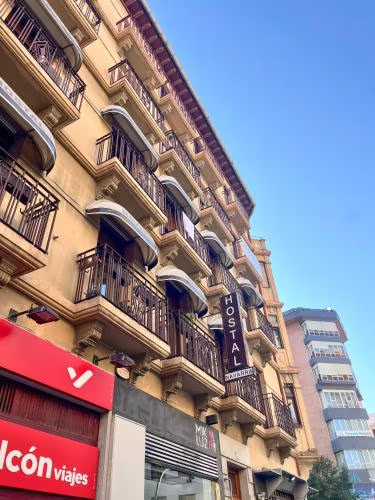
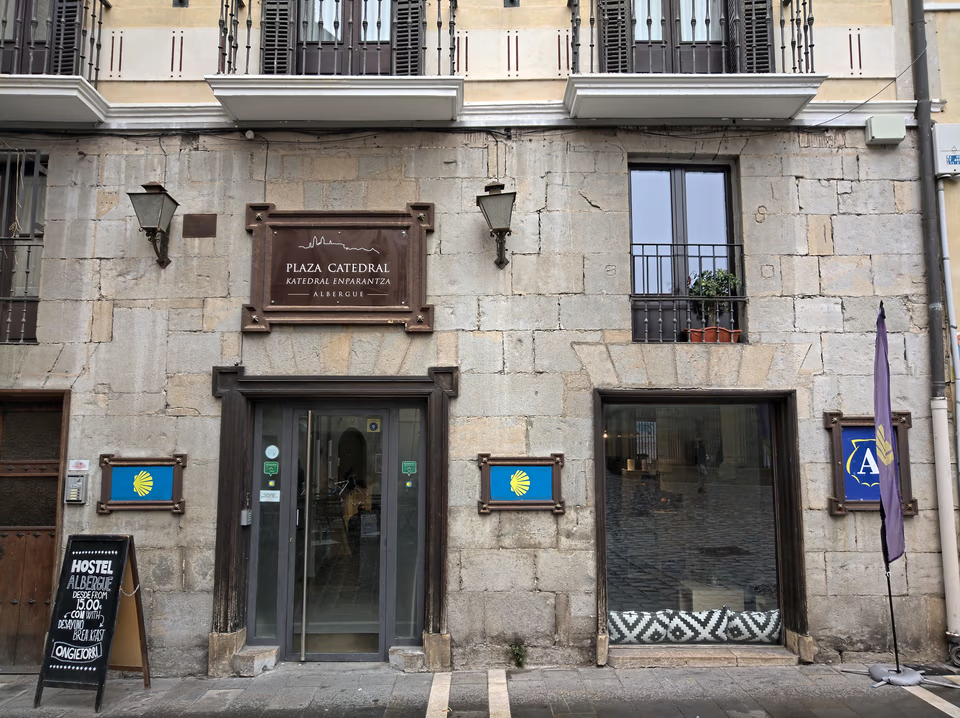
Where to stay in Pamplona
The places pilgrims rate highest in Pamplona come first.
- Top #1
 ClosedReservations accepted
Albergue Casa Ibarrola
- Top #2
 ClosedReservations not accepted
Albergue Casa Paderborn
- Top #3
 OpenReservations not accepted
Albergue Municipal de Peregrinos - Iglesia de Jesús y María



Services in Pamplona
What you can find in town before the next stage.
- ATM
- Café
- Shop
- Tobacco
- Medical clinic
- Pharmacy
- Fountain
- Post office
- Train station
- Bus station
- Airport
- Restaurant
Source: © OpenStreetMap contributors · updated January 2025
Town 5 of 49