Town on the Camino
Romont
Switzerland
- places to stay
- 9
Romont is the town of glass on the round hill: founded by Savoy in 1240, with a ring wall, a collegiate church full of windows from seven centuries, and the Swiss museum of glass art in the castle. On the Place Saint-Jacques, an inn took in pilgrims for around four hundred years. An afternoon is enough, and the morning after too.
How long to stay?
An afternoon is enough, and the next morning is yours too. You arrive after 30.7 kilometres from Fribourg, climbing the hill at the very end. In the afternoon you can manage the collegiate church, the Place Saint-Jacques and a walk round the old town. The Vitromusée in the castle only opens at 11:00, but the stage to Moudon is short at 14.5 kilometres: you can visit the museum in the morning and still arrive early. The museum is closed on Mondays.
Romont in Ninja numbers
- 323.0 kilometres past Konstanz, Romont lies on the Via Jacobi. Geneva is still 120.9 kilometres away.
- 781 metres is the highest point of the stage from Fribourg, just before the end. The hill comes last.
- 1240 is when Peter II of Savoy founded the town on the "rotundus mons", the round hill. Hence the name.
- 45 years old: that's what the Vitromusée turned in 2026. It opened in 1981 as the Swiss museum of stained glass.
- 14.5 kilometres is the distance to Moudon, a short stage after the long days before.
Arriving: past the abbey and up the hill
The last kilometres from Fribourg lead through Chavannes-sous-Orsonnens with its chapel of St-Jacques. At the entrance to the town lies the Cistercian convent of La Fille-Dieu, founded in 1268. Then you climb the hill on which the old town sits behind its ring wall. Romont is the capital of the Glâne district and has just over 6,000 inhabitants.
In brief: a town for Savoy
In 1240 Peter II of Savoy founded Romont as a stronghold on a round hill above the countryside, in Latin "rotundus mons". The castle, which now houses the Vitromusée, also dates from the 13th century. A ring wall still encloses the old town. Pilgrims knew Romont too: from the 16th century until around 1956, the Auberge du St-Jacques inn put up pilgrims and travellers. Then it closed, and the post office stands in its place today.
Light from seven centuries
Romont calls itself the capital of stained glass, and for good reason: the collegiate church has windows from the 14th, 15th and 19th centuries, alongside modern windows from the 20th century. In the castle, the Vitromusée shows stained glass from the Middle Ages to the present, and at the entrance to the town the convent of La Fille-Dieu has windows by the English artist Brian Clarke. For a pilgrim who has seen nothing but sky and fields for days, it's a contrast: here, light tells a story.
The town of glass: what to see
- Collégiale Notre-Dame de l'Assomption: The collegiate church was built in the 13th and 15th centuries in the late Gothic style. Its old windows date from the 14th, 15th and 19th centuries, the contemporary ones are by Alexandre Cingria, Yoki, Sergio de Castro and Henri Broillet. Look for the figure of St James in the choir stalls: here your patron sits carved in wood. We couldn't find opening hours.
- Place Saint-Jacques: From the 16th century until around 1956 the Auberge du St-Jacques stood here, an inn for pilgrims and travellers. Since it was redesigned around 1995, the square has borne the apostle's name. In a niche at the south-west corner stands a figure of St James by the French sculptor Georges Jeanclos (1933–1997), donated by a canon of the town. A good spot for a photo with your rucksack.
- Vitromusée in the castle: The only Swiss museum devoted entirely to the art of glass, with stained glass from the Middle Ages to the 20th century, antique flasks and reverse glass painting. Open March to September 11:00 to 17:00, October to February 11:00 to 16:00, closed on Mondays; in January admission is free on Tuesdays (according to the 2026 programme). We couldn't find admission prices.
- La Fille-Dieu Abbey: The Cistercian convent at the entrance to the town was founded in 1268. Its church dates from the 14th century, and the stained glass is by Brian Clarke. You pass it on your way into town.
- Ring wall: The town wall still encloses the old town. It shows that Romont was built as a fortress above the land.
Honestly
- The stage to get here is long. 30.7 kilometres from Fribourg, and the highest point comes just before the end. You climb the hill tired.
- The museum is closed on Mondays. If you arrive on a Sunday and leave on a Monday, you won't see the Vitromusée.
- No pilgrim hostel. In Romont you sleep in a hotel, a private room or a group accommodation.
- Lots of times are missing. We couldn't find opening hours for the collegiate church or the abbey.
Where pilgrims sleep
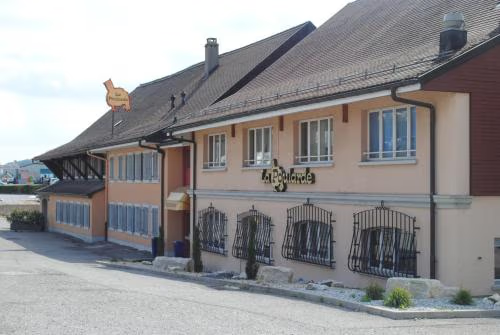
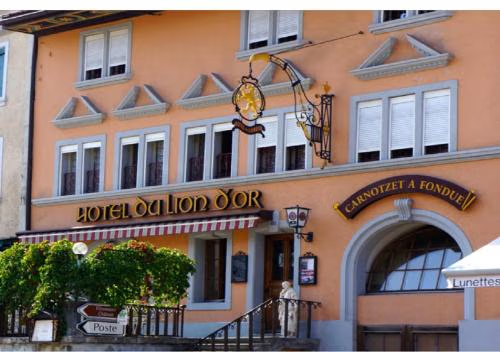
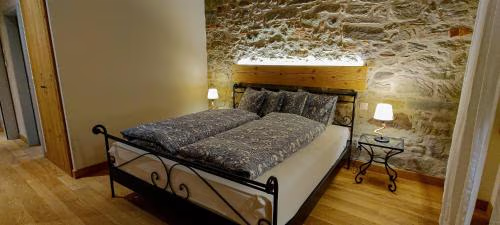
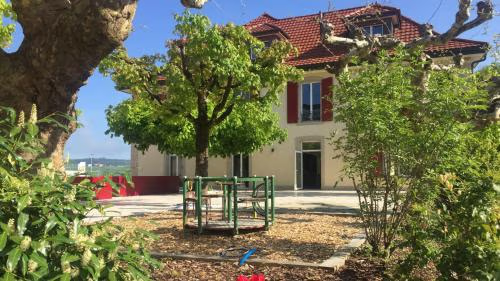
There is no pilgrim hostel in Romont. Several families rent private rooms to pilgrims, and there are also a few hotels. For groups there's the Centre sportif et culturel; ask beforehand whether it also takes individual pilgrims.
Ninja tips
- Museum in the morning. The Vitromusée opens at 11:00, and the stage to Moudon is only 14.5 kilometres long. You can afford to set off at midday.
- Find St James in the choir stalls. He sits among the carved figures, a quiet greeting to everyone on his way.
- Photo on the Place Saint-Jacques. The figure by Georges Jeanclos stands in a niche at the south-west corner of the square.
- Stop at the abbey on your way in. La Fille-Dieu lies at the entrance to the town. If you still have the energy when you arrive, stop there; tomorrow you leave in the other direction.
Onward: over the ridge into Vaud
Beyond Romont, a ridge path with wide views quickly takes you across the border from the canton of Fribourg into the canton of Vaud. The highest point is 4.7 kilometres past the town, at 811 metres. Then you descend to Curtilles, which you reach after 8.1 kilometres, and follow the Broye to Moudon. The stage is 14.5 kilometres long, with 182 metres of ascent and 393 metres of descent.
What awaits you tomorrow
Moudon, the little town on the Broye that was once almost a capital. Its church of Saint-Étienne has choir stalls from 1502 with apostles and prophets, and in the Middle Ages there were three hospitals for travellers here.
Deep dive: A round hill and an inn for pilgrims
A short read, in case you want to learn more about Romont. About three minutes' reading.
Savoy on the hill
In the year 1240, Peter the Second of Savoy was looking for a place from which to rule the land. He found a round hill that people called rotundus mons, and built a town on it with a wall and a castle. The Latin name became Romont. The wall still stands today.
An inn with the apostle's name
From the sixteenth century there was an inn here called the Auberge du Saint-Jacques, which took in pilgrims and travellers. It lasted for around four hundred years. Around 1956 it closed, and the post office was built in its place. When the square was redesigned around 1995, it was given back the apostle's name. A canon of the town donated a figure of St James, made by the French sculptor Georges Jeanclos.
A town of glass
The collegiate church was built in the thirteenth and fifteenth centuries. In its windows, medieval stained glass glows next to works from the twentieth century. In 1981 a museum of stained glass opened in the castle, the only one in Switzerland devoted entirely to this art. Today Romont likes to call itself the capital of glass, and outside the town even the old convent of La Fille-Dieu has modern windows by an English artist.
What Romont gives you
When this text was written, in the autumn of 2026, the museum in the castle was celebrating its forty-fifth birthday. You are standing on a hill where pilgrims found shelter centuries ago. Stained-glass windows do something you know from walking: they let the light through and colour it as they do. Perhaps the way is a little like that.
Where to stay in Romont
Places to stay in Romont.
 Open
Erika Demierre
- Open
Anne und Daniel Stern
- Open
Centre sportif et culturel
33€