

Town on the Camino
Fribourg
Switzerland
- places to stay
- 16
- Camino
- 1
- Elevation
- 592 m
Fribourg (Freiburg) is the city between two languages: founded in 1157 by the Zähringen dukes above a loop of the Saane, and bilingual to this day. Pilgrims sleep in the oldest still-active Franciscan monastery in Switzerland, climb 365 steps up the cathedral tower and then set off into French-speaking Switzerland. Worth a rest day.
Right now in Fribourg (as of October 2026)
- Cathedral tower only until 30 November: The climb is open from 1 March to 30 November 2026, Monday to Saturday 10:00 to 17:00, Sunday 12:00 to 17:00, last ascent half an hour before closing. It stays closed in snow or frost.
- Galtern gorge closed in winter: The path through the Galtern gorge just before the city is not passable in winter. Follow the detour instead.
How long to stay?
Worth a rest day. Fribourg is the first big city of French-speaking Switzerland on the Via Jacobi, and the old town fills a whole day: the cathedral and its tower, the Franciscan church with choir stalls from 1305, the covered Bern Bridge down by the Saane, and the funicular between the lower and upper town. There's a practical reason too: Fribourg is the last big town before Lausanne, a good place to do laundry, shop and rest.
Fribourg in Ninja numbers
- 291.5 kilometres past Konstanz, Fribourg lies on the Via Jacobi. Geneva is still 152.3 kilometres away.
- 365 steps lead up the 74-metre cathedral tower, one step for every day of the year.
- 1305 is when the choir stalls of the Franciscan church were carved, 66 seats, among the oldest in Switzerland. You sleep a few steps away.
- CHF 33 (approx. €35) is the price of a bed in the monastery's pilgrim dormitory, with your own sleeping bag (as of October 2026).
- 23.1 kilometres is tomorrow's distance to Payerne, where the Three Lakes Way meets the Via Jacobi.
Arriving: across the Saane into the city
From Schwarzenburg you come via the Sense, Heitenried, St. Antoni and Tafers and then across wide fields towards Fribourg. In summer the trail runs through the Galtern gorge, a ravine that ends right in the old town at the Palme bus stop; in winter it is closed. Across the Saane, through the Bellevue underpass and past the chapel of St-Barthélemy from 1473, which is abandoned and fenced off, you reach the upper town. From here the street signs and the language change: you have arrived in French-speaking Switzerland.
In brief: a free town above the river
In 1157 Duke Berthold IV of Zähringen founded the city on the Plateau du Bourg, high above a loop of the Saane. The name means "free town". Houses for strangers and the sick appeared early: a town hospital around the middle of the 13th century, a house of the Knights of St John in the lower town from 1224, and a leper house in Bourguillon that has been a Marian shrine since the 15th century. In 1481 Fribourg joined the Swiss Confederation. It has had a Catholic university since 1889, and in 1924 the collegiate church of St-Nicolas was raised to a cathedral.
Two languages, one river
Fribourg is effectively bilingual, and that has a long history. For a long time the city chancery wrote in German. In the modern era French gained ground and, partly through the mercenary service of many Fribourgers, became the first language of culture. For you as a pilgrim this means: here the German-speaking part of the Via Jacobi ends. From tomorrow people greet you with "Bonjour", the signposts point to Payerne and Moudon, and bread is called pain. If you've come from Konstanz, Fribourg is where you notice for the first time that the way leads west, to the French Ways of St James and on to Spain.
The city above the Saane: what to see
The old town is steep but compact. You can reach everything on foot without your rucksack, and the funicular helps on the way back.
- St-Nicolas Cathedral: Built from 1283 to 1490, a cathedral since 1924. Above the main portal the Last Judgement is shown in relief, an image medieval pilgrims saw again and again on their way. The stained-glass windows were created by the Polish artist Józef Mehoffer between 1896 and 1936 in Art Nouveau style, and in the 1970s windows by Alfred Manessier were added. The organ by Aloys Mooser (1824–1834) drew Franz Liszt and Anton Bruckner. The church is open Monday to Saturday from 7:30 to 19:00 and Sunday from 9:00 to 21:30, with restrictions during services (as of October 2026).
- Cathedral tower: 74 metres, 365 steps up a spiral staircase, and at the top the view over the old town and the Fribourg Prealps, and back along the way you came. Admission CHF 6 (approx. €6.40), students and seniors CHF 4 (approx. €4.30), tickets at the Info Point Bourg, Rue des Epouses 8. Opening hours: see the box above.
- Église des Cordeliers: The church of the Franciscan monastery of Sainte-Croix, the oldest still-active monastery of the Franciscan family in Switzerland. Inside are 66 choir stalls from 1305 and three famous altarpieces: the altarpiece of the Master of the Carnation from 1480, the Furno altarpiece (1509–1513) and the St Anthony altarpiece by Hans Fries (1506). This is also where pilgrims sleep. We couldn't find the church's opening hours; ask at the gate.
- Pont de Berne: The city's last covered wooden bridge, down in the old town on the Saane. Its present form dates from 1653. In 1340 the people of Fribourg deliberately sawed through it during an attack by the Bernese to stop the enemy. For a pilgrim who has just come from the Bern region, that's a nice twist.
- Funicular: Since 1899 it has linked the lower town of Neuveville with the upper town at Saint-Pierre. After a stroll through the lower town, it saves you the steep walk back up.
Honestly
- The arrival is unspectacular. When the Galtern gorge is closed, you come into the city through underpasses and along streets. The old town makes up for it.
- Fribourg is steep. There's a lot of climbing between the lower town on the Saane and the upper town. Plan your evening so you don't have to go up and down three times.
- Switzerland is expensive. Even the pilgrim bed in the monastery costs CHF 33 (approx. €35), more with a linen sleeping bag and towel.
- From here there are two lines. From Fribourg the Via Jacobi has two official lines: via Hauterive and Romont, or via Payerne. Our map and this page follow the line via Payerne; for the line via Romont you need the association's route guide.
Where pilgrims sleep
The first address is the Couvent des Cordeliers – Auberge pour les pèlerins at Rue de Morat 6, in the middle of the old town: the Franciscan monastery has 24 places in three dormitories for pilgrims and groups, plus three single and two double rooms. A dormitory bed costs CHF 33 (approx. €35) with your own sleeping bag, a linen sleeping bag CHF 9 (approx. €9.60), a bath towel CHF 5 (approx. €5.40) (as of October 2026). Check-in is between 16:00 and 18:45; there's a kitchen, Wi-Fi and breakfast from 7:00 to 9:00. Enquiries on +41 26 347 11 60 or accueil@cordeliers.ch.
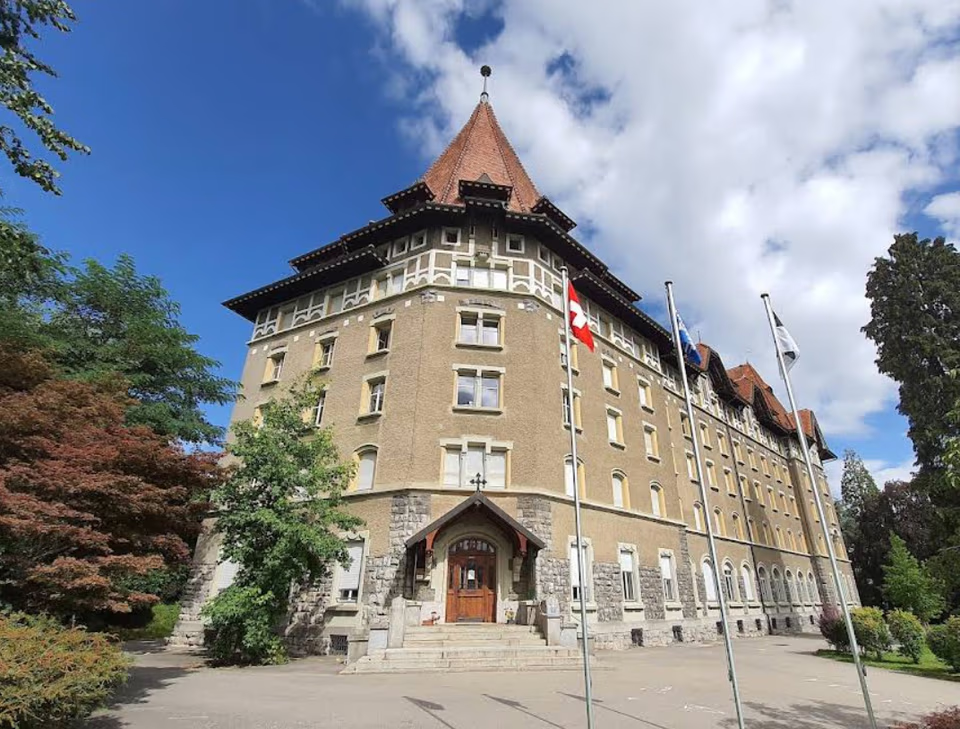
Church-run houses such as the Convict Salesianum and the Cité Saint Justin also take guests; ask them about their terms. On top of that there are hotels in every price range.
Ninja tips
- Arrive between 16:00 and 18:45. That's the only time you can check in at the Cordeliers. Arrive later and you're standing outside the door.
- Bring a sleeping bag. Otherwise you pay CHF 9 extra for the linen sleeping bag.
- Climb the tower early. The last ascent is half an hour before closing, and in frost the door stays shut.
- Go down to the Saane. The Bern Bridge and the lower town are the quietest part of Fribourg. Take the funicular back up.
- Breakfast at the monastery. Tomorrow it's 23.1 kilometres to Payerne. Eat well before you set off.
Practical tips for pilgrims
- Language: Fribourg is bilingual. From here on, the Via Jacobi is French-speaking.
- Train: Fribourg is on the Lausanne–Bern railway line. A good place to start or end a section.
- Tickets and information: Info Point Bourg, Rue des Epouses 8, near the cathedral.
- Currency: You pay in Swiss francs; we've also converted many of the prices on this page into euros.
Onward: into the Broye valley to Payerne
In the morning you leave Fribourg heading west. From here the Via Jacobi has two official lines that meet again at Lucens: one via the Cistercian abbey of Hauterive and Romont, one via Payerne. Our map follows the line via Payerne, 23.1 kilometres to the small town on the Broye.
What awaits you tomorrow
Payerne and its abbey church. The Romanesque church of the former Cluniac priory dates from the 11th century. In Payerne the Three Lakes Way from Basel ends, and from here both routes continue together towards Geneva.
Deep dive: The city that speaks two languages
A short read, in case you want to learn more about Fribourg. About four minutes' reading.
A foundation on the rock
In the year 1157, Duke Berthold the Fourth of Zähringen was looking for a site for a new town. He found it on a rocky plateau that the Saane flows around in a wide loop. The river protected the settlement on three sides, and the fourth was easy to fortify. He called it the free town, Friburg, and even the early spellings show that two languages met here: Friborc, Fribor, Friburg.
Shelter for strangers
A town on a river and on a road lives from those who come and go. Around the middle of the thirteenth century there was a town hospital next to the old church of Notre-Dame. In 1224 the Knights of St John settled in the lower town, an order whose task was caring for pilgrims and the sick. Outside the town, in Bourguillon, stood a house for lepers, which in the fifteenth century became a place of pilgrimage to the Mother of God. Whoever arrived here in those days on the way west found doors meant for strangers.
The bridge they sawed through
The neighbours were not always friends. Bern, the powerful city to the east, attacked Fribourg in the year 1340. The people of Fribourg sawed through their wooden bridge over the Saane so that the enemy could not get into the town. The bridge was rebuilt, its present form dates from 1653, and to this day it is called the Bern Bridge. In 1481 Fribourg itself joined the Swiss Confederation.
German and French
For a long time the city chancery wrote in German. But in the modern era French gained ground, partly because many men of Fribourg served as mercenaries, and gradually it became the first language of culture. German never disappeared, though. To this day Fribourg is a city where two languages live side by side.
The cathedral and the friars
Above everything rises the tower of St-Nicolas, which took more than two hundred years to build, from 1283 to 1490. Only in 1924 did the church become a cathedral. Many of its windows were made between 1896 and 1936 by an artist from Kraków. A few streets away, Franciscan friars have lived for centuries. Their monastery is the oldest still-active house of the Franciscan family in Switzerland, and their choir stalls are more than seven hundred years old. Today the brothers take in pilgrims, as the town's hospitals did in the Middle Ages.
What Fribourg gives you
When this text was written, in the autumn of 2026, Fribourg was the city where the Via Jacobi changed from one language to another. You have walked in German up to here. From tomorrow you walk in French, and one day in Spanish. Fribourg shows you that you can live with two languages without losing yourself. The way stays the same.
Where to stay in Fribourg
Places to stay in Fribourg.
 OpenReservations accepted
Convict Salesianum
 Open
Christine Mivelaz
33€- Open
Cité Saint Justin
33€


Town 22 of 28