

Town on the Camino
Rüeggisberg
Switzerland
- places to stay
- 6
- Caminos
- 2
- Elevation
- 929 m
Rüeggisberg is the highest point between Lake Thun and Fribourg, and the place of a beginning: around 1075, monks from Cluny founded their first priory in the German-speaking world here. Of the church, only one transept wing still stands, freely accessible, with a view of the Bernese Alps. A break is enough, then it's down into the Schwarzwasser.
How long to stay?
A break is enough. Rüeggisberg lies in the middle of the stage from Wattenwil to Schwarzenburg, and most pilgrims stop here without staying the night. Allow half an hour to an hour: the priory ruins are a few minutes from the village, freely accessible, and from up here you look back at the Bernese Alps. If you end your day here, you'll find bed & breakfasts and private rooms, but no pilgrim hostel.
Rüeggisberg in Ninja numbers
- 261.7 kilometres past Konstanz, you are standing at the highest point of this section of the Via Jacobi. Geneva is still 182.1 kilometres away.
- 185 metres is what you climb on the last 4.0 kilometres from Riggisberg. After that it's almost all downhill.
- Around 1075, a baron gave the church on this hill to the abbey of Cluny. It became the first Cluniac priory in the German-speaking world.
- 703 metres is the lowest point before Schwarzenburg, down by the Schwarzwasser, just under four kilometres after the village.
- 10.6 kilometres are left to Schwarzenburg, the end of the stage.
Arriving: up onto the Längenberg
From Wattenwil, the trail climbs gently through open country with wide fields, via Burgistein and Riggisberg. The Stockhorn range lies behind you, ahead the view opens to the west. Rüeggisberg is a scattered settlement on the plateau of the Längenberg. The priory ruins are only a few minutes' walk from the village, and the trail leads right past the monastery buildings.
In brief: Cluny on the hill
Around 1075, Baron Lütold von Rümligen gave the church of St Martin on the "mons Richeri" to the Burgundian abbey of Cluny so that a monastery could be founded here. It is considered the first Cluniac priory in the German-speaking world and probably the oldest monastery in the Bern region. Usually a prior and two to four monks from Cluny lived here. The Romanesque church grew from the late eleventh century until about 1185. In 1484 the priory passed to the newly founded collegiate chapter of St Vincent in Bern, and after the Reformation, in 1541, the church and convent buildings were pulled down except for the north arm of the transept. The stones ended up in houses and in the village church, and what was left served as a barn. Only the excavations of 1938 to 1947 uncovered the foundations again.
A beginning in stone: what to see
Two things make the stop worthwhile, and both are close together.
- Priory ruins: What remains of the priory is the north transept wing with parts of the crossing tower, plus the excavated foundations. The ruins belong to the canton of Bern, are protected and freely accessible. For pilgrims it is a quiet place: monks of an order that helped shape Europe's great pilgrim routes lived here. Between Easter and September, services are held here once a month, and in November there's an Advent market. Next to the ruins, a small museum shows Romanesque sculpture and finds from the excavations; it was redesigned in 2022, together with an archaeological trail. We couldn't find the museum's opening hours.
- St Martin's Church: The village church has an early Romanesque core and was rebuilt after a fire in 1532. Inside is a permanent exhibition of confirmation photos since 1914. The series shows how the young people's clothes and bearing changed over a century.
Honestly
- No pilgrim bed. There's no pilgrim hostel, only bed & breakfasts and private rooms. At the end of the stage in Schwarzenburg, 10.6 kilometres further on, there's more choice.
- The museum is a stroke of luck. We couldn't find opening hours. Expect to see only the ruins, and be glad if the door is open.
- A steep gorge afterwards. Beyond the village the trail drops steeply to the Schwarzwasser and climbs steeply but briefly up the other side. Pace yourself, the stage is only half done.
Ninja tips
- Look back. From the Längenberg, on a clear day, you can see the Eiger, Mönch and Jungfrau. It's one of the last great views of the Alps before the trail heads into Fribourg country.
- Halfway. The stage from Wattenwil to Schwarzenburg is 21.2 kilometres long; Rüeggisberg lies 10.6 kilometres after Wattenwil, almost exactly in the middle. A good spot for lunch.
- Ruins before church. If you're short of time, choose the ruins: they're freely accessible, the church and museum not necessarily.
- Brown signposts. The brown Way of St James signposts guide you along the whole stage, including at the turn down into the Schwarzwasser.
Onward: down into the Schwarzwasser
The trail leads past the monastery buildings down into the Schwarzwasser gorge, to 703 metres, and steeply up the other side onto a plateau. Via Wislisau and Elisried, past the site of the former shortwave transmitter, you reach Schwarzenburg after 10.6 kilometres, with 239 metres of ascent and 376 metres of descent.
Deep dive: The monks of Cluny on the Längenberg
A short read, in case you want to learn more about Rüeggisberg. About two minutes' reading.
A gift to Burgundy
Around the year 1075, a nobleman from the area, Lütold von Rümligen, gave away his property on this hill. He gave the church of St Martin to the abbey of Cluny in Burgundy, the most powerful monastery of its time. Cluny sent monks, and on the Längenberg the order's first house in the German-speaking world was founded. There were never many of them: a prior and two to four brothers.
A church over a hundred years
The monks built a Romanesque church, on which work went on from the late eleventh century until around 1185. The priory owned land as far as the Schwarzenburg area and vineyards on Lake Biel, and two smaller priories depended on it. In the fifteenth century it lost its independence: in 1484 it was incorporated into the new chapter at Bern Minster.
Pulled down and found again
After the Reformation, nobody needed a monastery on the hill any more. In 1541 the church and convent buildings were pulled down, and only one arm of the transept was left standing. The farmers took the stones for their houses, and what was left became a barn. Only between 1938 and 1947 did archaeologists dig out the foundations again.
What Rüeggisberg gives you
When this text was written, in the autumn of 2026, the old transept wing stood open in the landscape, with no roof over the visitors' heads. You are standing in a place where an order from Burgundy gained a foothold more than nine hundred years ago. From here your way continues west, towards Burgundy and France, to where these monks once came from.
Where to stay in Rüeggisberg
Places to stay in Rüeggisberg.
 OpenReservations accepted
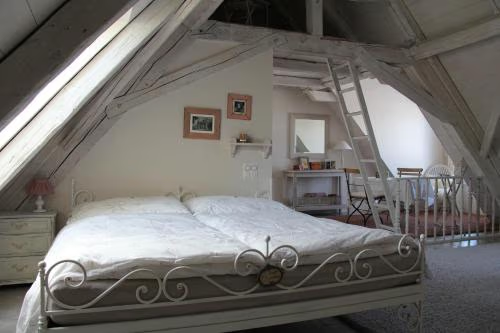
B&B Bären
 Open
Andi und Doris Steller
- Open
Elisabeth und Jürg Willen
Town 1 of 1
Continue along the Luzernerweg
Rüeggisberg is the last popular town on the Luzernerweg.