

Town on the Camino
Samos (over Samos)
Lugo, Galicia, Spain
- places to stay
- 7
- Camino
- 1
- Elevation
- 540 m
Samos is the worthwhile detour of the Camino Francés: about seven kilometers longer than via San Xil, the variant from Triacastela leads you to a Benedictine monastery from the 6th century, with two cloisters and a Mozarabic chapel under a cypress. An afternoon is enough; the monastery albergue is currently closed.
Right now in Samos (as of October 2026)
- Monastery albergue closed: The pilgrim albergue in the monastery is temporarily closed because of construction work, and no reopening date is known. Plan on a private albergue or keep walking to Sarria.
How long to stay?
An afternoon is enough, with a guided tour. If you come from Triacastela, you are here early in the day after 10 kilometers. The tour of the monastery takes less than half a day, and the Capilla del Ciprés is a walk of a hundred meters. After that you can stay the night or still walk the 15.4 kilometers to Sarria. A rest day is not worth it in this small village.
Samos in Ninja numbers
- 10.0 kilometers is the distance from Triacastela to here, with 445 meters of descent in the valley of the Río Oribio.
- 129.9 kilometers remain from here to Santiago de Compostela.
- Around 7 kilometers is what this detour costs you compared with the variant via San Xil.
- 54.5 meters is the side length of the large cloister from the late 17th century; it is considered one of the largest monastery cloisters in Spain.
- 1582 is the date of a red inscription in the smaller cloister. It reads "Qué miras bobo", what are you looking at, fool.
Arriving: the monastery in the valley floor
The way from Triacastela follows the Río Oribio, also called Río Sarria, through chestnut and oak forest and small villages such as San Cristovo do Real, Lusío, Renche and San Martiño do Real. Then the valley opens up, and the monastery suddenly stands before you: dark slate walls, a Baroque facade from the 18th century without towers and an outdoor staircase modeled on the staircase of the cathedral of Santiago at the Obradoiro. Above the door stands Saint Benedict. The village itself is small and lies around the monastery.
In brief: fifteen centuries of monks
The founding is attributed to Saint Martin of Braga in the 6th century. In the 8th century the monks left the monastery for a time, King Fruela restored it, and the later King Alfonso II spent his childhood here, the king under whom the tomb of James was discovered. In the 10th century Ordoño II introduced the Benedictines, and in the 12th century Samos joined the reform of Cluny. A papal bull of 1020 confirmed the monastery's right to host pilgrims. In the Napoleonic war the monastery served as a field hospital, and after the expropriation of the monasteries the monks left and returned in 1880. In the middle of the 16th century and once more in 1951 the monastery burned; most of what you see today dates from the 17th and 18th centuries.
The detour worth taking: what to see
Plan for the guided tour, it is the reason for the detour.
- Monasterio de San Julián de Samos: The tour leads through the cloisters, the sacristy and the 18th-century church, whose dome shows four scholars of the Benedictine order who wrote about Mary. In the smaller Claustro de las Nereidas from the 16th century stands a Baroque fountain; look for the red inscription of 1582. The large cloister, from the end of the 17th century, measures about 54.5 meters on each side; in it stands a statue of the scholar Benito Jerónimo Feijóo by Francisco Asorey. Feijóo was a monk in Samos and is considered a pioneer of the Spanish Enlightenment. Tours Monday to Saturday 10:00–12:30 and 16:30–18:30, Sundays and public holidays 12:45–13:30 and 16:30–18:30, about €5 (as of October 2026); in winter no tours on Tuesdays. Call ahead: 982 546 046.
- Capilla del Salvador, the Capilla del Ciprés: About a hundred meters from the monastery on the Rúa do Salvador stands a small chapel of slate slabs, Mozarabic, from the end of the 9th or the beginning of the 10th century, with an elliptical triumphal arch and frescoes of Asturian character that count among the oldest wall paintings in Galicia. Next to it grows a cypress about 26 meters tall. How old it is, the sources argue: anything from three hundred to a thousand years can be read. For a pilgrim, this chapel is the piece that is older than almost everything you will still see on the way to Santiago.
Food and drink
Samos has a few bars and restaurants with a pilgrim menu; one pilgrim named a menu for €15 in July 2026. The local sweet is the Biscoito Manxarín, a sponge biscuit you can buy at the Casa Manxarín.
Honestly
- The monastery albergue is closed. Of all things, the albergue that many made the detour for is closed because of construction work. The private albergues fill the gap only partly.
- The tour is the only way to see the monastery. If you come at the wrong time, you stand in front of the facade; on Sundays there is only a short window in the morning.
- The road to Sarria is dangerous. Several pilgrims warned in 2025 and 2026 against walking the LU-633 to Sarria: bends, traffic, no shoulder. Stay on the marked way via Pascais and Aguiada.
- Seven kilometers more. If you have already seen many monasteries, skip the detour and go via San Xil.
Where pilgrims sleep
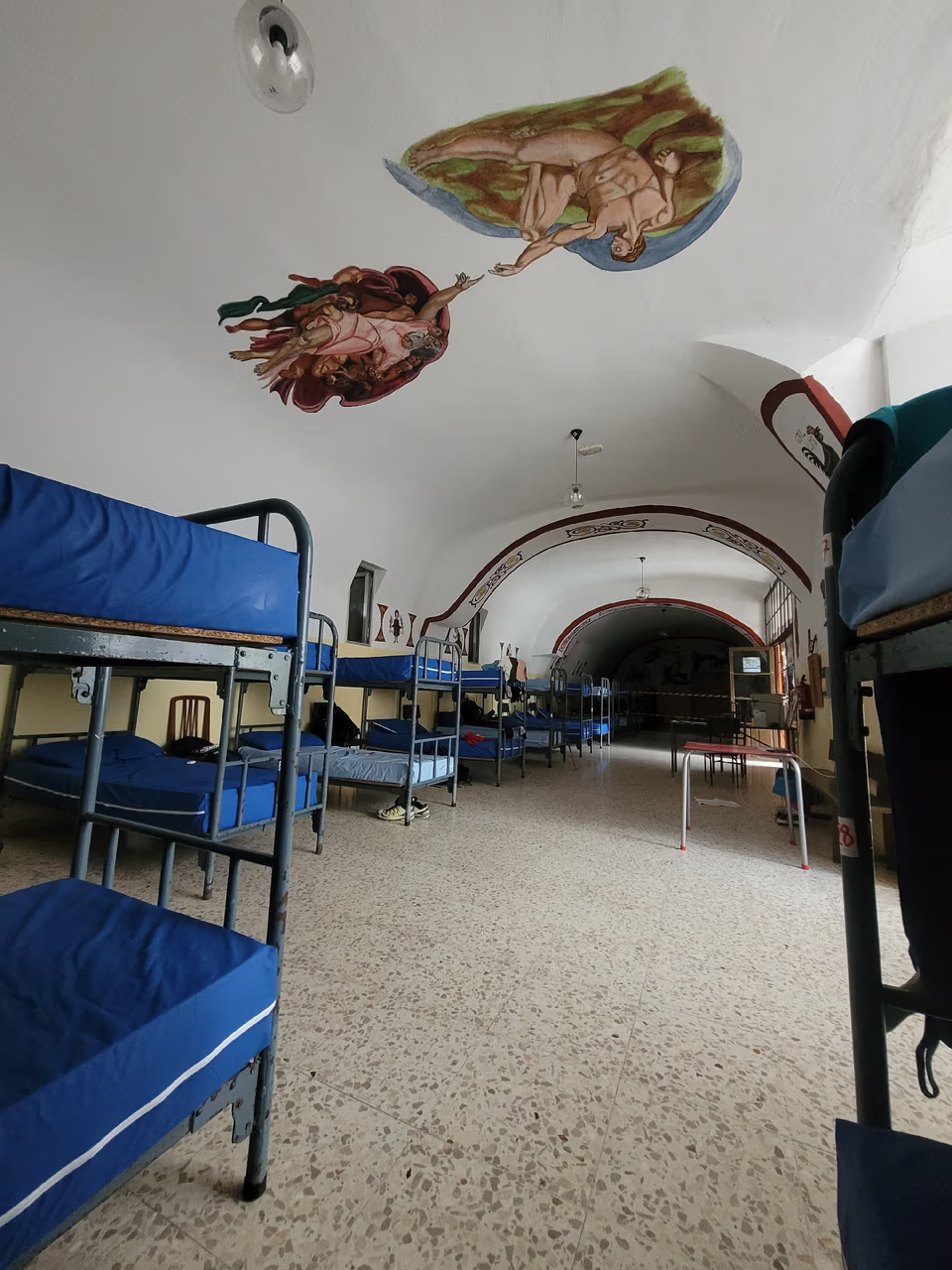
The Albergue del Monasterio de Samos belongs to the monastery and takes only pilgrims, on a donation basis, in a large hall under copies of Romanesque frescoes from San Isidoro in León. It has no heating and normally opens only from spring to mid-October. It is currently closed because of construction work (as of October 2026). Open are the private albergues Val de Samos (dormitory from €15, April to October according to the operator) and Tras do Convento (few beds, April to November). In winter it gets tight in Samos; then Sarria is the safe choice.
Ninja tips
- Arrive before 12:30 or after 16:30. In between there are no tours.
- Don't walk on the road to Sarria. Follow the yellow arrows via Pascais, Gorolfe and Sivil to Aguiada; the road is shorter, but narrow and without a shoulder.
- Call ahead. We only have the tour times from an undated source; the monastery gives information at 982 546 046.
- Walk the hundred meters to the cypress. The Capilla del Ciprés is not part of the monastery tour, which shows the cloisters, sacristy and church.
- Get your post done: The post office at Avenida de Compostela 24 is open on weekdays from 8:30 to 14:30.
When it rains
Then Samos is a good place to wait it out. - Monastery tour: Mon–Sat 10:00–12:30 and 16:30–18:30, Sun 12:45–13:30 and 16:30–18:30, about €5.
Practical tips for pilgrims
- Post: Avenida de Compostela 24, Mon–Fri 8:30–14:30.
- Holidays: On 12 July 2027 it is the local holiday (San Bieito); shops may be closed.
Onward: via Pascais to Sarria
Beyond the monastery you leave the road at Teiguín and climb up to Pascais, at 579 meters the highest point of the day, then it goes up and down via Gorolfe and Sivil, where a medieval bridge with a chapel crosses the river, to Aguiada. There the variant via San Xil joins your way again, and after 15.4 kilometers you are in Sarria, with 375 meters of ascent and 455 meters of descent.
What awaits you tomorrow
Sarria, the place where the way changes: whoever starts here has exactly the good hundred kilometers ahead that are needed for the Compostela. From Sarria on, you are rarely alone.
Deep dive: A monastery that kept starting over
A short read, in case you want to learn more about Samos. About three minutes' reading.
A valley that monks sought
Samos lies in a narrow valley on the Río Oribio, surrounded by mountains. That monks settled here is no coincidence: seclusion was what they were looking for. The founding is attributed to Saint Martin of Braga, a bishop of the sixth century. It cannot be proven; the oldest inscription that names the monastery is much younger.
A king as a child
In the eighth century the monks left the monastery, and King Fruela had it restored. Here came, after the murder of his father, a boy who later became King of Asturias as Alfonso the Second. Under his rule a tomb was found in Galicia that was held to be that of the Apostle James, and he had the first church built over it. He is considered the first pilgrim to Santiago. The monastery where he grew up lies on the way that the pilgrims took afterward. In 1020 a papal bull confirmed that Samos was allowed to take in pilgrims.
Fire and return
In the tenth century Benedictines moved in, in the twelfth the monastery followed the reform of Cluny. In the middle of the sixteenth century a fire destroyed almost everything. They built anew, bigger: the Gothic cloister of the Nereids, later the large cloister, in which the statue of the monk Feijóo now stands, who wrote books from here with which the Enlightenment in Spain began. In the war against Napoleon the monastery became a field hospital, in the nineteenth century the state expropriated the monasteries, and the monks left. In 1880 they came back. In 1951 it burned again, and again it was rebuilt.
What Samos gives you
When this text was written, in the autumn of 2026, Benedictines still lived in Samos, and their albergue for pilgrims had just been closed because of construction work. That fits a place that has started over so often. You make a detour of seven kilometers here. The monastery has fifteen centuries of detours behind it and still stands.
Where to stay in Samos (over Samos)
The places pilgrims rate highest in Samos (over Samos) come first.
- Top #1
 OpenReservations accepted
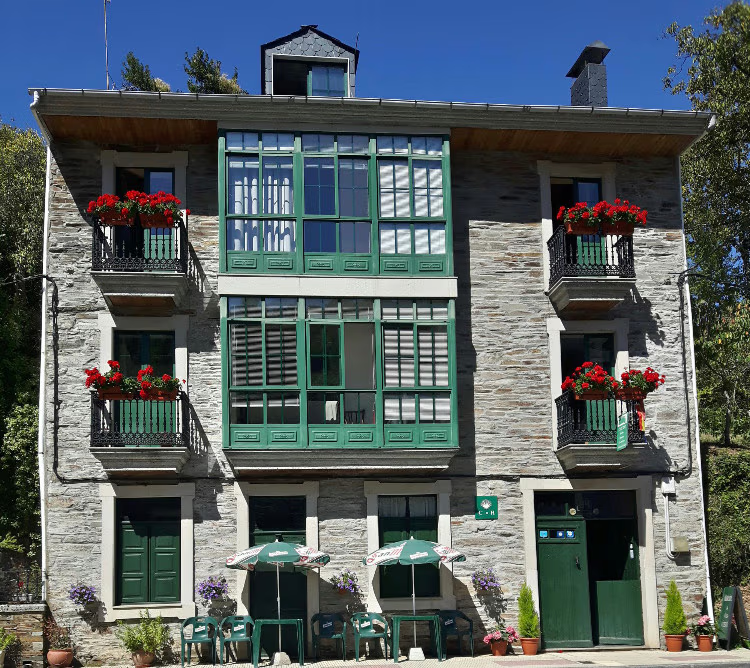
Casa Licerio
- Top #2
 OpenReservations accepted
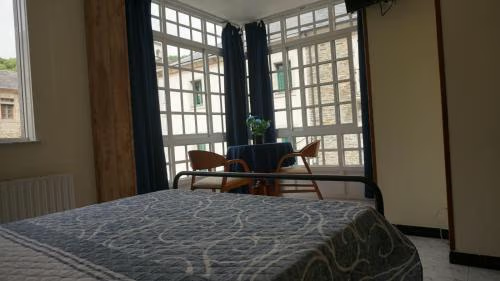
Pensión Castro Parrillada
- Top #3
 ClosedReservations accepted
Pensión Santa Rosa

Services in Samos (over Samos)
What you can find in town before the next stage.
- ATM
- Café
- Shop
- Tobacco
- Medical clinic
- Pharmacy
- Fountain
- Post office
- Restaurant
Source: © OpenStreetMap contributors · updated November 2025
Town 40 of 49