

Town on the Camino
Santa Bárbara de Nexe
Portugal
- places to stay
- 2
- Camino
- 1
- Elevation
- 152 m
Santa Bárbara de Nexe is the first pilgrimage church on the way: even before there were yellow arrows, people from the surrounding area made their way to a chapel where miracles were said to have happened. 13.3 kilometres beyond Faro stands one of the biggest village churches in the Algarve hinterland. There is no bed here, and Loulé is still 9.3 kilometres away.
How long to stay?
A break is enough, half an hour to an hour. Santa Bárbara de Nexe is a village in the Barrocal, the limestone hills behind the coast, and not a stage town. What holds you here is the parish church with its azulejos and its chancel vault, plus a coffee. After a good 13 kilometres from Faro the break comes at just the right time, and what remains to Loulé is manageable.
Santa Bárbara de Nexe in Ninja numbers
- 13.3 kilometres since Faro. The sea is behind you, the hills have begun.
- 9.3 kilometres are left to Loulé, your first stage town. To the end of the Way in Benfica do Ribatejo it is 439.0 kilometres (according to Camino Ninja).
- 1291 is when the name “Nexe” first appears, in a charter about the boundaries between Faro and Loulé. So you have been standing on a borderline for over 700 years.
- 1733 is the date on the church’s high altar. The figure of Saint Barbara in it is older still, from the 17th century.
Arriving: up into the amphitheatre
From Faro the Caminho Português Central do Sul leads you north via Montenegro, away from the coast and into the Barrocal. Santa Bárbara de Nexe lies in a natural amphitheatre on the slopes of the Serra de Monte Figo, looking down over the Ria Formosa and the Atlantic. It is your first look back at what you left this morning. The village counts as a suburb of Faro, but the lanes are lined with stone walls, and in February the almond trees blossom here.
In brief: borderland since the Middle Ages
People settled here as early as the Palaeolithic. The oldest inhabitant known by name is a Roman, Sextus Numisius Eros, known from a gravestone of the 2nd century. Later came the Visigoths, then the Moors, until King Afonso III finally incorporated the land into the Kingdom of Portugal in 1272. In 1291 “Nexe” is first mentioned, as a boundary point between Faro and Loulé. The church was built on the site of an older chapel, and the village became a parish of its own in the 16th century. Today the freguesia, with a good 4,100 inhabitants (2011 census), belongs to the municipality of Faro.
Pilgrims before the pilgrims: what to see
The village has one sight, and it is enough for your break.
- Parish church of Santa Bárbara: The Junta de Freguesia calls it “one of the biggest and most important churches in rural Algarve”. It was built on the site of a chapel where miracles were reported and to which people from the region made pilgrimages. So you are not the first pilgrim to arrive here, just one with a more distant goal. Outside it is plain; the beauty is inside: pointed arches on columns, and in the chancel a vault whose ribs form the pattern of a lily. The walls are clad up to plinth height with 17th-century azulejos, and above the chancel arch two angels crown Saint Barbara. The high altar bears the year 1733, and a side altar is dedicated to Saint Amaro. Stylistically, Manueline, Baroque and Neoclassical mix. At the end of 2025 the state heritage authority proposed classifying the church as a monument of public interest. We have not found opening times; if the door is shut, you are left with a view of the bell tower.
Honestly
- No bed for pilgrims. There is no pilgrim hostel in Santa Bárbara de Nexe, and Camino Ninja knows only private accommodation here. Your stage goal is Loulé, 9.3 kilometres further on. According to our route page there is no pilgrim hostel there either.
- Whether the church is open is a matter of luck. We have found neither opening times nor Mass times. We could not confirm a pilgrim stamp either.
- Supplies yes, but no guarantee. There are cafés, shops and restaurants in the village, as reports from the walking festival show. Which ones are open when, we do not know. Fill your bottle here all the same.
- The sources do not agree. Whether the church was begun in the 14th or the 15th century, and whether it has one nave or three, depends on which source you read. Look for yourself and count the columns.
Ninja tips
- Turn round. From the amphitheatre you look down on the Ria Formosa and the Atlantic, to where you set off this morning.
- Take your break here. After Santa Bárbara de Nexe there are only Goldra and Goncinha until Loulé, and whether there is a café there, we do not know.
- The walking festival is at the end of January. In 2025 and 2026 the Junta de Freguesia invited people at the end of January and the start of February to a walking festival with guided tours through the Barrocal (in 2025 there were 27 walks). If you are walking around that time, ask.
- In January the charolas sing. Groups go from house to house and café to café with an accordion, singing improvised New Year songs, the “janeiras”.
Onward: through the Barrocal to Loulé
The Caminho Português Central do Sul continues through the limestone hills. After 4.8 kilometres you pass through Goldra, after a further 2.1 kilometres through Goncinha, and then after 9.3 kilometres in total you have reached Loulé, the goal of your first stage.
Deep dive: A chapel where miracles happened
A short read, in case you want to learn more about Santa Bárbara de Nexe. About 2 minutes' reading.
On the border
Santa Bárbara de Nexe is a place that lay between two others for a long time. When its name first appears in a charter in 1291, it is about the boundary between Faro and Loulé. The landscape that goes with it is the Barrocal, a strip of limestone hills between the flat coast and the mountains behind. Whoever comes here has the sea at their back and the hills ahead.
The chapel and the miracles
Before the big church there was a small chapel here. The Junta de Freguesia tells that miracles were reported at this chapel and that people of the region made pilgrimages to it. The parish church arose over it, probably in the fourteenth century, according to other sources in the fifteenth. One source links the chapel with the year 1444 and the Order of Saint James. In the sixteenth century the village became a parish of its own.
An interior from several centuries
What you see today has grown over centuries. In the chancel a vault spans overhead whose ribs draw a lily. In the seventeenth century the tiles came onto the walls, along with the picture above the chancel arch in which two angels crown Saint Barbara. In 1733 the high altar was dated. In autumn 2025 the proposal was on the table to put the church under state heritage protection.
What Santa Bárbara de Nexe gives you to take along
You have been on the road only a few hours, and already you are standing at a place to which people made pilgrimages long before anyone marked the way north with arrows. Their goal was this chapel. Yours lies further away. Perhaps that is a good thought for the first day: that pilgrimage does not begin with distance, but with setting out.
Where to stay in Santa Bárbara de Nexe
Places to stay in Santa Bárbara de Nexe.
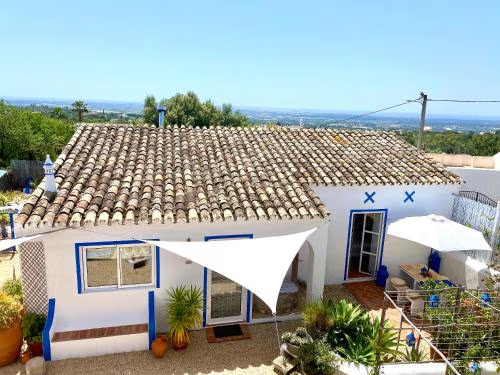 OpenReservations accepted
Casa da Aldeia
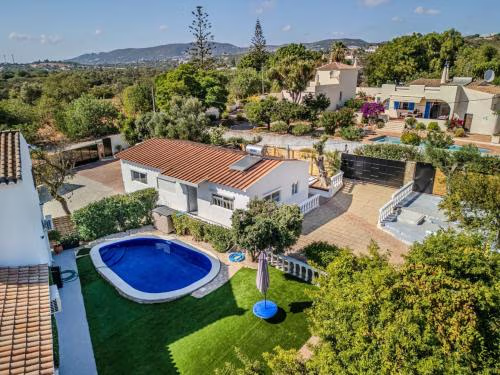 OpenReservations accepted
Quinta Veigas
Town 2 of 24