

Town on the Camino
Santillana del Mar
Cantabria, Spain
- places to stay
- 20
- Caminos
- 2
- Elevation
- 88 m
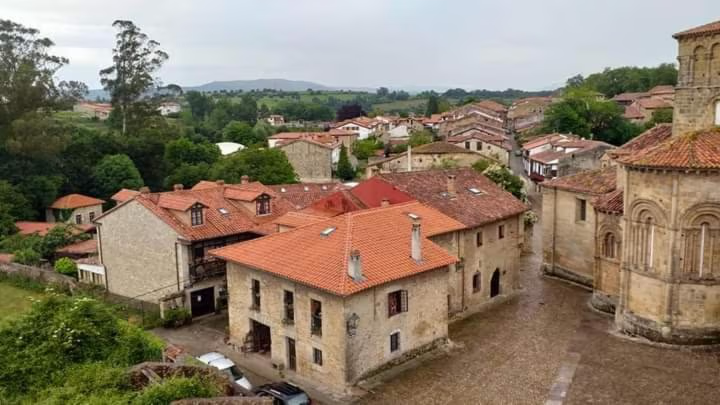
Santillana del Mar is the village of three lies: not holy, not flat, not by the sea. Instead it has stone lanes, noble houses and a Romanesque collegiate church with a cloister full of carved capitals, 525.2 kilometres before Santiago. Altamira lies right next door.
Right now in Santillana del Mar (as of October 2026)
- Municipal hostel closed: According to Gronze, the town's Jesús Otero pilgrim hostel has been closed since 2023; no reopening date is known.
- End of season: The large El Convento hostel closes on 15 October and reopens on 27 March.
How long to stay?
An afternoon is enough, but take all of it. You arrive after a long stage from Santander or a short one from Boó, and the village is small enough to see on foot in an afternoon: down the Calle del Cantón to the collegiate church, through the cloister, across the squares. If you want to see Altamira, plan the evening or the early morning for it. At midday it is crowded; early and late it gets quiet.
Santillana del Mar in Ninja numbers
- 37.8 kilometres lie between Santander and Santillana del Mar, one of the long stages of the Northern Way.
- 525.2 kilometres still to go to Santiago.
- 42 capitals are carved in the Romanesque cloister of the collegiate church.
- 1196 was the year the monastery of Saint Juliana became a collegiate church.
- 1879 was the year the cave of Altamira was discovered.
Arriving: across the meadows of Queveda
The last kilometres before Santillana run gently uphill via Viveda and Queveda, through meadows and past farms. Just before the village you reach the day's highest point at 122 metres. Then the path leads into the stone village, and on the Plaza Mayor and in the lanes you notice at once: you were not the only one on the way, the day visitors are here too.
In brief: a monastery gave the name
The name comes from Sancta Iuliana, a martyr from Nicomedia in Asia Minor. A monastery under her patronage was founded in the 9th century, and in 1196 it became a collegiate church, the Colegiata. The village grew up around it, and later noble families built their houses with coats of arms here. The neighbours' mockery is old: "ni es santa, ni es llana, ni tiene mar", neither holy nor flat nor by the sea. The monastery did, however, own land right down to the coast, hence the "del Mar".
Romanesque and Stone Age: what to see
Santillana is small but dense. There are two things you should not miss, each in its own way a place of origins.
- Colegiata de Santa Juliana: The Romanesque collegiate church from the 12th century stands on an older building and has been part of the UNESCO World Heritage site of the northern Spanish Ways of St James since 2015. For pilgrims it is the heart of the village, which owes its name to it. The finest part is the cloister with its 42 capitals, where you can discover scenes and ornaments. We have not found reliable opening hours or prices.
- Museo de Altamira: The cave of Altamira, discovered in 1879 by Marcelino Sanz de Sautuola, made Palaeolithic cave art famous worldwide and has been a UNESCO World Heritage site since 1985. The real cave is almost inaccessible: there are only a few visits a week and the waiting list is closed. The museum next to it houses the Neocueva, an exact replica with the best-known paintings. Figures for the distance from the village centre vary between just over one and about two kilometres; opening hours are at cultura.gob.es/mnaltamira.
- The old town: Cobblestones, houses with coats of arms and the town hall on the Plaza Mayor. Loveliest early in the morning, before the coaches arrive.
Food and drink
Typical of Santillana are the tableta, a sponge biscuit with lemon zest, traditionally eaten with a glass of milk, and quesadas. The set menus in the old town are uniform and rather expensive; you eat more cheaply outside the historic core.
Honestly
- Lots of bustle. Santillana is a day-trip destination. At midday the groups crowd into a few streets.
- Expensive for pilgrims. Eating in the old town costs more than elsewhere on the way.
- No municipal hostel. The town's hostel has been closed since 2023, so the cheap bed for a few euros does not exist here at the moment.
- Altamira only as a copy. You will practically never see the original cave; the museum shows the replica.
Where pilgrims sleep
According to Gronze, the municipal Jesús Otero hostel next to the collegiate church has been closed since 2023. The largest hostel is the Albergue El Convento in the Regina Coeli convent, about 100 metres from the historic core: 60 beds, €16 in the low season and €19 from mid-June to mid-September, communal dinner for €11 (as of March 2026). It belongs to the diocese of Santander, is run by a non-profit social project and looked after by volunteer hospitaleros, and it is open from 27 March to 15 October. There is also a private hostel in the old town and plenty of guesthouses and posadas, many of them over €50 for a double room.
Ninja tips
- Cloister first. If you only have time for one thing, make it the cloister of the Colegiata.
- Lanes early or late. The day visitors come around midday; in the morning, when you set off, you have the village almost to yourself.
- Check Altamira beforehand. The museum's closing day and opening hours are best checked the day before online or by phone on +34 942 818 005.
- Dinner at El Convento. If you sleep there, you eat together with the other pilgrims, which is also the cheapest hot meal in the village.
Practical tips for pilgrims
- Supplies: Cash machine, pharmacy, grocery, bakery and bars are all in the village.
- Stamp: At the hostels.
- Laundry: El Convento has a washing machine and dryer for a fee.
Onward: along the coast to Comillas
According to the Camino Ninja map the next stage to Comillas is 22.5 kilometres with 559 metres of ascent and 617 metres of descent. The day's highest point, 146 metres, comes right after Santillana; then the way leads via Oreña, Caborredondo and Cóbreces down to the beach of Luaña, the lowest point of the day, and via Liandres and La Iglesia to Comillas.
What awaits you tomorrow
Comillas, where Gaudí built one of his first works: a summer house with a tower covered in ceramic sunflowers.
Deep dive: The village of three lies
A short read, in case you want to learn more about Santillana del Mar. About three minutes' reading.
A saint from Asia Minor
Juliana of Nicomedia was a martyr from the east of the Roman Empire, from the area of today's İzmit in Turkey. How her name reached the Cantabrian coast is told by a tradition that cannot be verified. What is certain is that a monastery under her patronage was founded here in the 9th century and that the village was named after her: Sancta Iuliana, Santillana.
From monastery to collegiate church
In 1196 the monastery became a collegiate church, a church with a chapter of clergy who celebrated the liturgy together. The church you see today is Romanesque and dates from the 12th century. Its cloister with 42 capitals is one of those places where you can easily spend half an hour simply looking. Since 2015 the collegiate church has been part of the UNESCO World Heritage site of the Ways of St James in northern Spain. That makes it explicitly a pilgrim place, not just a monument.
A cave changes prehistory
A few kilometres away, Marcelino Sanz de Sautuola found the cave of Altamira in 1879, with its bison, deer and horses on the ceiling. For a long time people refused to believe him that Stone Age humans could paint like that. Today Altamira is regarded as one of the most important sites of Palaeolithic art. Because visitors endangered the paintings, the cave is almost closed, and in the museum you see an exact replica.
What Santillana gives you
The mocking verse says Santillana is neither holy nor flat nor by the sea. For pilgrims that is only half true. The village is holy through a woman who died for her faith in late antiquity, and flat it really is not. The sea you will see tomorrow. Today you may simply marvel, between Romanesque and Stone Age.
Where to stay in Santillana del Mar
The places pilgrims rate highest in Santillana del Mar come first.
- Top #1
 ClosedReservations accepted
Albergue de Peregrinos El Convento
- Top #2
 OpenReservations accepted
Hospedaje Octavio
- Top #3
 OpenReservations accepted
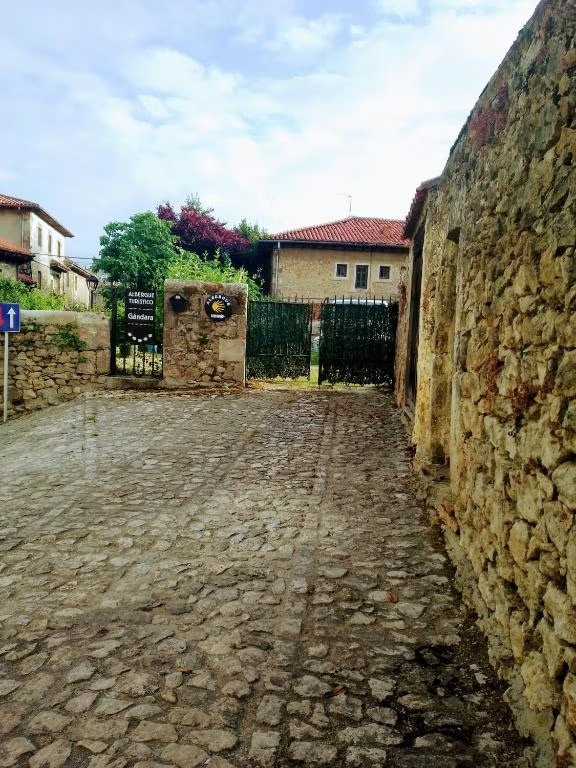
Albergue Gandara


Services in Santillana del Mar
What you can find in town before the next stage.
- ATM
- Café
- Shop
- Pharmacy
- Fountain
- Post office
- Train station
- Restaurant
Source: © OpenStreetMap contributors · updated February 2026
Town 23 of 49