

Town on the Camino
São Pedro de Rates
Distrito do Porto, Região do Norte, Portugal
- places to stay
- 6
- Caminos
- 3
- Elevation
- 54 m
São Pedro de Rates is a place of beginnings: here James is said to have consecrated the first bishop of Braga, around 1100 Count Henry brought monks from Cluny, and in 2004 the first purely pilgrim albergue in Portugal opened here, still run on donations. The Romanesque church stands right on the Way. One evening is enough.
How long to stay?
One evening is enough, but give the church an hour. Church, museum, pillory and the little Rua Direita lie close together, and one to two hours cover everything. If you are only passing through at midday, you should still not skip the church. The village is too small for a rest day.
Rates in Ninja numbers
- 38.5 kilometers is the distance from the cathedral in Porto to here. If you slept in Vairão, you only walked 13.1 today.
- 205.4 kilometers remain to Santiago on the Camino Portugués Central.
- 2004 is when the first albergue in Portugal for pilgrims only opened here. You still pay with a donation.
- 1910 is when the church became a national monument; the restorers then brought back the 12th century.
- April 26 is the feast of Saint Peter of Rates.
Arriving: the church first
From Arcos you come to Rates over a short stretch of the N206 and the hamlet of Borgonha, and the first thing you see is the most important: the Romanesque church stands at the entrance to the village. Watch for the fork there: to the right the Camino Central continues, to the left, according to pilgrim reports, a connection leads toward the coast. The albergue lies in the upper part of the village, directly on the Way.
In brief: bishop, monks, knights
Beneath today's church, archaeologists found remains of a pre-Romanesque church in 1997 and 1998; the oldest building phases go back to the 6th century. By the 11th century at the latest, monks lived here. Around 1096 Count Henry, the father of the first king of Portugal, had the monastery rebuilt, and in 1100 he gave it, together with his wife Teresa, to the priory of La Charité-sur-Loire, a daughter house of Cluny. It was the first Cluniac monastery in Portugal. Building continued into the 13th century. In the 16th century the monastery passed to the Order of Christ, and in 1552 the saint's relics were taken to Braga. Rates was its own municipality until 1836 and is now a village in Póvoa de Varzim.
A place of beginnings: what to see
Everything lies on the Way or a few steps beside it.
- Igreja Românica de São Pedro de Rates: A granite building with three naves, a transept and three apses, with richly sculpted capitals and corbels. A continuous stone vault was planned but abandoned around the middle of the 12th century, which is why the church has a wooden roof. The rose window is a reconstruction from the restoration of the 1930s and 1940s; at that time the Gothic bell tower was torn down to win back the 12th-century building. Behind the church stand sarcophagi. What matters for you is the story: on this spot the first bishop of Braga, a disciple of James, is said to have suffered martyrdom. According to an undated source, opening hours are Tuesday to Saturday 9:00 to 13:00 and 14:00 to 17:30; check them on site.
- Núcleo Museológico: The small museum belongs to the church. We found no reliable information on its contents or admission.
- Fonte de São Pedro: The fountain near the church is said to help against infertility. The water is drinkable: a chance to fill your bottle.
- Pelourinho and Rua Direita: The pillory is a reminder that Rates administered its own justice until 1836. Nobility and bourgeoisie lived on the Rua Direita, and on the square stands the old 18th-century town hall.
Eating and drinking
A bar with a small shop is a few meters from the albergue, a snack bar across the street, and about 200 meters further on a restaurant with a pilgrim menu. Pilgrims praise the cod there. A café at the church serves burgers, and a restaurant opens early on Sundays with breakfast. The albergue has a kitchen.
Honestly
- The donation is not entirely voluntary. In autumn 2026 it was requested at check-in; €10 is considered the usual amount.
- The mattresses are plastic. There are no sheets, only disposable covers, and the beds are 1.90 meters long.
- It is loud at night. Cars roll over the cobbles in front of the albergue, and in four dormitories many people snore.
- Church and museum are probably closed on Sundays and Mondays. The opening hours we found are undated.
Where pilgrims sleep
The Albergue de Peregrinos de São Pedro de Rates belongs to the town of Póvoa de Varzim and has been run since its opening in 2004 by volunteer hospitaleros of an association, financed through donations. It has four dormitories, takes only pilgrims with a credencial, opens at 14:00, closes at 22:00 and is open all year. You cannot reserve. An old house with a garden, patios, a kitchen and washing facilities; most pilgrims praise it as clean and warm-hearted. There are also a few guesthouses in the village, a double room from about €40 to well above (as of October 2026).
Ninja tips
- Arrive before 14:00 or shortly after. Without a reservation, the order of arrival decides.
- Pack a sleeping bag or sleeping-bag liner. On the plastic mattresses you only get a disposable cover, for €1.
- Keep earplugs handy. Cobbles outside the house, many beds.
- Have your donation ready in cash. Expect about €10.
- Visit the church before 17:30. Best right on arrival, it is on the Way.
- Fill your bottle at the fountain of São Pedro. The water is drinkable.
Practical tips for pilgrims
- Credencial and stamp: At the albergue, the credencial costs €2.
- Shopping: small shop at the bar near the albergue; we found no documented ATM or pharmacy.
- Stage planning: If you want to walk here from Porto in one day, it is 38.5 kilometers. It is shorter with a night in Vairão.
Onward: via Pedra Furada to Barcelos
The Way first goes downhill on the road, then for over an hour on farm tracks through rural country to the N306 and past the church of Pedra Furada (6.5 kilometers, restaurant and albergue there). Via Pereira and Barcelinhos you reach Barcelos after 16.6 kilometers, with 205 meters of ascent and 224 meters of descent. The highest point is 143 meters near Pedra Furada, the lowest 18 meters at the Cávado before the town. Along the way asphalt, dirt tracks and cobbles alternate, and there are no big climbs.
What awaits you tomorrow
Barcelos, the town of the rooster that crowed for a pilgrim. You arrive over a fourteenth-century bridge across the Cávado, and on Thursdays the market has filled the Campo da Feira since 1412.
Deep dive: The bishop of Rates
A short read, in case you want to learn more about São Pedro de Rates. About four minutes' reading.
A legend from the first century
The story told in Rates begins with James himself. In the year 44 the apostle is said to have visited the northwest of the peninsula and, on the ridge of Rates, to have consecrated a man named Peter as bishop, the first bishop of Braga. Peter, so the legend goes on, rescued a pagan princess who had herself baptized and vowed chastity. Her father had him pursued. Peter fled into the chapel of Rates and was beheaded there.
Centuries later, in the ninth century, a hermit named Felix is said to have followed a light in the night and found the body under rubble. On that spot the church was built, and the relics became a goal of pilgrimages.
What the historians say
The legend has gaps, and you should know them. James is attested in Jerusalem in the year 44, where he was executed. The Bollandists, the scholars who have been examining the lives of the saints since the seventeenth century, call the discipleship of Peter purely traditional. What is documented is something else: beneath the church, archaeologists found in 1997 and 1998 walls of a pre-Romanesque church, and the oldest building phases reach back to the sixth century. In an antechamber lay a Roman gravestone that had later been reinterpreted in a Christian sense and reused. So people prayed here very early.
Cluny in Portugal
Around 1096 Count Henry of Burgundy had the dilapidated monastery rebuilt. Henry then ruled the county of Portucale, from which Portugal emerged, and his son became the first king of the country. In the year 1100 Henry and his wife Teresa gave the monastery to the priory of La Charité-sur-Loire, a house of the great abbey of Cluny. Abbot Hugh of Cluny was a close relative of Henry. Monks from France came and brought the rule of Saint Benedict. Thus Rates became the first monastery in Portugal belonging to Cluny, and the church you see today was built in the following hundred years. The stone vault that was planned was never completed.
Knights, relics and a governor
At the beginning of the sixteenth century the monastery passed to the Order of Christ, the successor of the Templars in Portugal. The first commander of Rates was Tomé de Sousa, who later went to Brazil as its first governor general. In 1552 the relics of Saint Peter were taken to Braga. In the nineteenth century the monastery church became a parish church, in 1910 a national monument, and in the 1930s and 1940s the state restored it back to its medieval condition.
What Rates gives you
When this text was written, in autumn 2026, pilgrims were still sleeping here against a donation, in the albergue that opened in 2004 as the first of its kind in Portugal. Whether James was ever here, nobody knows. What is certain is that people have prayed at this place for fifteen centuries and that someone here decided to take in pilgrims again before that was common in Portugal. Some things begin with a legend and then come true.
Where to stay in São Pedro de Rates
The places pilgrims rate highest in São Pedro de Rates come first.
- Top #1
 OpenReservations not accepted
Albergue de peregrinos de São Pedro de Rates
KitchenCooktopsPlates & UtensilsAnd more - Top #2
 OpenReservations accepted
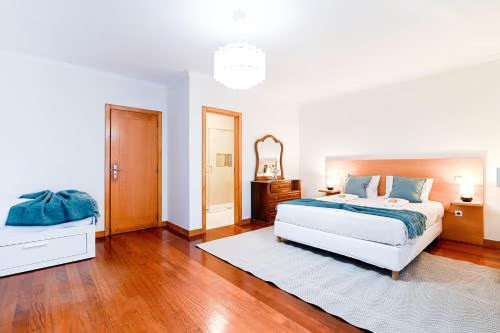
Casa Tomé de Sousa
- Top #3
 Open
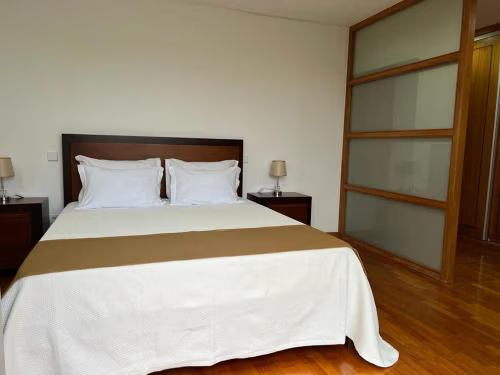
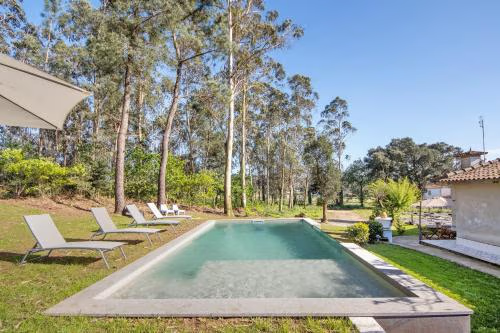
Casa Anabela

Services in São Pedro de Rates
What you can find in town before the next stage.
- ATM
- Café
- Shop
- Pharmacy
- Fountain
- Airport
- Restaurant
Source: © OpenStreetMap contributors · updated January 2026
Town 2 of 2
Continue along the Aqueduct Trail
São Pedro de Rates is the last popular town on the Aqueduct Trail.