

Town on the Camino
Schwyz
Switzerland
- places to stay
- 11
- Camino
- 1
- Elevation
- 514 m
Schwyz gave Switzerland its name, and the Museum of the Federal Charters keeps the document the country long saw as its founding deed. You arrive beneath the Mythen peaks with tired knees after a descent of almost 900 metres from the Haggenegg. An afternoon is enough, then it is five kilometres on to the lake.
How long to stay?
An afternoon is enough. Schwyz is a cantonal capital with a large square, a baroque church and a museum worth seeing while you are here. It does not fill a second day. That is why many pilgrims spend the night in Brunnen on the lake, 5.2 kilometres further on. If you stay in Schwyz, you have the evening for the main square and a short walk to the boat the next morning.
Schwyz in Ninja numbers
- 898 metres is how far the path drops from the Haggenegg in just 6.0 kilometres down to Schwyz. Your knees already know.
- 17.7 kilometres from Einsiedeln to here, with 573 metres of ascent and 942 metres of descent.
- 334.8 kilometres still lie ahead of you to Geneva, where the Via Jacobi ends. You have put a quarter of the way from Konstanz behind you.
- 972 is when the place first appears with certainty in a document, as "villa Suittes".
- 1291 is the date on the Federal Charter you will see behind glass in the museum.
Arriving: from the Mythen into the heartland
The descent from the Haggenegg is hard on the knees: from the pass at 1,414 metres the path drops to 515 metres, with the two Mythen peaks above you. Below, the valley basin opens up with the old centre around the main square. The association that looks after the route calls Schwyz the "former heartland of Switzerland". In the local dialect, "Schwyz" still means the whole country too.
In brief: a village name becomes a country's name
Schwyz has been documented since 972. The village's name later passed to the canton and then to the whole Confederation; the English "Switzerland" also goes back to "Schwytzerland". Where the name itself comes from is unknown. The parish church of St. Martin had several predecessors: a Romanesque church was consecrated in 1121, a later one burned down in 1642, and today's late baroque church was consecrated in 1774. Around 15,000 people live in the municipality today (as of 2020).
Around the main square: what to see
Everything important is a few minutes' walk apart. You can manage it with your rucksack on, even just passing through.
- Museum of the Federal Charters (Bundesbriefmuseum): Built in 1936 as an archive for Switzerland's founding documents. At its centre lies the Federal Charter of early August 1291, by which Schwyz, Uri and Nidwalden joined together, along with the Morgarten Charter of 1315, original documents from the state archive and a collection of flags. The charter used to be staged as if on an "altar of the fatherland"; today the museum presents it as one document among several. It is worth it for pilgrims because here you understand the country you will be walking through for the next weeks. Open Tuesday to Sunday 10:00 to 17:00, closed on Mondays; Bahnhofstrasse 20 (according to the museum portal, undated; check beforehand).
- Parish church of St. Martin: The late baroque church on the main square was consecrated in 1774 and is already the fifth on this spot. A good place to sit after the descent. We did not find mass times.
- Town hall, Hofstatt Ital Reding and Haus Bethlehem: Three buildings of national importance near the main square; Haus Bethlehem stands at Reichsstrasse 9. We did not find opening times; the short detour is worth it from the outside.
Food and drink
Schwyz is a cantonal capital with supermarkets, bakeries and restaurants around the main square. As everywhere in Switzerland, food is expensive; if you want to save, shop at the supermarket and eat on the main square.
Honestly
- The descent hurts. Almost 900 metres over six kilometres is hard on the knees. Poles help.
- Hardly any pilgrim beds. There is no pilgrim hostel in Schwyz, only a backpacker hotel and many holiday flats. Most pilgrims carry on to Brunnen.
- The museum is closed on Mondays. If you arrive on a Monday, you will not see the Federal Charter.
- A capital, not a pilgrim town. We found no traces of St. James in Schwyz; this is about the history of the country, not of the Way.
Where pilgrims sleep
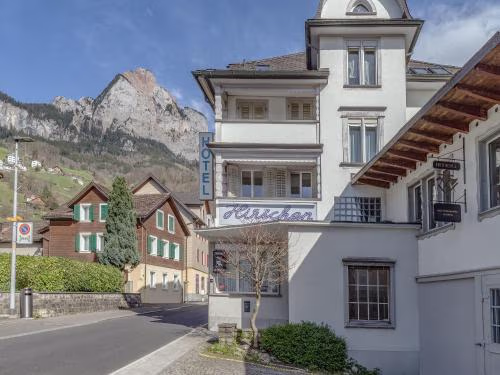
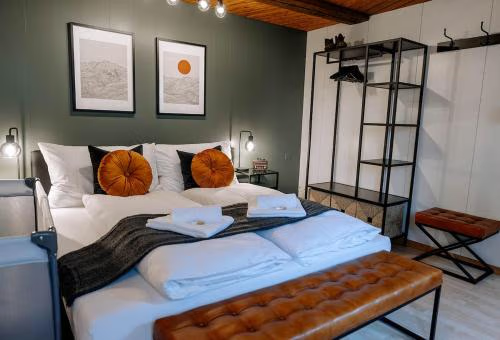
There is no pilgrim hostel, parish or monastery accommodation in Schwyz. The cheapest option is the Hirschen Backpacker-Hotel & Pub in the centre; otherwise there are mainly holiday flats. You will find a pilgrim bed with breakfast 5.2 kilometres further on in Brunnen, at Haus Maria Theresia by Ingenbohl Monastery. In Switzerland, book by phone the day before.
Ninja tips
- Snow on the Haggenegg: In spring, check the snow conditions before setting off from Einsiedeln. If there is still snow up top, the descent to Schwyz is slippery.
- Museum before the boat: If you are sleeping in Brunnen, you can visit the museum in Schwyz in the afternoon and then walk the 5.2 kilometres to the lake.
- Yellow signs, sticker no. 4: Where it gets unclear, a sticker with the number 4 shows the way. A blue border means towards Santiago.
Practical tips for pilgrims
- Pilgrim passport: If you do not have one yet, best order it in advance from the Jakobsweg Schweiz association, CHF 12 (approx. €13) (as of October 2026).
- Train: Schwyz has a station on the Gotthard line; if you need to stop after the descent, you can get away quickly.
- Money: You pay in francs; cards are accepted almost everywhere.
Onward: to Lake Lucerne
From Schwyz you walk via Ibach and past Ingenbohl Monastery to Brunnen, 5.2 kilometres, almost flat, with 75 metres of ascent and 150 metres of descent. There you take the boat to Treib; the crossing takes about ten minutes. Then you climb steeply to Seelisberg and walk via Emmetten to Beckenried, 24.1 kilometres in total from Schwyz.
What awaits you tomorrow
A path that crosses a lake. In Brunnen you board the boat, and for ten minutes Lake Lucerne becomes part of the Via Jacobi. On the far side, below Seelisberg, lies the Rütli meadow.
Deep dive: A village that named a country
A short read, in case you want to learn more about Schwyz. About three minutes' reading.
From a village name to a country's name
You are standing in a place whose name you know in every language in the world, just not in this form. Schwyz is first mentioned with certainty in the year 972, as villa Suittes. Nobody knows exactly where the name comes from. What is certain is where it went: first to the valley and the canton, then to the whole alliance of places that formed around Schwyz. And in English, Schwytzerland became Switzerland. In the local dialect the difference still does not exist: the town is called Schwyz, and so is the country.
A charter and an altar
In early August 1291, Schwyz, Uri and Nidwalden joined together with a charter. It is short, it is in Latin, and for a long time it was read as the founding document of Switzerland. In 1936 it was given a house of its own in Schwyz. The charter lay there as if on an altar of the fatherland; that was the intended effect. Today the museum tells a more honest story. The charter is one document among several, next to it lies for example the Morgarten Charter of 1315, and the history of the Confederation does not begin on a single day.
A church that kept coming back
The parish church of St. Martin on the main square is not the first. A Romanesque church was consecrated in 1121, a later one burned down in 1642, and the church you see today was consecrated in 1774. Five churches on one square: that is the story of a place that kept starting again without ever moving.
What Schwyz gives you
Today you crossed the highest pass of the Swiss Via Jacobi and came down into the valley that gave a whole country its name. From here you walk through the history of that country: across the lake, past the Rütli meadow, to Stans, into the Ranft. Schwyz reminds you that a great name can start small. With a village, a charter and a few people who joined together.
Where to stay in Schwyz
Places to stay in Schwyz.
 OpenReservations accepted
Hirschen Backpacker-Hotel & Pub
 OpenReservations accepted
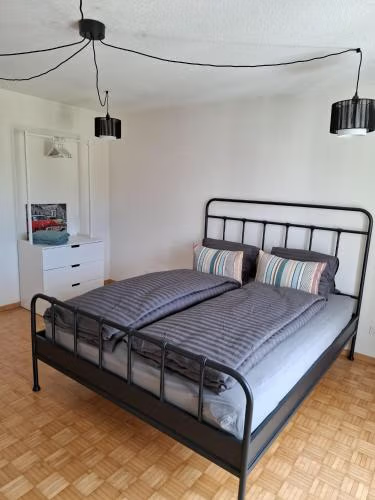
Ferienwohnung mit Herz
 OpenReservations accepted
Wohnung mit Herz



Town 8 of 28