

Town on the Camino
Tavira
Portugal
- places to stay
- 24
- Camino
- 1
- Elevation
- 8 m
The Via Nascente begins in Tavira, at the church of Santiago, where above the door the apostle raises a sword. After the conquest around 1242 the town on the Gilão belonged to the Order of Santiago, and in the chancel of Santa Maria lie the tombs of seven of its knights. You set off with the shell in a place where St James was venerated as a fighter. Come a day early.
How long to stay?
Worth a rest day, and before the start. Tavira is not a stage destination but your first morning: you arrive by train or bus, and the next day 26 kilometres to Castro Marim lie ahead of you. If you only arrive in the late afternoon, you have hardly any time for the town. The two old main churches, the castle, the bridge and the quarter around the hill of Santa Maria easily fill a day, and you can collect your first stamp in peace and look at the way out of town. We haven't found reliable opening times for the churches, so allow some buffer.
Tavira in Ninja numbers
- 660.6 kilometres is the distance from Tavira to Trancoso, the end of the Via Nascente, according to Camino Ninja. You won't be in Santiago there, but you will be in the north of Portugal.
- 26.0 kilometres is the first stage to Castro Marim, flat along the coast.
- 7 knights of the Order of Santiago have their memorial tombs in the chancel of Santa Maria do Castelo. According to tradition their deaths were the reason for the conquest of the town.
- Over 20 churches are counted in Tavira, but only two are parish churches with a baptismal font: Santa Maria do Castelo and Santiago, a few metres apart.
- 2 arches of the old bridge over the Gilão collapsed in the flood night of 3 December 1989. You leave the town over this bridge.
Arriving: the first arrow at the church of Santiago
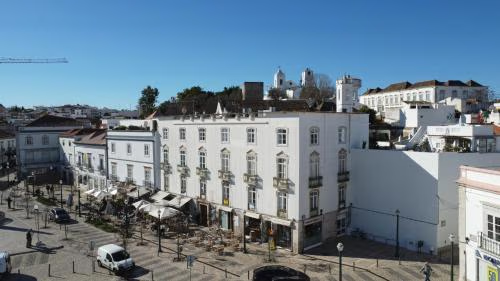
You don't reach Tavira on foot but by train on the Algarve line or by bus, for example from Lisbon. The town lies at the mouth of the Gilão, on both banks, with old bridges and roof terraces. To the west, in Faro, the Caminho Português Central do Sul begins and heads north to the Tagus; it shares no route with the Via Nascente.
The starting point of the Via Nascente is the Igreja de Santiago up on the hill, next to the castle. According to a pilgrim guide you find the first yellow arrow and the first shell there. From here the arrows lead down, over the old bridge and east. If you don't know the way, look at the way out the day before: the Via Nascente is not marked uniformly everywhere, and on this route you can't manage without a GPS track.
In brief: Phoenicians, Moors, knights of the order
Tavira is older than it looks. At the end of the 8th century BC people from the eastern Mediterranean settled on the hill of Santa Maria, and their wall dates from this time. In the atrium of the Palácio da Galeria, ritual wells from the 7th and 6th centuries BC were found. In the 11th century the Moors built the castle, which then guarded the ford across the river, before there was a bridge.
Then came the Order of Santiago. Under its master Paio Peres Correia, Tavira was conquered; the sources give 1239, 1240 or 1242, most often 1242. King Sancho II gave the town and the patronage of its church to the order, and the pope confirmed this in 1245. Until the middle of the 16th century Santa Maria do Castelo belonged to the order. The earthquake of 1755 hit both main churches hard, and they were rebuilt in the late 18th century. The last great catastrophe came from the river: in the night of 3 December 1989 the flood tore away two arches of the old bridge, and cars drifted as far as the Praça da República.
Where Saint James carries a sword
For pilgrims from northern Europe Tavira is a small surprise. The James you meet here doesn't sit there with hat and staff. Above the great south portal of the Igreja de Santiago he raises his sword on a yellow medallion, probably against a Moor. A pilgrim wrote in January 2024 after his visit only: "Santiago here is different from the one in Spain."
The reason lies in the history of the town. Tavira was conquered by a knightly order that bore the apostle's name, and the James of this order was the fighter, not the pilgrim. In the chancel of Santa Maria do Castelo lie the memorial tombs of seven knights, opposite a gravestone of their master Paio Peres Correia, and in the Senhor dos Passos chapel the crosses of the Order of Santiago and the Order of Christ are carved into the wooden vault. You will meet the knights of Christ again tomorrow: Castro Marim was their first seat. So you set off with a shell, under a saint with a sword. What you make of that, you decide over the next 660 kilometres.
On the hill and by the river: what to see
The most important sights lie close together on the hill of Santa Maria, the bridge down by the river. We haven't found reliable opening times for any of these places.
- Igreja de Santiago: the Via Nascente starts here. The church is one of the town's two parish churches; it existed by 1270 at the latest, when King Afonso III gave its patronage to the Bishop of Silves. After the earthquake of 1755 it was rebuilt around 1763. Look above the south portal for the medallion with the sword-swinging James, inside for the painted wooden panels with saints from the 15th and 16th centuries, and high above the altar for a Hebrew inscription with the name of God. According to a pilgrim report from January 2024 an entrance fee was charged, and there was a stamp for the pilgrim passport.
- Igreja de Santa Maria do Castelo: the main church was built soon after the conquest, according to tradition on the site of the great mosque, though this is not proven. After the earthquake the Italian Francisco Xavier Fabri rebuilt the nave and outer walls; the Gothic south portal, the bell tower and the side chapels are older. In the chancel lie the tombs of the seven knights of Santiago, opposite a gravestone of Paio Peres Correia that was first set in 1721 and may be empty. A second tomb of the master lies in Tentudía in Spain. The main portals are mostly shut; you get in at the north-west corner under the clock tower, where there is also a small museum.
- Capela do Senhor dos Passos: the chapel in Santa Maria was built around 1510 to 1520, donated by Lançarote de Melo, in the Manueline style. Crosses of the Order of Santiago and the Order of Christ are carved into its wooden vault. For a pilgrim on the first day it is the whole region in a single glance upwards: the orders that shaped the Algarve.
- Castelo de Tavira: the castle dates from the 11th century, from Moorish times, and has an octagonal outer tower. It stands right next to Santa Maria above the mouth of the Gilão. Good for a first look at the town you leave through tomorrow.
- Ponte antiga: in Tavira it is called the Roman bridge, but the town itself gives it a medieval origin in the 12th century. After the flood of 1989 two arches were missing. Tomorrow morning you leave the town over it, this evening you can look at the way.
- Igreja da Misericórdia: built 1541 to 1551 by the master builder André Pilarte. It is known for azulejo panels from the 19th century with the fourteen works of mercy. One of them is to shelter strangers; in Portuguese the traditional phrase for it is "dar pousada aos peregrinos", to give pilgrims shelter. A fitting picture for someone who has to find a bed every evening from tomorrow.
- Palácio da Galeria and Núcleo Islâmico: in the Palácio da Galeria, with a loggia from the 16th century, lie the Phoenician ritual wells. The Núcleo Islâmico shows finds from the 11th to 13th centuries, including the Vaso de Tavira from the late 11th or early 12th century. Both are good for a rest day; check the opening times beforehand.
Honestly
- Tavira is hardly geared to pilgrims. In January 2024 a pilgrim found no information about the way at the tourist office, and even in the church of Santiago nobody knew about the Camino, only the stamp was ready. Bring your pilgrim passport and don't expect advice from a pilgrim office.
- The Roman bridge isn't Roman. Even the town calls it medieval. It is beautiful all the same.
- The main church is mostly locked. At Santa Maria do Castelo the big portals are usually shut. Look for the entrance under the clock tower.
- In winter the coast is empty. In January 2024 a pilgrim found many cafés and restaurants between Tavira and Castro Marim closed. On the first day take enough water and something to eat, even if the stage looks flat and short.
- You have to check opening times yourself. For churches, castle and museums we haven't found reliable current times. Service times neither.
Where pilgrims sleep
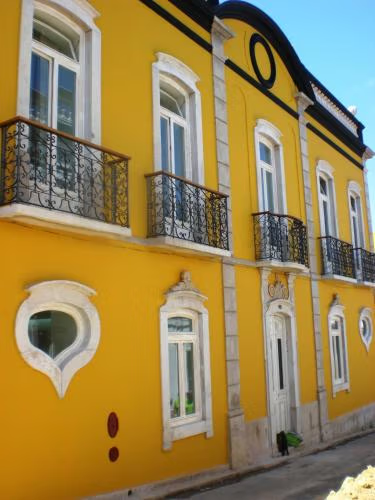
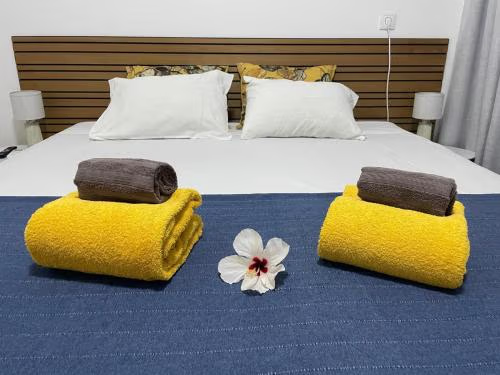
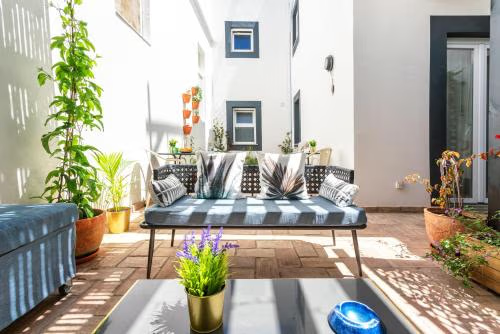
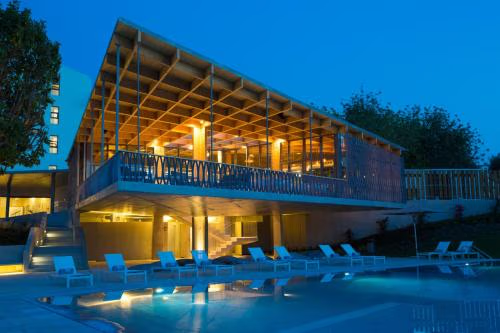
There is no pilgrim hostel in the strict sense in Tavira. The cheapest choice with a dormitory feel is the youth hostel HI Tavira – Pousada de Juventude. A pilgrim stayed there in January 2024; the breakfast buffet only began at 8.30am, so they packed him a lunch packet instead. Ask about it on arrival if you want to start early. Tavira also has guesthouses, pensions and holiday flats in every price range, most within walking distance of the old town.
Ninja tips
- Get your first stamp in the church of Santiago. The way begins here, and according to a pilgrim report of 2024 the stamp was available here. The start stamp at the starting point is worth more than one from a café.
- Look at the way out the day before. The arrows lead from the church down over the old bridge and then along the Ria Formosa nature park to the east. If you have seen it in daylight, you will find it more easily in the morning.
- Make the detour to Cacela Velha. The way passes the entrance to the village. The village with its 17th-century fortress and church lies above the Ria Formosa lagoon; in 2024 the church was open, and a pilgrim got a stamp there.
- In Altura stay on the arrows. At the big roundabout the way goes straight on towards Castro Marim. To the right over the N125 you get to Vila Real de Santo António, which is a variant in some descriptions but not the Camino Ninja track.
- Tip your head back. In the Senhor dos Passos chapel you see the crosses of both knightly orders in the wooden vault. In Castro Marim you meet one of them again.
Practical tips for pilgrims
- Supplies: Tavira has everything: restaurants, supermarkets, pharmacies, a station on the Algarve line and a bus station.
- Stamp: in the Igreja de Santiago, the starting point.
- Best time: March to May and late September to early November. In July and August it gets too hot in the Alentejo, which you walk through from Mértola.
- Planning: on the Via Nascente there are almost no pilgrim hostels. Call ahead in the small stage towns the day before.
Onward: east along the coast
From the church of Santiago you leave the town over the old bridge and then head east along the coast. After 5.2 kilometres you pass Cabanas de Tavira, after 13.3 kilometres Vila Nova de Cacela, the turn-off to Cacela Velha. Manta Rota follows after 15.0, Altura after 17.2 kilometres; according to a pilgrim guide there is a supermarket, cafés and a pharmacy there. After that the way turns inland, and after 26.0 kilometres you stand beneath the castle of Castro Marim.
What awaits you tomorrow
Castro Marim is the last town of the Algarve before the Guadiana and Spain. Its castle stands above salt pans in which flamingos stand, and in 1319 King Dinis made it the first seat of the Order of Christ, the successor to the Templars. On the first day you therefore go from the knights of Santiago to the knights of Christ.
Deep dive: The master and the seven tombs
A short read, in case you want to learn more about Tavira. About four minutes' reading.
Where you stand
When you stand in front of the church of Santiago in Tavira, you stand at the beginning of a long way. From here it is more than six hundred and sixty kilometres to Trancoso, and from there many more days to Santiago de Compostela. Above the portal of the church James raises a sword. A few steps further stands Santa Maria do Castelo, and in its chancel lie tombs that explain why the apostle looks like this here.
An order with the apostle's name
In the thirteenth century the Algarve was still Moorish. The kings of Portugal had conquered the north and the middle of the country, and for the south they relied on the knightly orders. One of them bore the name of Saint James, the Order of Santiago. Its knights lived by a rule like monks and fought like soldiers. Their master in Portugal was Paio Peres Correia.
Under his leadership first Cacela fell, which you walk through tomorrow, then Tavira. When exactly is still not certain. Some sources give June 1239, the historian Alexandre Herculano May 1240, most the year 1242. What is certain is what came after: King Sancho the Second gave the order the town and its church, and the pope confirmed this in the year 1245. For some three hundred years Santa Maria do Castelo belonged to the knights of Santiago.
Seven knights out hunting
The conquest has a story of its own in Tavira, and it is a legend. Seven knights of the order, so it is told, went hunting near the town, with falcons, and came too close to the Moorish castle. They were killed. In some versions this happened during a truce, at a place with old stone tombs, in another near Antas, in today's district of Luz. One version knows six knights and a Jewish merchant. Paio Peres Correia, the story goes on, then attacked the town in fury and took it.
In the chancel of Santa Maria lie today the memorial tombs of the seven. Opposite, a gravestone commemorates their master. It was first set in the year 1721, and whether anyone lies beneath it is uncertain. Paio Peres Correia has a second tomb, in the monastery of Tentudía in Spain. Three years before this gravestone, in 1718, a grave with a dead man and a Moorish scimitar was found in the church. Both were buried again.
More miracles gather around Paio Peres Correia. At the siege of Seville in the year 1248 he is said to have asked the Virgin to stop the sun so that his knights could finish the battle. In Tavira people also tell of seven ghost knights who are said to have appeared above the church of Santa Maria during a siege around 1328.
An uncomfortable question
Every year Tavira commemorates the seven with a festival. Not everyone thinks this is right. The lawyer and author Paulo Larcher wrote in June 2022 in the Algarve newspaper Postal that according to tradition the master killed the town's inhabitants at the conquest, fighters and non-fighters alike. He asked who the martyrs really are, and thought it wrong to celebrate a massacre.
You don't have to follow him in everything. But the question belongs in this place. The James with the sword above the portal is an image from a time when the apostle was invoked as a helper in war. The James you are walking to is, for most pilgrims today, a different one: one to whom people from many countries are travelling in peace.
The church at the beginning
The church where your way begins is older than its present face. In the year 1270 King Afonso the Third gave its patronage to the Bishop of Silves, so it already stood a generation after the conquest. Like Santa Maria it is oriented north and south, not east, as you would expect of a church. Beside the east door a round line shows, and some suppose it to be the prayer niche of an older mosque. It cannot be proven.
The earthquake of 1755 hit it hard too, and the rebuilding went slowly. In the year 1763 King José ordered the brotherhoods that had their altars in the church to contribute to the costs. One of them, the brotherhood of the Most Holy Sacrament, lasted into the nineteen-forties. What you see today is therefore a church that was raised again also with the money of its brotherhoods, with the fighting apostle above the door and a name of God in Hebrew letters above the altar.
What Tavira gives you to take along
Tavira has both in it, within a few metres. In the church of Santiago Hebrew letters hang above the altar, the name of God, and in the Misericórdia the tiles show the works of mercy, which include taking in strangers and pilgrims. The knights lie in the chancel, the mercy hangs on the wall. You may choose what you take with you. Tomorrow morning you walk over the old bridge from which the river took two arches in December 1989. It carries you all the same. That is not a bad beginning.
Where to stay in Tavira
Places to stay in Tavira.
 OpenReservations accepted
HI Tavira – Pousada de Juventude
 OpenReservations accepted
Porta Nova Guesthouse by R-Tex
 OpenReservations accepted
Casas da Formosa - Downtown Alegria



Town 1 of 25