

Stage town on the Camino
Tui
Pontevedra, Galicia, Spain
- places to stay
- 25
- Caminos
- 2
- Elevation
- 51 m
Tui is the gateway to Galicia: crossing the bridge from Portugal, you enter a bishop's city whose cathedral of 1225 stands like a castle above the Miño. In 2025, 41,645 pilgrims began their last 118 kilometres to Santiago here. From now on you need two stamps a day, and the Way gets busier.
Right now in Tui (as of October 2026)
- 800 years of the cathedral: The cathedral was consecrated in December 1225 and celebrates its anniversary in 2025/26. Since the end of June 2026 it has been newly lit in the evenings.
- Hostels closing: The private hostels Villa San Clemente and A Troita are already closed for the winter, and Pallanes closes at the end of October. The public hostel and some private ones stay open all year.
- Diocesan museum: The museum in the old pilgrim hospital is being refitted and should open in 2026. We have not found out whether it is open yet.
How long to stay?
An afternoon is enough. The old town is compact, and the most important thing is the cathedral with its cloister and tower, for which you need one to two hours. After that there is time for an evening stroll along the Miño. If you are starting here, you need a night anyway to pick up your credencial and stamps. For a whole rest day, the most that is worth it is a trip over to Valença.
Tui in Ninja numbers
- 41,645 pilgrims began their Camino in Tui in 2025. That makes Tui the third-largest starting point of all the Caminos, after Sarria and Porto.
- Around 118 kilometers is the distance from Tui to Santiago, according to Camino Ninja, just over the 100 you need for the Compostela.
- 2 stamps a day are what you need in your credencial from here on.
- 800 years is the age of the cathedral since December 2025.
Arriving: over the bridge and up to the cathedral
You come from Valença over the Ponte Internacional, an iron bridge from 1886, on the footpath at the side. With that you are in Spain, and your watch goes an hour forward. After the bridge you turn right onto the riverside path along the Miño, then climb over cobblestones through the Calle Obispo Maceira into the old town. Via the Calles Piñeira and Sanz you reach the Praza do Concello, and the cathedral stands in front of you.
In brief: bishops on the border
After the reconquest from the Moors, Tui became one of the most important bishoprics of Galicia, supported by the kings of León. The town was one of the seven provincial capitals of the old Kingdom of Galicia. Because it lay right on the border with Portugal, its cathedral was built like a fortress, with battlements and wall walks. In the middle of the eighteenth century a hospital for the poor and for pilgrims was built. Since 1967 the old town has been a protected monument, and remains of the medieval wall can still be seen.
In the old town: what to see
- Catedral de Santa María: The cathedral was begun around 1120 and consecrated in December 1225. It was begun in Romanesque and completed in Gothic, and its west portal is regarded as the first Gothic sculptural ensemble on the Iberian Peninsula. From the outside it looks like a castle. This is also where you get your stamp. Admission is around €5 with an audio guide (as of October 2026).
- The cloister and the tower: The Gothic cloister from the thirteenth century is, according to Gronze, the only surviving medieval cathedral cloister in Galicia. From the tower, the Torre da Homenaxe, you look across the Miño to Portugal, to the land you have just walked through.
- San Telmo: In the cathedral lies buried Pedro González Telmo, a Dominican from Frómista on the Camino Francés, who died in Tui in 1246. Sailors in Spain and Portugal revere him as their patron saint. The small Capela de San Telmo, built over his house, is designed in the Portuguese Baroque style and is a meeting place for pilgrims starting in Tui.
- Convento das Clarisas: The convent of the Poor Clares, which people call "As Encerradas", the enclosed ones, was founded in 1524. The nuns bake the almond fish here, the "peixiños", the town's best-known pastry.
- Santo Domingo: The Gothic church of the old Dominican monastery was finished in 1524 and has a south portal with the Adoration of the Magi. Noble families of the area are buried here.
Food and drink
Try the peixiños of the Poor Clares, small almond biscuits in the shape of a fish. The great specialty of Tui is the meixón, the glass eel, with its own festival during the San Telmo celebrations after Easter. It is, however, very expensive.
Honestly
- For starters, the public hostel is unreliable. It has only 36 beds, takes no reservations, and in high season gives priority to pilgrims coming from Portugal. If you start in Tui, you should book privately.
- An industrial estate awaits tomorrow. Before O Porriño the main route leads through the largest industrial estate in Galicia, with almost three kilometers of straight asphalt road. Take the variant along the river (see Ninja tips).
- From here it gets crowded. With the many starters from Tui the path fills up, especially in summer.
Where pilgrims sleep
- Albergue de peregrinos de Tui: the public hostel of the Xunta in the old town behind the cathedral, in the former nineteenth-century parish house. 36 beds, €10 per night, open all year, no reservations. There are no dishes in the kitchen, and the bed linen is disposable. You cannot get a credencial here; it is available in the cathedral.
There is no parish or donativo hostel in Tui. The private hostels usually cost €15 to €19 in the dormitory, and some are closed in winter (see box).
Ninja tips
- The river variant to O Porriño: Instead of walking through the industrial estate, take the variant along the Río Louro. It is only about half a kilometer longer and leads over a ford, through villages and along a riverside path. Careful: stay on your side of the river and do not cross it, even if arrows tempt you to.
- Two stamps from today: On the last 100 kilometers you need at least two stamps a day. Get the first one in the cathedral and collect more along the way in bars, churches or hostels.
- Credencial for starters: You get it in the cathedral or at the tourist office at Paseo da Corredoira 16, which is open from Tuesday to Sunday. Most private hostels issue it too.
- Set your watch forward: If you come from Portugal, it is an hour later in Tui. Plan your arrival at the hostel accordingly.
- To the river in the evening: In the evening, walk along the riverside path on the Miño toward the bridge. From below you see the cathedral above the town.
Practical tips for pilgrims
- Cathedral in winter: The opening hours are shorter, with a lunch break. Plan your visit for the morning or the late afternoon. You can visit the roofs only in summer, with a guided tour.
- Shopping: In the old town there is a supermarket, bakers, a pharmacy and cash machines.
- Getting there: If you start here, the nearest airport is Vigo, half an hour by car.
Onward: through Galicia to Santiago
From Tui you follow the Camino Portugués Central through Galicia. The next stage leads to O Porriño, just under 16 kilometers according to Camino Ninja. Many go on to Redondela, which is around 32 kilometers. On the way there is only one notable climb, behind Mos up to the Capela Santiaguiño.
What awaits you tomorrow
If you take the variant along the Río Louro, you walk over a ford and along riverside paths through the nature area of As Gándaras, instead of past warehouses. At the end waits O Porriño, the first town on your Galician way.
Deep dive: God's castle on the border river
A long read, in case you want to learn more about Tui. About twenty-five minutes' reading.
Up on the hill
If you have come over the iron bridge from Valença and worked your way up through the steep lanes, at some point you find yourself standing on Praza de San Fernando. In front of you rises a building that at first glance cannot quite decide whether it is a church or a fortress. Battlements run along the tops of the walls, towers stand like sentries, and only the portal with its stone figures tells you that you are in front of a house of God. This is the Cathedral of Santa María de Tui, consecrated more than eight hundred years ago and still a bishop's church today.
This double nature is no accident and no whim of a master builder. It is the history of this town in stone. Tui sits on a hill above the Miño, and down on the other side of the river Portugal begins. For almost nine hundred years this was a border where people sometimes eyed each other warily, sometimes gave each other gifts, and sometimes fired at each other. Tui was a bishop's see, capital of a province of the old Kingdom of Galicia, a marketplace, a fortress and always a place of passage for people on their way to Santiago.
Today Tui is something else for many pilgrims: a beginning. If you start here, you have just under one hundred and twenty kilometres ahead of you, enough for the Compostela. If you come from Portugal, you already have weeks behind you. Both stand on this square and look at the same castle of God. This text tells you where it comes from, who lies in it, and why a saint who was really on his way to Santiago became the heart of this town.
Tude, a Greek hero and a Visigothic king
The town is old, and it invented an even older origin for itself. Roman authors such as Pliny and Ptolemy knew the place by the name Tude. Already in antiquity people said that a Greek hero had founded it: Diomedes, son of Tydeus, a warrior from the Trojan War. Tydeus supposedly became Tude, and Tude became Tui. That is a legend, and the town has liked to cherish it. A hero from Homer's world as your founder looks good in the chronicles.
What came afterwards is easier to prove. Under the Romans, Tude lay on the great road that linked Braga with Lugo and Astorga, and it was a station on it. If you came through Valença, you may have seen the Roman milestone in front of the church of Santo Estêvão that marks forty-two miles on exactly this road between Braga and Tui. So the way you are walking is, in its outline, far older than any legend of Saint James.
After the Romans came the Suebi, a Germanic people who founded a kingdom of their own in the northwest of the Iberian Peninsula. Under King Rechimund, in the middle of the fifth century, Tui was one of their capitals, and coins were minted here. By the sixth century at the latest, Tui had a bishop. A bishop named Anila took part in the Second Council of Braga. After the Suebi came the Visigoths, and around the year 700 their king Witiza held court in Tui. Young princes, it is said, were sent here to the edge of the realm, far from the intrigues at the royal court in Toledo. So thirteen hundred years ago Tui was already a place people withdrew to in order to be far from the centre.
Laid waste, abandoned, moved
Then darkness fell over Tui. At the beginning of the eighth century, Muslim armies devastated the town. The Asturian king Alfonso the First reconquered the area in 739, but it could hardly be held. Tui lay in the no man's land between the powers and was practically empty for decades. Only around 860 did counts, on the king's orders, settle people here again.
The bishop had long since taken himself to safety. He was living in Iria Flavia, today's Padrón, the place where, according to legend, the boat carrying the body of Saint James came ashore. On 30 January 915, King Ordoño the Second ordered him to return to his diocese. It needed its shepherd more urgently than ever, he said.
But the next danger came over the water. Norse raiders, the Vikings, attacked the coasts of Galicia. At the beginning of the eleventh century they destroyed Tui and took the bishop prisoner. A Galician tourism website names a Viking called Olaf as their leader and gives the year 1024. Other accounts stick to the vague "early eleventh century", and that is exactly how cautiously you should take the story. The Olaf meant is apparently Olaf Haraldsson. If that is right, Tui's history holds a special irony. This Olaf later became King of Norway and after his death was venerated as Saint Olav. The people of the north made pilgrimages to his grave in Trondheim, just as others did to Santiago.
After the raid the bishop's see stood empty for decades and was administered from Santiago. Only in 1071 did King García and his sister Urraca restore the diocese and move it to the monastery of San Bartolomeu de Rebordáns. Its church is considered the most important pre-Romanesque building in the town. In 1170, King Ferdinand the Second of León had the inhabitants resettled on the hill where you are now standing. He gave the new town a wall and a town charter. He also wanted to give it a new name, San Buenaventura. It never caught on. Tui stayed Tui.
Border town and provincial capital
At the same time, the world on the other side of the river was changing. In the first half of the twelfth century, the County of Portugal broke away from León and became a kingdom of its own. The Miño, until then a river in the middle of one realm, became a border. And Tui became a border town, with everything that goes with that.
For the diocese, this position was both a curse and a blessing. The historian Andréia Cristina Lopes Frazão da Silva describes how in the twelfth century Tui received donations and privileges from Portuguese as well as Castilian and Leonese nobles. The bishops became lords of the town and its surroundings. They sat as princes of the Church on a hill from which you could see two kingdoms.
How closely the two banks were intertwined is shown by a small story told over in Valença. There São Teotónio is the town's patron, regarded as Portugal's first saint. He was born around 1082 in Ganfei, a village near Valença, and his first teacher was his uncle Crescónio, abbot of a Benedictine monastery near Tui. So Portugal's first saint learned to read on the Galician side. Borders were more permeable back then than the cathedral's battlements would suggest.
When you walk through Galicia today, you are walking through an autonomous region of Spain. For a long time Galicia was formally a kingdom of its own, united with Castile under one crown but with its own institutions. It was divided into seven provinces: Santiago, A Coruña, Betanzos, Mondoñedo, Lugo, Ourense and Tui. Tui was the capital of the southernmost, from the twelfth century until the reorganisation of Spain in 1833.
This position carried weight. Tui was a trading centre with a river port and guilds. From the twelfth century a Jewish community lived in the upper town, with a synagogue, merchants, goldsmiths, scribes, doctors and apothecaries. In the cathedral cloister, a seven-branched menorah is carved into the stone. The Galician tourist board reads it as a sign that the Jewish community contributed to the building. That is a remarkable detail in a Christian cathedral of the Middle Ages, and we will come back to the Jews of Tui.
In 1623, Tui received the title "very noble and very loyal". In 1664 the assembly of the Kingdom of Galicia, the Juntas, where the representatives of the seven provinces met, gathered here. For a town of this size, that was a high point.
A cathedral modelled on Santiago
Exactly when construction of the cathedral began is disputed, and it is worth saying so honestly. The town of Tui gives the year 1120. Wikipedia places the start at the end of the eleventh century, because a church is already mentioned in a deed of donation in 1095. It was issued by Raymond of Burgundy and Urraca, then Counts of Galicia. Probably both are right: there was an earlier building, and around 1120 the great project you see today began.
The builders took as their model the cathedral of Santiago, which was just being built at the time. As there, there is an ambulatory around the choir and a three-aisled transept. Tui was to become a little sister of the apostle's church. The driving force was Bishop Pelayo Menéndez. Under him, in 1138, the cathedral chapter was organised according to the Rule of Saint Augustine, and when he died in 1156 the Romanesque parts as far as the transept were finished.
Inside, look at the capitals, the heads of the columns. The Romanesque sculptors carved plants there, fabulous creatures and scenes from the Bible, among them the Nativity and the Adoration of the Magi. The north portal is among the oldest parts, Romanesque except for the upper section, which was later finished in Gothic style. The tympanum above it rests on two corbels on which a bear and a wolf sit.
In the last quarter of the twelfth century, the way of building changed. The nave and the vaults were already built in Gothic style, with pointed arches instead of round ones. What had begun as a Romanesque church was completed as a Gothic one. That makes Tui a place where you can practically touch the transition between two eras with your hand.
Prophets, kings and a star
And then there is the west portal. When you stand on the square, you are looking straight at it. It is considered the first Gothic sculptural ensemble on the Iberian Peninsula. It was made by stonemasons from France who were connected with the workshops of Laon, Sens and Chartres, that is, with great cathedrals of the early Gothic. How these men came to the farthest edge of the continent has not been recorded.
At the sides of the portal stand stone figures. On the left you can make out Moses, Isaiah, Peter and John the Baptist. On the right stand Jeremiah and Daniel, and next to them four figures are interpreted as kings and queens who supported the building: Alfonso the Ninth and Ferdinand the Second of León, Berenguela of Barcelona and Urraca of Portugal. So the patrons had themselves placed next to the prophets, a Portuguese woman among them. That too is border history.
In the tympanum above the door, the portal tells of the birth of Jesus. Below you see the Annunciation to Mary, the Nativity, with Mary lying on a bed, and the message to the shepherds. Above, the Three Kings meet Herod and then worship the child. It is the story of people who follow a star and set out on a long journey. For a portal that pilgrims have been walking through for centuries, it is a fitting image.
Around 1250 an open porch was built in front of the portal, extending the sacred space towards the square. By then the church had already been consecrated. In December 1225, under King Alfonso the Ninth of León, Bishop Esteban Egea consecrated the cathedral, once the west portal was finished. In December 2025, Tui celebrated the eight hundredth anniversary of that consecration.
Battlements instead of angels
What sets Tui Cathedral apart from almost all others you notice when you walk once around it. It is fortified. Crenellated towers, wall walks and passageways make you think of a castle. There are reasons for this, and they lie in the late Middle Ages.
In the fifteenth century Galicia was a restless land. Noble families fought over power and land, and in 1467 peasants and townspeople rose up against the castle lords in the great Irmandiño revolt. Then came the wars around 1480. A cathedral on a border hill could not just be a place of prayer. It had to be able to defend itself.
So they built. In 1408 the Soutomaior tower went up at the southwest corner of the cloister, named after a noble family of the area. In 1424 came the tower of San Andrés on the north side, which also became the burial chapel of Bishop Juan Fernández de Soutomaior. Between 1482 and 1485 Bishop Diego de Muros had a tower palace built on the south side. At the end of the fifteenth century, between 1495 and 1499, they even rebuilt the Romanesque east end. Where there had been semicircular apses, a flat, three-part east wall was built. That too was connected with the wars of the time.
Originally the cathedral had Romanesque towers at the ends of the transept and two towers at the west. The transept towers were taken down in the eighteenth century; only the bell tower remained. In 1530 Bishop Diego de Avellaneda had the crossing tower renewed. Today you can climb the Torre da Homenaxe and look out over the Miño, the town and the border. In summer there are even guided tours across the roofs. From up there you understand why battlements were needed here. You can see Portugal, and Portugal could see you.
Inside: a cloister, a shrine, a treasury
Behind the walls it grows quiet. The cloister was built in the second half of the thirteenth century in the Cistercian Gothic style. It is the only medieval cloister that has survived at a Galician cathedral. Somewhere on these walls you will also find the menorah.
Off the cloister lies the chapter house, where the canons met, with eight arches on paired columns. Spanish Wikipedia calls it the largest chapter house of any Spanish cathedral. Today the cloister and chapter house display finds from excavations, a medieval sarcophagus, Visigothic epitaphs and old grilles.
Inside the church you will notice the choir in the main chapel, completed in 1699 by Castro Canseco. Then there are Baroque organs, the large altarpiece of the Expectation of Our Lady, in Spanish the Retablo de la Expectación, and in the Chapel of Relics a large relic altar. The most important shrine, though, is the chapel of San Telmo, which Bishop Diego de Torquemada had built in 1579 and which was extended to the east in 1732. The relics of the town's patron are kept there. With it he received, for the first time, a space of his own in his cathedral.
The diocesan museum is in the former chapel of Santa Catarina. There you can see the cathedral treasury: chalices, processional staffs, vestments, a seat made by the silversmith Juan de Nápoles Mudarra in 1602, a painted wooden image of the Virgin and Child from the late fourteenth or early fifteenth century, and a goblet made from a coconut from the fifteenth century.
The canvases of shame
The truth about this cathedral also includes a dark chapter. The Jewish community whose menorah is in the cloister came to an end in 1492. Under the Catholic Monarchs, Jews had to leave Spain or be baptised. The synagogue of Tui was put to other uses. Many stayed as converts, and in the sixteenth century numerous families of Jewish origin lived in Tui.
The Inquisition distrusted them. Anyone convicted of secretly continuing to live as a Jew had to wear a penitential garment, the sambenito. Canvases bearing the person's name and sentence then hung on the walls of the cathedral, according to the Galician tourist board until those concerned had paid a levy. In Tui five such canvases from the seventeenth century survive, each with a Saint Andrew's cross, a name, a year and an accusation. One member of parliament called them unique in Europe. In 2022 the Galician parliament voted unanimously to examine protecting them as cultural heritage. Tui even had a prison for canons of Jewish descent, built in 1611.
Today Tui deals openly with this legacy. The town belongs to the network of Spanish Jewish quarters, and in September 2026 it devoted an exhibition to the cathedral's sambenitos. When you walk through the lanes of the upper town, you are also following in the footsteps of these people.
A pilgrim who died in Tui
And now to the man who became more important to Tui than any bishop. Pedro González was born around 1190 in Frómista, a place you know if you have ever walked the Camino Francés. His uncle Tello Téllez de Meneses was Bishop of Palencia. The nephew became a canon and, thanks to papal permission, dean at a very young age, even though he had not reached the minimum age. A textbook career.
Then came a break. Tradition tells of a public humiliation during his ceremonial entry into Palencia that shook him so deeply that he left everything behind. He joined the Dominican order, at the friary of San Pablo in Palencia, and became a preacher. He was chaplain and confessor to King Ferdinand the Third and accompanied him at the conquest of Córdoba. Later he was prior of the friary in Guimarães in Portugal. Above all, though, he preached in Galicia, and many of the miracles later attributed to him concerned sailors and fishermen.
In old age he withdrew to Tui. Here he was a friend of Bishop Lucas, a learned man you will hear more about shortly. And here his journey ended in a way that must move any pilgrim: according to Spanish Wikipedia, he fell ill on a pilgrimage to the apostle's tomb in Santiago and died in Tui at Eastertide in the year 1246. The sources disagree about the exact date, 14 or 15 April. He never reached Santiago. He was buried in the cathedral.
So if you start in Tui, you are beginning at the place where another pilgrim had to stop. And if you know Frómista because you have already walked the Camino Francés, you have now arrived at a man from one of your old stages. Since 1985 Tui and Frómista have been twin towns, under the protection of San Telmo.
How Pedro became San Telmo
Hardly had Pedro González been buried when people in Galicia began telling of miracles that had happened after they called on him. In 1258, only twelve years after his death, Bishop Gil Pérez de Cerveira sent the General Chapter of the Dominicans in Toulouse in France a report on one hundred and eighty miracles. From it, the Dominican Gérard de Frachet drew a short biography in 1260 for his collection of lives of the friars.
Here a question begins that you have to leave honestly open. Why did the Bishop of Tui put so much effort into this? In 2017 the historian Andréia Cristina Lopes Frazão da Silva proposed an answer, explicitly as a hypothesis. Tui was a border diocese, often destroyed, long administered by mighty Santiago, and until the thirteenth century it had no saint of its own connected with its history. Santiago had the apostle. Tui had no one. A devout Dominican who had died in the town and was buried in the cathedral would have been the ideal candidate. Whether promoting his cult was calculated church politics, genuine devotion or both cannot be decided. Perhaps it was both.
His name is a small riddle too. He was never canonised. In 1741 Pope Benedict the Fourteenth only confirmed his cult as a Blessed. Sailors in Spain and Portugal nevertheless made him their patron, without any mandate from the Church. And they called him Telmo. The name very probably comes from a confusion with a much older saint of seafarers, Saint Erasmus, in Italian Sant'Elmo. Saint Elmo's fire, the bluish glow on ships' masts during thunderstorms, is named after him. That is why San Telmo is often shown holding a blue candle or a small ship. And so, by way of a mix-up of names, a preacher from Castile became the saint of sailors from Seville to the Canary Islands.
In 2016 the confraternities of Tui, Porto and Frómista jointly asked Pope Francis to canonise him at last, and the Diocese of Tui-Vigo has opened proceedings. When this text was written, in autumn 2026, he was still a Blessed.
Besides his tomb in the cathedral, San Telmo has a second place in Tui, the Capela de San Telmo, built over the house where he lived and is said to have died. It was built between 1769 and 1803 in the Portuguese Baroque style. The newspaper El Español calls it the only example of this style in all of Galicia. A saint from Castile, venerated by sailors in Spain and Portugal, in a chapel in Portuguese style on Galician soil: you could hardly fit more border history into one building.
Today the chapel is a meeting point for pilgrims setting out from Tui. And every year at Easter the town celebrates its patron, from Holy Saturday to Easter Monday. On Easter Sunday this includes the Festa do Meixón, the feast of the glass eel, the town's great speciality. A fish festival suits a saint of fishermen.
A bishop who made it to Jerusalem
The friend San Telmo had in Tui deserves a story of his own. Lucas came from León and from 1221 to 1239 was a canon at the collegiate church of San Isidoro, one of the great churches on the Camino Francés. He was a traveller on a scale that impresses even today's pilgrims. He had been to Rome and Constantinople, to Cyprus, Jerusalem, Armenia and France. He visited all four places where nails from the Cross of Christ were venerated at the time, in France, Constantinople, Nazareth and Tarsus.
Lucas also wrote. He compiled a collection of the miracles of Saint Isidore, a polemic against the Cathars and, in 1236, at the request of Queen Berenguela, a world chronicle from the Creation to his own day, the Chronicon mundi. It is his principal work. From 1239 until his death in 1249 he was Bishop of Tui, and he went down in history as Lucas of Tui. In those years an old preacher who wanted to go to Santiago one more time was living in his border town. A bishop who had seen half the known world, and a Dominican who never reached his goal. You would love to know what the two of them talked about.
A house for the poor and for pilgrims
Where pilgrims pass through, a bed and care are needed. According to the historian Ávila y la Cueva, Tui already had a hospital near the cathedral in the twelfth century that cared for the sick poor and took in pilgrims going to Santiago or coming back from there. On the ground floor was the town's market hall, the Alfóndega, and an inscription bore the year 1181. Nursing and trade under one roof: that was medieval pragmatism.
The oldest document in the hospital's archive dates from 24 March 1441. In it the town's judges, Pedro Estévez, Juan da Bouza and Lorenzo Calvo, together with other citizens, grant the hospital for the poor and pilgrims the levies raised on the market scales. So trade paid for the hostel. In 1569 Bishop Diego de Torquemada, the same man who built the San Telmo chapel, gave the house a set of rules in fifteen articles. They also applied to a second hospital, San Xián dos Lázaros, where lepers were cared for outside the town.
In 1756 Bishop Juan Manuel Rodríguez Castañón had a new building put up on the same site, under the protection of the Virgen del Pilar. The building is arranged around a Baroque courtyard where the wards were. On the ground floor there were offices for notaries and a church prison. Until the twentieth century the house served the poor, the sick and foundlings. In 1902 it became too small; the foundation stone was laid for a new hospital, inaugurated in 1923, and the old house was sold to an order of missionary sisters. In 1954 the history of the hospital came to an end altogether.
Today the old pilgrim hospital houses the museum and historical archive of the diocese. When this text was written, in autumn 2026, the diocesan museum was being refitted with money from Galicia and the European Union. Whether it is already open when you pass by, we have not been able to find out.
The enclosed nuns and their almond fish
On your way through the old town you hear the bells of a convent every hour on the hour. It belongs to the Poor Clares, whom people in Tui call "As Encerradas", the enclosed ones. The convent was founded in 1524 on the site of a Romanesque church of Our Lady. The travel guide of the Barceló hotel group relates that it grew out of a pious community of women in which ten women shut themselves away.
The church you see was built from 1688 to plans by Domingo de Andrade, a master builder of the Galician Baroque who also worked on the cathedral of Santiago. Its Baroque altarpiece from the seventeenth century is considered outstanding. A vaulted passage runs beneath the convent, linking the upper town with the area between the walls. It was designed by the engineer Pelayo Mancebo, the same man who built the iron bridge over the Miño.
And the nuns bake. Their little almond biscuits in the shape of fish, the peixiños, are the town's best-known pastry. A fish made of almonds, from a convent, in a town whose patron protects fishermen. In Tui a lot of things are connected.
Cannons on the river and a bridge of iron
The cathedral's battlements were not the end of the fortifications. In 1640 Portugal broke away from Spain again after sixty years under a shared crown, and almost three decades of war followed. In the same year Tui extended its medieval wall. On the other side, Portugal built Valença up in the seventeenth and eighteenth centuries into a bastion fortress with twelve bastions. If you came through Valença, you saw it. Two towns, with only the river between them, both armed in stone against each other.
In 1809 war stood on the river again. Napoleon's Marshal Soult wanted to invade Portugal from Galicia with his army. In February his troops tried to cross the Miño at Tui and failed. They had to swerve east as far as Ourense, where there was a bridge. The river you are walking along held up a military campaign back then.
And then, at last, came the bridge. In 1879 Spain and Portugal agreed to build a joint road and railway bridge. The engineer Pelayo Mancebo y Ágreda designed a structure of iron lattice, almost four hundred metres long, with the railway on top, the road below and footpaths on both sides. It went into service in 1884 and was formally inaugurated on 25 March 1886. People like to say Gustave Eiffel built it. That is a legend for which there is no evidence. You came into Spain on the footpath of this bridge.
The twentieth century brought Tui one more bitter moment. In July 1936, when the generals rose against the Republic, Tui was the last town in Galicia to fall. Republicans put up resistance at a place called Volta da Moura, and only on 26 July did the rebels march in, with reinforcements from Vigo and Ourense. Harsh persecution followed, including of the mayor, Guillermo Vicente Santiago.
From the edge into calm
With the reorganisation of Spain in 1833, Tui lost its province. Pontevedra became capital of the new province. In 1959 the Diocese of Tui became the Diocese of Tui-Vigo, and the church of Santa María in Vigo became a second cathedral. Many people from the area emigrated in the nineteenth and twentieth centuries, first to the Americas, later to other countries in Europe.
Perhaps it was precisely this stepping back that preserved the old town. The cathedral has been a protected monument since 1931, and since 1967 the whole historic centre has been protected, with remains of the medieval wall at the Porta da Pía and defensive works from the seventeenth and eighteenth centuries along the riverbank. There is even a small German connection: since 2013 Tui has been twinned with Versmold in Westphalia.
For the Way of Saint James, Tui already had its hospital and cathedral in the Middle Ages. The Codex Calixtinus, the great pilgrims' book of the twelfth century, describes only the routes through France and the Camino Francés, however, not the Portuguese ones. A medieval route description of that kind does not exist for Tui. One traveller we do know about is Cosimo de' Medici, later Grand Duke of Tuscany, Cosimo the Third. In early 1669 he travelled up from Portugal, set foot on Spanish soil at Tui and went on via Redondela, Pontevedra and Padrón to Santiago, where at the beginning of March he prayed at the apostle's altar. Today you are walking almost exactly his route.
In 1993 the Galician government opened a public pilgrim hostel in a former nineteenth-century rectory behind the cathedral. That was the beginning of Tui's new role.
Eight hundred years and forty thousand beginnings
Today Tui is one of the great starting points of the Camino. In 2025, according to the figures of the Pilgrim's Office in Santiago, 41,645 people began their journey here, a good eight in every hundred of all pilgrims who received a Compostela. Only in Sarria and in Porto did more people start. The reason is simple: from Tui to Santiago it is just under one hundred and twenty kilometres on foot, more than the one hundred you need for the certificate. Add to that a border crossing, a cathedral and a town that feels like a real beginning.
For the cathedral, 2025 was a special year. On 30 November 2025 the town opened the programme for the eight hundredth anniversary of the consecration. The Galician culture minister José López Campos said that the cathedral was not only a religious symbol but "unha das xoias do patrimonio cultural galego", one of the jewels of Galicia's cultural heritage. There were concerts during the anniversary year, in summer 2026 the artist Carlos Fer showed his installation "Relicario" in the cathedral, and since 27 June 2026 the façade has been lit in a new way at night. If you stand by the river after dark and look up, you see God's castle in a light it did not have for eight hundred years.
What Tui gives you
Tui is a town that lives from the edge. It lay on the edge of the Roman Empire, on the edge of the Visigothic kingdom, on the edge of León and on the edge of Castile. It was destroyed, abandoned, moved and rebuilt. It fortified itself against its neighbours and traded with them, borrowed the building style from across the river for its saint, and built a bridge once the cannons fell silent. Borders, Tui shows you, are rarely only walls. They are also places where something new begins.
Perhaps you are standing at the beginning right now. Then you are in good company with tens of thousands who take their first steps here, unsure, with new shoes and an empty pilgrim passport. Perhaps you are coming from Lisbon or Porto and already have weeks in your legs. Then you are now on the last stretch. In the cathedral lies a man who also wanted to reach Santiago and did not make it. That is no reason to worry, more a quiet reminder that the way itself already counts, not only the goal.
Sit down in front of the west portal once more in the evening. Look at the kings following a star, and at the stone prophets who have stood in the same place for eight hundred years. Then go to sleep. Tomorrow morning you set off, heading north, and the river stays behind you.
Where to stay in Tui
The places pilgrims rate highest in Tui come first.
- Top #1
 OpenReservations accepted
Albergue Convento del Camino
- Top #2
 ClosedReservations accepted
Albergue Villa San Clemente
- Top #3
 OpenReservations accepted
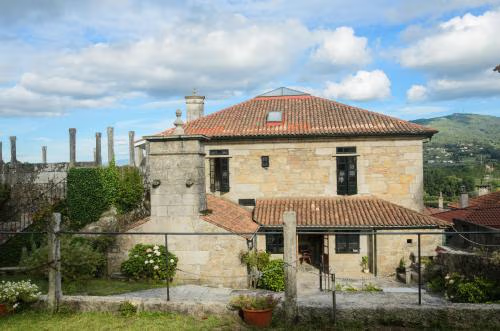
Hotel A Torre do Xudeu



Services in Tui
What you can find in town before the next stage.
- ATM
- Café
- Shop
- Pharmacy
- Fountain
- Post office
- Train station
- Bus station
- Restaurant
Source: © OpenStreetMap contributors · updated January 2026