

Town on the Camino
O Porriño
Pontevedra, Galicia, Spain
- places to stay
- 32
- Caminos
- 2
- Elevation
- 30 m
O Porriño is a town of granite: Antonio Palacios, the architect of Madrid's Palacio de Cibeles, was born here in 1874, and his town hall stands by the Camino like a small castle. According to Camino Ninja it is about 102 kilometres to Santiago. An afternoon is enough, but take the river variant in the morning.
Right now in O Porriño (as of October 2026)
- 50 years of Palacios' grave: On 30 October 2026 it will be 50 years since Antonio Palacios' remains were brought back to his home town, as he had wished. The town is marking it in October 2026 with an exhibition and a documentary film. We couldn't find the venue or times.
- The variant in the rain: After heavy rain the variant along the Río Louro can be muddy or flooded. Then you're better off taking the route through the industrial estate.
- Albergues in winter: The public albergue is open all year. For some private ones the information on the winter season is contradictory, so ask before you go.
How long to stay?
An afternoon is enough. What makes O Porriño special lies close together in the centre: Antonio Palacios' town hall, fountain and pharmacy, and the pavilion of a Madrid metro station. You can easily see it all after you arrive. We found no museums with fixed opening hours that would justify a rest day. Sleep here, eat bread and walk on the next morning.
O Porriño in Ninja numbers
- About 102 kilometres to Santiago from here, according to Camino Ninja. If you start in O Porriño, you're just over the 100 kilometres needed for the Compostela and have not a single metre to spare for shortcuts.
- 20,965 people lived in the municipality at the start of 2025. It is an industrial town, and you notice that the moment you walk in.
- Over €260,000 is what Galicia spent, by January 2025, on restoring an entrance to the Madrid metro that stands here on the Camino.
- 2 stamps a day are what you need in your credencial here too, as on all of the last 100 kilometres.
Arriving: through the industrial estate or along the river
From Tui it's about 16 kilometres, according to Camino Ninja. Shortly before O Porriño you have a choice. The main route runs through the As Gándaras industrial estate, the largest in Galicia: almost three kilometres of dead-straight asphalt to a footbridge over the railway, then along the N-550. At kilometre marker 99.408 you leave it to the left and enter town via Rúa Manuel Rodríguez. You pass the chapel of San Sebastián and the chapel of San Benito, see the apses of the church of Santa María and reach the town hall via Rúa Ramón González.
The alternative is the variant along the Río Louro, laid out in 2013 and only about half a kilometre longer. It branches off to the left about 300 metres after kilometre marker 106.048, at a sign, and leads across the A Ponte Baranco ford over the Louro, through the villages of Mosende and Pontellas and finally along a path beside the river. Keep the river on your right and don't cross it, even if arrows tempt you to. The path ends right at the public albergue.
In brief: an innkeeper, a hospital and a lot of stone
The town is said to take its name from an innkeeper, a mesonero called Juan Porro, who ran an inn here in the Middle Ages. That is tradition. What is documented is a pilgrim hospital: a Hospital de Santa María is mentioned in a will in 1569 and can be traced until the middle of the seventeenth century.
O Porriño grew big on its granite. In the nineteenth and early twentieth centuries people began quarrying the area's pink stone on a large scale. Today the most important granite deposit in Spain lies here, and the "Rosa Porriño" variety is shipped via the port of Vigo to Italy, Japan and China. The town's most famous son came from a family with its own quarries: Antonio Palacios.
The architect's town
Antonio Palacios, born in O Porriño on 8 January 1874, helped shape Madrid: the Palacio de Cibeles, the Círculo de Bellas Artes and the first stations of the metro. He left his home town buildings that you'll see as you walk through, most of them in granite. He even gave it the plans for the town hall. In 1924 O Porriño made him an honorary citizen. He died near Madrid in 1945 and in 1976, as he had wished, was buried in his home town's cemetery. His gravestone reads simply "Antonio Palacios - Arquitecto".
You'll meet him again in Santiago: on the Paseo da Ferradura stands a pavilion he built in 1908 and 1909 for the regional exhibition.
In Palacios' granite: what to see
The Palacios buildings and the old chapels lie in the centre or right on the route. We couldn't find opening hours for the interiors. You see most of it from outside anyway.
- Casa do Concello: The town hall is O Porriño's landmark. Palacios designed it in 1918 and 1919 and asked no fee, giving the plans to his birthplace. Construction began in 1921 and it was finished in 1924. It looks like a medieval castle, with a corner tower, battlements and a wall walk, all in granite, on a small, elongated plot. In front of it stands a monument to Palacios. For pilgrims the square is a landmark: the main route passes the town hall, and the stage to Redondela starts at the roundabout in front of it the next morning. In January 2025 the building even featured on a Spanish national lottery ticket.
- Templete de San Luis: A pavilion of granite, iron and glass that Palacios designed in 1919 as the entrance to the Gran Vía metro station in Madrid. Inside, a lift went down to the platforms, for a few céntimos. In the early 1970s it was dismantled in Madrid and brought to the architect's home town. It stands on the Campo da Feira on Avenida Domingo Bueno. The Galician government restored it for over €260,000, explicitly taking into account that it stands on the Camino. A glass element recalls the old metro sign. Since 2021 a replica has stood in Madrid; the original is here.
- Fonte do Cristo and Botica Nova: Palacios designed the fountain on Praza do Cristo in 1904, and it was finished a year later. On a fluted column with ceramics by Daniel Zuloaga stands a page holding the town's coat of arms, carved by the sculptor Cerviño. Also dedicated to the Cristo is the Capela do Cristo of 1898 or 1899, funded by Servando Ramilo Nieves. Also by Palacios is the Botica Nova, which he built between 1909 and 1912 as a pharmacy with a flat for his brother José. Look out for the large arch over the entrance. Today it is a cultural space.
- The chapels on the route: If you take the main route, you pass the simple chapel of San Sebastián, which neighbours built for their daily Mass, and the chapel of San Benito, where the market used to be held and which is a popular stop for pilgrims. Its feast day is 11 July. Behind it stands the parish church of Santa María, whose date of construction the sources give differently. The pilgrim hospital mentioned in 1569 bore the same name. Mass times vary by season and day of the week.
Food and drink
O Porriño is a bread town. The typical pan do Porriño is a loaf with a hard crust and a soft crumb, and two of the town's bakeries were among the 80 best in Spain in 2018 and 2019. There's even a bread fair of its own, the Feira do Pan. The second speciality is callos, tripe, with its own festival on the first Sunday in October. For self-catering there are several large supermarkets near the public albergue.
Honestly
- The way into town is an industrial estate. If you take the main route, you walk almost three kilometres dead straight through the industrial estate and then along the N-550. In dry weather take the Louro variant.
- The public albergue is functional, not charming. It lies a little outside the centre near the road, can be noisy and gets very hot in summer. The kitchen has a microwave but no crockery and no cutlery.
- O Porriño isn't pretty everywhere. The town lives from industry and granite. The centre with its pedestrian zone and the Palacios buildings is the part worth seeing.
- Tomorrow you'll share the road with cars. The stage to Redondela crosses the N-550 several times and often runs along the hard shoulder.
Where pilgrims sleep
- Albergue de peregrinos de O Porriño: the Xunta's public albergue, since 2003 on Avenida de Buenos Aires right by the Louro, with two dormitories. €10 a night, open all year, no reservations, credencial required. Check-in from 13:00 to 22:00, and in the morning you have to be out before 08:00. There's no washing machine. Pilgrims praise it as clean, with friendly staff.
We found no parish or donativo albergue in O Porriño. The private albergues mostly charge €15 to €25 for a dorm bed (as of September 2026) and are spread across town, so check the location before you book. Several have curtains on the bunks, and some include breakfast.
Ninja tips
- Bring cutlery and a plate: The public albergue has no kitchen equipment at all. If you want to cook, you need your own gear or a ready meal for the microwave.
- Don't miss the albergue: It lies beyond the level crossing on Avenida de Buenos Aires. It's easy to walk past.
- Supplies before the variant: There's hardly anywhere to stop on the Louro variant. Stock up on water and food before the turn-off.
- Shop as soon as you arrive: The supermarkets are close to the albergue. Buy your supplies for the stage to Redondela right away.
- A Palacios walk in the evening: Go from the town hall to the Templete and the Fonte do Cristo. That way you see in one evening what links this town to Madrid.
- Hi-vis vest or light clothing for tomorrow: On the N-550 you're hard to see in fog or at dusk.
- Bread for the road: Pack a piece of pan do Porriño for the climb to Santiaguiño. It tastes better up there than any energy bar.
Practical tips for pilgrims
- Shopping and money: The town has cash machines, a pharmacy, bakeries, a butcher and supermarkets.
- Tourist office: The tourist office is on Avenida de Buenos Aires. We couldn't find its opening hours.
- Getting here and away: O Porriño has a station on the line between Vigo and Porto and bus connections to Vigo and Santiago.
- Stamps: Since Tui you need two stamps a day. Collect them in albergues, bars and churches.
Onward: over the Santiaguiño to Redondela
From the roundabout by the town hall, turn left into Calle Ramiranes as far as the roundabout on the N-550 that separates O Porriño from Mos, then go under the A-52 motorway. Via Ameiro Longo you reach Veigadaña after 3.5 kilometres, according to Camino Ninja, and after 6 kilometres Mos with its public albergue, 37 beds for €10. Beyond Mos the only real climb of the day begins: 147 metres of ascent over just over three kilometres to the Capilla de Santiaguiño, 9.1 kilometres from O Porriño according to Camino Ninja. Fill up your water in Mos. After Saxamonde it goes steeply downhill. It's 15.6 kilometres to Redondela, according to Camino Ninja. You're still on the Camino Portugués Central, on which pilgrims from the Portuguese Coastal Way have also been walking since Valença.
What awaits you tomorrow
Redondela, the town where two ways become one: here the Central meets the coastal variant via Vigo, and from there everyone walks to Santiago together. On the way to the albergue you pass under the Viaduto de Madrid, a railway bridge from 1876. Just past the Capilla de Santiaguiño a Roman milestone stands by the path, a witness to the old road between Braga and Astorga.
Deep dive: The architect who came home
A long read, in case you want to learn more about O Porriño. About twelve minutes' reading.
A town of stone
When you stand at the town hall of O Porriño, you are standing in front of a castle that never was one. A corner tower with battlements, a wall walk, heavy granite walls, and arches and shapes that recall the Romanesque and the Gothic. And yet the building is only just over a hundred years old. It was finished in 1924. It was built by a man who was born in this town, became famous in Madrid and in the end came back to be buried here.
O Porriño is not a town for which pilgrims used to make long detours. It is an industrial town in the valley of the Louro, with a good twenty thousand inhabitants, warehouses, quarries and a station on the line between Vigo and Porto. If you've come from Tui, you have the largest industrial estate in Galicia behind you, or a quiet path by the river. But if you arrive here and keep your eyes open, you soon notice that this town has a story that reaches far beyond it. It is about pink stone, about a boy from a family of quarrymen, and about a metro station that now stands where there is no metro.
An innkeeper called Porro
Where the name comes from, nobody knows for sure. The loveliest explanation is a story of the road. In the Middle Ages, so it is told, an innkeeper called Juan Porro ran an inn here, and his name stuck to the place. The house of Porro became O Porriño. Whether this Juan Porro really existed cannot be proven. But the story suits a place on an old road where travellers needed a roof and a meal.
Other tales reach much further back, to a pre-Roman people of the area and a king nicknamed "the Childlike", from whom the name is supposed to derive. There are no reliable sources for this version. Take it for what it is: a legend, of the kind many Galician places tell about themselves.
The ground becomes firmer in the sixteenth century. In 1569 a will mentions a pilgrim hospital in O Porriño, the Hospital de Santa María. It can be traced until the middle of the seventeenth century. What exactly went on there, how many beds it had and who cared for the pilgrims, we haven't been able to find out. But it shows you that people on their way to Santiago were already stopping here more than four hundred years ago, just as you are today.
Older than any pilgrim
The oldest traces of people in O Porriño lie not in the centre but out in the Gándaras de Budiño, the marshy plain along the Louro that you may have walked through today. In 1961 the palaeontologist Emiliano Aguirre discovered stone tools there. In the early 1980s the archaeologist Julio Vidal Encinas dug further in the old river deposits. The finds belong to the so-called Acheulean culture, whose typical tools are hand axes, and date from the Middle Pleistocene. Experts count As Gándaras among the best-known sites of this kind on the Iberian Peninsula.
Exactly how old the finds are is still being researched. The archaeologist Eduardo Méndez-Quintas of the University of Vigo thinks an age of around 300,000 years is possible. That would make As Gándaras the oldest known place of human presence in Galicia. That is a hypothesis, not a result. But it is a strange thought: long before anyone knew the word pilgrim, people with stone tools were walking through this valley.
Today the Gándaras are a wetland that the European Union protects as a site of community importance, with alders, willows, bulrushes and more than one hundred and thirty-five species of birds. Since 2013 the Camino's variant has led across the A Ponte Baranco ford and along the Louro through this landscape. A local journalist wrote back in 2016, however, that the river had been suffering for over a hundred years from the industry on its banks. The beautiful and the noisy lie close together here.
A castle on the Pianist
Above the town rises Monte Castelo. People also call it "O Pianista", the Pianist, because of the shape of its rocks. In the eleventh century a castle stood on its summit, the Castelo de Miravel, of which remains survive. Another source says the castle was occupied in the fourteenth century and probably destroyed in the fifteenth. We know nothing more about it.
The pink stone
What made O Porriño big lies underground. The municipality has the most important granite deposit in Spain. The stone has a pink tone, and the variety bears the town's name: Rosa Porriño. Granite was probably quarried here for a long time; one source even credits the Romans with starting it, without evidence. The great boom came in the nineteenth and early twentieth centuries, when the quarries were opened up on a large scale. The stone went out into the world, to New York and to Japan, and today it is shipped via the port of Vigo mainly to Italy, Japan and China.
Almost the entire centre is built of this granite. An article in 2026 said that at sunset the town takes on a pink glow. And if you pass through Vigo later, or have already been there: the great gateway to the Atlantic on Praza de América, a monument to the emigrants, weighs 427 tonnes, and its granite comes from a quarry in Porriño.
Since 2011 there has even been a small museum in a pink granite quarry, the Minergal, according to a Galician portal the first mineral museum in Galicia. Admission is free; we couldn't find opening hours.
The boy from the quarrying family
Antonio Palacios Ramilo was born in O Porriño on 8 January 1874, the youngest of seven children. His father Isidro worked as a builder's labourer on public works, his mother came from the town, and the family owned granite quarries in Atios and Budiño. Antonio spent part of his childhood in the north of Portugal, where his father worked on the railway. So the boy grew up with stone and on both sides of the border you crossed in Tui.
In 1885 he went to secondary school in Pontevedra, and in 1892 to Madrid, first to become an engineer, then an architect. He graduated on 20 December 1900. His models were great ones: the architects of the Chicago School, the Viennese Otto Wagner, the Frenchman Viollet-le-Duc and the English art critic John Ruskin.
Our Lady of Communications
In Madrid Palacios built a career that still stands in the cityscape today. Together with his partner Joaquín Otamendi he won the competition for the new palace of the post, telegraph and telephone on the Plaza de Cibeles. Construction began in 1907, and on 14 March 1919 King Alfonso the Thirteenth and Queen Victoria Eugenie opened the building. The people of Madrid found it so big and splendid that they jokingly christened it "Nuestra Señora de las Comunicaciones", Our Lady of Communications, as if it were a cathedral. Today it is Madrid's city hall.
Then came a hospital for day labourers, a bank building known as the House of the Caryatids, which now houses the Instituto Cervantes, and the Círculo de Bellas Artes with its tower. And Palacios designed the first stations of the Madrid metro, which opened in October 1919: the entrances, the pavilions, the tiles. Little of it survives in Madrid.
Buildings for home
For all his fame, Palacios never forgot O Porriño. In 1904 he designed a fountain for the square by the Cristo, finished a year later. It recalls an old wayside cross: a fluted column with ceramics by the artist Daniel Zuloaga, topped by a stone page holding the town's coat of arms, carved by a sculptor named Cerviño. In 1906 a school followed, the Escuela Fernández Areal. It no longer stands; it was demolished in 1969. Between 1909 and 1912 he built a pharmacy with a flat for his brother José, who was a pharmacist, the Botica Nova, with a large arch over the entrance.
In 1924 the town named him an honorary citizen. In the same year the building was finished that was his greatest gift to O Porriño.
A town hall like a castle
The old town hall was dilapidated, and Palacios designed a new one. In 1918 he drew the first plans, in 1919 he handed them to the town, and he asked no fee for them. Construction began in 1921, under the direction of the stonemason Manuel Ruibal Solía. The plot was small and elongated, and Palacios made something monumental of it: a granite building in a language of forms that recalls the Middle Ages, with a corner tower, battlements and a wall walk. The Galician tourism authorities count it among the best-known works of regionalism in Galicia.
This building has its scars too. A pilgrim portal reports that it burned out in 1976 and was restored by 1983. We haven't found a second source for this. Today the municipal administration works here, and in front of the building stands a monument to its architect. In 2024 and 2025 the town celebrated Palacios' hundred and fiftieth birthday and its town hall's hundredth. In January 2025 the building even appeared on a Spanish national lottery ticket.
A metro station without a metro
Perhaps the loveliest story is told by a small pavilion on the Campo da Feira. In Madrid, the Gran Vía, Calle de la Montera, Calle de Hortaleza and Calle de Fuencarral meet at a junction. The square used to be called Red de San Luis, after a church that burned down in 1936. In 1919 Palacios put up a pavilion of polished granite there, with a roof of iron and glass. Inside, a lift went down to the new metro, and anyone who wanted to use it paid a few céntimos.
When the station got escalators, nobody needed the lift any more. In the early 1970s the pavilion was dismantled. The sources disagree on the exact year: 1970, 1971 and 1972 are all given. It went to its architect's home town, and so an entrance to the Madrid metro came to O Porriño. The iron and glass roof didn't come with it.
Later the Galician government had it restored for more than 260,000 euros. A new roof protects it, a glass element recalls the station's old sign, new lighting shows it off, and a different paving in the ground traces how far the old canopy once reached. On 8 January 2025, Palacios' hundred and fifty-first birthday, the Galician culture minister visited the restored building. The planning, it was said, had taken into account that the pavilion stands at the entrance of the Portuguese Way of Saint James. So it was restored for you, too.
In Madrid a replica now stands on the old spot. The Gran Vía station was rebuilt and reopened in July 2021, and in the process the remains of the old lift shaft were even found. But the original stands here, on a pilgrim route, far from the Gran Vía.
Homecoming
Antonio Palacios died on 27 October 1945 in El Plantío near Madrid, in a house he had designed himself. He was first buried in San Lorenzo de El Escorial. But his wish was to lie in O Porriño. On 30 October 1976 he was moved to the cemetery of his home town. His granite gravestone says only two things: his name and his profession.
When this text was written, in the autumn of 2026, O Porriño was preparing for the fiftieth anniversary of this homecoming, with an exhibition and a documentary film. Since 1999 the town has awarded a prize in his name, and besides the monument in front of the town hall there has been a second sculpture of him since 2011, created by Suso Balado.
You can see something in this that pilgrims know well. Palacios went away, far away, and made a career in the capital. In the end he wanted to go back to where he had started. For many, the Camino too is a path on which at some point you realise where you actually belong.
Palacios along the way
Palacios also left traces on the other Portuguese routes. If you walk the coastal variant via Vigo, you pass his works: in Baiona, where a granite Madonna about 15 metres tall stands, in Panxón with the Templo Votivo do Mar, and in Vigo, where he built a theatre and a bank. And in Santiago, on the Paseo da Ferradura in the Alameda, stands a pavilion he built in 1908 and 1909 for the great regional exhibition. If you stroll there at the end of your journey, you'll pass an early work by the man in whose town you are sleeping tonight.
Industrial town or pilgrim stop?
It would be dishonest to tell O Porriño only through its beautiful buildings. For many pilgrims it is above all the town after the industrial estate. A pilgrim portal calls it "un polígono industrial que nadie olvida", an industrial estate nobody forgets, and that is not meant as praise. The municipality lives from granite, the car industry, logistics and machinery, and the As Gándaras business park lies right on the Camino.
You can complain about it, and many do. But you can also ask what a Camino is actually meant to show: only what is beautiful, or also the land as it is today. The Louro variant, which has existed since 2013, is a compromise: if you're looking for peace, you'll find it by the river. If you walk through the industrial estate, you see what this area lives from. Both belong to O Porriño, and which way is the right one is for you to decide.
Bread and tripe
Finally, something you can definitely take with you. O Porriño is known in Galicia as a bread town. The typical bread has a hard crust and a soft crumb. People here say their bread has more than four hundred years of history. We can't prove that, but the town celebrates it with its own bread fair, and two bakeries from the municipality were among the eighty best in Spain in 2018 and 2019.
On the first Sunday in October the town then belongs to callos, tripe, a hearty dish. Its festival draws thousands of visitors. For a pilgrim after a long day on asphalt, that may be just the thing.
What O Porriño gives you
O Porriño is not a town that overwhelms you with beauty. It is a working town of pink stone, on a river that has seen Stone Age people and warehouses. But it shows you that there is often more behind an unremarkable place than first meets the eye. A boy from a family of quarrymen became one of Spain's great architects, built palaces in the capital and in the end came home.
When you walk past the town hall towards Redondela tomorrow morning, look once more at the tower with its battlements. Then walk on. You still have about a hundred kilometres ahead of you, and perhaps along the way you'll notice, like Palacios, where you are really heading.
Where to stay in O Porriño
The places pilgrims rate highest in O Porriño come first.
- Top #1
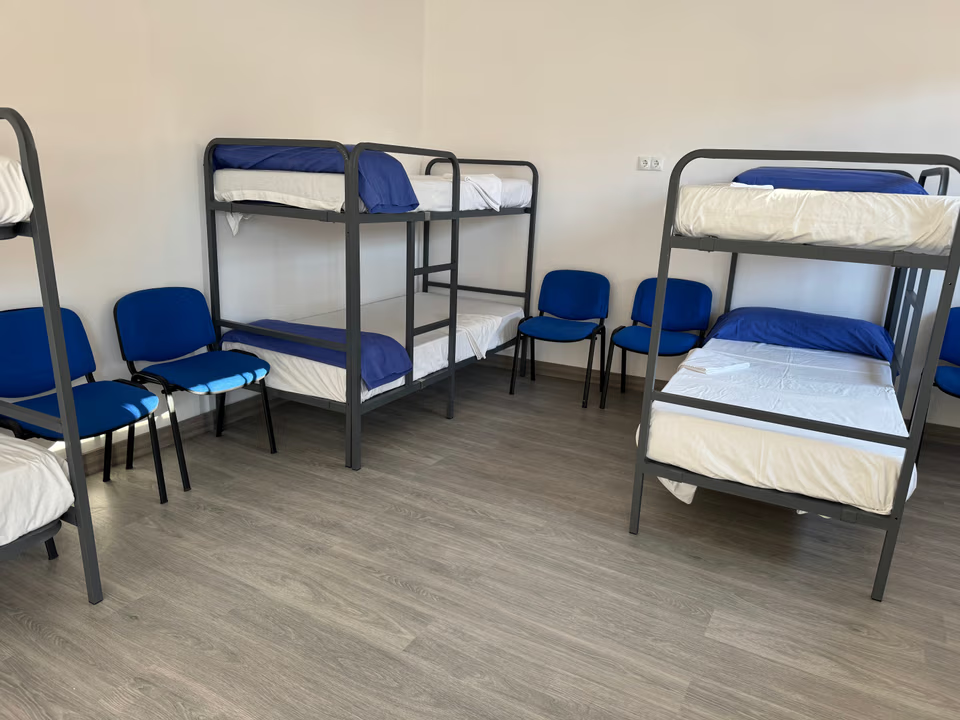 OpenReservations accepted
Albergue el cristo
- Top #2
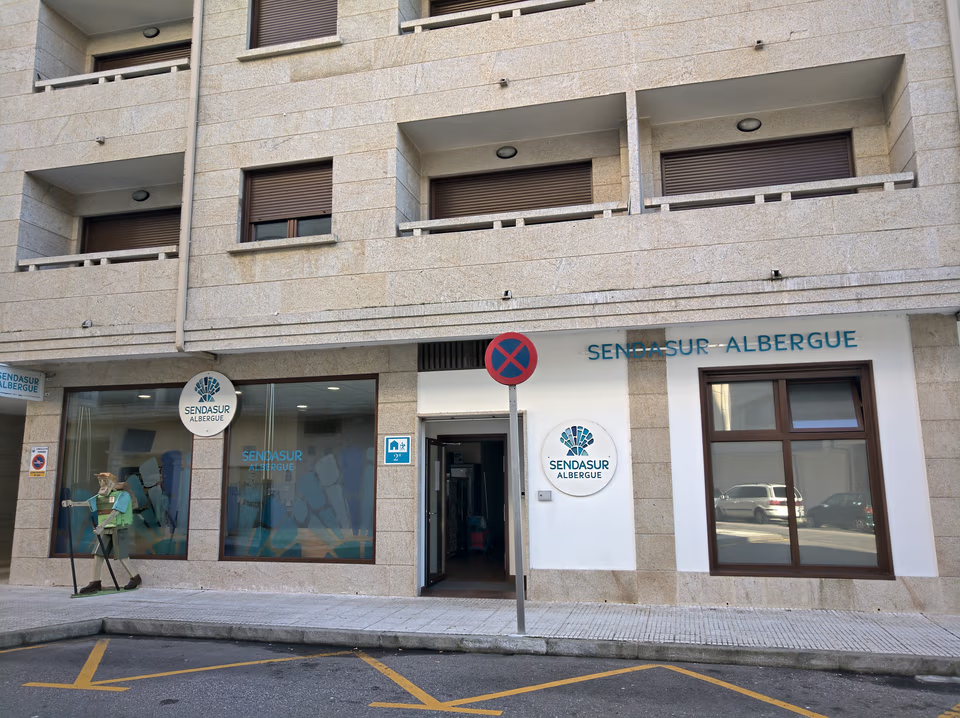 OpenReservations accepted
Albergue Senda Sur
- Top #3
 OpenReservations accepted
Albergue Casucho da Peregrina


Services in O Porriño
What you can find in town before the next stage.
- ATM
- Café
- Shop
- Tobacco
- Medical clinic
- Pharmacy
- Fountain
- Post office
- Train station
- Restaurant
Source: © OpenStreetMap contributors · updated January 2026