

Town on the Camino
Vila Flor
Portugal
- places to stay
- 4
- Camino
- 1
- Elevation
- 544 m
Vila Flor is the town King Dinis named in 1286 for its beautiful setting: a place of olives above the Vilariça valley, 75.7 kilometres beyond the start on the Douro on the Caminho Leon de Rosmithal. One gate of the medieval ring wall survives, along with an idiosyncratic museum. A quiet place for the evening after the climb out of the valley.
How long to stay?
An afternoon is enough. Vila Flor is small; the Arco de D. Dinis, the churches and the town museum are close together. After the long climb out of the Vilariça valley you will be glad of a short walk round and a quiet evening. Tomorrow the descent to the Tua awaits.
Vila Flor in Ninja numbers
- 75.7 kilometres lie behind you since the start on the Douro, 377.4 are still to go to Santiago.
- 432 metres is the climb from the lowest point of the route in the Vilariça valley (112 metres) up to the town (544 metres).
- 24.7 kilometres is the stage from Torre de Moncorvo, with 582 metres of ascent and 435 metres of descent.
- 1286 is the year King Dinis gave the place its name; before that it was called Póvoa d'Além Sabor.
- 3.5 metres wide and 4 metres high is the pointed arch of the Arco de D. Dinis, the last of what were once five town gates.
Arriving: up from the valley
Beyond Torre de Moncorvo the way drops into the fertile Vilariça valley, where it reaches its lowest point at 112 metres. Via Horta da Vilariça and Nabo you then climb again; from Nabo it is another 6.7 kilometres to Vila Flor. At the top the town lies at 544 metres, surrounded by olive groves.
In brief: a flower for a town
The place grew up during the Reconquista and was called Póvoa d'Além Sabor, the settlement beyond the Sabor. On 24 May 1286 King Dinis gave it a town charter and a new name: Vila Flor, the flowering town, because, so tradition says, he liked the landscape so much. Around 1295 he had a ring wall with five gates built. In 1512 King Manuel confirmed the charter. In the Middle Ages many Jewish families who had fled persecution lived here, until Manuel I expelled the Jews from Vila Flor too.
Today Vila Flor likes to call itself Portugal's capital of olive oil. Olives and chestnuts are the main products, and the Vilariça valley you have just climbed out of is one of the most fertile plains in the area.
Through the king's gate: what to see
- Arco de D. Dinis: Of the ring wall with five gates only the south gate survives, a pointed arch 3.5 metres wide between two semicircular towers. The site has been protected since 1955. For pilgrims, the gate is the place to imagine how a travelling party like Rožmitál's entered a walled town in the 15th century.
- Museu Municipal Doutora Berta Cabral: The town museum was founded in 1957 on the initiative of the then town secretary Raul de Sá Correia and is named after Berta Cabral, the first woman to write a Portuguese grammar. All the pieces were donated by residents: parchments, coins, sacred art, paintings, the town's two charters, African collections and a row of typewriters from the oldest to the most modern model. In 2020 the northern cultural authority called it a "caso museológico muito singular"; at the same time the building urgently needs renovation. We did not find opening hours.
- Igreja da Misericórdia: The church on Largo do Rossio dates from the 18th century and was rebuilt after a collapse.
- Barragem do Peneireiro: The 1973 reservoir on the edge of town supplies the town with water; next to it are a campsite and a holiday complex.
Honestly
- The climb is the price. From the Vilariça valley it is more than 400 metres of climbing to the town, in summer under a blazing sun.
- No pilgrim hostel. In Vila Flor you sleep in a guesthouse, on a country estate or in a hotel. Book ahead, there is not much choice.
- The museum is one for the curious. The collection is colourful and not yet fully catalogued, the building needs renovation, and opening hours are unclear.
Where pilgrims sleep
There is no pilgrim hostel in Vila Flor. You will find the places to stay in and around town, guesthouses, an agritourism estate and a hotel, further down this page. At the Peneireiro reservoir there is also a campsite and a holiday resort. Book ahead.
Ninja tips
- Buy olive oil here, but only if you can send it home. It is too heavy for the rucksack, but as a present from the "capital of olive oil" it is unbeatable.
- Look at the typewriters in the museum if it is open. Hardly any museum on the Camino shows anything like it.
- Start early tomorrow. The stage to Abreiro is not long at 21.5 kilometres, but it has 794 metres of descent, and you will feel them in your knees.
Practical tips for pilgrims
- Shopping: Between Vila Flor and Murça there are only villages; stock up here.
- Buses: The town has a bus station, from which a short cycle path leads to the holiday complex at Peneireiro.
- Credencial: We did not find a fixed stamp point; ask at the town hall or the church.
Onward: down to the Tua
The next stage to Abreiro is 21.5 kilometres, with 553 metres of ascent and 794 metres of descent. Via Samões (km 79.0) and Freixiel (km 86.1) the way runs through hills with olives and vineyards and finally down to the Tua. There the Caminho Leon de Rosmithal crosses the river at Abreiro.
What awaits you tomorrow
Abreiro is a village at a bridge over the Tua. In 1466 the Bohemian embassy passed through here, and its chronicler wrote several pages about the place he called "Alebra". The municipality of Mirandela plans to open a pilgrim hostel there in early 2027.
Deep dive: The town named after a flower
A short read, in case you want to learn more about Vila Flor. About three minutes' reading.
A king on the move
King Dinis ruled Portugal for almost half a century and travelled widely through his country. In May 1286 he gave a settlement in the highlands of Trás-os-Montes a town charter. Until then it had been called Póvoa d'Além Sabor, the settlement beyond the river Sabor. Dinis named it Vila Flor. Tradition says he chose the name because the flowering landscape impressed him so much. Whether he really looked across the hills and thought of flowers, nobody knows. But the name has stayed.
Walls and gates
Nine years later Dinis had the town fortified. A ring wall with five gates protected it. Of all this only the south gate still stands today, a pointed arch between two round towers that people call the Arco de D. Dinis. It has been protected since 1955. Whoever walks through it enters the old core of a town that for centuries was borderland, refuge and market town.
Refuge and expulsion
In the late Middle Ages many Jewish families came to Vila Flor. They were fleeing persecution and found a new home here. Under King Manuel the First this came to an end: the Jews had to leave Vila Flor too. It is a story repeated in many towns of Trás-os-Montes, in Torre de Moncorvo just as here.
What Vila Flor gives you
Today you climbed up from the lowest point of the route, out of a hot, fertile valley into a town with a beautiful name. Perhaps that is the way this route tells its story: first the effort, then a place where you would like to stay. Tomorrow the way goes down again, to the Tua. For tonight it is enough to have arrived.
Where to stay in Vila Flor
Places to stay in Vila Flor.
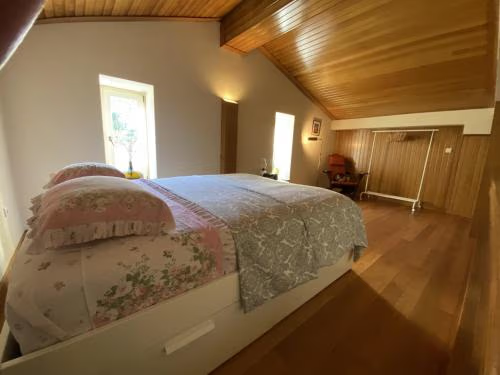 Open
Casa dos Capitães Mores - Vila Flor
KitchenWater BoilerBreakfastAnd more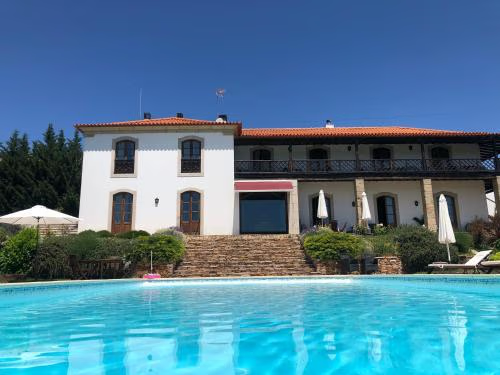 Open
Quinta Da Pereira E Enricas Agro-Turismo
BreakfastWi-FiTVAnd more Open
Alojamento Local Santa Luzia
Town 4 of 16