

Town on the Camino
Torre de Moncorvo
Portugal
- places to stay
- 7
- Camino
- 1
- Elevation
- 396 m
Torre de Moncorvo is the town of iron and almonds on the Caminho Leon de Rosmithal: 51.0 kilometres beyond the Douro, with a Renaissance church that looks far too big for a place of 2,600 people and a museum about the iron ore of the Serra do Reboredo. After the longest stage of the route, a good place to rest.
How long to stay?
An afternoon is enough, and you need it. You arrive after 31.3 kilometres from Freixo de Espada à Cinta, the longest stage of the whole route. Two or three hours are enough for the basilica, the iron museum right next to it and a walk through the old town with the remains of the castle. The rest of the day belongs to your feet.
Torre de Moncorvo in Ninja numbers
- 51.0 kilometres lie behind you since the start on the Douro, 402.1 are still to go to Santiago.
- 31.3 kilometres is the stage from Freixo, with 726 metres of ascent and 789 metres of descent.
- 112 metres above sea level is the lowest point of the whole route, just 8.9 kilometres beyond the town in the Vilariça valley.
- Around 1,500 miners worked in the municipality's iron mines in the 1950s.
- 1 euro is the entry fee to the iron museum according to the museum, and it is free on Sunday mornings.
Arriving: from the plateau into town
After Freixo de Espada à Cinta you walk across the plateau to Mós, where a stretch of medieval paved road and the remains of a castle with an oval ring wall survive; Mós already had a town charter in 1162. Then, over the last 15.7 kilometres, the way drops down to Torre de Moncorvo. From far away you can see the tower of the basilica above the roofs, and you keep it in sight until you stand in the middle of the old town.
In brief: a tower, a raven and a lot of iron
The name Torre de Moncorvo first appears in 1258 in the records of King Afonso III. Tradition tells of a Mem or Mendo Corvo who found a treasure and built a tower with it; historians see him rather as a border knight of the Reconquista. In 1285 King Dinis gave the settlement its town charter and made it the main town of the area, and in the 14th century it was fortified. After the expulsion of the Jews from Spain in 1492 and the edict of Manuel I, Moncorvo remained until the 20th century a place where families secretly held on to the Jewish faith.
What made the area rich was iron. Ore was mined in the Serra do Reboredo, industrially since the 19th century, with around 1,500 miners in the 1950s. In 1983 mining stopped after the mining company went bankrupt, a new start began in 2020, and in April 2025 the concession was withdrawn again. What remains is farming: olives, wine and above all almonds.
Basilica, iron and almonds: what to see
Everything lies close together in the small old town.
- Basílica de Nossa Senhora da Assunção: Construction of the main church began in 1544 and was only finished in the early 17th century, a three-aisled hall church behind a Renaissance façade with a mighty bell tower. Inside are a Baroque high altar from the 18th century, a Flemish triptych of Saint Anne and an 18th-century organ. It has been a National Monument since 1910 and was raised to a basilica in 2022. Some call it the largest church in Trás-os-Montes; for you, after the long day, it is the place to sit down and arrive. In winter it is open on Tuesdays from 14:00 to 17:30 and Wednesday to Sunday from 9:30 to 12:30 and 14:00 to 17:30; in summer on Tuesdays from 14:00 to 18:00 and Wednesday to Sunday from 10:00 to 12:30 and 14:00 to 18:00 (as of November 2026).
- Museu do Ferro e da Região de Moncorvo: Since 1995 the iron museum has been housed in a 17th-century manor house near the basilica. It tells of smiths, geology and mining up to the Ferrominas mine and shows a short film about mining in the early 1950s. It is open Tuesday to Sunday, in winter from 9:30 to 12:30 and 14:00 to 17:30, in summer from 10:00 to 12:30 and 14:00 to 18:00 (as of November 2026).
- Igreja da Misericórdia: The Misericórdia church houses the museum of sacred art.
- Casa da Roda: An 18th-century house where abandoned children were taken in, a reminder of the poverty of the region.
- Museu do Castelo: Of the castle, parts of the walls and the Porta da Traição, the “Traitor's Gate”, survive. Inside the ruins a small museum explains the site and how the walled town developed over the centuries.
- Centro de Estudos Judaicos and photography museum: Also in the old town are the Centre for Jewish Studies, which belongs to the story of the families who secretly held on to the Jewish faith here, and the Núcleo Museológico de Fotografia do Douro Superior with photographs of the region.
Eating and drinking
The product Moncorvo is known for is the amêndoa coberta, a sugar-coated almond. It was recently chosen as one of the "7 Maravilhas Doces de Portugal", and in the old town there are shops where you can try it. For a stage like tomorrow's it makes good provisions.
Honestly
- The stage before is hard. 31.3 kilometres with more than 700 metres of climbing in each direction, and there is no pilgrim hostel on the way or here.
- On Mondays the basilica and the iron museum are closed. And on Tuesdays the basilica only opens in the afternoon. If you arrive on one of those days, plan your visit for the next morning before you set off.
- Tomorrow gets hot. Beyond the town the way drops into the Vilariça valley, to the lowest point of the route; in summer it is an oven.
Where pilgrims sleep
There is no pilgrim hostel in Torre de Moncorvo. You will find the places to stay in town, guesthouses, a residencial and manor houses run as Turismo de Habitação, further down this page. Plan early, because for many pilgrims Moncorvo is the only sensible stage end after the long stage from Freixo.
Ninja tips
- Come in February or March. That is when the almond trees around Moncorvo blossom, and in March the town celebrates the almond blossom.
- Take amêndoas cobertas with you. Light, long-lasting and just right for the climb to Vila Flor.
- Visit the iron museum on a Sunday morning. According to the museum, entry is free then.
- Fill your bottles tomorrow morning. The Vilariça valley is the lowest and, in summer, hottest section of the route.
Practical tips for pilgrims
- Getting there: The nearest station on the Douro line is Pocinho; Moncorvo has a taxi rank and a bus station.
- Shopping: Torre de Moncorvo is a small town with shops; between here and Vila Flor there are only small places.
- Credencial: You can get your stamp at the Loja Interativa de Turismo, the pink building next to Praça Francisco Meireles.
Onward: through the Vilariça valley to Vila Flor
The next stage to Vila Flor is 24.7 kilometres, with 582 metres of ascent and 435 metres of descent. First it goes down into the fertile Vilariça valley, where 8.9 kilometres beyond the town you reach the lowest point of the whole Caminho Leon de Rosmithal at 112 metres. Via Horta da Vilariça (km 63.5) and Nabo (km 69.0) you then climb up to Vila Flor.
What awaits you tomorrow
Vila Flor is the place that King Dinis named in 1286 because he liked the landscape so much. One gate of its town wall survives, the Arco de D. Dinis, and after the long climb out of the valley the small town is a quiet place for the evening.
Deep dive: The raven on the tower
A short read, in case you want to learn more about Torre de Moncorvo. About three minutes' reading.
A name from a legend
Anyone who comes to Torre de Moncorvo asks about the name. People here tell of a man called Mem Corvo, Mendo the Raven, who found a treasure and built a tower with the money. From the tower of Mem Corvo came the name of the town. A second story tells of a Moorish woman called Zaida who was baptised Joana. Both belong to folklore; none of it is documented. Historians see Mem Corvo rather as a simple knight who held a piece of land in the border country of the Reconquista. All that is certain is that the name appears in royal records for the first time in 1258.
A town with two faiths
In 1285 King Dinis made Moncorvo the main town of the area. Two hundred years later refugees came across the Douro: Jews who had been expelled from Spain in 1492. A few years later King Manuel the First forced all Jews in Portugal to be baptised as well. Many families in Moncorvo outwardly accepted the new faith and secretly held on to the old one, for generations, into the twentieth century. The great church that rose from 1544 on the highest point of the town is part of this story too.
Iron under your feet
The mountains around Moncorvo are full of iron. It was mined for a long time, but on a large scale only in the nineteenth and twentieth centuries. In the fifties around fifteen hundred men worked in the mines. Then the company went bankrupt, and since 1983 mining has stood still; a new start failed in 2025. The museum next to the basilica keeps what remains of it.
What Moncorvo gives you
When the embassy of the Bohemian knight Jaroslav Lev of Rožmitál passed through Moncorvo in 1466, the great church did not yet stand. The riders came along the same rough road from Freixo that you walked today and moved on into the valley the next morning. You are in a place where many strangers have stopped before: refugees, miners, pilgrims. Rest. Tomorrow the way goes downhill first.
Where to stay in Torre de Moncorvo
Places to stay in Torre de Moncorvo.
 Open
Caçula
- Open
Ninho do Corvo
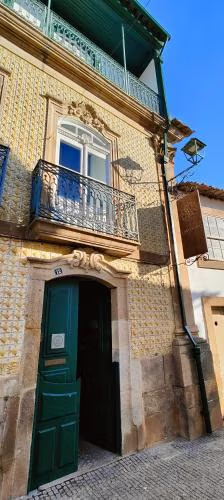 Open
Casa Da Avo - Turismo De Habitacao


Town 3 of 16