

Town on the Camino
Vila Franca de Xira
Distrito de Lisboa, Região de Lisboa, Portugal
- places to stay
- 4
- Caminos
- 2
- Elevation
- 2 m
In Vila Franca de Xira the Ribatejo wears a red waistcoat: this is where the land of the campinos begins, the mounted bull herders, and in early July bulls run through the streets. After 41.3 kilometres from Lisbon, an afternoon is enough for the market, the pillory and the Tagus bank, and then it is 19.8 kilometres to Azambuja.
How long to stay?
An afternoon is enough. Behind you are 41.3 kilometres of city fringe, industry and Tagus boardwalks, and Vila Franca de Xira is the first town on the Way that no longer looks like Lisbon. The important things lie close together: the tiled market, the pillory in front of the town hall, the monument to the campinos and the old quay on the river. A small museum in a church is open Wednesday to Sunday. There is not enough here for a rest day, unless you arrive for one of the bull festivals.
Vila Franca de Xira in Ninja numbers
- 41.3 kilometres is the distance from Lisbon to here according to Camino Ninja. The Camino Ninja stage plan splits it like this: one night in Alverca or Alhandra, then the next day through Vila Franca to Azambuja.
- 578.0 kilometres still lie ahead of you to Santiago, according to Camino Ninja. So you have just managed seven per cent.
- 1,700 metres is the length of the Ponte Marechal Carmona including all its viaducts. Until it was opened on 30 December 1951, the nearest bridge over the Tagus was 80 kilometres upstream in Santarém.
- 28 October 1856 is the day the railway line from Lisbon to Vala do Carregado opened, passing through Vila Franca. At the station hang tile pictures by Jorge Colaço from 1930.
Arriving: out of the capital
From Lisbon the Camino Portugués Central leads through the Parque das Nações and along the Tagus on wooden boardwalks. The suburbs, industrial estates and railway tracks stay with you for a long time, and only in Vila Franca de Xira does the city fringe turn into a town with a face of its own. The town sits on the bank of the Tagus, at the edge of the Lezíria, the fertile floodplain where the campinos tend bulls and horses. The Fátima route Caminho do Tejo also passes through Vila Franca; as far as Santarém you share the route with pilgrims bound for Fátima.
In brief: Templars, quay and uprising
Finds in a cave show that people were living here as early as the Neolithic; Phoenicians, Romans and Arabs left their traces. The founding of the medieval town around 1200 is attributed to French followers of King Afonso Henriques. Later the lords of the town were the Templars and their successor, the Order of Christ. Their representatives lived at what is now the Largo Conde Ferreira, next to the main church. The town charter of 1510 already mentions the quay, and until the 1950s the town lived off the river.
In May 1823 an uprising started from here, the Vilafrancada: Prince Miguel wanted the absolute monarchy back and set himself against the constitution of 1822. It was a prelude to the civil war of 1828 to 1834. Vila Franca de Xira only became a city in 1984.
The red waistcoat: land of the campinos
On the Largo Rodrigo César Pereira stands, since 1982, the monument to the campino, the cattle herder of the Ribatejo who leads the fighting bulls on horseback. His festive costume is precisely laid down: green cap with a red band, white shirt, red waistcoat, red sash, blue trousers, white knee socks, black shoes with spurs and, with it, the long staff, the pampilho. The red waistcoat, the Colete Encarnado, gave the town's great festival its name. It takes place on the first weekend of July, with bulls driven through the streets, a race of the campinos and a night of grilled sardines. In October the bulls run a second time. Even the campinos have their own patron saint: Nossa Senhora de Alcamé, whose chapel stands in the Lezíria. Once a year the faithful carry the image of the Virgin on their shoulders from the main church some ten kilometres out to it, and then fields and cattle are blessed.
Between market and river: what to see
The old town is small, and the old main axis was the Rua Direita, which is now called Rua Dr. Miguel Bombarda. For most of the churches we found no opening times.
- Mercado Municipal: The market hall was built in 1929, and in 1933 the town decided to decorate its gables with tile pictures. The panels from the Sacavém factory show farm work, landscapes and people in traditional dress. For pilgrims this is the quickest introduction to the land you will walk through over the next few days: Lezíria, field work, campinos, all on tiles.
- Pillory and town hall square: On the Praça Afonso de Albuquerque, in front of the town hall of 1893, stands a Manueline pillory, a national monument and a sign of the old self-government. It only came to this square in 1953.
- Igreja da Misericórdia: The Misericórdia brotherhood was founded in 1561 by decree of King Sebastião. In 1563 it took over the town's old hospital, an albergaria from the 14th or 15th century, and built it into its premises. So even in the Middle Ages travellers found a bed here. The church has tiles and paintings from the 18th century.
- Igreja Matriz de São Vicente: The main church in the Rua Gomes Freire was founded in 1667 by the Third Order of Saint Francis. Above the portal you can see the emblem of the Franciscans, the crossed arms of Christ and Francis. From here the pilgrimage sets out to the campinos' chapel in the Lezíria.
- Núcleo Museológico do Mártir Santo: In the 16th-century church of the martyr Saint Sebastian, the town museum has shown sacred art from the parishes of the municipality since 2001, with an audio guide. According to the council it is open Wednesday to Sunday from 9:30 to 12:30 and 14:00 to 17:30, closed on public holidays (as of 2025). The only place in the old town where you can rely on a time.
- Quay and Jardim Municipal: The town garden lies on an old river beach, where fish and melons used to be sold. Further north the Avieiros settled, fishermen from Vieira de Leiria who found a new home on the Tagus. For a break by the river, this is the right place.
Honestly
- Up to here it is not a pretty Way. The first 41.3 kilometres from Lisbon are suburb, industry and country road, and tomorrow too you still pass railway and business parks. Vila Franca is the first town that makes up for it, but only a little.
- There is no pilgrim hostel. If you want to sleep cheaply, you are better off staying in Alhandra or going on to Azambuja.
- Bull festival means bulls in the street. At the Colete Encarnado in early July and again in October, bulls are driven through the lanes, and in 2025 the press reported eight injured. With a rucksack and tired legs, keep to the barriers and ask about the programme before you walk through the old town.
- Without opening times, a lot is a matter of luck. For the main church, the Misericórdia and the market hall we found no reliable times.
Where pilgrims sleep
There is no real pilgrim hostel in Vila Franca de Xira. The nearest is 4.0 kilometres back in Alhandra: A família – Associação de Peregrinos, a small hostel run by a pilgrims' association. The next pilgrim hostel ahead of you is the Albergue de Peregrinos de Azambuja, 19.8 kilometres further on. In town itself you sleep in a private hostel or guesthouse; according to our data a bed in a dormitory starts at €25 to €30 (as of November 2026). Camino Ninja pilgrims praise the breakfast and the cleanliness, though one had to take a taxi back to the Way from his guesthouse. Look at the location on the map before you book.
Ninja tips
- Get your stamp at the Turismo. The tourist office is at Rua Almirante Cândido dos Reis 187 and is open Monday to Friday from 10:00 to 18:30, Saturday from 10:00 to 13:00 and 14:00 to 18:30, in winter until 18:00, closed on Sunday (as of 2025). We have not had it confirmed whether there is a pilgrim stamp there; just ask.
- Take a look at the station, even if you are not travelling. The tile pictures by Jorge Colaço show landscapes of the Ribatejo and scenes from history.
- Look at the facades. Vila Franca has many tiled house fronts from the first decades of the 20th century, in Art Nouveau and Art Deco style. The walk between market and quay is the nicest part.
- The train stays within reach. The line from Lisbon has run through Vila Franca since 1856, and Azambuja too has a station with trains to Lisbon. If your feet protest after the first few days, that is your emergency exit.
Onward: under the bridge to Azambuja
In the morning you cross the railway line and pass under the Ponte Marechal Carmona, then follow farm tracks that avoid the main road, past the stations of Castanheira and Carregado. According to Camino Ninja, Castanheira do Ribatejo lies after 4.8 kilometres, Vala do Carregado after 7.5, Vila Nova da Rainha after 13.0 and Azambuja after 19.8 kilometres. From Vila Franca de Xira to Tomar, Camino Ninja describes the Way together with Turismo do Alentejo e Ribatejo.
What awaits you tomorrow
Azambuja is a short day with an early finish and a real pilgrim hostel for €10 (as of November 2026). The name comes from Arabic and means wild olive tree. You will need the rest there: after it come 32.5 flat kilometres to Santarém.
Deep dive: A river without a bridge
A short read, in case you want to learn more about Vila Franca de Xira. About 2 minutes' reading.
The town on the water
When you stand on the quay at Vila Franca de Xira, you stand at the place that fed the town for centuries. The town charter of 1510 already names this quay. Boats tied up here, fish and melons were sold here, on a river beach where the town garden lies today. Later came fishermen from Vieira de Leiria on the Atlantic coast, the Avieiros, and stayed on the Tagus. The river was road, market and workplace all at once.
Nineteen fifty-one
For a long time there was no bridge. Anyone who wanted to cross the Tagus between Lisbon and the other bank had to go as far as Santarém, eighty kilometres upstream, or take a boat. Last of all, motor boats called gasolinas ran here. In March 1949 work on a bridge began, from September 1950 the arches were assembled, and on 30 December 1951 President Craveiro Lopes opened the Ponte Marechal Carmona. It was the first bridge over the Tagus in the Lisbon region and remained the only one for about fifteen years.
The disputed toll
As early as March 1952, cars and lorries had to pay. Pedestrians, cattle, bicycles and farm machinery could cross free, but the toll remained disputed, and people here found it unfair. It was only abolished on 1 November 1979. The bridge brought the traffic, but it took away the river's role. The road became more important than the water, and those who had lived off the river lost standing.
What Vila Franca gives you to take along
As this text was written, in autumn 2026, the bridge is regarded as the town's landmark. Tomorrow you walk under it and not over it, because your way stays on this side of the river. Perhaps that is the lesson of this place: not every crossing is built for you. Some ways lead along the water and not across it. Follow the Tagus north, it will accompany you as far as Santarém.
Where to stay in Vila Franca de Xira
Places to stay in Vila Franca de Xira.
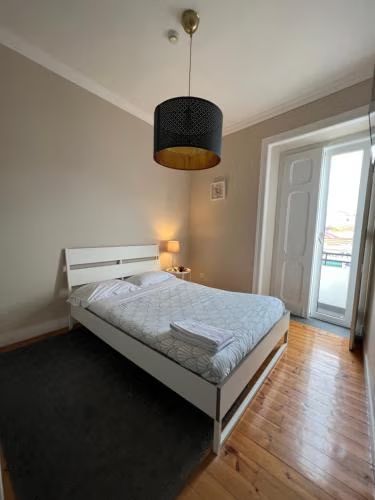 OpenReservations accepted
Hostel Domus Plaza
 Open
Pensão Ribatejana, Lda.
25€- Open
Hospedaria Maioral

Services in Vila Franca de Xira
What you can find in town before the next stage.
- ATM
- Café
- Shop
- Tobacco
- Medical clinic
- Pharmacy
- Fountain
- Post office
- Train station
- Bus station
- Restaurant
Source: © OpenStreetMap contributors · updated January 2026
Town 2 of 43