

Town on the Camino
Zumaia
Gipuzkoa, Basque Country, Spain
- places to stay
- 5
- Caminos
- 2
- Elevation
- 10 m
Zumaia lies where the Urola and Narrondo meet the sea, 5.4 kilometres after Getaria: pilgrims once waited at the chapel of Saint James on the bank for the boat across the river; today it is part of the painter Zuloaga's house. Behind the town the flysch rock layers stand steeply in the sea. An afternoon is enough; a cheap bed is hard to find here.
Right now in Zumaia (as of October 2026)
- Donation hostel: The pilgrim hostel in the Convento San José (39 places, formerly April to mid-October) is listed by a hostel portal as permanently closed (as of August 2026). Pilgrims report that there is no cheap hostel in Zumaia. Call ahead before you arrive or plan to go on to Deba.
How long to stay?
An afternoon is enough. Zumaia is a small town with a Gothic church, a museum and a coast whose rocks rank among the 100 most important geological sites in the world. If you come from San Sebastián or Orio, Zumaia is a possible end of stage; if you come from Zarautz, you are here in the late morning and usually walk on. A good hour is enough for the chapel of San Telmo above Itzurun beach and a look at the rocks.
Zumaia in Ninja numbers
- 10.5 kilometres from Zarautz to here, via Getaria and Askizu, with 373 metres of ascent.
- 793.1 kilometres still lie ahead of you to Santiago on the Camino del Norte.
- More than 100 million years of the earth's history are stored in the rock layers on the coast.
- 1347 was the year Zumaia received its town charter, then under the name Villagrana de Zumaya.
- 12.4 kilometres with a good 500 metres of ascent take you on to Deba.
Arriving: across the river mouth
From Askizu the path drops to the mouth of the Urola. You cross first the Urola and then the Narrondo and walk through Ángeles Sorazu, Nagusia and Arritokieta streets into the old town. On the right bank of the Urola, on a dune outside town, stands the old chapel of Saint James. That is where the way from Getaria used to end, before a boat took the pilgrims across.
In brief: ferry, monastery, town charter
In 1347 King Alfonso XI of Castile granted the town its charter. The settlement had grown around the monastery of Santa María, first mentioned in 1292. In the Middle Ages the Santiago chapel with a small almshouse stood on the right bank of the river, where pilgrims waited for the boat to Zumaia; in the 16th century this ferry traffic was an important source of income for the town. At the beginning of the 20th century the painter Ignacio Zuloaga bought the chapel, the almshouse and a large part of the dune and built himself a summer house there, inaugurated in 1921.
Where pilgrims waited for the boat: what to see
- Ermita de Santiago and Espacio Cultural Zuloaga: The chapel is documented from the 15th century. Here pilgrims coming from Getaria waited for the boat across the Urola. Zuloaga kept the old place of devotion and built his house around it. Today the house shows his works and his collection, with paintings by El Greco, Zurbarán and from Goya's circle. For you, it is the place where the old way waited for the boat. We have not checked opening hours; ask at the tourist office on 943 143 396.
- San Pedro: The Gothic church in the centre has an altarpiece by Juan de Antxieta, his only known work in Gipuzkoa.
- Ermita San Telmo and Itzurun beach: The chapel stands above the beach where the flysch rock layers rise from the sea. Here you can see the boundary at which the dinosaurs disappeared 66 million years ago, the so-called K–T boundary. In 2022 the International Union of Geological Sciences included the site among its 100 most important geological heritage sites.
Honestly
- No cheap bed. The donation hostel in the convent is listed as closed, and the private Santa Klara hostel only takes reservations by phone. Without a plan you quickly pay €75 or more in Zumaia.
- The flysch variant is beautiful but hard. Pilgrims describe it as a steep, sandy up and down. With a heavy pack and tired legs, the official route is the better choice.
- The hardest stretch is still to come. It is 12.4 kilometres to Deba with more than 500 metres of ascent. If you take a long break in Zumaia, that is still ahead of you.
Where pilgrims sleep
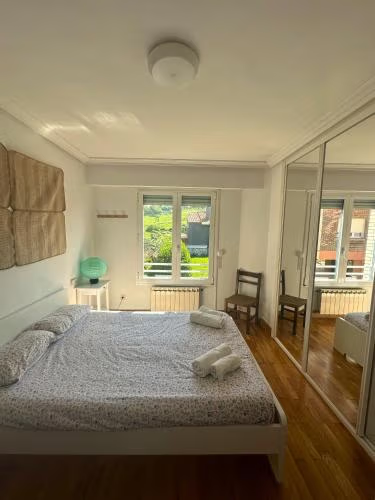
We cannot confirm an open public hostel in Zumaia. The pilgrim hostel in the Convento San José, run by the Saint James association of Gipuzkoa in the former cells of the Carmelite nuns, had 39 places for a donation but only took pilgrims coming from San Sebastián or Orio. A hostel portal now lists it as permanently closed. The private Albergue Santa Klara on Calle Santa Klara has 20 places at €30 with breakfast and, according to the portal, is open all year; reservations by phone only (as of August 2026). There are also rooms such as the Habitaciones Hondar-Gain 10 with sea views, where pilgrims paid about €75 per person and advised booking ahead, and a few hotels.
Ninja tips
- Book before you set out. Pilgrims report that they found no bed in Zumaia without a reservation.
- Refill your water at the second footbridge. Just before it, on the left, there is a public toilet and a fountain.
- Decide at the bridge. After the second footbridge the way splits: straight on, the official Camino goes through town; to the right, the flysch route follows the GR-121 past San Telmo. It rejoins the main route after a good three kilometres.
- Shop in Itziar if you find nothing here. On the way to Deba there are shops there.
Practical tips for pilgrims
- Tourist office: Phone 943 143 396, turismoa@zumaia.eus.
- Connections: Zumaia has a railway station.
- Fiesta: On 29 June Zumaia celebrates San Pedro.
Onward: up to Itziar and down to Deba
After Zumaia the path climbs via Mardari into the hinterland. At Itziar (km 112.0) you reach the highest point at 291 metres, where the church of Santa María stands, built over an older Romanesque building. Then it goes down past the chapel of San Roque to Deba (km 115.5). In total 12.4 kilometres with 531 metres of ascent and 530 metres of descent.
Deep dive: The boat across the Urola
A short read, in case you want to learn more about Zumaia. About three minutes' reading.
Waiting by the river
Anyone walking west from Getaria in the Middle Ages faced a problem at Zumaia. Two rivers flow into the sea here, the Urola and the Narrondo, and there was no bridge. On a sand dune on the right bank of the Urola stood a small chapel dedicated to the Apostle James, and next to it a house where devout women lived and took in pilgrims. Here the pilgrims waited for the boat. In the sixteenth century the crossing was an important source of income for the town.
The painter buys the dune
At the beginning of the twentieth century the painter Ignacio Zuloaga bought the chapel, the house and a large part of the dune. He had a summer house built there in the new Basque style, inaugurated in 1921. He did not tear down the old chapel. He took it into his estate. In its renovated apse hangs a Christ by the sculptor Julio Beobide from Zumaia, opposite a painted altarpiece from the fifteenth century with scenes from the life of Mary. Zuloaga's house became a meeting place for artists, and today it is a museum with his paintings and his collection.
The pages of the earth
Behind the town, on Itzurun beach, the rocks stand in slanting layers in the sea, like the pages of a book. They tell more than a hundred million years of the earth's history. At one point a boundary between the layers can be seen. It marks the time, around sixty-six million years ago, when the dinosaurs disappeared. Above the beach stands the chapel of San Telmo, dedicated to the patron saint of seafarers. The seafarers' brotherhood of San Telmo was founded in Zumaia in the year 1610.
What Zumaia gives you
You no longer have to wait for the boat. A bridge carries you across the river, and the way simply continues. But on the bank the chapel still stands, where others before you sat and could do nothing but wait. And on the beach time lies in layers, so much of it that a pilgrim's life would not even be a line in it. Perhaps Zumaia is the place where you allow yourself to wait.
Where to stay in Zumaia
Places to stay in Zumaia.
 OpenReservations accepted
Habitaciones Hondar-Gain 10
 OpenReservations accepted
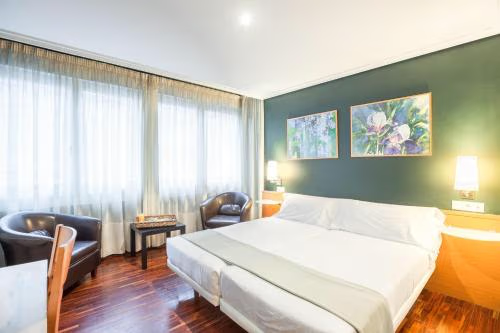
Zumaia Hotela
 OpenReservations accepted
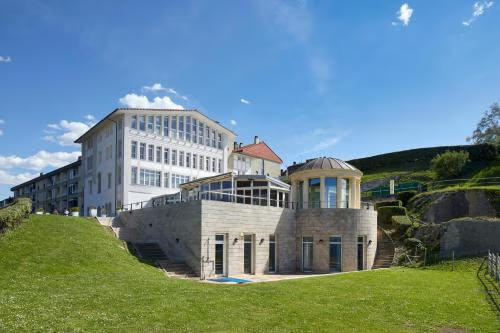
Hotel & Talasoterapia Zelai

Services in Zumaia
What you can find in town before the next stage.
- ATM
- Café
- Shop
- Tobacco
- Pharmacy
- Fountain
- Post office
- Train station
- Bus station
- Restaurant
Source: © OpenStreetMap contributors · updated February 2026
Town 7 of 49