

Town on the Camino
Alpalhão
Portalegre, Portugal
- places to stay
- 7
- Caminos
- 2
- Elevation
- 326 m
Alpalhão is a crossroads: here the route from Valencia de Alcántara ends, and you carry on north along the Via Nascente. A 16th-century granite cross stands in the village, and crosses are carved into old doorposts. A quiet village for an evening, not for a rest day.
How long to stay?
An afternoon is enough. Alpalhão is a village, not a museum town. After 26.6 kilometres from Castelo de Vide, all you want is to arrive anyway. What there is to see lies close together: the granite cross, the churches and the old lanes with their door marks. The granite rocks in the geopark and the chapel of Nossa Senhora da Redonda lie outside the village, and how far from the route, we have not checked. For them you would need more time and energy than this evening leaves you.
Alpalhão in Ninja numbers
- 56.3 kilometres is the length of the route from Valencia de Alcántara according to Camino Ninja. It ends in Alpalhão.
- 26.6 kilometres was today's stretch from Castelo de Vide, with only Alagoa in between, after 12.8 kilometres. If you have arrived here, you have the longest stage of this route behind you.
- Kilometre 428.2 of the Via Nascente: this is where you join it. It is still 233.0 kilometres to Trancoso.
- 1,238 inhabitants were counted in the freguesia of Alpalhão in the 2011 census.
- 1977 is the year the granite cross from the mid-16th century was declared a building of public interest.
Arriving: from the hill to the crossroads
From Castelo de Vide you walk down to the south-west. According to Camino Ninja, Castelo de Vide lies at 560 metres, Alagoa at 385, Alpalhão at 325. After the climb to Marvão, this is the day when it goes downhill, but it is a long one.
With Alpalhão, the route Valencia de Alcántara - Alpalhão comes to an end. Here it meets the Via Nascente, which comes up from Tavira on the Algarve and runs north to Trancoso. For cars, too, Alpalhão is a junction: according to the municipality of Nisa, the roads to Castelo de Vide, Crato and Portalegre meet in the village, along with the access to the IP2 expressway. Alpalhão is a freguesia, a district of the municipality of Nisa, and one of the three largest places in that municipality.
In brief: a village that moved
The castle is said to have been built under Sancho I between 1185 and 1200, and the area probably belonged to the Templars. Little is certain about it. Under King Dinis the village moved to its present site in 1309; in 1319 it passed to the Order of Christ, the successor of the Templars, and stayed with it. In 1512 King Manuel I gave Alpalhão a new town charter. Until the 19th century the village was a concelho of its own, with a town hall and a clock tower, then it was merged into Nisa. The castle has vanished; we have not found surviving walls documented. The Rua do Castelo still carries its name.
Crosses in stone: what to see
Alpalhão is quickly explored. We did not find opening times for the churches.
- Cruzeiro de Alpalhão: The stone cross from the mid-16th century is one of only two protected monuments in the freguesia, protected since 1977 as an Imóvel de Interesse Público. A hexagonal granite column stands on three steps, with a cross on top, showing the crucified Christ on one side and a Pietà on the other. In 1953 the granite base was torn down and shortly afterwards rebuilt. For a pilgrim, it is the place where you can mark the end of one road and the start of the next.
- Crosses on the doorposts: In the Rua do Castelo and the Rua Direita, crosses and slits are carved into old doorposts. The municipality of Nisa's heritage report interprets them as traces of Jewish families after their expulsion. If you walked through the Judiaria of Castelo de Vide yesterday, here you read the echo of it in miniature. Look at the door frames, not just the facades.
- Igreja Matriz Nossa Senhora da Graça and Igreja do Calvário: The parish church belongs to the Diocese of Portalegre-Castelo Branco. The Igreja do Calvário forms, with the Largo da Devesa, a central square of the village. The municipality considers both worth protecting; we did not find construction dates or Mass times.
- Capela de Nossa Senhora da Redonda: A hermitage with a chapel, the hermit's house and a forecourt with a cross, protected since 1997. Near the chapel are a dolmen and a striking boulder. How far it is from the route, we have not checked.
- Blocos pedunculados of Arez and Alpalhão: Granite blocks standing on a narrow base, like mushrooms of stone. They came about when the weathered granite around them was gradually worn away. The Naturtejo Geopark lists them as a geomonument with five sites between Arez and Alpalhão.
Honestly
- Not much goes on here. Alpalhão lives from raw-material extraction and food businesses and is not a day-trip destination. The beauty lies in the detail, on doorposts and on a cross base.
- Supplies are basic. A pilgrim guide lists only the bare necessities. If you are heading to Nisa tomorrow, you have 15.4 kilometres ahead of you; buy supplies beforehand.
- You will not find the castle. If you look for a ruin after the name Rua do Castelo, you will find a lane.
- The finest stones lie outside. Granite rocks and the Redonda chapel are not to be had without a detour. After 26.6 kilometres it is only worth it if you really still have legs.
Ninja tips
- Walk the Rua Direita and the Rua do Castelo slowly. Only those who look will see the carved crosses on the doorposts.
- End the day at the Cruzeiro. Here you meet the Via Nascente, and from tomorrow your route is a different one.
- Replan the next days. From here, the stages of the Via Nascente apply. Nisa is 15.4 kilometres away, Vila Velha de Ródão 35.2.
Onward: north on the Via Nascente
From Alpalhão you follow the Via Nascente towards Trancoso. After 15.4 kilometres you reach Nisa, after 24.1 kilometres São Simão, after 35.2 kilometres Vila Velha de Ródão on the Tagus. Camino Ninja describes the route from Valencia de Alcántara, which ends here, together with Turismo do Alentejo e Ribatejo, the region's tourism authority.
Deep dive: A village at the crossroads
A short read, in case you want to learn more about Alpalhão. About two minutes' reading.
Where you stand
When you arrive in Alpalhão, you arrive at a crossroads. Roads from several directions meet here, and today two pilgrim routes as well: the short one from Spain via Marvão and Castelo de Vide, and the long one from the south, coming up from the Algarve. From tomorrow you walk on the long one.
A village that moved
Where Alpalhão first stood is not entirely clear. A castle is said to have existed already at the end of the twelfth century, and the area probably belonged to the Templars. In 1309 King Dinis had the village moved to the place where it lies today. Ten years later he handed it to the Order of Christ, which he himself had founded when the Templar Order was dissolved. Alpalhão remained under this order. In 1512 it received a new town charter from King Manuel the First.
Crosses of granite
Granite is the stone of this region. The great wayside cross, set up in the village around the middle of the sixteenth century, is hewn from it, with the Crucified on one side and the Mother with her dead Son on the other. In 1953 its base was torn down, and shortly afterwards the cross stood again. Since 1977 it has been protected as a monument. In the old lanes there are also smaller crosses, carved into the doorposts. The municipality interprets them as traces of Jewish families after the expulsion. What exactly they meant, whether protection, sign or confession, we do not know for sure.
What Alpalhão gives you
One road ends here, another takes you in. At a crossroads you have only one thing to do: decide where you are going. You made that decision already when you set out from Valencia de Alcántara. Now it is north.
Where to stay in Alpalhão
Places to stay in Alpalhão.
 OpenReservations accepted
Alma Nova
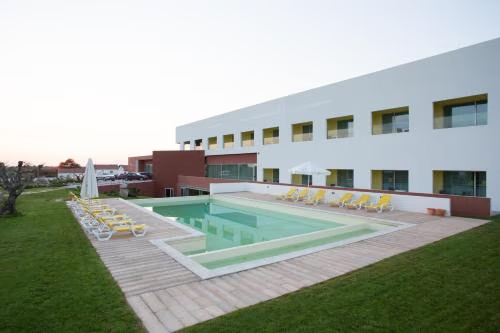 OpenReservations accepted
Monte Filipe Hotel
- OpenReservations accepted
Casa Lopes


Town 16 of 25