


Baiona is the harbour where Europe first heard about America: on 1 March 1493 the Pinta sailed in here. Today you arrive along the coast from Oia, walk around the Monterreal fortress on its walls and still have about 129 kilometres to Santiago. There is no public albergue, so book your bed.
Right now in Baiona (as of October 2026)
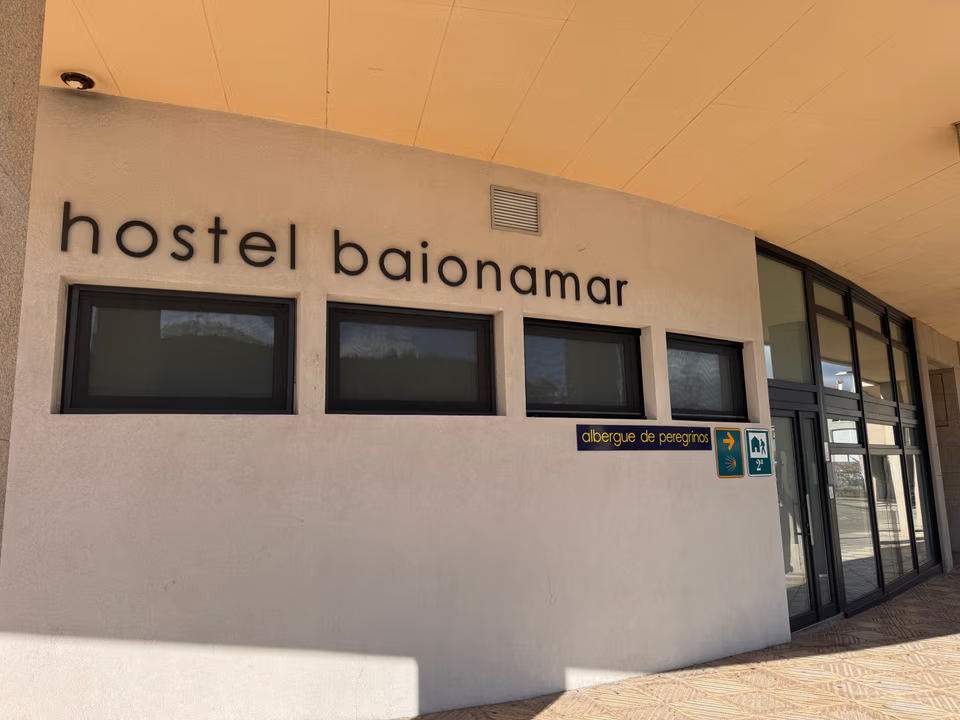
- One albergue takes a winter break: Hostel Baionamar is only open from 1 March to 31 October. From November, the only pilgrim albergue left in Baiona is Albergue Estela do Mar, which is open all year. You can also move on to Sabarís and A Ramallosa, three to four kilometres further.
- Festa da Arribada: On the first weekend of March, Baiona re-enacts the arrival of the Pinta with a medieval market. Beds are scarce then.
How long to stay?
An afternoon is enough, but don't walk through: sleep here. The old town is small, and the walk around the fortress, the Pinta in the harbour and a look into the Colegiata fit nicely into the afternoon after you arrive. That is exactly what you miss if you only pass through, because the official route skips the seafront, the harbour and the fortress. A rest day is only worth it if you want to see the Virxe da Rocha up on the hill and the museums at leisure. The Pinta is closed on Mondays.
Baiona in Ninja numbers
- About 129 kilometres separate Baiona from Santiago, according to Camino Ninja. Some pilgrims only start their walk here.
- 1 March 1493 is the day Baiona celebrates: the Pinta brought news of the discovery of America, three days before Columbus himself sailed into Lisbon.
- 89,147 pilgrims walked the Portuguese Coastal Way in 2025 up to 7 December, about 20 percent more than the year before. Baiona still has no public albergue.
- About 3 kilometres of crenellated walls enclose the peninsula of the Monterreal fortress.
- 15 metres tall is the Virxe da Rocha above the town. It took 20 years from the foundation stone to the inauguration.
Arriving: along the coast, like the Pinta once did
From Oia it is a little over 18 kilometres according to Camino Ninja, from A Guarda just under 30. You walk the Senda Litoral, the coastal variant of the Portuguese Coastal Way, along the rocky shore and through Silleiro. Just before town, the access road to the Virxe da Rocha branches off the road from A Guarda. In town, the arrows lead you along Rúa Ventura Misa, the street through the inside of the old town. From there you barely see the seafront, the harbour or the fortress. Take the detour, it is worth it.
In brief: a harbour with privileges
The fortified peninsula was settled before the Romans, as Abobriga, and later under the name Erizana. In 1201 King Alfonso the Ninth of León gave the place a town charter and the name Bayona. In the late Middle Ages, Baiona and A Coruña were the only Galician ports allowed to trade with foreign countries. In 1493 the Pinta came back from America, and in 1585 the townspeople fought off an attack by Francis Drake. Since 1966 the Monterreal fortress has been a state-run hotel, a Parador.
The first news from America
At the end of February or on 1 March 1493, a small, storm-damaged ship appeared off Baiona: the Pinta, captained by Martín Alonso Pinzón from Palos. On the way home a storm had separated her from the Niña, on which Columbus was sailing. From here Pinzón wrote to the royal court in Barcelona. Whether he wanted to get ahead of Columbus, with whom he had fallen out, we don't know. What is certain is that he was seriously ill. After repairs he sailed on to Palos and died at the end of March. Baiona turned that day into its festival: since 2015 the Festa da Arribada has been a Festival of International Tourist Interest, and since 1977 Baiona has been twinned with Palos de la Frontera.
Between fortress and harbour: what to see
Distances are short. Fortress, harbour and old town lie side by side, and the Virxe da Rocha is the only detour uphill.
- Fortaleza de Monterreal: The fortress on the Monte Boi peninsula was built between the eleventh and the seventeenth centuries, and about 3 kilometres of crenellated walls enclose 18 hectares. It has been a Parador since 1966, but the grounds are open to walkers, daily from 8:00 to 21:00 according to the tourist board. The Paseo de Monte Boi around the outside of the walls is 1.5 kilometres long and easy, and it ends at the Torre del Reloj, whose bell once sounded the alarm during attacks. For pilgrims it makes a good evening walk after the stage. We could not find an entry price for walkers.
- Carabela Pinta and Casa da Navegación: At the jetty in the harbour lies a replica of the Pinta, built in 1993 and 1994 at the Amado shipyard in O Freixo and fitted out inside as a floating museum, with an audio guide. Here you understand how little space the men had when they crossed the Atlantic in 1493. Open Tuesday to Sunday, mornings and afternoons. At Rúa Ventura Misa 17, right on your route, the Casa da Navegación tells the story of the harbour, from shipwrecks to trade with America, Tuesday to Saturday. The combined ticket for both costs €3 (as of October 2026).
- Ex-Colegiata Santa María and Hospital Sancti Spiritus: The thirteenth-century church looks like a small castle, and its Cistercian-style nave recalls the monastery of Oia, which you passed today. From 1482 to 1850 it was a collegiate church. In the atrium stand wayside crosses that were moved here from the streets in 1841. Next door is the Baroque chapel of Santa Liberata from 1695. And at Rúa Manuel Valverde 6 stands the Hospital Sancti Spiritus, originally a pilgrim hospital on the coastal way and, until the early twentieth century, a home for the homeless. Pilgrims slept here centuries ago. We could not find opening hours for the Colegiata.
- Virxe da Rocha: The 15-metre Madonna on Monte Sansón holds a boat in her right hand, and her face and hands are made of white marble. The foundation stone was laid in 1910, but she was only inaugurated in 1930 because money ran short. A narrow spiral staircase takes you up inside her into the boat, which holds five people, for a symbolic fee. From there you see the Cíes Islands and the beaches of Nigrán. On the last Sunday of August there is a pilgrimage here.
Food and drink
Baiona eats the sea: brown crabs, velvet crabs, goose barnacles, mussels, queen scallops and clams, depending on the season. Octopus comes "á feira" with paprika, oil and coarse salt, grilled or as empanada de pulpo. On Sundays the restaurants fill up quickly and some only open in the evening. Then tapas are the better choice.
Honestly
- There is no public albergue. Back in 2017 the town had already spent more than a year trying to get a municipal albergue, and nothing has come of it to this day. The two private pilgrim albergues have 38 beds between them. Book ahead, especially in summer and at weekends.
- The official route misses the best part. The arrows lead through the old town and skip the seafront, the harbour and the fortress. If you just walk through, you see little of Baiona.
- Summer gets crowded. Baiona is considered one of the most beautiful towns in Galicia, and at weekends and during festivals beds are scarce.
- Tomorrow turns urban. From A Ramallosa, the official route to Vigo heads inland, over a lot of asphalt and a long entry into the city. The coast is the nicer choice (see Ninja tips).
Where pilgrims sleep
- Albergue Estela do Mar: a private pilgrim albergue in the centre, open all year, with 20 beds in one large dormitory plus a few private rooms. Sheets and a towel are included. Pilgrims praise the garden with plenty of space to sit and dry laundry and the friendly staff, but complain that there are too few showers for 20 people.
- Hostel Baionamar: a private albergue on Rúa Venezuela with 18 beds in two dormitories, open from 1 March to 31 October. There are no towels, and in the kitchen you can only heat food, not cook. The supermarket is two minutes away. In summer it can get warm at night.
A dorm bed in either costs roughly €16 to €21, depending on the season. If both are full, keep walking: after 3 kilometres, in Sabarís, you reach the Albergue Playa de Sabarís, and after 4 kilometres, in A Ramallosa, the large Albergue-Hospedería Pazo Pías with 62 beds. Both are open all year.
Ninja tips
- Around the fortress in the evening: Walk the Paseo de Monte Boi, 1.5 kilometres along the outside of the walls to the Torre del Reloj. For the walk inside, allow about an hour and a half including stops.
- One ticket, two museums: The €3 combined ticket gets you into the Pinta and the Casa da Navegación. The Pinta is closed on Mondays, the Casa da Navegación on Sundays and Mondays.
- Up inside the Madonna: The staircase in the Virxe da Rocha is narrow, and sometimes you have to wait. Up in the stone boat there is room for five.
- Tomorrow along the beach: Instead of following the arrows through town, many pilgrims walk along the coast past the Santa Marta and Ladeira beaches to Sabarís and the old bridge of A Ramallosa, mostly on a cycle path.
- Keep left from A Ramallosa: Where the routes to Vigo split, stay by the water. Pilgrims on the forum advise: whenever you can turn left towards the beach, do it.
- Sleep in peace: If you want quiet in the evening, find a bed away from the harbour and the nightlife strip.
Practical tips for pilgrims
- Stamp: The albergues stamp, and bars along the route often do on request.
- Post: The post office is open Monday to Friday from 8:30 to 14:30, not on Saturdays.
- Holidays: 16 July and 27 September are local holidays. Beds fill up early then, and shops and banks stay closed.
- Shopping: Buy supplies for tomorrow before you shower. You do pass through villages on the way to Vigo, but it is a long day.
Onward: along the Ría de Vigo
The next big stage takes you a little over 26 kilometres to Vigo, according to Camino Ninja. After a little over 3 kilometres you reach Sabarís, after a little over 4 the bridge of A Ramallosa. There the route splits: the official route heads inland, while the coastal variant runs via Panxón, Canido and Samil, the city beach. In Redondela, about 42 kilometres from Baiona according to Camino Ninja, your route joins the Camino Portugués Central.
What awaits you tomorrow
Early in the morning you cross the Ponte da Ramallosa, a thirteenth-century footbridge with ten arches. In its middle stands a stone cross with San Telmo, the patron saint of sailors, who according to legend had the bridge rebuilt. At the foot of the cross, so the story goes, a pregnant woman used to wait from midnight for the first man to pass by. If he poured a little water on her belly, he became the child's godfather. In the evening Vigo awaits, the largest city in Galicia.
Deep dive: The news that came with the Pinta
A long read, in case you want to learn more about Baiona. About fifteen minutes' reading.
At the harbour where the news arrived
If you stand down at Baiona's harbour in the evening, a small wooden ship lies at the jetty in front of you. It looks surprisingly small. This is a replica of the Pinta, built in 1993 and 1994 for the five hundredth anniversary. The original lay here in the spring of 1493. It had come back from a world nobody in Europe knew about yet, and it brought the news to this coast first.
Baiona has built its sense of itself on that moment. The town celebrates it every year with a festival, it is twinned with Palos de la Frontera, the port from which Columbus's ships set out, and since 1993 a monument called Encontro entre Dous Mundos, the meeting of two worlds, has recalled it. It was unveiled by Felipe, then Crown Prince. Yet Baiona was an important place long before 1493, and it stayed one afterwards. This text tells of a peninsula that was fortified again and again, of a captain who came home ill, of vows made in a storm, of pilgrims and saints, and of a Madonna who holds a boat in her hand.
Abobriga, Erizana, Bayona
The peninsula on which the fortress stands today juts into the bay like a bolt across a door. Whoever held it controlled the entrance to the Ría de Vigo. No wonder people settled here early. The first mention of the place is dated to around 140 before Christ, under the name Abobriga, a name with Celtic roots. Roman sources report a siege of the fortified peninsula by the consul Servilianus. The Romans called it Erizana.
Like many towns on this coast, Baiona has told itself an even older and more glorious origin. Diomedes, a hero of the Trojan War, is said to have founded the town. That is a legend. Incidentally, the same story of Diomedes is told in Tui on the Miño.
The year 1201, on the other hand, is documented. That year King Alfonso the Ninth of León gave the place a town charter and a new name: Bayona. At the harbour, where the Pinta lies, the Paseo Alfonso IX bears his name. In the thirteenth century the church of Santa María was built, which later became a collegiate church.
A harbour with privileges
Baiona lived from the sea, and it lived well. King John the Second of Castile granted only two Galician ports the right to trade with foreign countries: Baiona and A Coruña. In the fifteenth and sixteenth centuries, trade flourished. In the Casa da Navegación on Rúa Ventura Misa, the town today tells of these links to Europe and later to America, but also of shipwrecks and the dangers of seafaring.
Whoever had such a harbour had to defend it, and Baiona changed hands more than once. In the fourteenth century, Ferdinand the First of Portugal, who had had himself proclaimed King of Castile, resided here for a while, until he had to return to Portugal. In 1474 Pedro Madruga, a Galician nobleman and Count of Caminha, took the town and built a tower on Monte Boi. Under the Catholic Monarchs a new order came. They allowed about two hundred families to settle inside the walls of the peninsula, with the same rights as the citizens of Baiona.
How far the men of this harbour travelled is shown by a story from the years 1519 to 1522. A Spanish fleet under Magellan set out to find a westward route to the Spice Islands. Only a few came back three years later, having been the first to sail around the Earth. Two of them came from Baiona: Diego Carmena and Vasco Gómez, both nicknamed Gallego, the Galician.
Three ships, and one comes first
Baiona's most famous story, however, does not begin here but in the south of Spain, in Palos. In August 1492 three ships set sail westwards. Christopher Columbus commanded the Santa María. The town of Palos had to provide the Niña and the Pinta, as a penalty the Crown had imposed on it. The Pinta was small, and historians estimate her at about forty tons and just under fifteen metres long. She was hired from her owners, Cristóbal Quintero and Gómez Rascón, who sailed on her themselves. Her captain was Martín Alonso Pinzón, an experienced seaman from Palos, then about fifty years old.
Also on board the Pinta was a sailor known as Rodrigo de Triana. It was he who first sighted land on 12 October 1492. Until then Columbus and Pinzón got on well. After that, they did not. On 21 November 1492 the Pinta separated from the other ships. Columbus wrote in his logbook that Pinzón had sailed off out of greed, to look for gold on his own. Later witness statements in lawsuits tell it differently: Pinzón had found the island we now call Haiti first and told Columbus about it. Who is right is still disputed today. The only certainty is that from then on the two men were enemies.
At Christmas 1492 the Santa María ran aground and was lost. Thirty-nine men stayed behind in the new world. With the Niña and the Pinta, the rest set off for home on 16 January 1493.
The storm and the vows
In mid-February the two ships ran into the worst storm of the whole voyage near the Azores. In the night before 14 February they lost sight of each other. On the Niña nobody expected to see land again, and in their distress the men did what seamen did in those days. They vowed pilgrimages.
Columbus had as many chickpeas put into a cap as there were men on board, one of them marked with a cross. Whoever drew it was to go as a pilgrim to Santa María de Guadalupe and carry a five-pound wax candle. Columbus reached in first and drew the pea with the cross. A second lot was for a pilgrimage to Loreto in Italy. It fell to Pedro de Villa, a seaman from El Puerto de Santa María, and Columbus promised to pay for his journey. The third lot bound the winner to a night vigil in the convent of Santa Clara in Moguer, and again it fell to Columbus. On top of that, the whole crew vowed to walk in procession, in penitential shirts, to the first church of Our Lady they reached on land.
It is a scene that may feel familiar to you as a pilgrim. The men who had just seen a new world promised, in their fear, neither gold nor glory, but a walk on foot to a holy place. When the Niña anchored off an island of the Azores on 17 February, half the crew went ashore to fulfil the vow. The Portuguese took them for pirates and held them prisoner for two days. And Columbus kept his word: in the night before 16 March 1493, right after his return, he kept vigil in Santa Clara in Moguer and had a Mass of thanksgiving said.
The Pinta off Baiona
The Pinta had also survived the storm. She reached the coast of Galicia and sailed into Baiona. The ship was damaged, and her captain was seriously ill. From here Pinzón wrote several letters, to various places in Spain and to the royal court, which was then in Barcelona. The news reached the court in the first half of March.
The men stayed a few days until the Pinta was repaired. Probably on 9 March they sailed south. On 15 March 1493 the Pinta sailed into Palos, on the same day as the Niña with Columbus, who had come by way of Lisbon. Pinzón never went back into his town. He was taken to an estate near Moguer and then to the monastery of La Rábida. There he died around 31 March 1493, a few weeks after his return. As he had wished, he was buried in the monastery church of La Rábida.
Was Baiona really first?
Baiona calls itself the first place in Europe to learn of the discovery of America. In one important sense that is true: the Pinta was the first ship of the expedition to reach the Iberian Peninsula, and Pinzón's letters were the first news to reach the court. Columbus only arrived in Lisbon on 4 March.
As so often, though, a second look is worthwhile. Baiona celebrates 1 March, but historians tend to put the Pinta's arrival at the end of February, some on 28 February. And strictly speaking, the Niña had already set foot on Portuguese soil on 17 February, in the Azores, far out in the Atlantic. Whether that already counts as Europe is something people can argue about for a long time.
The more delicate question is a different one. Anyone who knows about the enmity between the two men will wonder whether Pinzón wanted to get ahead of the Admiral with his letters. Columbus had distrusted him since November, and the witnesses of the Pinzón family later defended him in court. But what Martín Alonso was thinking in Baiona, the sources do not tell us. All that is documented is that he wrote and that he was ill. He died before he could explain himself to anyone. Perhaps it is most honest to see Baiona not as the scene of a race, but as the place where a mortally ill seaman found solid ground again after the longest voyage of his life.
The fortress on Monte Boi
Above the harbour lies the peninsula called Monte Boi, and on it the Monterreal fortress. Its walls were built between the eleventh and the seventeenth centuries, about three kilometres long, with battlements and three great gates. The oldest is the Puerta del Sol, and there is also the Puerta Real from the sixteenth century. The fortress got its name in honour of the Catholic Monarchs: Monte Real, the royal hill.
Three towers guard the peninsula. The Torre del Reloj at the entrance carries a bell that used to sound the alarm when enemies came. The Torre de la Tenaza to the east carried a battery of cannon that protected the harbour. The Torre del Príncipe to the west, facing the bay, may be the oldest. It served as a lighthouse and bears three coats of arms, those of the Habsburgs, of the Sotomayor family and of Baiona.
In 1924 Ángel Bedriñana Meana bought the site from a nephew and heir of the Elduayen family. He was a Spaniard who had made his fortune in Cuba with sugar cane. He put the rest of his life and his fortune into restoring it. His heirs sold it to the state, and in 1966 a Parador opened inside, one of the state-run hotels in historic buildings. It bears the name of a man who once held command in this fortress: the Count of Gondomar.
A governor against Drake
Diego Sarmiento de Acuña was born in 1567 in Astorga, a town you may know from the Camino Francés. As a young man he helped defend Baiona and Vigo against the English in 1585. The privateer Francis Drake had sailed into the ría with a fleet, on his way to the Caribbean. He held Vigo for two weeks and extorted supplies. But he could not take Baiona, whose townspeople fought him off.
King Philip the Second then made Diego Sarmiento military governor of Baiona and of the fortress of Monte Real, responsible for the southern border and the coast of Galicia. Later he became Count of Gondomar and had a career that took him far from this peninsula. From 1613 he was Spanish ambassador in London, with one interruption until 1622. His pressure helped bring about the execution of Sir Walter Raleigh in 1618, and the English never forgave him for it. His great library is now in the Royal Library in Madrid. And his name stands over the door of the hotel in his old fortress.
Pilgrims, saints and a hospital
Where are the pilgrims in this story of ships and fortresses? They were there, even if the chronicles speak of them more quietly than of captains and counts. On Rúa Manuel Valverde stands the Hospital Sancti Spiritus. It was built as a shelter for pilgrims on the coastal way, which is also called the Camino Monacal, the way of the monks. Later, until the early twentieth century, the house took in the homeless of the area. So if you sleep in a private albergue in Baiona today, you are walking a way on which people already needed a roof centuries ago.
A few steps further stands the church of Santa María. It was built in the thirteenth century, Romanesque with early Gothic features, and it looks like a small fortress. Its nave recalls the Cistercian church of Oia, which you passed today. From 1482 to 1850 it was a collegiate church, with a chapter of clergy. In 1841 wayside crosses that until then had stood scattered in the streets were set up in its forecourt. At the edge of town, by the coast, stands yet another old cross under a stone roof, the Cruceiro da Santísima Trinidade.
Next to the church stands the chapel of Santa Liberata, built in 1695. Tradition says Liberata was one of nine sisters born on the same day, daughters of a Roman governor. She had vowed to remain a virgin, and when her father wanted to marry her off, she prayed to become ugly. A beard grew on her face, and her furious father had her crucified. In Baiona, it is said, she died. All of this is legend. Scholars suspect the story arose from a misunderstanding: a famous crucifix in Lucca shows Christ with a beard in a long robe, and later viewers took the figure for a crucified woman. In 1969 the Church removed Liberata from the general calendar. In Baiona, however, she is still venerated. Women call on her when they want to get free of an unwanted man.
The Madonna with the boat
Above the town, on the slope of Monte Sansón, about a hundred metres above the sea, stands a huge stone woman. This is the Virxe da Rocha, the Virgin of the Rock. She is fifteen metres tall, and in her right hand she holds a boat.
The idea came from the engineer Gustavo Calvo Julián. On 18 September 1910 the foundation stone was laid, with a zinc box of gold, silver and bronze coins walled into it. Then the money ran out. People collected from the townsfolk, and in Madrid a stage play was even performed whose proceeds went to the building. The stonework was done by Antonio Palacios from O Porriño, a Galician architect. Face and hands were carved in white marble by the Madrid sculptor Ángel García. Only on 14 September 1930, twenty years after the foundation stone, was the statue inaugurated.
What makes her special is her interior. The figure is hollow, and a narrow spiral staircase leads up into the boat. Five people fit inside, looking out over the Atlantic, the Cíes Islands and the beaches of Nigrán. It is a strange and lovely feeling to stand in the boat of a Madonna who watches over a seafaring town. Every year on the last Sunday of August, people from the area go up to her for a romería, a pilgrimage with a festival.
The Arribada and today
On the first weekend of March, Baiona turns into a medieval town. At the Festa da Arribada, the festival of the arrival, the stalls of a medieval market fill the lanes, and the arrival of the Pinta with her news is re-enacted. Since 1974 the day has been a local holiday in Baiona, and since 2015 the festival has been recognised as a Festival of International Tourist Interest. And since 1 March 1977 Baiona has been twinned with Palos de la Frontera. The two harbours, where the voyage began and where it first ended, have been linked ever since.
Today a little over twelve thousand people live in the municipality, and more and more pilgrims come. The Portuguese Coastal Way that you are walking has been an official Way of Saint James since 2016 and is growing faster than any other in Galicia. In 2025, more than 89,000 people walked it by early December. Many of them stop in Baiona. Even so, the town has no public albergue. It tried to get one in 2017, it was never built, and so pilgrims sleep in private houses. When this text was written, in the autumn of 2026, there were two pilgrim albergues with just under forty beds between them.
What Baiona gives you
Baiona is a place where people arrived. The Pinta arrived here, with a mortally ill captain and news that was to change the world. Pilgrims arrived, looking for a bed in the Hospital Sancti Spiritus.
Perhaps you will take with you from here a scene that does not actually take place in Baiona, but out in the storm: men in fear of death drawing chickpeas from a cap and promising to walk to a church if they survive. You are already on your way, without a storm and without a vow, or perhaps with one that only you know. When you stand on the walls of Monterreal in the evening and look out over the bay, Santiago is just under a hundred and thirty kilometres away. The news you will one day bring home, you are writing yourself right now.
Where to stay in Baiona
The places pilgrims rate highest in Baiona come first.
- Top #1
 OpenReservations acceptedAlbergue Estela do MarBaiona
4.717 reviews
16€KitchenMicrowavePlates & UtensilsAnd more - Top #2
- Top #3

- Top #4
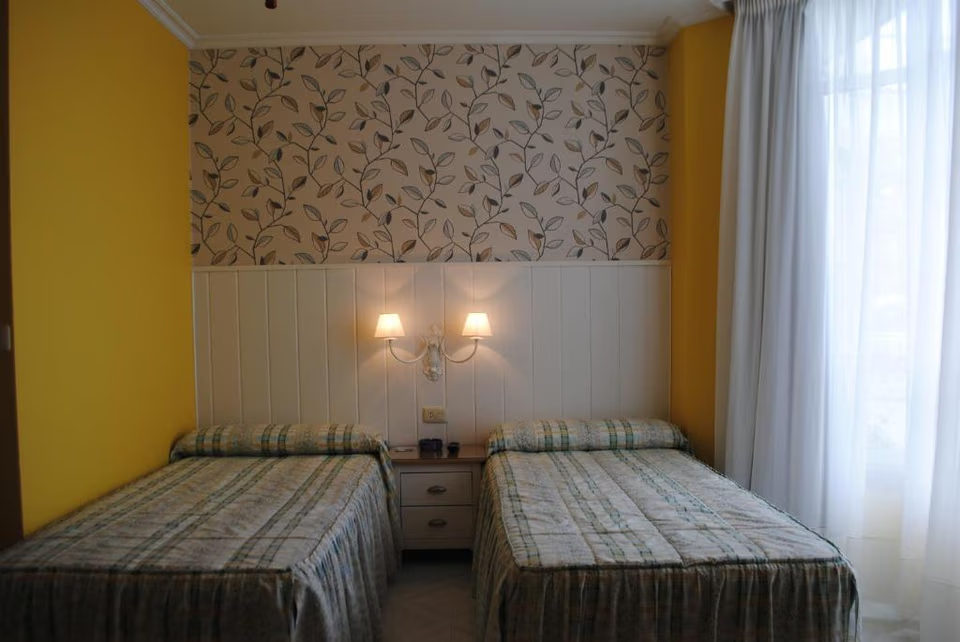 OpenReservations acceptedHostal Santa Marta PlayaBaiona25€Wi-FiCotton Sheets & Pillowcases
- Top #5
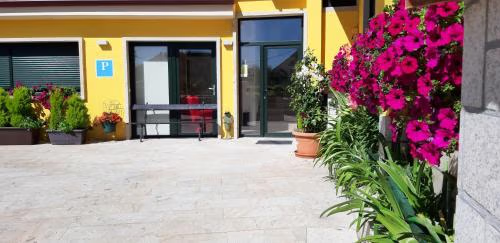 OpenReservations acceptedPensión O EscondidiñoBaiona28€Wi-FiTVIndividual Power PlugsAnd more
Services in Baiona
What you can find in town before the next stage.
- ATM
- Café
- Shop
- Tobacco
- Medical clinic
- Pharmacy
- Fountain
- Post office
- Bus station
- Restaurant
Source: © OpenStreetMap contributors · updated April 2026
Caminos through Baiona
Open a Camino to follow it on the map from Baiona.